
Introduction
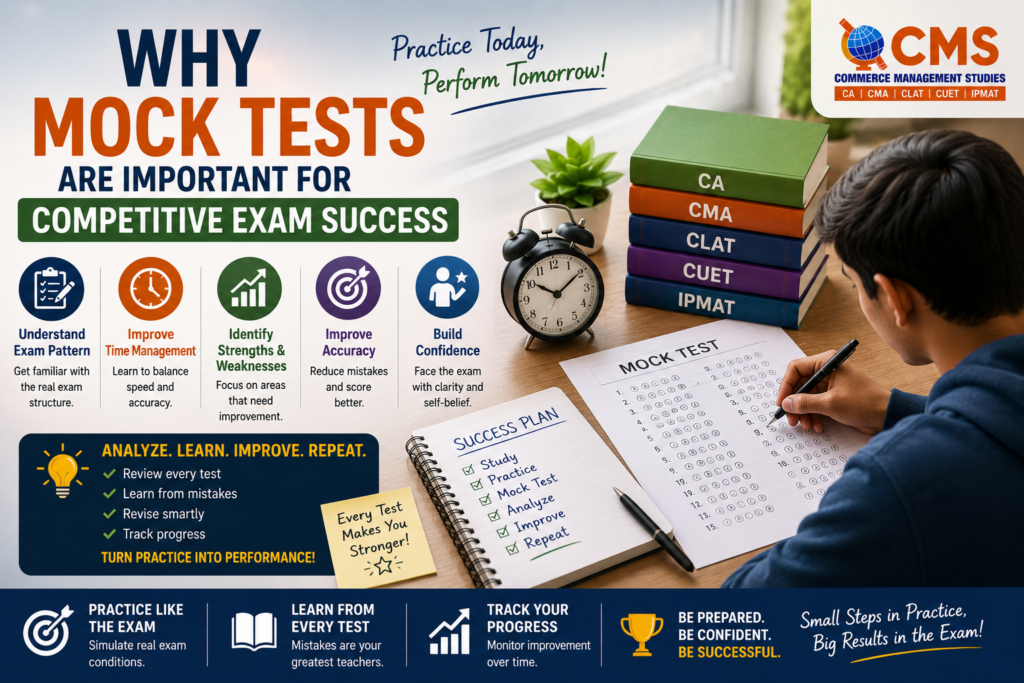
Competitive examinations such as CA, CMA, CLAT, CUET, and IPMAT require students to prepare differently from regular academic examinations. While understanding concepts is essential, students also need to know how to apply that knowledge accurately and efficiently within a limited amount of time. This is where mock tests become an important part of preparation. They provide students with an opportunity to practice in an examination-like environment and understand how effectively they can use their knowledge under time pressure.
Mock tests are not simply a way to predict examination scores. They are learning and assessment tools that can help students identify strengths, discover weak areas, improve time management, and become familiar with different question patterns. When used consistently and analyzed properly, mock tests can make preparation for CA, CMA, CLAT, CUET, and IPMAT more organized and focused.
What Is a Mock Test?
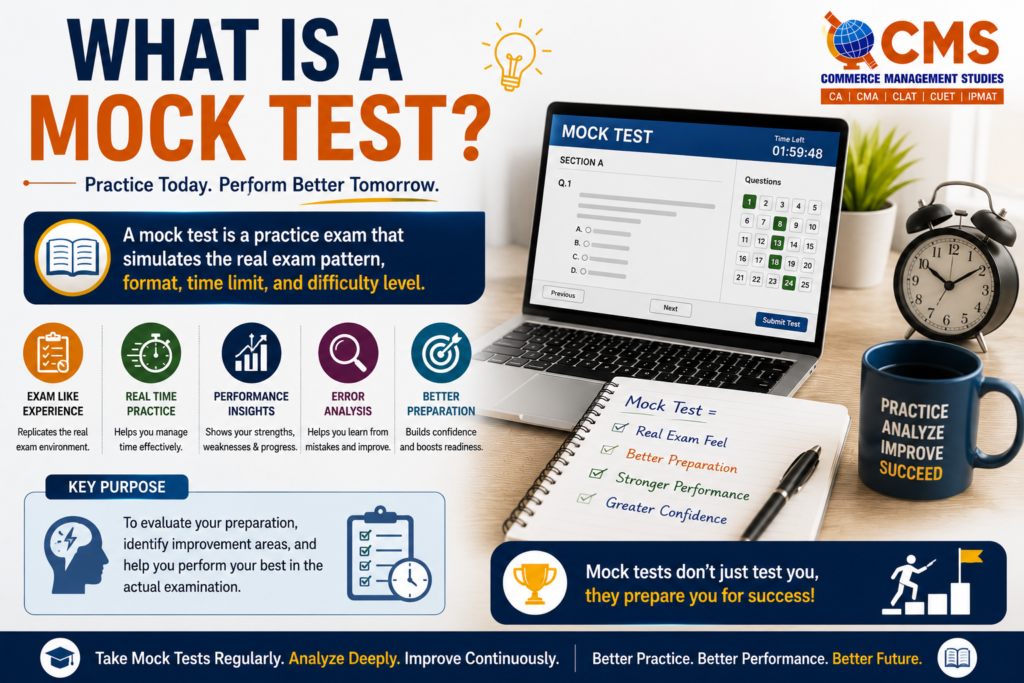
A mock test is a practice examination designed to replicate important aspects of an actual competitive examination. It generally follows a similar structure, question format, time limit, or difficulty level so that students can experience what it feels like to solve questions under examination conditions.
The purpose is not merely to complete the test and check the final score. A mock test gives students information about their current preparation. It can show which concepts they understand well, where they are making repeated mistakes, how much time they spend on different questions, and whether they can maintain accuracy while working under pressure.
1. Helps Students Understand the Examination Pattern
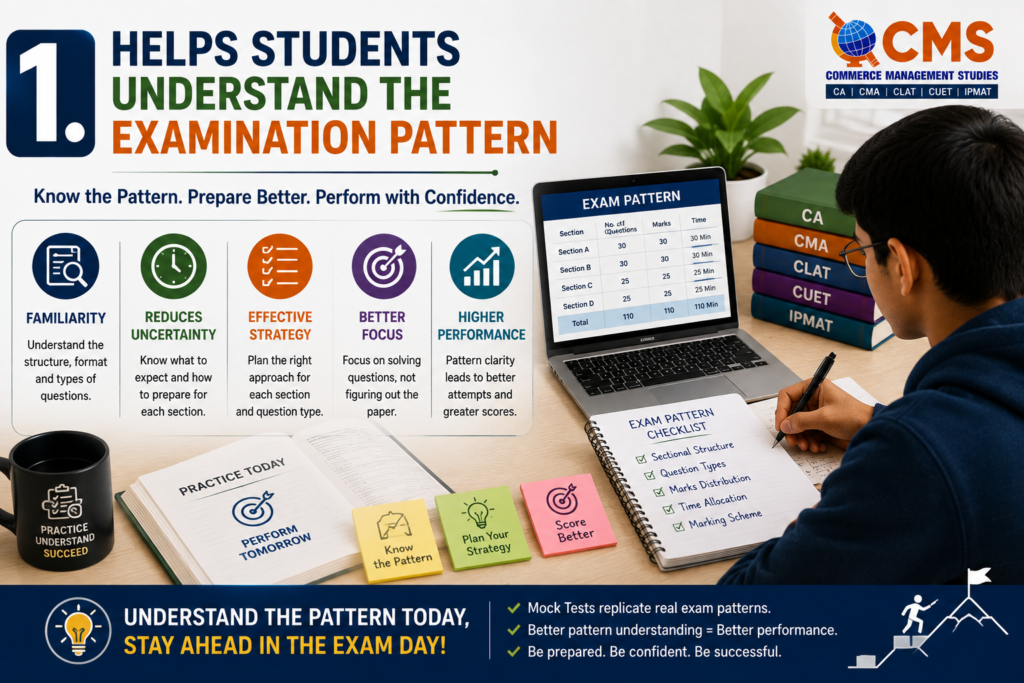
Every competitive examination has its own structure and requirements. CA and CMA involve detailed professional concepts and application-based questions, while CLAT tests areas such as reading comprehension, legal reasoning, logical reasoning, current affairs, and quantitative techniques. CUET and IPMAT have their own subject and aptitude requirements.
Regular mock tests help students become familiar with the format relevant to the examination they are preparing for. This familiarity can reduce uncertainty and allow students to focus more effectively on solving questions rather than spending valuable examination time figuring out how the paper works.
2. Improves Time Management
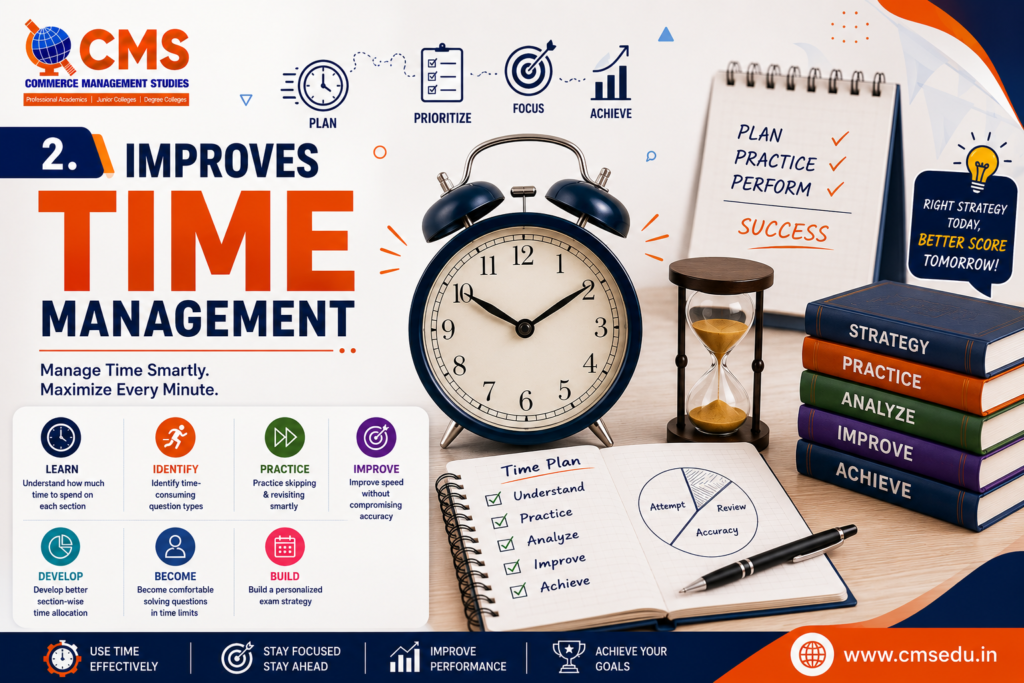
Time management is one of the most important skills in competitive examinations. A student may understand a question perfectly but still lose marks if too much time is spent on one difficult problem.
Mock tests allow students to experiment with different approaches to time management. Through repeated practice, students can learn which questions they can solve quickly, which ones require more time, and when it is better to move on and return later. This experience can help them develop a personal strategy for managing the examination clock.
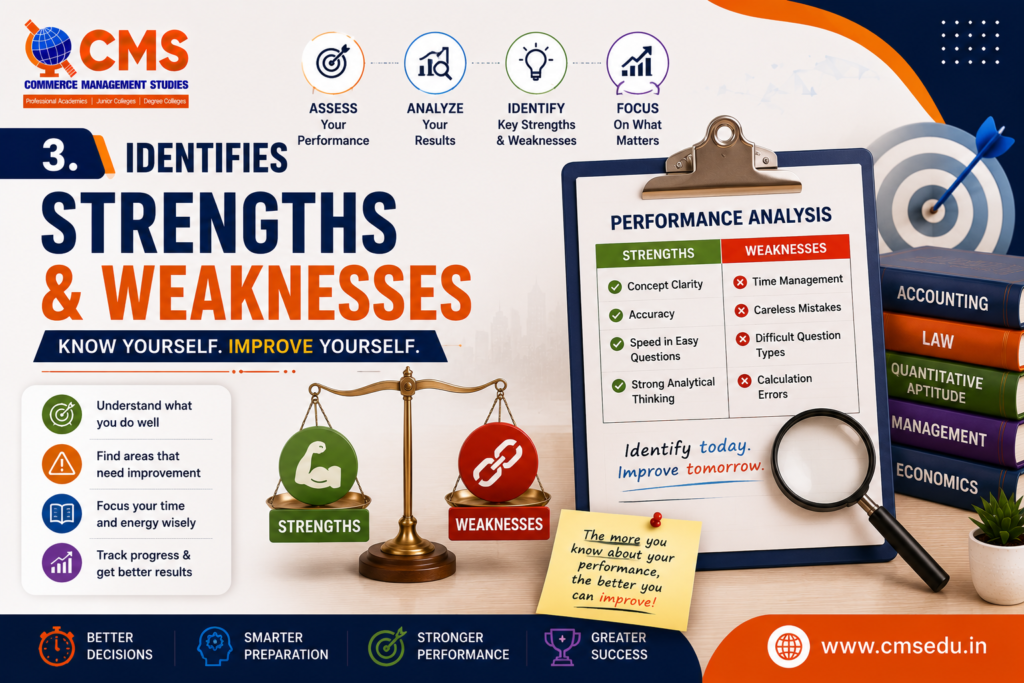
3. Identifies Strengths and Weaknesses
One of the biggest advantages of mock tests is that they provide measurable feedback. Instead of simply assuming that a topic has been understood, students can use test performance to determine how well they can actually apply the concept.
For example, a student preparing for CA may discover that accounting concepts are strong but certain application-based questions require more practice. A CLAT aspirant may have strong reasoning skills but need to improve reading speed. Similarly, an IPMAT student may perform well in verbal ability but struggle with quantitative questions. Mock tests can make these differences visible.
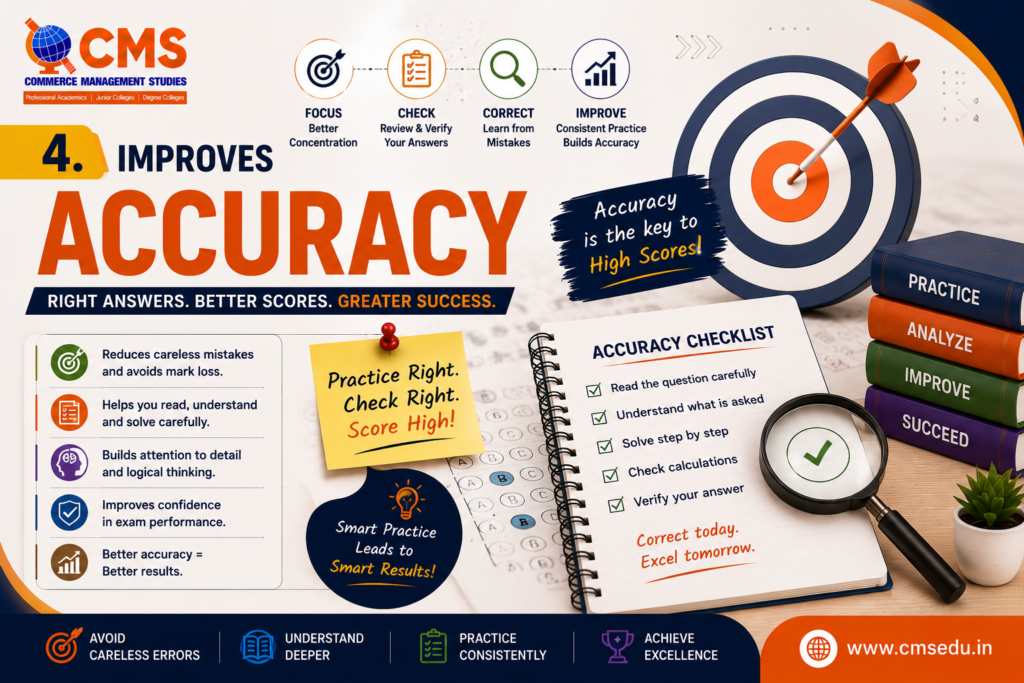
4. Improves Accuracy
Competitive examinations often require students to balance speed with accuracy. Solving questions quickly is useful only when the answers are correct. Rushing through a paper can lead to calculation mistakes, misreading questions, incorrect assumptions, and avoidable errors.
Regular mock tests help students recognize these patterns. If a student repeatedly makes careless mistakes, they can identify when and why those errors occur. They can then modify their approach, slow down when necessary, and develop habits that improve accuracy without sacrificing too much time.
5. Builds Examination Confidence
Facing a competitive examination for the first time can feel unfamiliar and stressful. Students may know the syllabus but still feel uncertain about how they will perform when confronted with a complete paper and a strict time limit.
Mock tests provide repeated exposure to this experience. As students take more tests, the examination environment becomes less unfamiliar. They can gradually become more comfortable with time pressure, difficult questions, unexpected problems, and the need to make quick decisions. This familiarity can contribute to greater confidence.
6. Helps Students Learn from Their Mistakes
A mock test becomes much more useful when students analyze it after completion. Simply checking the score does not explain why marks were lost. Students should examine their incorrect answers and understand the reason behind each mistake.
Mistakes can occur for different reasons:
- Lack of conceptual understanding
- Forgetting an important fact or formula
- Misreading the question
- Calculation errors
- Poor time management
- Guessing without sufficient reasoning
- Difficulty understanding a passage
- Confusion between similar concepts
Identifying the actual reason behind an error allows students to take corrective action instead of repeatedly making the same mistake.
Mock Tests for CA Preparation
CA preparation requires strong conceptual understanding and the ability to apply accounting, taxation, law, and other relevant concepts according to the applicable examination syllabus. Mock tests can help students practice handling a wide range of questions within the prescribed time.
For CA aspirants, mock tests can also help identify chapters or concepts that appear understood during regular study but become difficult when combined with questions from multiple topics. Reviewing performance after each test can help students decide which areas require additional revision and practice.
Mock Tests for CMA Preparation
CMA preparation involves areas related to cost and management accounting, financial concepts, business analysis, and other professional subjects depending on the level and syllabus. Students need to develop both conceptual clarity and the ability to apply concepts accurately.
Mock tests can help CMA aspirants practice numerical problems, conceptual questions, and application-based scenarios under time constraints. Regular testing can also help students improve their calculation accuracy and identify topics that require more focused revision.
Mock Tests for CLAT Preparation
CLAT preparation involves multiple skill areas, including English Language, Current Affairs including General Knowledge, Legal Reasoning, Logical Reasoning, and Quantitative Techniques. Students therefore need to manage different types of questions within a limited examination period.
Mock tests can help CLAT aspirants practice switching between sections and managing their overall time. They can also reveal whether a student is spending too long on lengthy passages or difficult reasoning questions. Analyzing these patterns can help students develop a more effective attempt strategy.
Mock Tests for CUET Preparation
CUET preparation can involve different subjects depending on the university programme and the student’s selected test components. Students need to understand their specific requirements and practice according to the applicable examination pattern.
Mock tests can help students improve speed and accuracy when answering objective questions. They can also help students identify topics that need additional revision. For students preparing alongside Intermediate, regular testing can provide a useful way to measure whether academic concepts are translating effectively into entrance-examination performance.
Mock Tests for IPMAT Preparation
IPMAT assesses aptitude-oriented abilities, including quantitative and verbal skills, depending on the specific examination structure. Students need to solve questions efficiently while maintaining accuracy, making timed practice particularly valuable.
Mock tests can help IPMAT aspirants understand how quickly they can work through different question types. They can experiment with question-selection strategies, learn when to move away from a difficult problem, and identify areas where additional aptitude practice is needed.
Why Test Analysis Matters More Than the Score
A mock-test score provides a useful snapshot, but the analysis behind that score is often more valuable. Students should avoid treating every test simply as a ranking exercise. Instead, they should use the results to understand their preparation.
After completing a mock test, students can review:
- Which questions were answered incorrectly
- Which questions were left unanswered
- Which questions took too much time
- Which topics caused repeated mistakes
- Whether errors were conceptual or careless
- Whether time was distributed effectively
- Which areas showed improvement
Keeping a record of these observations can help students track progress over time and make their preparation more targeted.
How Often Should Students Take Mock Tests?
The ideal frequency can vary depending on the examination, preparation stage, and individual needs. Early in preparation, students may benefit more from topic-wise tests and shorter assessments. As the examination approaches, they can gradually include more full-length mock tests under realistic time conditions.
Taking too many tests without adequate analysis may not be productive. Students need sufficient time between tests to review mistakes, revise weak topics, and apply what they have learned. The focus should be on quality practice and improvement rather than simply increasing the number of tests taken.
Mock Tests Should Complement Conceptual Learning
Mock tests cannot replace learning the underlying concepts. Students should first develop a strong understanding of the relevant syllabus and then use practice tests to evaluate how effectively they can apply that knowledge.
A balanced preparation cycle can involve:
Learn → Practice → Test → Analyze → Revise → Test Again
This cycle allows students to continuously identify gaps and improve their performance. Over time, it can make preparation more structured and reduce the chances of discovering major weaknesses only shortly before the actual examination.
Developing a Personalized Examination Strategy
Every student may approach an examination differently. Some students may be naturally quick at quantitative questions, while others may perform better in reading-based sections. Mock tests provide an opportunity to discover what works best for an individual student.
Students can experiment with the order in which they attempt sections, how much time they allocate to different areas, and when they should skip or revisit difficult questions. The goal is to develop a strategy based on actual performance rather than simply copying someone else’s approach.
The Role of Consistency in Mock-Test Practice
One or two mock tests cannot completely transform preparation. The real benefit comes from consistent practice over time. Students who regularly test themselves can observe patterns in their performance and make gradual improvements.
Consistency also helps students become comfortable with the discipline required for competitive examinations. Instead of viewing tests as something to fear, students can begin treating them as regular checkpoints in their preparation journey.
Integrated Preparation and Mock Tests
Students preparing for multiple academic and competitive goals can benefit from having a structured approach to testing. Those pursuing MEC or CEC alongside CA, CMA, CLAT, CUET, or IPMAT preparation can use mock tests to assess both their academic understanding and entrance-oriented skills.
At CMS, students can pursue integrated preparation for courses such as CA Coaching in Hyderabad, CMA, CLAT, CUET, and IPMAT alongside MEC or CEC. Regular assessments and mock-test practice can help students track their progress, identify areas for improvement, and become more comfortable with competitive examination formats.
Conclusion
Mock tests play an important role in competitive examination preparation because they help students move beyond simply studying concepts. They provide an opportunity to practice under time constraints, understand examination patterns, improve accuracy, develop time-management strategies, and identify areas that require further work.
For students preparing for CA, CMA, CLAT, CUET, or IPMAT, the most effective use of mock tests is to treat every test as a learning experience. The score is only one part of the process; analyzing mistakes, revising weak areas, and applying those lessons in the next test are what create continuous improvement. With consistent practice and thoughtful analysis, mock tests can become a powerful tool for building confidence, improving performance, and preparing more effectively for competitive examinations.