
Introduction
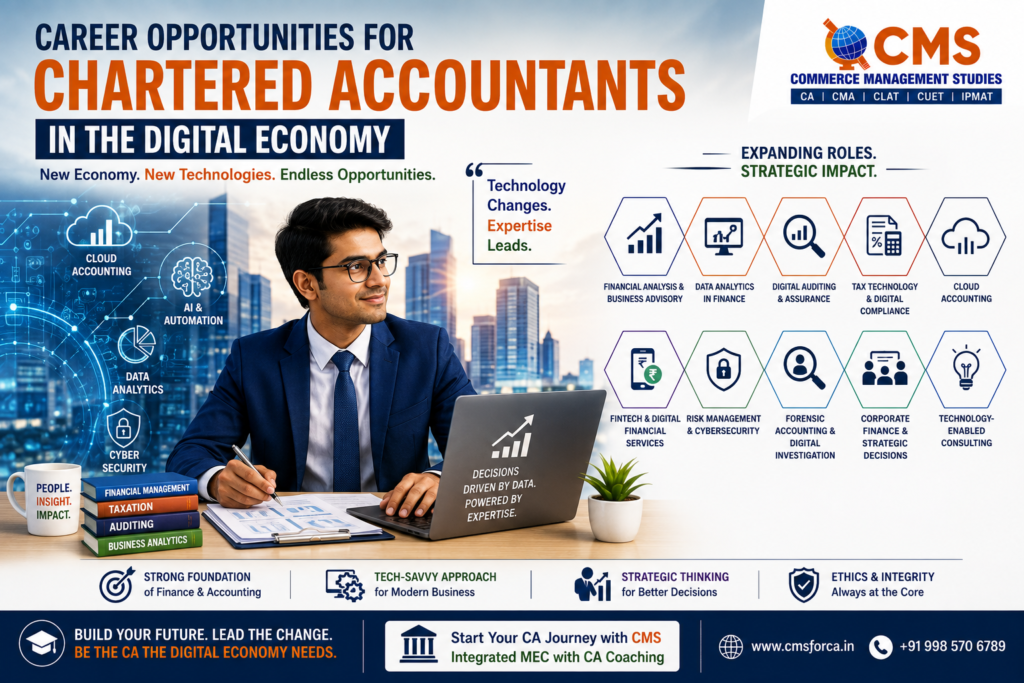
The role of a Chartered Accountant has changed significantly as businesses increasingly rely on digital technologies, data, automation, and online financial systems. Traditionally, CA careers were strongly associated with accounting, auditing, taxation, and compliance. These areas continue to remain important, but digital transformation has expanded the ways in which Chartered Accountants can contribute to businesses and organizations. Technologies such as cloud accounting, artificial intelligence, data analytics, automation, and digital financial systems are changing how financial information is processed and interpreted.
For aspiring CAs, this transformation creates an opportunity to combine professional financial knowledge with technology and analytical skills. Routine activities can increasingly be automated, allowing professionals to spend more time on areas that require interpretation, professional judgment, risk assessment, and strategic decision-making. ICAI itself has highlighted the growing importance of technologies such as AI, data analytics, robotic process automation, cloud computing, and fintech within the accounting profession.
Understanding the Digital Economy
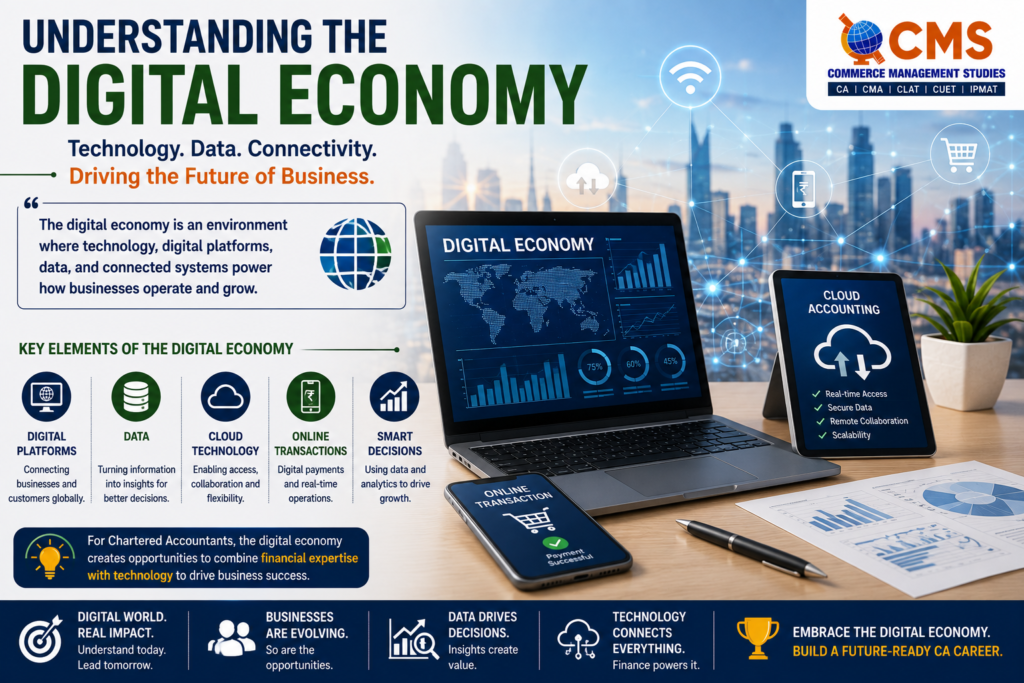
The digital economy refers to an economic environment in which technology, digital platforms, data, online transactions, and connected systems play an important role in how businesses operate. Companies today may conduct transactions online, maintain financial information through cloud platforms, use digital payment systems, and rely on data to make business decisions.
This environment creates new requirements for financial professionals. Businesses need people who can understand financial information while also being comfortable working with digital systems. For Chartered Accountants, this means that professional knowledge can increasingly be combined with technology awareness to support modern financial management and business decision-making.
How Technology Is Changing the CA Profession
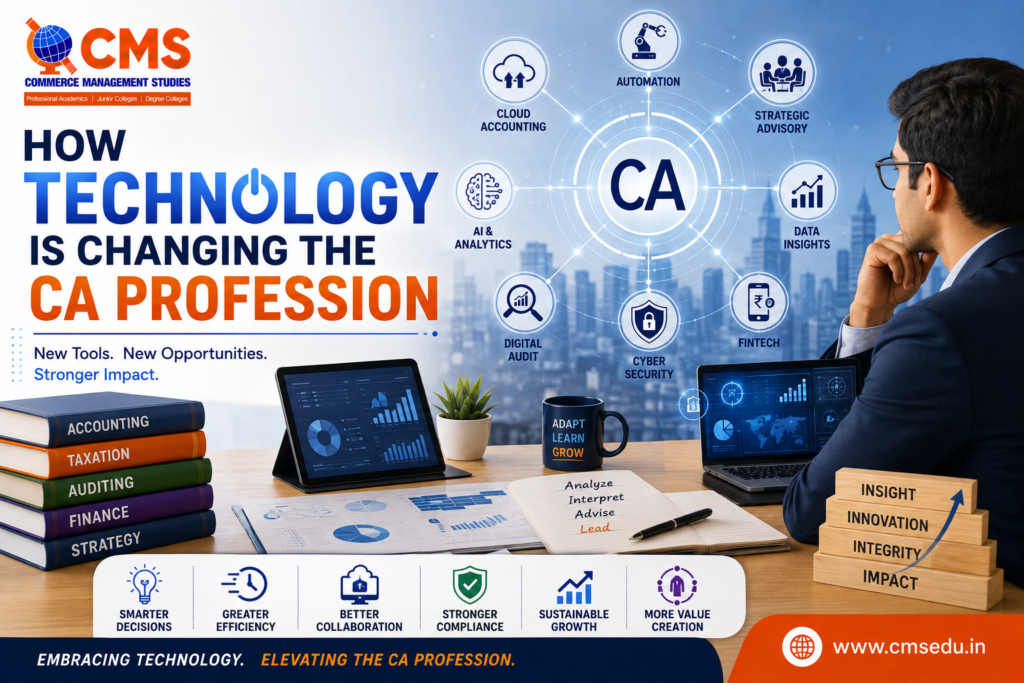
Technology is reducing the amount of manual effort required for many repetitive accounting activities. Automation can assist with processes such as data entry, reconciliation, reporting, and other routine financial tasks. Cloud-based systems can also make financial information more accessible and facilitate collaboration across locations.
This does not necessarily reduce the importance of Chartered Accountants. Instead, it can shift their focus toward work that requires professional judgment and interpretation. Understanding what financial data means, identifying risks, evaluating business performance, advising clients, and ensuring appropriate compliance remain areas where human expertise continues to be important.
1. Financial Analysis and Business Advisory
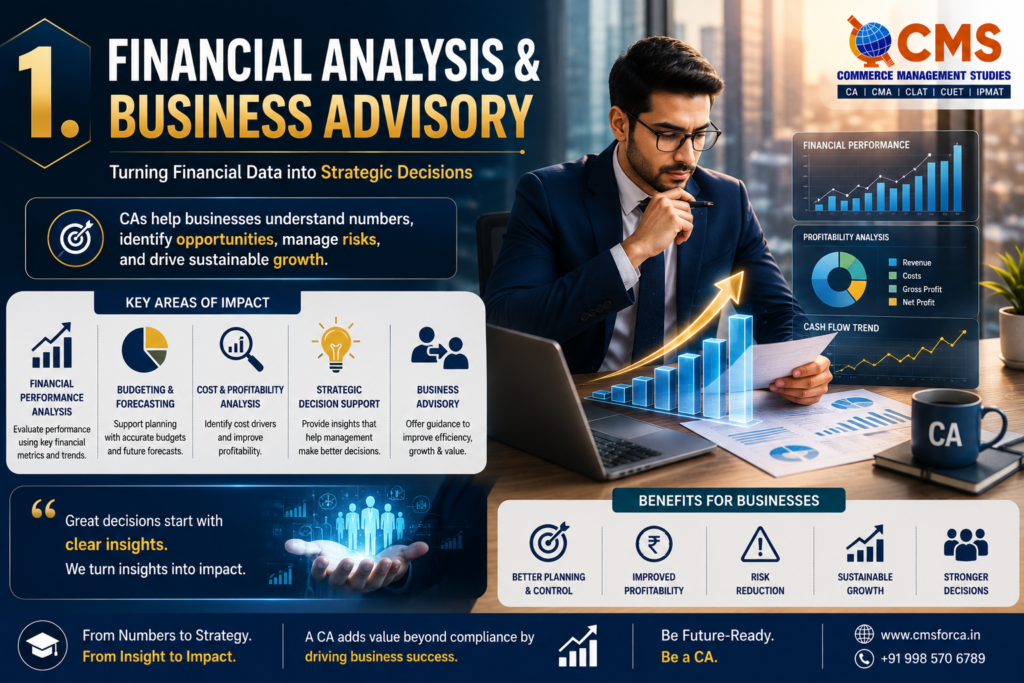
One growing area for CAs is financial analysis and business advisory. Businesses generate large amounts of financial information, but data becomes valuable only when it can be interpreted and used to support decisions.
Chartered Accountants can analyze financial performance, identify trends, evaluate costs, study profitability, and help management understand the financial implications of different decisions. In a data-driven business environment, the ability to convert financial information into practical insights can become an important professional skill.
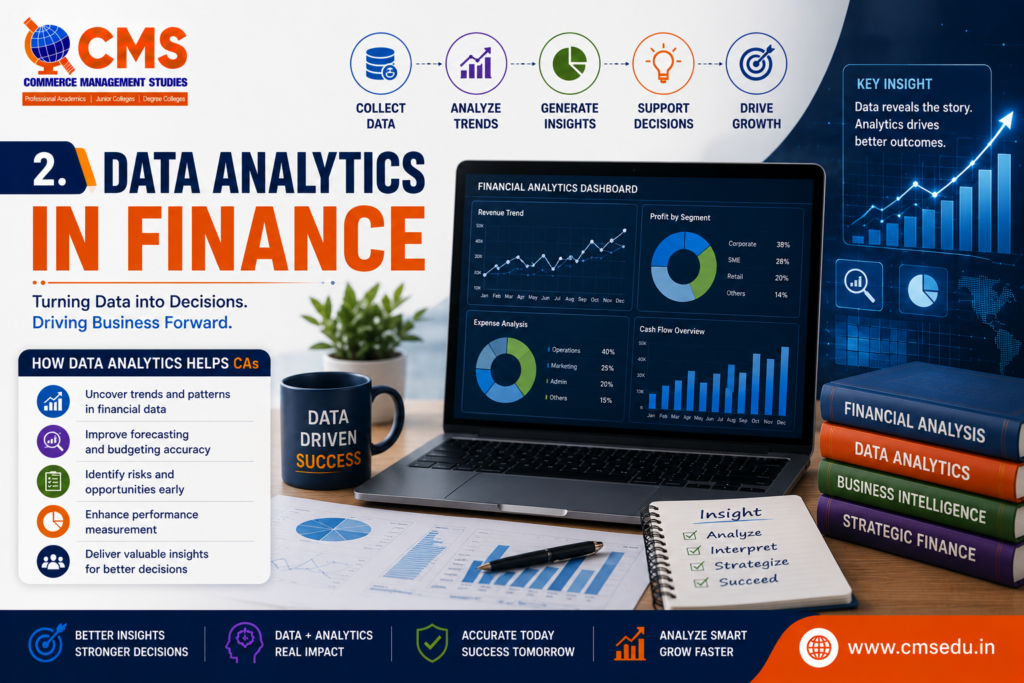
2. Data Analytics in Finance
Data analytics is becoming increasingly relevant to accounting and finance. Organizations can use large amounts of financial and non-financial data to identify patterns, evaluate performance, forecast outcomes, and support strategic planning. ICAI publications have highlighted data analytics as an emerging area where accounting professionals can contribute beyond traditional reporting functions.
CAs who develop an understanding of data analytics can potentially work more effectively with business information. They can use analytical tools to examine financial trends, identify unusual transactions, compare performance indicators, and provide management with more detailed insights.
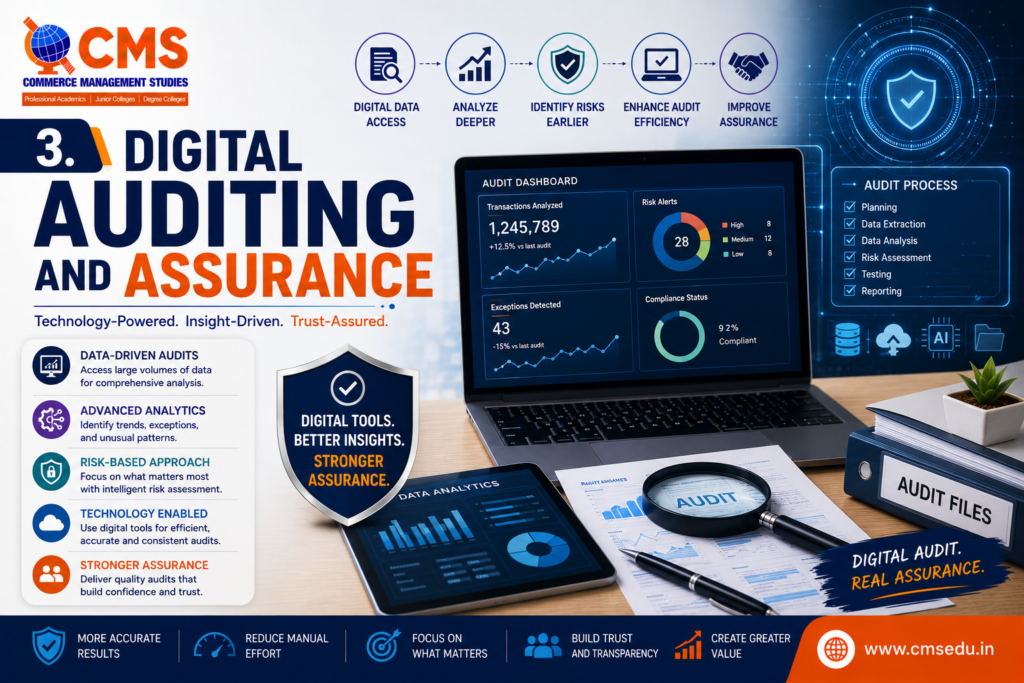
3. Digital Auditing and Assurance
Auditing is another area being influenced by technology. Digital systems can provide auditors with access to larger datasets and allow them to use technology to examine transactions, identify unusual patterns, and improve the efficiency of audit procedures.
This creates opportunities for professionals who understand both auditing principles and digital tools. Instead of relying entirely on manual examination, modern audit work can increasingly involve data analysis and technology-supported procedures. CAs therefore have an opportunity to develop specialized skills in digital audit and technology-enabled assurance.
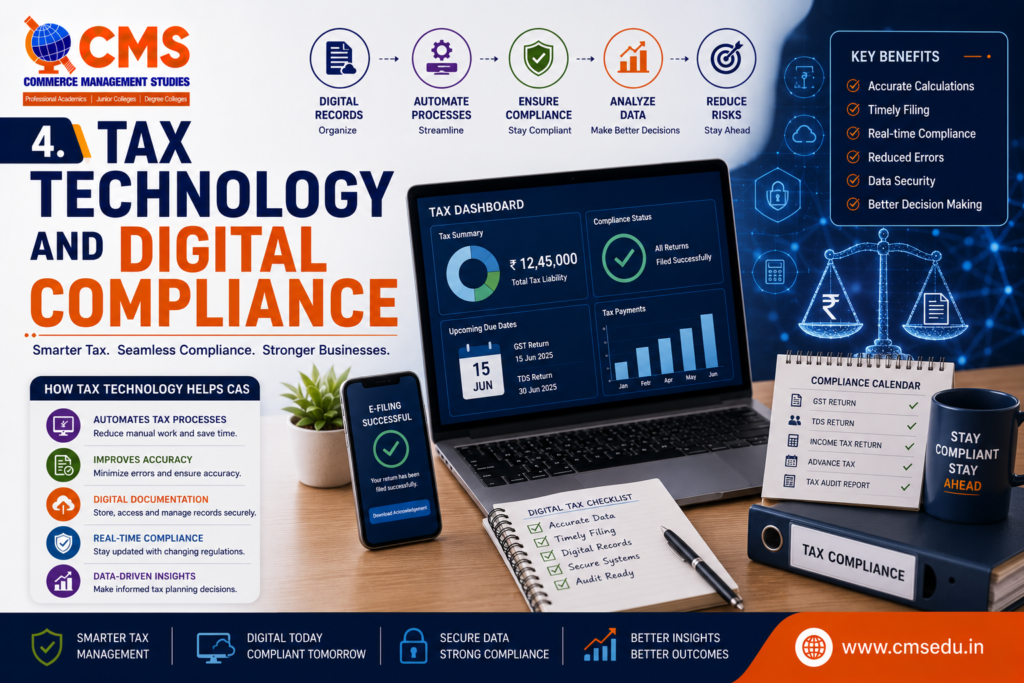
4. Tax Technology and Digital Compliance
Taxation has also become increasingly technology-driven. Businesses use digital systems to maintain records, prepare information, complete compliance processes, and manage tax-related data. This creates demand for professionals who understand taxation while also being comfortable working with digital platforms.
CAs can work in tax advisory, compliance, tax planning, and technology-enabled tax services. Their role can involve interpreting regulations, reviewing digital records, identifying potential compliance issues, and helping businesses understand their tax responsibilities in an increasingly automated environment.
5. Cloud Accounting
Cloud accounting allows financial information and accounting applications to be accessed through internet-based systems. It can support collaboration, real-time access, scalability, and remote working, making it increasingly relevant to modern businesses. ICAI has also published dedicated guidance on cloud computing for accountants.
For Chartered Accountants, knowledge of cloud accounting can create opportunities to work with businesses that are moving away from traditional accounting systems. Professionals can help organizations understand financial workflows, improve processes, manage digital records, and use technology more effectively while maintaining appropriate controls.
6. Fintech and Digital Financial Services
Financial technology, or fintech, has transformed many areas of banking, payments, lending, investment, and financial services. Chartered Accountants with knowledge of finance and technology can contribute to organizations operating in this rapidly developing sector.
Their expertise can be relevant to areas such as financial reporting, compliance, risk assessment, internal controls, financial analysis, and business planning. Understanding how digital financial systems operate can therefore complement traditional accounting knowledge and broaden potential career pathways.
7. Risk Management and Cybersecurity
As businesses become increasingly dependent on digital systems, managing technology-related risks becomes an important part of organizational governance. Financial data is particularly sensitive, making data integrity, privacy, access controls, and cybersecurity important considerations for businesses.
CAs with knowledge of technology-related risks can contribute to internal controls, risk assessment, governance, and compliance activities. ICAI has identified cyber risk management as an area where accounting professionals can apply their financial and analytical knowledge alongside technology awareness.
8. Forensic Accounting and Digital Investigation
Forensic accounting combines accounting, auditing, investigation, and analytical skills to examine financial irregularities and potential fraud. As financial information becomes increasingly digital, professionals may also need to understand digital records and technology-based evidence.
This creates opportunities for CAs interested in investigation-oriented careers. Professionals can work on fraud examinations, financial investigations, dispute-related assignments, and other situations where financial information needs to be examined carefully. Technology and data analysis can support this work by helping professionals identify unusual transactions and patterns.
9. Corporate Finance and Strategic Decision-Making
Digital businesses often need professionals who can understand both financial performance and broader business strategy. Chartered Accountants can contribute to corporate finance activities such as financial planning, budgeting, forecasting, performance analysis, and investment evaluation.
As automation handles more routine processes, CAs can increasingly focus on interpreting financial information and supporting management decisions. Their understanding of accounting, finance, taxation, and business can provide a strong foundation for strategic roles within organizations.
10. Technology-Enabled Consulting
Consulting is another area where Chartered Accountants can use their professional knowledge in combination with technology. Businesses may need guidance when implementing new financial systems, improving reporting processes, managing financial data, or strengthening internal controls.
A CA with knowledge of digital tools can contribute by understanding the financial requirements of a business and helping connect those requirements with appropriate technological processes. This combination of financial expertise and digital awareness can be particularly useful as organizations continue to modernize their operations.
Skills Future CAs Should Develop
A CA entering the digital economy needs more than traditional accounting knowledge. Technology does not replace the importance of professional expertise, but it increases the value of professionals who can work confidently with digital systems and interpret technology-generated information.
Important skills include:
- Financial analysis
- Data interpretation
- Digital accounting
- Technology awareness
- Business communication
- Analytical thinking
- Risk management
- Problem-solving
- Cybersecurity awareness
- Understanding of AI and automation
- Adaptability and continuous learning
Developing these skills can help future professionals remain prepared as the nature of financial work continues to evolve.
Will Technology Replace Chartered Accountants?
The increasing use of automation and artificial intelligence has raised questions about the future of traditional accounting roles. However, the more important change may be the transformation of the work itself. AI and automation can assist with repetitive activities, but professional judgment, ethical responsibility, interpretation, communication, and decision-making remain important parts of the CA profession. ICAI has similarly emphasized that technology should be viewed as a tool that can support professionals while human judgment remains essential.
This means future CAs may need to work alongside technology rather than compete against it. Professionals who understand how to use digital tools effectively can potentially spend more time on higher-value activities such as advisory, analysis, risk assessment, and strategic support.
Preparing Students for the Future of CA
Students interested in CA can begin developing digital awareness alongside their academic preparation. A strong foundation in Commerce, Economics, and Mathematics can help students develop financial, numerical, and analytical abilities, while exposure to technology can prepare them for the changing nature of professional work.
At CMS, students pursuing MEC with integrated CA Coaching in Hyderabad can build their Intermediate foundation while beginning their preparation for the CA pathway. Developing conceptual clarity alongside analytical thinking, digital awareness, and consistent study habits can help students prepare not only for professional examinations but also for the changing expectations of the finance profession.
The Importance of Continuous Learning
The digital economy changes quickly, and professionals cannot depend entirely on what they learned at the beginning of their careers. New technologies, regulations, financial systems, and business models continue to emerge, making continuous learning increasingly important.
For Chartered Accountants, professional development can include learning new accounting technologies, understanding data analytics, exploring AI applications, improving cybersecurity awareness, and staying updated with regulatory developments. A willingness to learn and adapt can help professionals remain relevant as their roles evolve.
Conclusion
The digital economy is expanding the career possibilities available to Chartered Accountants. Traditional areas such as accounting, auditing, taxation, and compliance remain important, while emerging opportunities are developing in financial analysis, data analytics, cloud accounting, fintech, digital auditing, risk management, forensic accounting, and technology-enabled consulting. The combination of financial expertise and digital skills can allow CAs to contribute to organizations in increasingly strategic ways.
For students considering Chartered Accountancy, this changing environment presents an opportunity to think beyond conventional career paths. Building strong fundamentals while developing analytical ability, technology awareness, communication skills, and a habit of continuous learning can create a strong foundation for the future. The CA profession is evolving with technology, and professionals who are prepared to understand and work with that change can find diverse opportunities in the digital economy