

Enroll Now
CEC Integrated with CA Coaching in Hyderabad at CMS
CEC + CA
Choosing CEC with CA Coaching in Hyderabad at CMS gives students a clear academic direction for managing Intermediate education alongside CA preparation. Instead of studying subjects in isolation, students can understand how commerce-related concepts connect with areas they will encounter in professional studies. Accounting concepts can be strengthened through numerical practice, while economics and business topics can be understood through application and analysis. CA-oriented preparation also introduces students to a more examination-focused style of learning, helping them develop accuracy, application skills and academic discipline. This makes the pathway suitable for students who want their Intermediate education to contribute towards their future goals in accounting, finance and related professional fields.
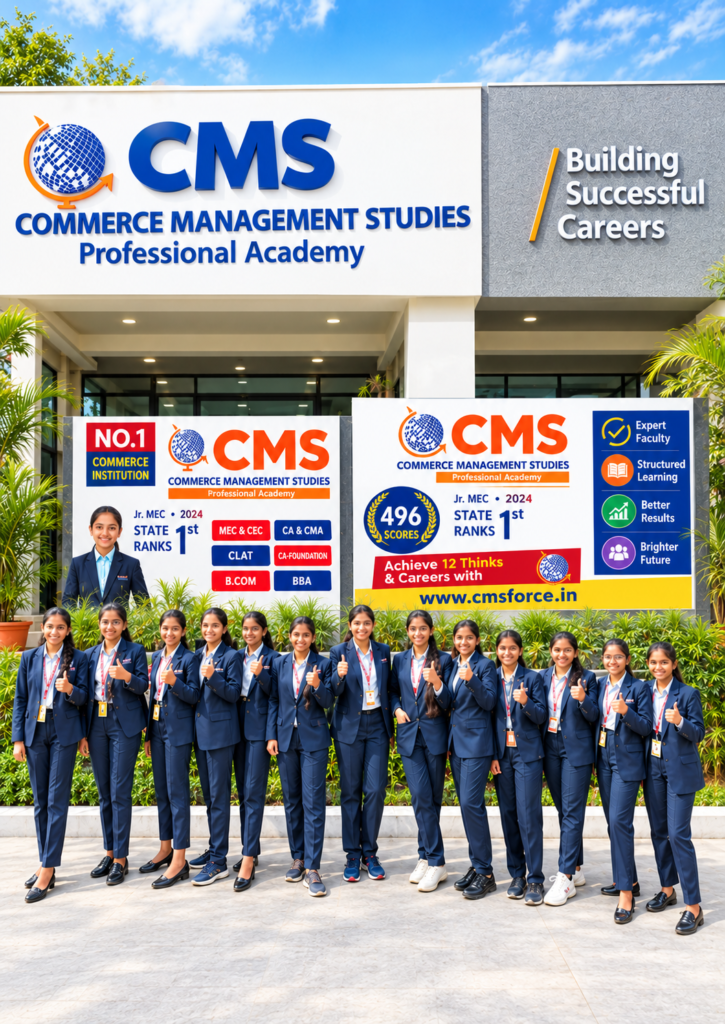
CMS is also trusted for its benchmark academic results and rank-oriented performance, with a strong focus on student achievement. The institution has recorded State-level and All India rank achievements, giving students an environment where academic performance and consistent improvement are valued. For students choosing CEC with CA, this results-focused culture can encourage them to set higher academic standards and remain committed throughout their preparation.
The emphasis is not only on completing the syllabus but also on helping students work towards stronger examination performance through disciplined preparation and continuous improvement. This makes CMS a suitable choice for students looking to begin their CEC with CA journey in an academically focused environment.
What Does CEC with CA Coaching in Hyderabad at CMS Include?
The CEC with CA program at CMS combines Intermediate academic preparation with focused support for CA Foundation-oriented learning. Students work on the concepts required for their Intermediate curriculum while receiving additional preparation that develops their understanding of accounting, business, economics and related areas. Classroom teaching is supported by regular practice so students have opportunities to apply what they learn instead of depending only on theoretical reading. This becomes particularly useful for subjects where students need to solve problems, interpret information, understand business situations or write structured answers. The program is designed to give students a clear academic routine in which learning, practice, revision and assessment work together throughout their preparation.
The program also includes different forms of academic support to help students progress steadily. Regular assessments can be used to understand whether students have understood important concepts and whether they are able to apply them independently. Mock examinations provide opportunities to practise answering questions under examination conditions, while doubt clarification helps students address topics that remain unclear after classroom teaching. Faculty guidance can further help students understand how to approach difficult questions, manage preparation time and revise effectively. By combining classroom instruction with practice, assessment, feedback and revision, CMS aims to make the CEC with CA pathway more organised and academically manageable for students.
Learn from Experienced Faculty for CEC with CA at CMS
Experienced faculty play an important role in helping students handle the academic requirements of both Intermediate and CA-oriented preparation. At CMS, faculty members guide students through concepts instead of encouraging them to rely only on memorisation. Difficult topics can be explained through examples, practical situations, numerical applications and step-by-step problem solving, depending on the subject. This approach is particularly useful for students who may understand a topic during the first explanation but struggle when they encounter a different question. Faculty support gives students the opportunity to revisit such concepts and understand the reasoning behind the answer, helping them become more confident in applying their knowledge independently.
Faculty guidance at CMS also extends beyond classroom explanation. Students may require different levels of support depending on their academic strengths, preparation progress and understanding of individual topics. Teachers can help students identify areas that require additional practice and guide them towards appropriate revision strategies. Regular interaction with faculty can also help students clarify questions before small learning gaps become larger difficulties. Through classroom teaching, practice sessions, assessments and academic feedback, students receive continued guidance as they progress through the CEC with CA curriculum. This helps create a learning environment where students are encouraged to ask questions, improve their mistakes and steadily strengthen their preparation.
Personalised Guidance for CEC + CA Students at CMS
Students preparing for Intermediate and CA Foundation may not face the same academic challenges. Some students may be strong in numerical problem-solving but need additional support with theory-based subjects, while others may understand concepts but require more examination practice. At CMS, personalised academic guidance can help students recognise these differences and work on their individual requirements. Faculty can review performance, identify topics that need attention and suggest suitable practice or revision methods. This kind of guidance is especially valuable when students are managing board examination preparation alongside professional-level academic expectations, as it helps them understand how to divide their preparation time according to their current needs.
Personalised guidance also helps students develop better study habits over time. Rather than waiting until examinations are close, students can work continuously on their weaker areas through regular practice and revision. Faculty feedback can help students understand whether their preparation methods are producing the expected results and where adjustments may be necessary. Students can also seek clarification when they encounter difficulty with a particular concept or question type. With consistent academic interaction, students can gradually become more independent in planning their preparation while still having access to faculty support when required. This balance can make the CEC with CA journey more structured and manageable.
Mock Tests for CEC Integrated with CA at CMS
Mock tests are an important part of examination-oriented preparation because they allow students to apply the concepts they have learned under conditions similar to an actual examination. At CMS, mock-test practice can help students become familiar with different question formats, manage the available time and practise selecting the right approach for different types of questions. Students preparing for Intermediate board examinations need to develop accuracy and answer-writing skills, while CA Foundation preparation also requires students to apply concepts and solve questions within a limited time. Regular mock-test practice gives students opportunities to work on these skills before facing their actual examinations. It also helps reduce uncertainty by giving students repeated exposure to examination-style questions.
The value of a mock test is not limited to the marks obtained. Performance analysis can help students identify whether mistakes are related to conceptual gaps, insufficient practice, calculation errors, incomplete answers or time management. Faculty can use these observations to guide students towards specific areas that require additional attention. Students can then revise the relevant concepts and practise similar questions to reduce the possibility of repeating the same mistakes. Over time, this process can help improve accuracy, speed and examination confidence. For students following the CEC Integrated with CA program at CMS, mock tests therefore become a practical tool for measuring preparation and identifying opportunities for improvement.
Continuous Assessments for CEC with CA Students
Continuous assessment helps students understand their preparation level throughout the academic year rather than discovering weaknesses only during final examinations. At CMS, regular academic assessments can be used to check how effectively students are understanding and applying the concepts taught in class. These assessments can also encourage students to revise consistently instead of postponing large portions of the syllabus until the examination period. When students regularly encounter questions from previously studied topics, they have more opportunities to reinforce their understanding and identify areas that require additional revision. This makes assessment part of the learning process rather than treating it only as a method of assigning marks.
Assessment performance can also provide useful feedback for students and faculty. A student who repeatedly makes similar mistakes may need additional conceptual explanation or guided practice, while another student may need to focus more on speed and examination technique. Identifying these differences early gives students more time to improve. Faculty can discuss areas of concern, recommend additional practice and encourage students to strengthen topics before moving too far ahead. For CEC with CA students, continuous assessment is particularly useful because preparation involves both Intermediate academic requirements and CA-oriented learning. Regular evaluation helps students keep track of both areas and work towards steady improvement.
Board Exam and CA Foundation Preparation at CMS
One of the important objectives of the CEC with CA program at CMS is to help students maintain a balance between their Intermediate board examination preparation and their CA Foundation-oriented preparation. Board examinations require students to understand the prescribed curriculum, revise thoroughly and present answers effectively, while CA Foundation preparation requires students to develop conceptual understanding and apply knowledge to examination-oriented questions. Managing these two requirements requires planning rather than last-minute preparation. CMS faculty can guide students through the academic priorities of each stage so that board preparation remains strong while students continue developing the knowledge and skills required for the CA pathway.
The preparation also encourages students to understand the difference between learning a concept and being able to apply it in an examination. Students may know a definition or formula but still face difficulty when the same concept appears in an unfamiliar question. Through practice, mock tests, problem-solving and faculty guidance, students can work on this transition from basic understanding to practical application. Regular revision can further strengthen retention and help students revisit important concepts before examinations. The goal is to help students approach both Intermediate and CA Foundation preparation with greater clarity, rather than treating the two as completely separate academic responsibilities.
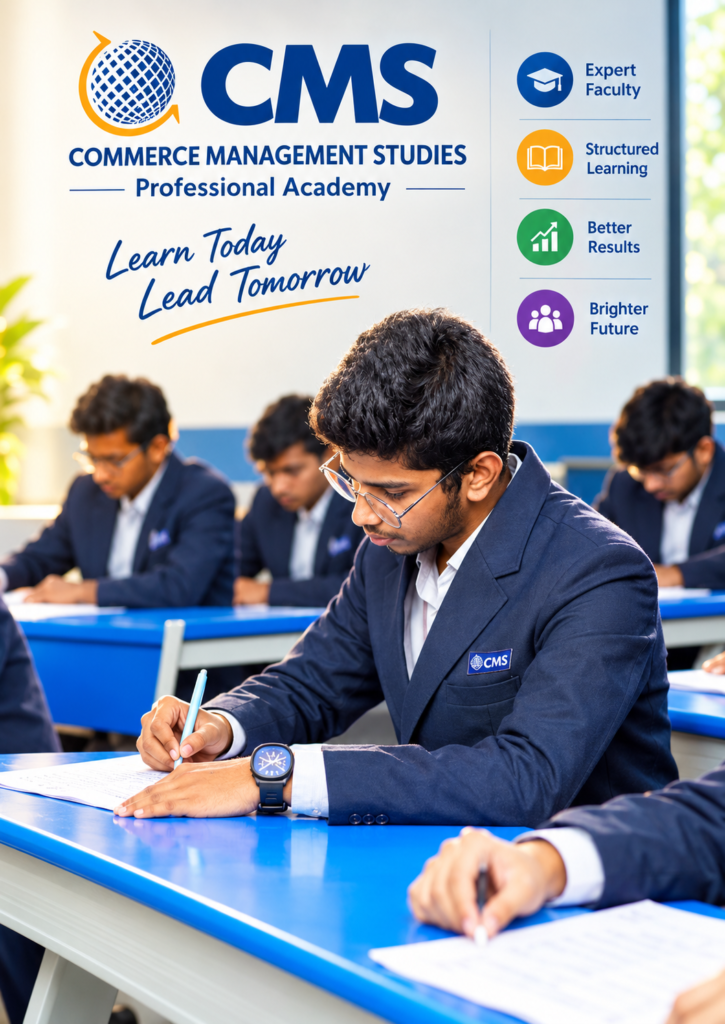
Who Should Choose CEC Integrated with CA at CMS?
CEC Integrated with CA at CMS can be suitable for students who have an interest in commerce, accounting, business, finance or professional education and want to begin their CA preparation during Intermediate. It can be particularly useful for students who prefer having a clear academic direction rather than completing Intermediate first and deciding on professional preparation later. Students who are willing to practise regularly, understand concepts in depth and work consistently towards examinations can benefit from this type of structured preparation. The program also suits students who want faculty support while managing the academic demands of Intermediate and the additional preparation required for CA Foundation.
Students considering this pathway should also understand that professional qualification requires sustained effort and commitment. The integrated program can provide academic guidance and preparation support, but students still need to participate actively in classes, complete practice work, revise regularly and learn from assessments. It is not necessary for every student to begin professional preparation in exactly the same way, so students should consider their interests, strengths and long-term career goals before choosing the pathway. For students who are genuinely interested in accounting, finance and business-related careers, CEC with CA can provide a focused academic route with CMS supporting them through the Intermediate stage.
Why Choose CMS as Your CEC with CA College in Hyderabad?
Choosing the right college for CEC with CA is about more than selecting a place to attend classes. Students need an institution that understands the academic expectations of Intermediate education as well as the commitment required to move towards a professional course like Chartered Accountancy. CMS provides students with a commerce-focused academic environment where their Intermediate years can become an important starting point for their future professional journey. The emphasis is on creating the right foundation, maintaining academic consistency and helping students develop a serious approach towards their studies. Students are encouraged to understand their long-term goals early, use their Intermediate years productively and gradually become more independent and responsible learners.
Key Reasons to Choose CMS for CEC with CA
- Commerce-Focused Academic Environment: Students learn in an environment centred around commerce education and professional career pathways.
- Early Professional Career Direction: Students who already have an interest in Chartered Accountancy can begin working towards that direction during their Intermediate education instead of waiting until Intermediate is completed.
- Clear Academic Progression: The CEC with CA pathway gives students a clearer connection between what they study during Intermediate and the professional education they plan to pursue afterward.
- Experienced Faculty: Learn from faculty who guide students through Intermediate subjects while supporting their CA-oriented preparation with clear explanations and practical examples.
- Mock Tests and Exam Practice: Get opportunities to practise examination-style questions, improve time management and understand how to approach different sections effectively.
- Continuous Assessments: Regular evaluation helps students track their preparation, identify mistakes and focus on topics that require further revision.
- Exam-Oriented Strategies: Students are guided on answering techniques, accuracy, time management, revision methods and approaches to different question patterns.
CMS aims to make the Intermediate stage more purposeful for students who already have an interest in commerce and professional careers. By choosing CMS as their CEC with CA College in Hyderabad, students can begin building their academic foundation with a clearer understanding of where their education can take them next.
Start Your CEC Integrated with CA Journey at CMS
Choosing CEC Integrated with CA is an important academic decision for students who want to build their Intermediate education alongside early preparation for Chartered Accountancy. At CMS, students can receive support through classroom teaching, experienced faculty, personal guidance, regular practice, mock tests, continuous assessments, doubt clarification and structured preparation. The focus is on helping students understand concepts, apply what they learn and gradually improve their examination performance. With appropriate planning, students can work towards their Intermediate board requirements while developing the academic foundation needed for CA Foundation preparation. This makes the program a suitable option for students who want their Intermediate years to contribute meaningfully towards their longer-term professional goals.
If you are looking for CEC with CA Coaching in Hyderabad at CMS, you can enquire with the CMS team to understand the program, academic pathway and admission process. Students and parents can discuss their academic goals and understand how the CEC + CA pathway fits into their future plans. Starting with the right guidance can help students approach Intermediate and professional preparation with greater clarity and confidence. CMS aims to provide students with the academic support and preparation environment needed to take the next step towards commerce and professional education.
Complete Info as per ICAI (Latest / New Scheme)
1. Levels
There are three main levels in the CA course under the new scheme:
- Foundation Course
- Intermediate Course
- Final Course
Additionally, there are Self-Paced Online Modules (SPOM) which are required after registering for Final Course.
Also, practical / training / soft skills components:
- ICITSS / Advanced‐ICITSS (Information Technology & Soft Skills)
- Articleship / Practical Training under a practicing CA of about 2 years.
2. Qualification Required (Eligibility)
What is required to register / move through levels:
- Foundation Course
Can be registered after Class 10. But can only appear in the Foundation exam after Class 12 / 10+2.
- Intermediate Course
Two routes:- Foundation Route: Passed Foundation + Class 12.
- Direct Entry Route: Graduates / Postgraduates:
- Commerce graduates with at least 55% marks.
- Non-commerce graduates / postgraduates with at least 60%.
- Also passed Inter-level of CMA / CS etc.
Provisional registration is allowed while final year of graduation is in progress. But one must complete graduation + complete an 8-month study period before appearing Intermediate exam.
- Final Course
Must have passed both groups of the Intermediate exam. Also must register for Final Course (which includes registering for SPOM). Practical training / articleship and ICITSS / Advanced ICITSS required.
3. Who Can Write (Appear for Exams)
- Foundation Exam: After the candidate has sorted the Class 12 requirement (i.e. has appeared/passed Class 12) and has been registered at least 4 months before the exam.
- Intermediate Exam: Once registered (either via Foundation or Direct Entry), and for Direct Entry the required 8-month study period after registration finishes before appearing.
- Final Exam: Only after both groups of Intermediate are passed, and the candidate has registered for Final, and has completed requirements like Articleship / practical training + ICITSS etc. Also SPOM modules as required.
4. How to Register
- Registration is online via ICAI’s Student / Self-Service Portal (SSP).
- Fill registration form for respective level (Foundation, Intermediate, Final). Submit required documents (mark sheets, identity proofs etc.).
- For Final level registration, one also selects SPOM modules (Sets C & D) at that time.
- For Intermediate via Direct Entry, if you are in final year of graduation, you can provisionally register, but need to submit your graduation result and complete study period before exam eligibility.
5. Registration Fee (for levels)
As per ICAI (Indian students):
Level | Fee for Registration (both groups) |
Foundation Course | ₹ 9,000 |
Intermediate Course | ₹ 18,000 (for both groups) |
Final Course | ₹ 22,000 (for both groups) |
Note: There are concession / reduced fees for students from certain Northeastern states / UTs etc. in earlier years; check current notifications.
6. Coaching Type
ICAI official sources do not mandate or prescribe coaching. Coaching is via private institutions etc, which vary in cost, mode (classroom / online). ICAI itself provides:
- Study Material (physical & digital) after registration.
- Virtual / live revision classes (LVRC) etc.
- Digital Learning Campus / LMS for SPOM modules (video lectures etc).
So “coaching type” under ICAI = self-study materials, virtual / online classes, revision test papers; private coaching is external.
7. Examination for Each Level
What exam(s), frequency, pattern etc:
Level | When Held / Frequency | Exam Pattern Highlights |
Foundation | Thrice a year: January, May, September | 4 Papers. Subjective & Objective mix. Minimum marks per paper and aggregate. Negative marking for objective / MCQ portions. |
Intermediate | Thrice a year: January, May, September | 6 papers (2 groups of 3 papers each) under New Scheme. Each paper 100 marks. In each paper: combination of descriptive (essay/problem) + MCQ case-scenario etc (approx 70% descriptive, 30% objective/case scenario MCQs) |
Final | Twice a year (Typically May & November) | 6 papers (2 groups) under New Scheme. Full detailed pattern in the ICAI syllabus page. Also includes integrated business solutions case study etc. SPOM modules are precondition. |
Also: SPOM (Self-Paced Online Modules) exams for the modules A, B, plus elective one’s C & D. These are done via “Self-Paced Module Test (SPMT)” portal.
8. Subjects for Each Level with Brief Intro
Here are the subjects under the New Scheme and what they cover, at a high level.
Foundation Course
There are 4 Papers:
- Accounting – Basics of accounting, recording of transactions, financial statements.
- Business Laws – Basic law relevant to business (business law topics as per syllabus).
- Quantitative Aptitude – Business mathematics, logical reasoning, statistics.
- Business Economics – Micro and macro-economics, business environment etc.
Intermediate Course
6 Papers (Group I & Group II):
- Group I:
- Advanced Accounting – Accounting standards, presentation, complex accounting (consolidations, etc.).
- Corporate and Other Laws – Company law + other relevant laws.
- Taxation – Income Tax Law + Goods & Services Tax (GST) sections.
- Group II:
- Cost and Management Accounting – Costing techniques, managerial decision making etc.
- Auditing & Ethics – Auditing principles, practices, standards + professional ethics.
- Financial Management & Strategic Management – Financial decision making, planning, strategic management concepts.
Self-Paced Online Modules (SPOM)
(After registering for Final Course, student must complete these modules):
- SET A (Mandatory): Corporate & Economic Laws
- SET B (Mandatory): Strategic Cost & Performance Management (
- SET C (Elective – choose one): Options like Risk Management; Sustainable Dev & Sustainability Reporting; Public Finance & Govt Accounting; Insolvency & Bankruptcy Code; International Taxation; Arbitration & Conciliation; Forensic Accounting; Valuation; Financial Services & Capital Markets; Forex & Treasury Management.
- SET D (Elective – choose one): Options such as Constitution of India & Art of Advocacy; Psychology & Philosophy; Entrepreneurship & Start-up Ecosystem; Digital Ecosystem & Controls.
Final Course
6 Papers (2 Groups). The exact paper names are:
- Group I (all 100-marks papers):
- Financial Reporting
- Advanced Financial Management
- Advanced Auditing, Assurance & Professional Ethics
- Group II:
- Direct Tax Laws & International Taxation
- Indirect Tax Laws
- Integrated Business Solutions (a Multi-disciplinary Case Study)
9. Exam Qualification Passing / Passing Criteria
- Passing a paper: Minimum 40% marks in each paper.
- Passing a group: If paper-wise pass (≥ 40%) and aggregate (across non-exempted papers in that group) 50% or more.
- To pass the exam level: All groups must be passed (i.e. all papers / groups). For Intermediate and Final levels.
- Exemptions: If you score 60% or more in a paper, you may get exemption in that subject (for certain terms / non-exempted papers) under Syllabus 2022.
- Final Level:
- Similar passing marks: usually 40% in each paper + 50% aggregate in a group. (As per ICAI, for Final Course under new scheme)
- SPOM Modules:
- Must complete prescribed learning hours via LMS.
- Pass each module with minimum 50% marks.
- No negative marking in SPOM exams.
- Marks in SPOM do not get aggregated with core Final Course papers for determining Final exam pass.
10. Other Important Details
- The New Scheme became effective from June 23, 2023.
- Validity of registration:
- Foundation Course registration validity: 4 years from first eligible attempt.
- Intermediate registration validity: 5 years from date of registration. It may be revalidated once (with fee) for further period.
- There is no revalidation at Foundation level.
- Negative marking:
- In Foundation & Intermediate objective/MCQ/case scenario portions: there is negative marking of 0.25 (¼ mark) for each wrong answer.
- In SPOM exams, no negative marking.
- Programme durations and training:
- Articleship / Practical Training is compulsory. New Scheme has relaxations for students who were under old scheme etc.
- IT & soft skills training (ICITSS / Advanced ICITSS) required at appropriate stages.
- Exemption windows / permanent exemptions: ICAI provides a Permanent Exemption Window for Intermediate / Final for certain candidates under certain conditions.
Frequently Asked Questions About CEC with CA
Clear answers about CEC with CA Coaching in Hyderabad at CMS.
1. What is CEC Integrated with CA?
CEC Integrated with CA is an academic pathway that combines Intermediate CEC education with focused preparation for Chartered Accountancy. Students continue their Intermediate studies while developing the commerce knowledge, conceptual understanding and examination skills required for the CA pathway.
2. What does CEC with CA include?
CEC with CA includes Intermediate-level commerce education along with CA-oriented preparation in relevant areas. Students can receive academic support through classroom learning, practice, revision, assessments and examination-focused preparation.
3. Is CEC with CA a good choice for students who want to become Chartered Accountants?
Yes, CEC with CA can be a suitable choice for students who are interested in Chartered Accountancy and want to begin building their commerce foundation during Intermediate. It allows students to develop relevant academic knowledge while starting focused preparation for the CA pathway.
4. Why should students choose CEC with CA after 10th?
Students interested in accounting, finance, business or Chartered Accountancy can choose CEC with CA after 10th to begin their commerce education with a clear professional direction. The pathway allows students to use their Intermediate years to build relevant knowledge and prepare for the next stage of professional education.
5. What are the benefits of choosing CEC with CA?
The main benefits include a strong commerce foundation, early exposure to CA-oriented preparation, better familiarity with accounting and business concepts, examination practice and a clearer academic pathway towards professional education.
6. How does CEC with CA help with CA Foundation preparation?
CEC with CA can support CA Foundation preparation by strengthening students’ understanding of commerce-related concepts and developing habits such as regular practice, problem-solving, revision and examination preparation. These skills can help students approach professional-level studies with greater confidence.
7. Can CEC students pursue Chartered Accountancy?
Yes, CEC students can pursue Chartered Accountancy by following the applicable CA qualification pathway and completing the required examinations and stages. CEC provides a commerce-oriented academic foundation that can be useful for students interested in CA.
8. Is CEC with CA better than doing CEC first and CA later?
CEC with CA can be beneficial for students who already know that they want to pursue Chartered Accountancy because they can begin professional preparation during Intermediate. However, the right choice depends on the student’s academic interests, preparation style and long-term career goals.
9. What subjects are important for students choosing CEC with CA?
Accounting, economics, business-related subjects and other commerce-oriented areas are important for students pursuing CEC with CA. Building strong conceptual understanding and problem-solving ability in these areas can support future professional studies.
10. Does CMS provide mock tests for CEC with CA students?
Yes, mock tests are part of the examination-oriented preparation at CMS. They give students opportunities to practise questions under examination conditions, work on time management and identify areas that require further improvement.
11. Does CMS provide personal guidance for CEC with CA students?
Yes, CMS provides academic guidance to help students understand difficult concepts, identify areas that need improvement and develop more effective preparation habits. Faculty support can help students manage their Intermediate and CA-oriented preparation more systematically.
12. How does CMS help students balance Intermediate and CA preparation?
CMS helps students manage both areas through planned academic preparation, regular practice, assessments, revision and faculty guidance. This allows students to work towards their Intermediate requirements while gradually developing the knowledge and skills needed for CA preparation.
13. Does CMS focus on concept-based learning for CEC with CA?
Yes, concept-based learning is an important part of the preparation at CMS. Students are encouraged to understand the logic behind concepts and apply their knowledge to questions and practical situations rather than depending entirely on memorisation.
14. Are regular assessments conducted for CEC with CA students at CMS?
Yes, continuous assessment is used to help students understand their academic progress and identify areas that require additional practice or revision. Assessment performance can also help students recognise recurring mistakes and improve their preparation.
15. What skills can students develop through CEC with CA?
Students can develop conceptual understanding, numerical reasoning, analytical thinking, problem-solving, time management, accuracy and examination skills. These abilities can support them during Intermediate, CA preparation and future professional studies.
16. Who should choose CEC Integrated with CA at CMS?
CEC Integrated with CA at CMS can be suitable for students who are interested in commerce, accounting, finance, business or Chartered Accountancy. It is particularly relevant for students who want to begin CA-oriented preparation during their Intermediate education.
17. Why choose CMS for CEC with CA in Hyderabad?
Students can choose CMS for its commerce-focused academic environment, experienced faculty, examination-oriented preparation and emphasis on student performance. CMS is also trusted for benchmark academic results, including State-level and All India rank achievements.
18. What makes CEC with CA at CMS different from a regular CEC program?
CEC with CA at CMS gives students an opportunity to pursue their Intermediate CEC education while also receiving focused preparation for the CA pathway. This provides students with an academic direction towards professional education rather than limiting their preparation to Intermediate board requirements alone.
19. Can CEC with CA lead to careers in finance and accounting?
Yes, CEC with CA can provide a foundation for students interested in professional careers related to accounting, finance, taxation, auditing and business. Students who continue through the required professional qualifications can explore a range of career opportunities depending on their qualifications and interests.
20. How can I enquire about CEC with CA admissions at CMS?
Students and parents can contact CMS to enquire about the CEC with CA program, understand the academic pathway and discuss the admission process. The CMS team can provide relevant information to help students decide whether the program matches their academic and career goals.
Our Branches Which Offer CEC + CA

BACHUPALLY
(Exclusive Residential Campus for Boys)

JNTU Metro
(Day Scholar Campus)

KPHB (SONY Campus)
(Exclusive Residential Campus for Girls)

SR Nagar
(Day Scholar Campus)
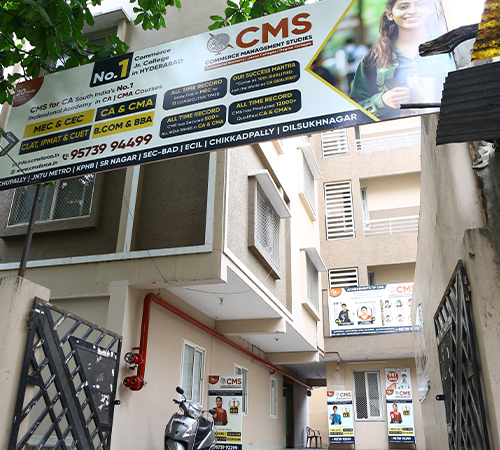
Secunderabad
(Day Scholar Campus)
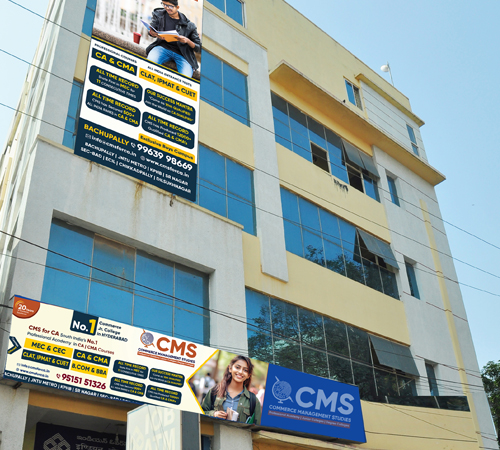
ECIL
(Day Scholar Campus)

Chikkadpally
(Day Scholar Campus)
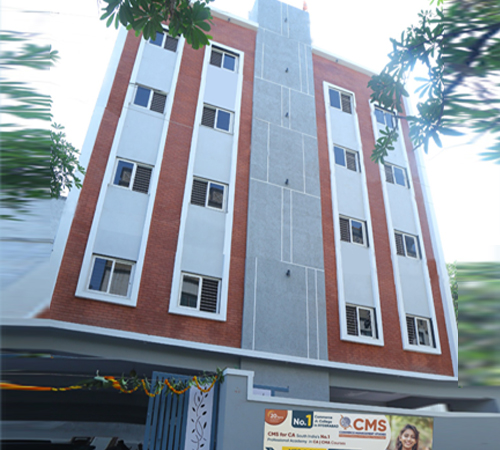
Dilsukhnagar
(Day Scholar Campus)

Chandanagar
(Day Scholar Campus)

Kompally
(Day Scholar Campus )
Take the Next Step with CMS
Build your Intermediate foundation, strengthen your commerce and accounting knowledge, and begin your CA preparation with focused academic guidance at CMS.