

BENEFITS OF CLAT EXAM
- Admission to Premier Law Schools
- Diverse Career Opportunities
- Gateway to Competitive Exams like IAS/IPS
- Networking and Peer Learning
- Structured Path for Legal Studies

Enroll Now
CMS : For Your Growth in Education
Best CLAT Coaching in Hyderabad
Best-in-Class CLAT Coaching in Hyderabad by CMS Institute:


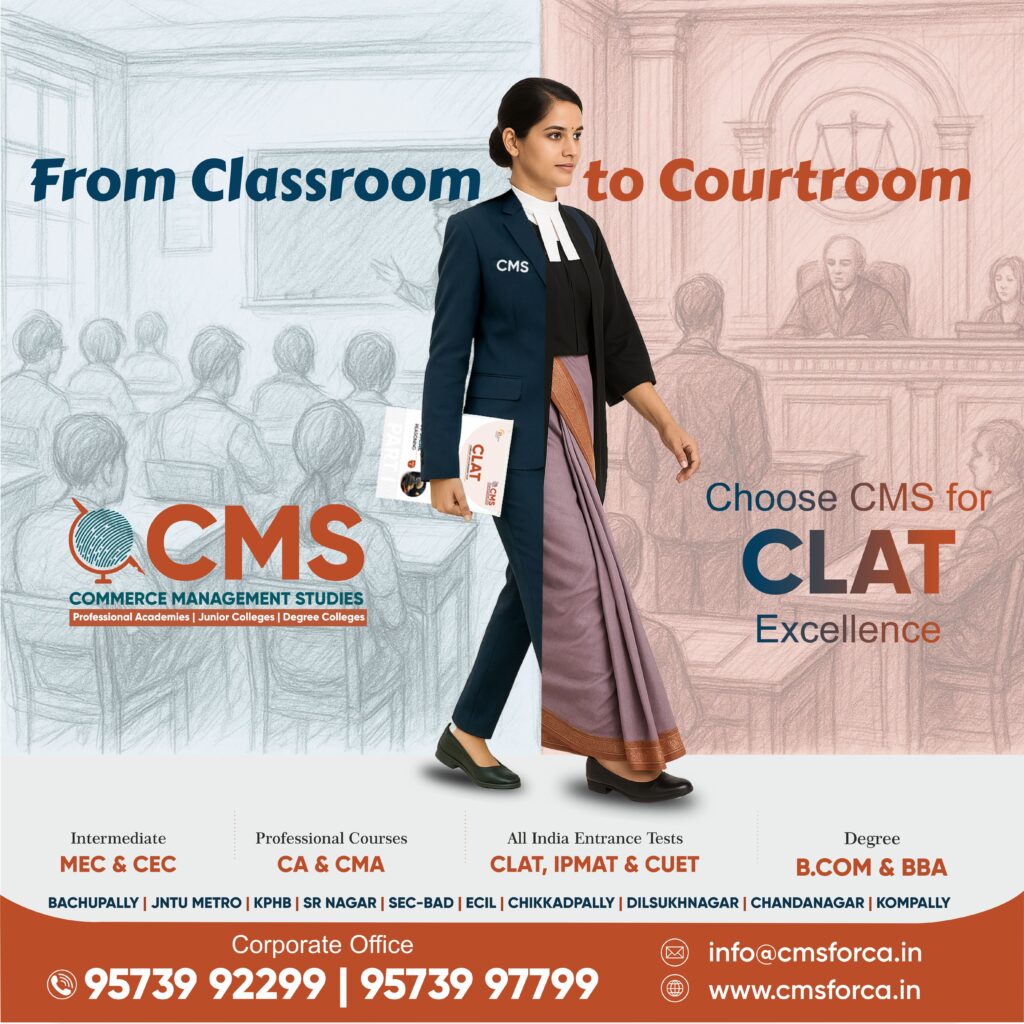
Join CMS for CLAT Coaching in Hyderabad: Where Excellence Meets Opportunity
Future Prospects for CLAT Aspirants in India after Successfully Clearing the CLAT Exam:
Clearing the CLAT exam opens the door to admission into leading National Law Universities (NLUs) across India. With the right preparation through CLAT Coaching in Hyderabad, aspirants can secure admission to an NLU based on their CLAT rank, preferences, and the admission criteria of the respective university. Students can then pursue a 5-year integrated undergraduate law programme, gaining knowledge of legal concepts, practical skills, and professional competencies.
After successfully completing the 5-year integrated law course from an NLU, graduates can explore diverse career opportunities in the legal field. They can pursue careers as corporate lawyers, legal advisers, advocates, legal consultants, and in-house legal professionals across law firms, companies, government organisations, and other institutions. The strong academic foundation and exposure gained during their NLU journey can help students build a career in various areas of law.
Why Join CMS for Intermediate with CLAT Coaching?
CMS offers an integrated learning environment where Intermediate education and CLAT preparation are brought together under one structured programme. Students receive academic support along with focused coaching for the different sections of the CLAT examination, including Legal Reasoning, Logical Reasoning, English Language, Quantitative Techniques, and Current Affairs. As an Intermediate with CLAT Coaching College in Hyderabad, CMS focuses on consistent practice, regular assessments, doubt clarification, and guidance to help students track and improve their preparation.
Students also benefit from a disciplined academic schedule and continuous mentoring throughout the programme. Regular mock tests and practice sessions help students become familiar with the CLAT examination pattern while developing essential skills such as analytical thinking, reading comprehension, logical reasoning, and time management. By combining Intermediate education with dedicated CLAT preparation, CMS provides students with a structured pathway to prepare for the entrance examination and pursue their goal of studying law at a leading National Law University.
Integrated CLAT Preparation with Intermediate
At CMS, we understand that preparing for competitive exams like CLAT requires a structured and consistent approach. Our integrated programme allows students to pursue their Intermediate education while preparing for CLAT alongside their regular academics. As a leading Intermediate with CLAT Coaching College in Hyderabad, CMS provides focused preparation covering key CLAT areas such as Legal Reasoning, Logical Reasoning, English Language, Quantitative Techniques, and Current Affairs. This integrated approach helps students manage their academic curriculum and entrance-exam preparation effectively.
Students at CMS benefit from expert guidance, regular practice sessions, assessments, and CLAT-focused study materials. The programme is designed to strengthen conceptual understanding while gradually developing the speed, accuracy, reasoning, comprehension, and time-management skills required for the CLAT examination. With Intermediate education and CLAT preparation planned together, students can work towards their goal of securing admission to leading National Law Universities without having to manage separate preparation schedules.
Join the Best CLAT Coaching Classes in Hyderabad:
Complete Information about CLAT
- List of Top Colleges (Participating NLUs & Others)
Some of the most prominent law colleges/universities (mostly National Law Universities, NLUs) that accept CLAT scores:
- National Law School of India University (NLSIU), Bengaluru
- NALSAR University of Law, Hyderabad
- West Bengal National University of Juridical Sciences (WBNUJS), Kolkata
- National Law University, Jodhpur
- National Law Institute University (NLIU), Bhopal
- Gujarat National Law University (GNLU), Gandhinagar
- Dr. Ram Manohar Lohiya National Law University (RMLNLU), Lucknow
- Maharashtra National Law University (MNLU), Mumbai
- Hidayatullah National Law University (HNLU), Raipur
- National Law University Odisha (NLUO), Cuttack
These are among the top preferred institutions for law aspirants using CLAT.
- Qualification Required / Eligibility Criteria
From recent sources (secondary / media) summarizing CLAT:
- For UG (Five-Year Integrated LLB): Must have passed 10+2 (or equivalent) from a recognized Board.
- Minimum required marks: 45% for General / OBC / NRI / OCI etc. categories; 40% for SC / ST categories.
- Those appearing in Class 12 (or equivalent) in the same year are often eligible to apply provisionally (subject to passing 10+2) by time of admission.
- Who Can Write?
- Students who have passed or are appearing for the Class 12 / 10+2 exam.
- There is no upper age limit mentioned in the sources consulted.
- Eligibility for PG (LLM) courses via CLAT: Must have a law degree (LLB) with required minimum marks (often 50% general, 45% for reserved categories) depending on NLU rules.
- How to Register?
Based on summary of recent announcements / media:
- Registration is online through the CLAT / Consortium of NLUs portal. (Exact registration site is consortiumofnlus.ac.in)
- Steps typically include: filling application form with personal, academic, and category details; uploading required documents (photo, signature, proof of 10+2 marks or admit card or equivalent); selecting the correct category (reserved / unreserved etc.)
- There is usually a deadline for application; sometimes a correction window after form submission. (Media sources mention deadlines as per every year’s notification)
- Registration / Application Fee
From recent media sources / CLAT summaries:
- For General / OBC / PWD / NRI / OCI categories: approx.₹4,000
- For SC / ST / BPL categories: approx.₹3,500
Note: Official notice must be checked for final fee, as it may vary slightly based on category or special reductions / waivers.
- Coaching Type / Preparation Options
Not officially prescribed by CLAT; sources indicate common practices:
- Private coaching institutes (classroom-based) in many cities offering CLAT preparation.
- Online coaching (video lectures, live classes) and test series / mock tests.
- Self-study using CLAT sample papers and past test papers.
- Some law schools / organizations conduct CLAT workshops.
- Examination Structure / Pattern
Based on recent CLAT exam pattern info (UG level):
- The exam is for UG (5-year integrated) and PG programs. Primary discussion here is about UG.
- Number of questions: 120 questions in the CLAT UG exam.
- Type of questions: Multiple Choice Questions (MCQs) only.
- Marking: +1 mark for each correct answer; −0.25 (minus one-quarter) for each wrong answer.
- Duration: Usually around 2 hours for UG-CLAT, though media reports sometimes mention this.
- Subjects / Sections in the CLAT UG Exam
For CLAT UG (as per latest pattern):
The exam is divided into sections. Main subjects / sections tested include:
- English Language – comprehension, grammar, vocabulary, etc.
- General Knowledge / Current Affairs – events of national & international importance, etc.
- Legal Reasoning – passages or scenarios with legal issues; ability to apply law / rules.
- Logical Reasoning – basic logic, puzzles, analytical reasoning.
- Quantitative Techniques – basic arithmetic, algebra, data interpretation etc.
- Exam Qualifications / Passing / Scoring
- To be considered in merit, candidate must attempt the CLAT exam and get a valid score. No “pass / fail” in strict sense — more about obtaining good score and rank.
- Wrong answers attract negative marking (−0.25). So accuracy matters.
- Scores are used to create a merit list / rank; admissions to NLUs / participating colleges follow counselling based on that rank.
- Category-based reservations apply (SC, ST, OBC, etc.) in seats allocation in NLUs. Candidate should apply under correct category and provide required certificate proofs.
- Other Important Details
- CLAT is conducted once a year.
- No upper age limit for UG exam (as per recent sources)
- Admit cards are issued ahead of the exam; must be downloaded from the official portal.
- Candidates must bring valid identity proof etc. to exam hall.
- For PG admissions, LLB degree percentage requirements (often 50% for general, 45% for reserved) need to be met.
- Frequently updated sample papers / past year papers are released / available for practice.
- Slight changes in pattern / number of questions / duration may occur year to year; important to check the current year’s Information Brochure from the Consortium of NLUs.
Official CLAT Documents / Resources
- CLAT– Official Website / Portal
Consortium of NLUs, for CLAT info & notification. Consortium of NLUs - CLAT Calendar (Important Dates)
Has dates like exam date, provisional answer key, result, counselling etc. Consortium of NLUs - CLAT Brochure from NALSAR (PDF)
Detailed eligibility, courses, etc. NALSAR University of Law - Revised CLAT Information Brochure – AY 2026-27 (NLSIU version)
Complete Information about CLAT
1. List of Top Colleges (Participating NLUs & Others)
Some of the most prominent law colleges/universities (mostly National Law Universities, NLUs) that accept CLAT scores:
- National Law School of India University (NLSIU), Bengaluru
- NALSAR University of Law, Hyderabad
- West Bengal National University of Juridical Sciences (WBNUJS), Kolkata
- National Law University, Jodhpur
- National Law Institute University (NLIU), Bhopal
- Gujarat National Law University (GNLU), Gandhinagar
- Dr. Ram Manohar Lohiya National Law University (RMLNLU), Lucknow
- Maharashtra National Law University (MNLU), Mumbai
- Hidayatullah National Law University (HNLU), Raipur
- National Law University Odisha (NLUO), Cuttack
These are among the top preferred institutions for law aspirants using CLAT.
2. Qualification Required / Eligibility Criteria
From recent sources (secondary / media) summarizing CLAT:
- For UG (Five-Year Integrated LLB): Must have passed 10+2 (or equivalent) from a recognized Board.
- Minimum required marks: 45% for General / OBC / NRI / OCI etc. categories; 40% for SC / ST categories.
- Those appearing in Class 12 (or equivalent) in the same year are often eligible to apply provisionally (subject to passing 10+2) by time of admission.
3. Who Can Write?
- Students who have passed or are appearing for the Class 12 / 10+2 exam.
- There is no upper age limit mentioned in the sources consulted.
- Eligibility for PG (LLM) courses via CLAT: Must have a law degree (LLB) with required minimum marks (often 50% general, 45% for reserved categories) depending on NLU rules.
4. How to Register?
Based on summary of recent announcements / media:
- Registration is online through the CLAT / Consortium of NLUs portal. (Exact registration site is consortiumofnlus.ac.in)
- Steps typically include: filling application form with personal, academic, and category details; uploading required documents (photo, signature, proof of 10+2 marks or admit card or equivalent); selecting the correct category (reserved / unreserved etc.)
- There is usually a deadline for application; sometimes a correction window after form submission. (Media sources mention deadlines as per every year’s notification)
5. Registration / Application Fee
From recent media sources / CLAT summaries:
- For General / OBC / PWD / NRI / OCI categories: approx.₹4,000
- For SC / ST / BPL categories: approx.₹3,500
Note: Official notice must be checked for final fee, as it may vary slightly based on category or special reductions / waivers.
6. Coaching Type / Preparation Options
Not officially prescribed by CLAT; sources indicate common practices:
- Private coaching institutes (classroom-based) in many cities offering CLAT preparation.
- Online coaching (video lectures, live classes) and test series / mock tests.
- Self-study using CLAT sample papers and past test papers.
- Some law schools / organizations conduct CLAT workshops.
7. Examination Structure / Pattern
Based on recent CLAT exam pattern info (UG level):
- The exam is for UG (5-year integrated) and PG programs. Primary discussion here is about UG.
- Number of questions: 120 questions in the CLAT UG exam.
- Type of questions: Multiple Choice Questions (MCQs) only.
- Marking: +1 mark for each correct answer; −0.25 (minus one-quarter) for each wrong answer.
- Duration: Usually around 2 hours for UG-CLAT, though media reports sometimes mention this.
8. Subjects / Sections in the CLAT UG Exam
For CLAT UG (as per latest pattern):
The exam is divided into sections. Main subjects / sections tested include:
- English Language – comprehension, grammar, vocabulary, etc.
- General Knowledge / Current Affairs – events of national & international importance, etc.
- Legal Reasoning – passages or scenarios with legal issues; ability to apply law / rules.
- Logical Reasoning – basic logic, puzzles, analytical reasoning.
- Quantitative Techniques – basic arithmetic, algebra, data interpretation etc.
9. Exam Qualifications / Passing / Scoring
- To be considered in merit, candidate must attempt the CLAT exam and get a valid score. No “pass / fail” in strict sense — more about obtaining good score and rank.
- Wrong answers attract negative marking (−0.25). So accuracy matters.
- Scores are used to create a merit list / rank; admissions to NLUs / participating colleges follow counselling based on that rank.
- Category-based reservations apply (SC, ST, OBC, etc.) in seats allocation in NLUs. Candidate should apply under correct category and provide required certificate proofs.
10. Other Important Details
- CLAT is conducted once a year.
- No upper age limit for UG exam (as per recent sources)
- Admit cards are issued ahead of the exam; must be downloaded from the official portal.
- Candidates must bring valid identity proof etc. to exam hall.
- For PG admissions, LLB degree percentage requirements (often 50% for general, 45% for reserved) need to be met.
- Frequently updated sample papers / past year papers are released / available for practice.
- Slight changes in pattern / number of questions / duration may occur year to year; important to check the current year’s Information Brochure from the Consortium of NLUs.
Official CLAT Documents / Resources
- CLAT– Official Website / Portal
Consortium of NLUs, for CLAT info & notification. Consortium of NLUs - CLAT Calendar (Important Dates)
Has dates like exam date, provisional answer key, result, counselling etc. Consortium of NLUs - CLAT Brochure from NALSAR (PDF)
Detailed eligibility, courses, etc. NALSAR University of Law - Revised CLAT Information Brochure – AY 2026-27 (NLSIU version)
Frequently Asked Questions About CLAT Coaching in Hyderabad
Clear answers about CLAT Coaching in Hyderabad at CMS, including eligibility, exam pattern, preparation, integrated MEC and CEC pathways, and admission support.
How do I choose CLAT Coaching in Hyderabad?
When selecting CLAT Coaching in Hyderabad, students can evaluate faculty expertise, teaching methodology, legal reasoning preparation, current affairs coverage, mock tests, doubt-solving support and interview guidance. It is also useful to check whether the coaching program follows the latest CLAT syllabus and examination pattern.
Which institute is known for CLAT Coaching in Hyderabad?
Students researching CLAT Coaching in Hyderabad can compare institutes based on their academic approach, faculty support, study resources, practice tests and examination guidance. CMS provides CLAT coaching support for students preparing for law entrance examinations and planning their future legal education.
Who is eligible to apply for CLAT?
Students who have completed or are appearing for Class 12 can apply for the CLAT Undergraduate examination, subject to the eligibility rules for that admission year. Under the commonly published eligibility criteria, candidates need at least 45% marks in Class 12, while SC and ST candidates need at least 40%. Students should confirm the latest official eligibility requirements before applying.
Can MEC and CEC students apply for CLAT after Intermediate?
Yes. Students from MEC and CEC backgrounds can apply for CLAT after Class 12 if they meet the eligibility criteria. Their Intermediate education can provide useful foundations in comprehension, analytical thinking and general awareness, while CLAT preparation helps them develop skills required for law entrance examinations.
What is the CLAT registration fee?
The CLAT application fee depends on the examination year and candidate category. The fee may also differ depending on whether candidates select additional services, such as purchasing previous question papers. Applicants should check the latest official CLAT notification for the exact registration fee and payment instructions.
What is the CLAT exam pattern?
CLAT Undergraduate is generally a comprehension-based entrance examination covering English language, current affairs including general knowledge, legal reasoning, logical reasoning and quantitative techniques. The exact number of questions, duration and examination instructions should be checked in the official notification for the relevant admission year.
What subjects should students prepare for CLAT?
Students preparing for CLAT should focus on English language, current affairs and general knowledge, legal reasoning, logical reasoning and quantitative techniques. Preparation involves reading comprehension, understanding arguments, analysing passages, following current events and practising numerical questions relevant to the examination.
What are the passing marks or cut-off marks for CLAT?
CLAT does not have one fixed qualifying mark that guarantees admission to every National Law University. Admission depends on factors such as the candidate’s rank, category, preferences, seat availability and the participating university’s admission process. Students should review the relevant year’s official counselling and admission information.
Is there a minimum Class 12 percentage required for CLAT?
Yes. The CLAT Undergraduate eligibility criteria generally require candidates to secure at least 45% marks in Class 12, with a 40% minimum for SC and ST candidates. Students appearing for their qualifying examination may also apply, subject to the applicable rules and required proof of qualification during admission.
Is there an age limit for CLAT?
CLAT Undergraduate has generally been conducted without an upper age limit. However, candidates should verify the current eligibility rules and any relevant admission conditions in the official notification for their intended examination year.
What is the difference between CLAT and an LLB course?
CLAT is a law entrance examination used by participating universities for admission to undergraduate law programs. An LLB is a law degree program that students pursue after meeting the relevant admission requirements. CLAT preparation helps eligible students compete for admission to participating law institutions.
What is the duration of the law program after CLAT?
Students admitted through CLAT Undergraduate generally pursue a five-year integrated law program after Class 12. The specific degree structure depends on the university, with programs combining legal studies and other academic subjects.
Does CLAT admission include counselling?
Yes. CLAT admission involves a counselling and seat-allocation process for participating institutions. Candidates generally submit preferences and follow the official instructions for registration, seat allotment, acceptance and admission formalities. The exact process and schedule are announced for each admission cycle.
How can students prepare for CLAT effectively?
Students can prepare for CLAT by following a consistent study schedule, practising comprehension-based questions, reading current affairs regularly and strengthening legal and logical reasoning. Taking mock tests, analysing mistakes and revising weaker topics can help students track their progress and improve examination readiness.
Are mock tests important for CLAT preparation?
Yes. Mock tests help students practise under timed conditions, become familiar with the examination format and identify areas that need further preparation. Reviewing performance after each test can help students improve accuracy, time management, comprehension and question-selection strategies.
How can students improve legal reasoning for CLAT?
Students can improve legal reasoning by practising passage-based questions, identifying relevant facts and principles, and learning to apply those principles logically. Regular practice can help develop analytical thinking and the ability to understand legal situations without relying only on memorised legal knowledge.
How can students improve current affairs and general knowledge for CLAT?
Students can strengthen current affairs and general knowledge by following reliable news sources, revising important national and international developments, and practising passage-based questions. Maintaining concise notes and reviewing topics regularly can help students build familiarity with relevant events and background information.
What should students check before joining CLAT Coaching in Hyderabad?
Before joining CLAT Coaching in Hyderabad, students can compare faculty experience, syllabus coverage, teaching methodology, mock-test frequency, study resources, doubt-solving support and interview preparation. It is also important to check whether the coaching approach aligns with the latest CLAT examination pattern.
Can students prepare for CLAT alongside Intermediate studies?
Yes. Students can prepare for CLAT alongside Intermediate studies by maintaining a balanced timetable for board examinations and entrance-test preparation. Regular reading, aptitude practice and revision can help students work towards their academic qualifications while developing skills relevant to law entrance examinations.
What career opportunities are available after qualifying for CLAT?
Students who gain admission to law programs through CLAT can pursue legal education leading to career pathways such as legal practice, corporate law, legal research, public service and further legal studies. Career opportunities depend on the degree completed, professional requirements and the student’s interests and qualifications.
Why choose CMS for CLAT Coaching in Hyderabad?
CMS provides students with a structured learning environment for CLAT preparation alongside their Intermediate education. Through academic guidance and focused entrance-examination preparation, students can work on developing comprehension, reasoning, quantitative aptitude and awareness of current affairs.
Can I study MEC or CEC with CLAT coaching at CMS?
Yes. Students can explore MEC or CEC integrated with CLAT preparation at CMS, allowing them to continue their Intermediate education while preparing for law entrance examinations. This approach helps students plan their academic studies alongside their interest in pursuing a legal career.
What is the advantage of the CLAT integrated program at CMS?
CMS offers an integrated learning approach for students interested in combining Intermediate education with CLAT preparation. Students can work on their regular academic subjects while developing entrance-examination skills in areas such as legal reasoning, logical reasoning, English and current affairs.
How does CMS support students preparing for CLAT?
CMS supports CLAT aspirants through structured academic preparation and entrance-examination guidance. Students can focus on strengthening comprehension, reasoning, current affairs and problem-solving skills while preparing for the requirements of their preferred law programs.
How can I enquire about CLAT Coaching at CMS?
Students and parents can contact CMS to enquire about CLAT Coaching in Hyderabad, integrated MEC or CEC options, eligibility requirements and the admission process. They can also learn about the academic approach, entrance-examination preparation and support available for students planning to pursue law after Intermediate.