

Introduction
When students hear the word “Commerce,” one of the first subjects they often think about is Accounts. While accounting is an important part of commerce education, the field is much broader than maintaining financial records or solving accounting problems. Commerce education can introduce students to business, economics, mathematics, finance, institutions, markets, and the way organisations function in the real world.
At the Intermediate level, commerce-oriented education can take different forms through streams such as MEC, CEC, and ACE. Each combination provides students with a different academic perspective. MEC brings Mathematics, Economics, and Commerce together; CEC combines Civics, Economics, and Commerce; while ACE focuses on Accounts, Commerce, and Economics. Together, these streams demonstrate that commerce education can develop a wide range of academic and practical skills rather than focusing on Accounts alone.
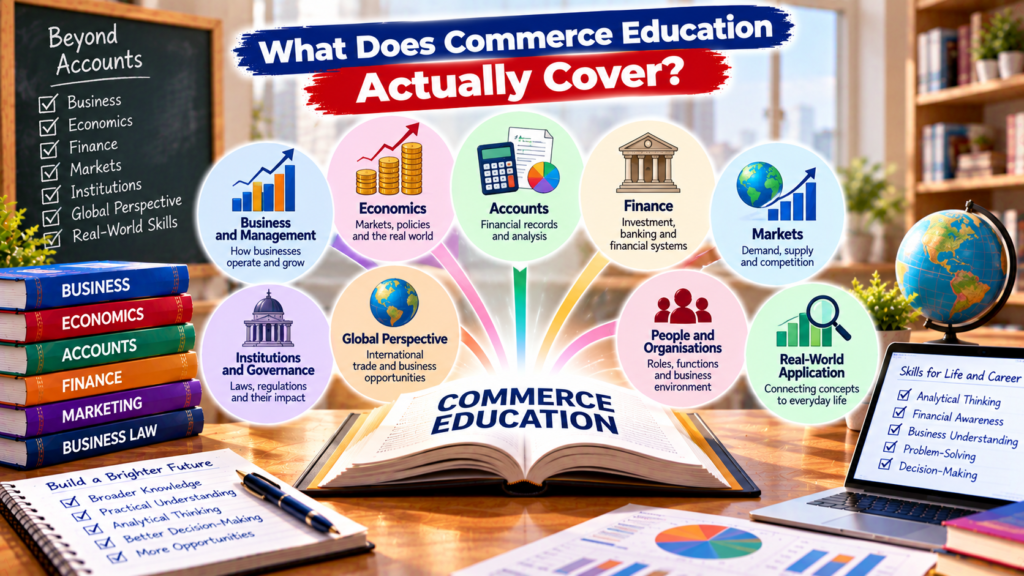
What Does Commerce Education Actually Cover?
Commerce education broadly deals with how businesses, markets, financial systems, organisations, and economic activities function. It can involve understanding how businesses are established, how money moves through organisations, how markets respond to changes, and how economic decisions affect individuals and businesses.
At the Intermediate level, students begin developing the foundations for understanding these areas. The exact subjects differ between MEC, CEC, and ACE, but all three can provide exposure to concepts connected with business and economics. This foundation can later be useful when students explore professional courses, undergraduate programmes, or entrance pathways.
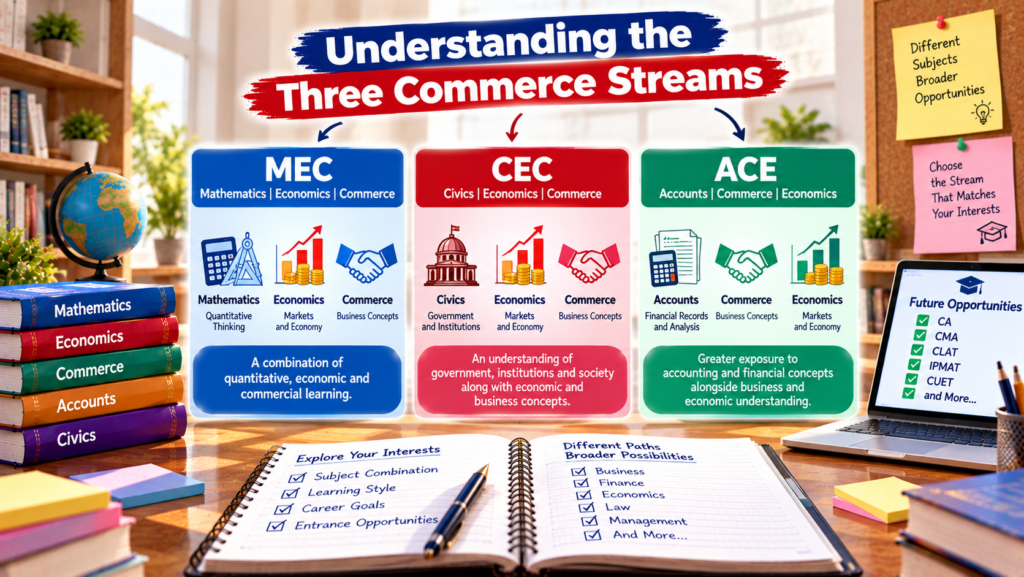
Understanding the Three Commerce Streams
The different Intermediate combinations allow students to approach commerce from different academic directions.
MEC includes Mathematics, Economics, and Commerce, creating a combination of quantitative, economic, and commercial learning.
CEC includes Civics, Economics, and Commerce, adding an understanding of government, institutions, and society to economic and business concepts.
ACE includes Accounts, Commerce, and Economics, providing greater exposure to accounting and financial concepts alongside business and economic understanding.
These differences mean that commerce education does not follow a single path. Students can choose a combination that aligns with their interests and the areas they may want to explore after Intermediate.
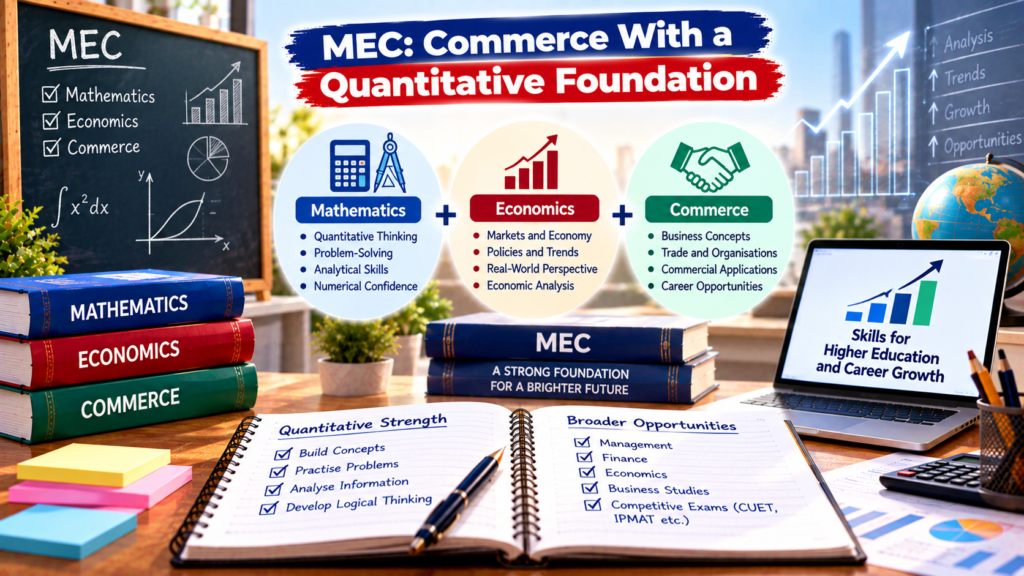
MEC: Commerce With a Quantitative Foundation
MEC can be suitable for students who enjoy Mathematics while also being interested in economics and business. Mathematics encourages structured problem-solving and quantitative reasoning, while Economics and Commerce introduce students to markets, business activities, and commercial concepts.
This combination can be useful for students who are considering areas such as management, finance, economics, business, and professional courses. It can also support students preparing for aptitude-based entrance examinations where quantitative ability is relevant.
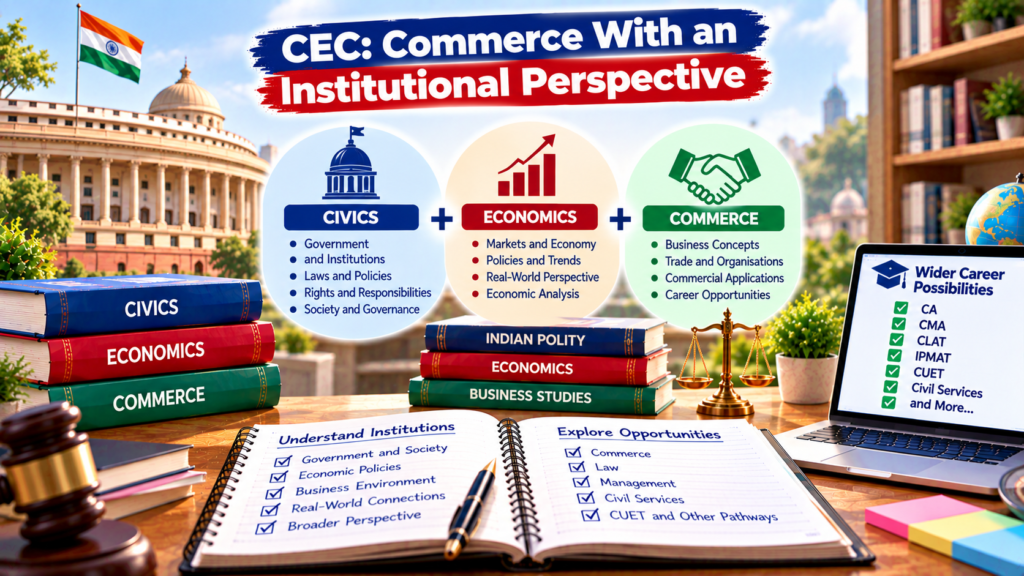
CEC: Commerce With an Institutional Perspective
CEC combines Civics, Economics, and Commerce. This gives students an opportunity to understand business and economic concepts while also learning about government, institutions, governance, and society.
The combination can be particularly interesting for students who want to explore areas such as law, civil services, management, commerce, economics, and social sciences. Civics can encourage students to understand how institutions function, while Economics and Commerce help them examine economic and business activities.

ACE: Commerce With Strong Financial Exposure
ACE combines Accounts, Commerce, and Economics. Students studying ACE get exposure to accounting principles as well as business and economic concepts.
Accounts can develop accuracy and systematic thinking, Commerce can provide an understanding of business activities, and Economics can help students understand broader economic relationships. This combination can be relevant for students interested in areas such as CA, CMA, accounting, finance, banking, business, and related undergraduate programmes.
Accounts Is One Part of Commerce
Accounts is undoubtedly an important component of commerce education, particularly for students studying ACE. However, understanding financial records is only one part of understanding how an organisation works.
A business also needs to understand customers, markets, costs, employees, competition, regulations, economic conditions, and future opportunities. This is why Commerce, Economics, Mathematics, and Civics can all contribute to a broader understanding of the environment in which businesses operate.
Economics Helps Students Understand Markets
Economics is an important part of MEC, CEC, and ACE. It helps students understand concepts such as demand, supply, production, markets, inflation, employment, resources, and economic growth.
These concepts are not limited to textbooks. They can be observed in everyday life. Changes in prices, consumer behaviour, business decisions, government policies, and employment conditions can all be connected to economic ideas. Learning Economics can therefore help students understand why certain changes occur and how they can affect businesses and society.
Commerce Helps Students Understand Businesses
Commerce introduces students to the structure and functioning of business activities. Students can begin understanding how businesses operate, how commercial transactions take place, and how different activities contribute to an organisation.
This knowledge can provide useful context for future studies in business administration, management, finance, accounting, corporate law, and other related areas. It can also help students understand how theoretical concepts are applied in real organisations.
Mathematics Builds Analytical Ability
For MEC students, Mathematics adds a strong quantitative component to commerce education. It encourages students to analyse information, identify relationships, apply formulas, and solve problems systematically.
These skills can be useful beyond Mathematics itself. Quantitative reasoning is relevant in areas such as finance, economics, business analytics, management, and several competitive entrance examinations. Developing mathematical confidence can therefore expand the types of academic pathways students may consider.
Civics Connects Commerce With Society
CEC introduces Civics alongside Economics and Commerce. This helps students understand that businesses do not operate independently of society and government.
Businesses function within legal, regulatory, and institutional frameworks. Government decisions can influence industries, markets, taxation, employment, and commercial activity. Understanding institutions can therefore help students develop a broader view of how business and society interact.
Commerce Can Develop Financial Awareness
Commerce education can help students become more comfortable with financial concepts. Understanding income, expenditure, savings, investment, business costs, revenue, and financial decisions can be useful in both academic and everyday contexts.
Financial awareness is valuable regardless of the specific career a student eventually chooses. Students can gradually learn to interpret financial information and understand the role that financial decisions play in organisations and individual lives.
Commerce Can Develop Decision-Making Skills
Business and economic situations often involve choices between different alternatives. Students may encounter examples where businesses have to decide how to use limited resources, respond to changes in demand, manage costs, or enter new markets.
Studying these situations can encourage students to compare alternatives, examine available information, and think about possible outcomes. These habits can contribute to broader decision-making and analytical skills.
Commerce and CA Preparation
Students interested in Chartered Accountancy can find relevant academic foundations within commerce-oriented Intermediate education. ACE provides exposure to Accounts, Commerce, and Economics, while MEC and CEC also include Commerce and Economics.
However, CA preparation involves a separate professional curriculum and examination structure. Students need to follow the applicable CA requirements in addition to their Intermediate education. Their commerce background can nevertheless help them become familiar with business, accounting, and economic concepts.
Commerce and CMA Preparation
CMA focuses on areas connected with cost management, accounting, finance, and business decision-making. Students from MEC, CEC, and ACE can explore CMA depending on their interests and eligibility.
ACE students may find the accounting component particularly familiar, while MEC students can bring quantitative and economic understanding into their preparation. CEC students also have a foundation in Economics and Commerce that can support their broader business understanding.
Commerce and Management Education
Management education requires an understanding of how different parts of an organisation work together. Marketing, finance, operations, human resources, strategy, and business analytics are all connected to the broader world of commerce and business.
MEC, CEC, and ACE can each provide useful foundations for students considering management education. Students can further develop communication, analytical thinking, quantitative ability, reading, and problem-solving skills as they progress.
Commerce and Law
Commerce can also provide useful background for students considering law. Modern legal practice includes areas such as corporate law, taxation, banking, contracts, competition law, financial regulation, and business compliance.
Students from CEC may have additional exposure to Civics and institutions, while MEC and ACE students can develop economic, commercial, and financial understanding. Students interested in CLAT can complement their Intermediate education with dedicated preparation in areas such as legal reasoning, logical reasoning, English, current affairs, and quantitative techniques.
Commerce and CUET
Students from MEC, CEC, and ACE can also explore undergraduate programmes through entrance routes such as CUET, depending on the specific programme and university requirements.
The subjects required for CUET can vary according to the programme being targeted. Students should therefore check the latest official requirements before planning their subject combination and entrance preparation. A strong Intermediate foundation can provide useful preparation where the academic content overlaps.
Commerce Education and Real-World Learning
One of the advantages of studying commerce-related subjects is that many concepts can be connected to everyday situations. Students can observe businesses in their local area, compare prices, follow economic developments, understand advertisements, examine how products are marketed, or observe how businesses respond to customer demand.
These observations can make classroom concepts easier to understand. Instead of treating Commerce and Economics as subjects that exist only for examinations, students can begin seeing how the concepts appear in everyday economic and business activities.
Skills Beyond Textbook Knowledge
Commerce education can help students develop skills that extend beyond subject-specific knowledge. Depending on their stream and learning approach, students can work on:
- Analytical thinking
- Numerical reasoning
- Financial awareness
- Business understanding
- Economic awareness
- Problem-solving
- Communication
- Decision-making
- Reading and interpretation
- Attention to detail
These skills can be useful across multiple higher-education and professional pathways.
Why Stream Choice Should Depend on Student Interests
There is no single commerce stream that is suitable for every student. MEC, CEC, and ACE have different subject combinations, and students should consider what they enjoy studying and which areas they may want to explore after Intermediate.
A student who enjoys Mathematics and business concepts may be interested in MEC. A student who is curious about government, society, Economics, and Commerce may consider CEC. A student who enjoys Accounts, business, and Economics may find ACE interesting.
Students should also consider the eligibility requirements of the higher-education programmes they may want to pursue. Future goals can change, so developing a strong academic foundation is often more useful than choosing a stream based only on a particular job title.
Building Professional Skills Alongside Intermediate
Students can begin developing useful professional skills during Intermediate itself. Presentations, group discussions, reading, problem-solving, basic financial awareness, and following business and economic developments can all contribute to broader learning.
Students preparing for CA, CMA, CLAT, IPMAT, or CUET can also gradually develop examination-specific skills alongside their regular Intermediate studies. The key is to maintain a realistic balance rather than treating every preparation goal as a completely separate workload.
How CMS Brings Different Commerce Pathways Together
At CMS, commerce-oriented Intermediate education is offered through streams such as MEC Coaching in Hyderabad, CEC Coaching in Hyderabad, and ACE, with integrated preparation options for pathways including CA, CMA, CLAT, IPMAT, and CUET. This allows students to continue their Intermediate education while developing knowledge and skills connected to the professional or entrance pathway they may want to explore.
The integrated approach can help students understand the connection between their Intermediate subjects and future academic opportunities. Instead of viewing Commerce as only an Accounts-focused education, students can explore the wider areas of mathematics, economics, business, finance, institutions, reasoning, and entrance preparation.
Conclusion
Commerce education is much broader than learning how to prepare accounts or record financial transactions. Through MEC, CEC, and ACE, students can explore different aspects of Mathematics, Economics, Commerce, Accounts, Civics, business, finance, and society.
The skills developed through these streams can provide foundations for several future directions, including CA, CMA, law, management, finance, business, and undergraduate programmes through CUET, subject to the relevant eligibility requirements. The real value of commerce education lies in helping students understand how numbers, businesses, markets, institutions, and economic decisions connect with one another.
For Intermediate students, MEC, CEC, and ACE can therefore be viewed not simply as subject combinations, but as different ways of building a foundation for higher education and a wide range of professional possibilities.