
Introduction
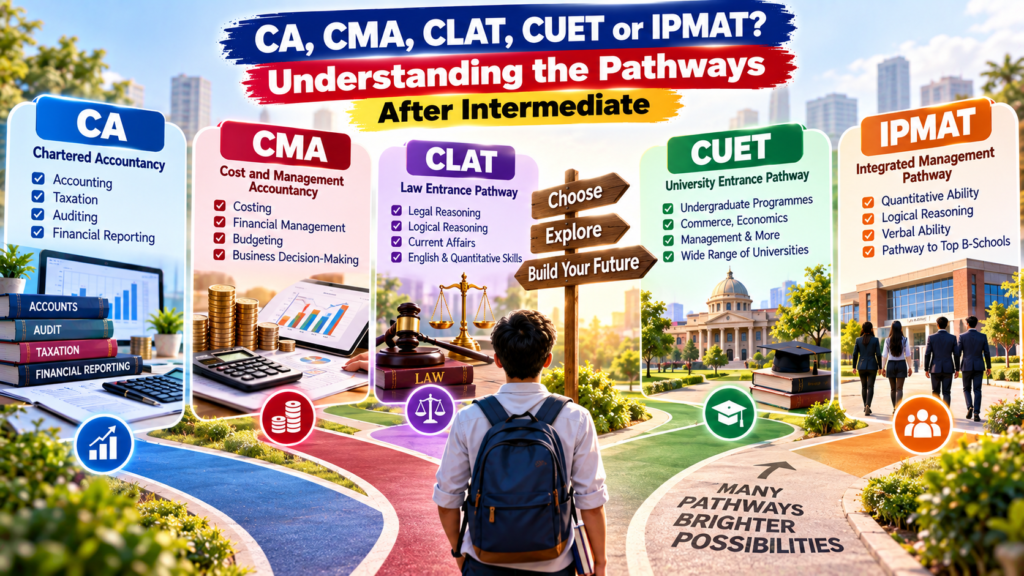
Completing Intermediate is an important stage for students because it is often the point where academic learning begins to connect with a specific career direction. For students from commerce-oriented streams such as MEC, CEC and ACE, the options after Intermediate are much broader than a single traditional career path. Students can explore professional courses, university entrance examinations, management programmes and law, depending on their interests, strengths and long-term goals.
CA, CMA, CLAT, CUET and IPMAT are some of the pathways that commerce students may consider. Although these options can sometimes appear similar because they all involve competitive preparation and further education, each one serves a different purpose. Understanding what each pathway leads to can help students make a more informed decision about what they want to pursue after Intermediate.
Understanding the CA Pathway After Intermediate
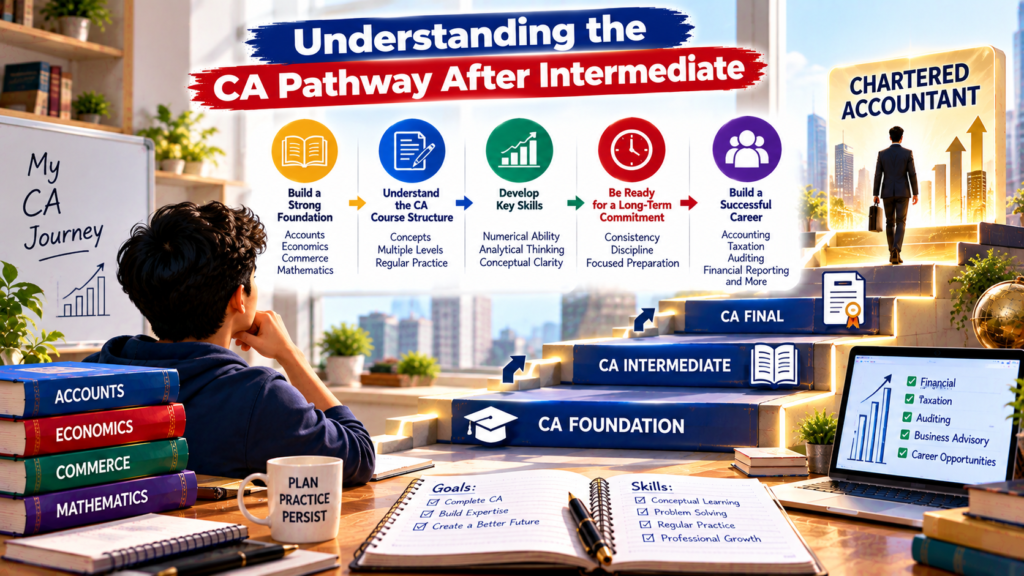
Chartered Accountancy is a professional career path focused strongly on accounting, taxation, auditing, financial reporting and related areas of finance. Students interested in understanding how organisations manage their finances, maintain financial records and comply with financial regulations may find the CA pathway relevant to their interests. The course also requires students to develop conceptual understanding, numerical ability and consistent study habits.
For an Intermediate student, CA preparation can be approached as a gradual process rather than something that begins only after completing Intermediate. Building a strong foundation in Accounts, Economics, Mathematics and business-related concepts can make later professional-level learning easier. Students should also understand that CA requires long-term commitment, regular practice and the ability to work through detailed concepts systematically.
Understanding the CMA Pathway After Intermediate
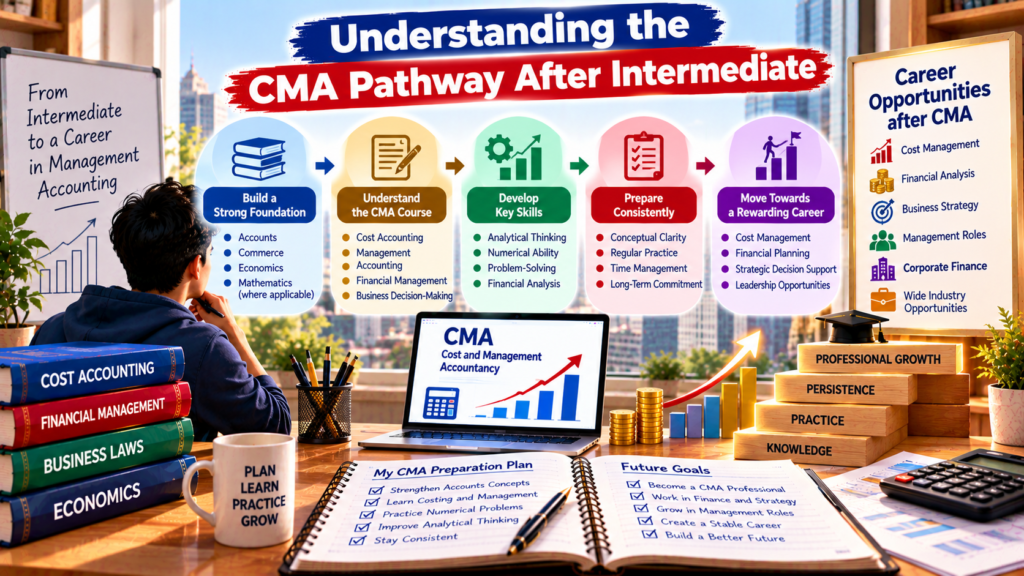
The Cost and Management Accountancy pathway is another professional option for students interested in finance and business. While accounting knowledge is important, the CMA profession also involves areas such as costing, budgeting, financial management, performance analysis and business decision-making. This makes it relevant for students who are interested not only in recording financial information but also in understanding how financial information can support organisational decisions.
Students considering CMA can begin developing useful foundations during Intermediate by strengthening their understanding of Accounts, Economics, Commerce and Mathematics where applicable. Analytical thinking and numerical confidence can be particularly useful because management accounting involves interpreting information and using it to understand costs, efficiency and financial performance.
CLAT: Exploring a Pathway Towards Law
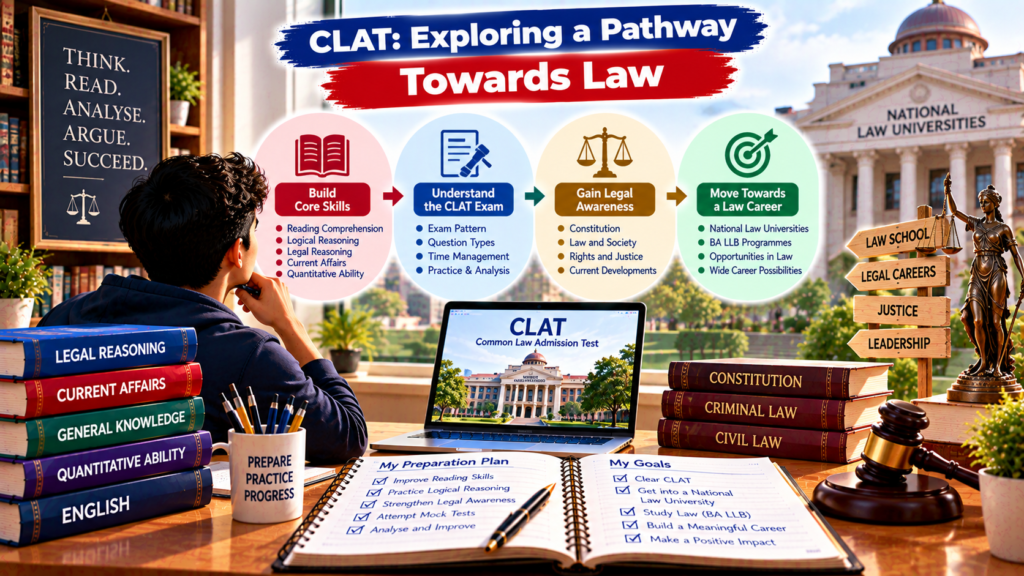
Students interested in law can consider the Common Law Admission Test, commonly known as CLAT, for admission to participating National Law Universities. Unlike CA and CMA, CLAT is not itself a professional qualification. It is an entrance examination that can provide a pathway into undergraduate law programmes.
Preparation for law entrance examinations requires a different combination of skills. Reading comprehension, logical reasoning, legal reasoning, awareness of current affairs and quantitative ability all play a role. Students from CEC may find their exposure to civics and social institutions useful, while students from MEC and ACE can also develop relevant analytical, economic and commercial perspectives. However, any student can build the required skills through structured preparation.
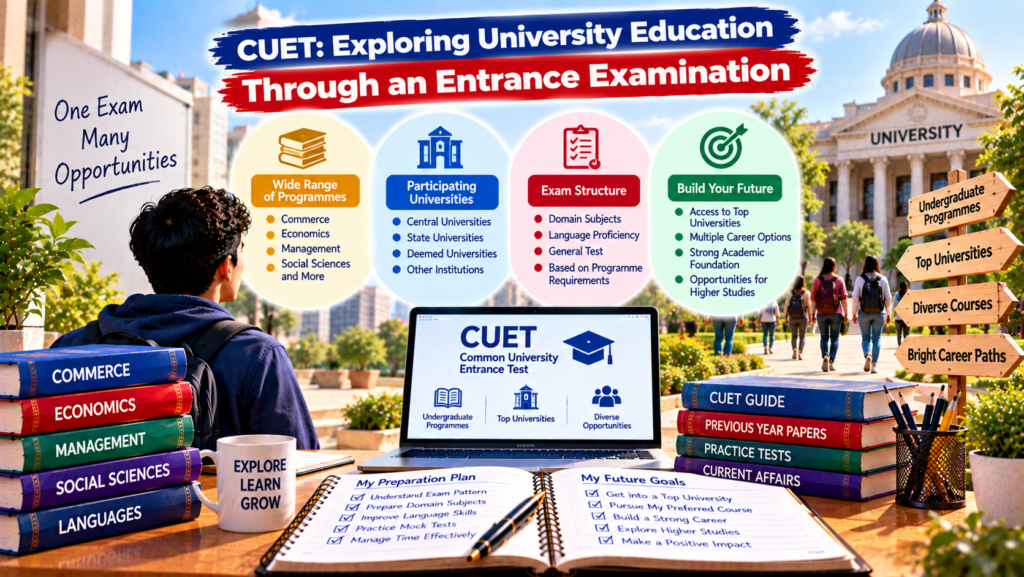
CUET: Exploring University Education Through an Entrance Examination
The Common University Entrance Test, or CUET, provides students with another route to undergraduate education. Unlike CA, CMA or CLAT, CUET is not a professional course or a career by itself. It is an entrance examination used by participating universities and programmes, with eligibility and subject requirements varying according to the institution and course.
For MEC, CEC and ACE students, CUET can be relevant when exploring undergraduate programmes in areas such as commerce, economics, management and other disciplines. Preparation therefore needs to be connected to the student’s intended university programme and its applicable subject requirements. Students should always check the current requirements of the universities and programmes they intend to apply for before finalising their CUET subject choices.
IPMAT: A Pathway Towards Integrated Management Education
Students who are interested in business, management and organisational decision-making can explore the Integrated Programme in Management Admission Test, or IPMAT, conducted by participating institutions. IPMAT can provide a pathway to integrated management programmes that combine undergraduate and management-level education.
The preparation approach for management entrance examinations can differ from that of professional courses. Students may need to work on quantitative ability, logical reasoning, verbal ability, reading comprehension and time management. MEC students may find their mathematical background useful for quantitative preparation, while students from CEC and ACE can also build the required abilities through regular practice in mathematics, reasoning and language-based questions.
How These Pathways Differ From Each Other
One of the easiest ways to understand these options is to look at what the student is ultimately preparing for. CA and CMA are professional pathways connected strongly with accounting, finance and business. CLAT is an entrance route towards legal education, while CUET can provide access to a range of undergraduate programmes. IPMAT is associated with admission to integrated management programmes.
The preparation style also differs. CA and CMA require sustained conceptual learning and professional-course preparation, while CLAT and IPMAT involve entrance-examination-oriented skills and timed practice. CUET preparation depends heavily on the student’s selected subjects and intended university programme. Therefore, students should not choose an option simply because it is popular; they should first understand the nature of the course, the examination requirements and the kind of work associated with the eventual career.
How MEC, CEC and ACE Students Can Explore These Options
MEC, CEC and ACE provide different combinations of subjects and therefore expose students to different academic skills. MEC combines Mathematics, Economics and Commerce, giving students opportunities to develop numerical reasoning, economic understanding and business awareness. CEC combines Civics, Economics and Commerce, providing exposure to institutions, society, economics and commerce. ACE combines Accounts, Commerce and Economics, creating a foundation around financial concepts, business and economic understanding.
These foundations can connect with different future pathways, but no stream automatically limits a student’s career choices. A student’s interests, aptitude, preparation and willingness to develop additional skills all matter. For example, a student interested in management may explore IPMAT, a student interested in law may prepare for CLAT, while another student interested in accounting and finance may consider CA or CMA. CUET can provide another route for students who want to pursue a suitable undergraduate programme through university admissions.
Why Early Preparation Can Make the Transition Easier
Starting to understand career options during Intermediate can help students avoid making decisions at the last moment. Early awareness allows students to identify the subjects and skills they need, understand examination patterns and gradually develop habits such as reading, problem-solving, revision and practice. It also gives students time to explore alternatives before committing to a particular pathway.
Early preparation does not necessarily mean preparing intensively for every examination at the same time. Instead, students can build common foundational skills first and then gradually focus on the pathway that matches their interests. Reading comprehension, analytical thinking, quantitative ability, communication and time management can support preparation across several options, even though each examination eventually requires its own focused strategy.
How CMS Connects Intermediate Learning With Future Pathways
At CMS, students pursuing MEC, CEC Coaching in Hyderabad and ACE can explore integrated preparation options alongside their Intermediate education. Depending on their chosen direction, students can work towards pathways involving CA, CMA, CLAT, IPMAT and CUET while continuing their regular academic studies. This approach helps students understand how their Intermediate subjects can connect with future professional courses and entrance examinations.
The advantage of understanding these pathways early is that students can make academic decisions with greater clarity. Rather than treating Intermediate and future entrance or professional preparation as completely separate stages, students can gradually build relevant concepts and skills while completing their Intermediate education.
How to Decide Which Pathway to Explore
There is no single pathway that is suitable for every commerce student. A student who enjoys accounting, taxation and financial analysis may want to investigate CA, while someone interested in costing, financial management and business performance may explore CMA. A student fascinated by law, arguments and legal systems may consider CLAT, while students interested in university-level commerce, economics or other undergraduate programmes can explore CUET.
Students interested in business leadership, management and decision-making can investigate IPMAT and the integrated management route. Before choosing, it is useful to consider subjects the student genuinely enjoys, areas where they are willing to practise consistently, the nature of the examination and what the subsequent course or career involves. Talking to teachers, reviewing official course information and understanding the preparation requirements can make this exploration more meaningful.
Conclusion
CA, CMA, CLAT, CUET and IPMAT represent different educational and career pathways that Intermediate students can explore. Some lead towards professional qualifications, while others provide entry into undergraduate programmes or integrated management and law education. Understanding these differences is important because the right preparation strategy depends on the pathway a student eventually chooses.
For students from MEC, CEC and ACE, Intermediate can be a valuable foundation for exploring these possibilities. Instead of rushing into a decision, students can use their Intermediate years to understand their strengths, develop fundamental skills and learn about different career directions. With clearer awareness and consistent preparation, they can approach the transition from Intermediate to higher education or professional study with a more informed plan.