
Introduction
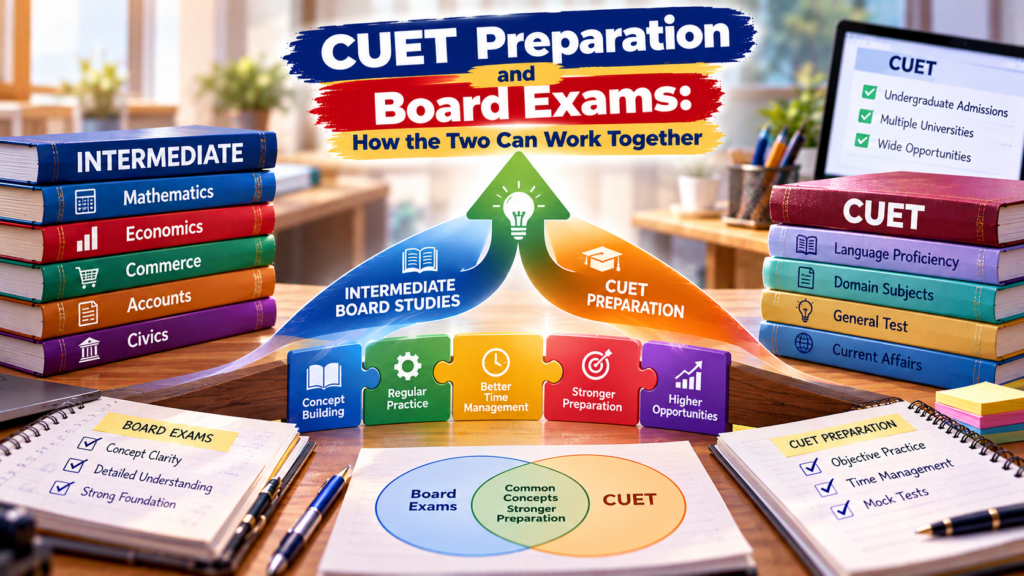
For Intermediate students, the final two years of school are an important period for building academic knowledge and preparing for higher education. Students from streams such as MEC, CEC, and ACE may also consider entrance examinations such as CUET for admission to undergraduate programmes. Managing Intermediate examinations and entrance preparation together may initially seem like two separate tasks, but with the right approach, students can often make their academic preparation work towards both goals.
Intermediate examinations and CUET may have different examination patterns and requirements, but there can also be areas of overlap. Concepts studied in Mathematics, Economics, Commerce, Accounts, and other relevant subjects can provide an academic foundation that students can revise and practise for entrance examinations as well. Instead of waiting until Intermediate examinations are over to begin CUET preparation, students can gradually build relevant skills alongside their regular studies.
Understanding the Role of Intermediate Studies
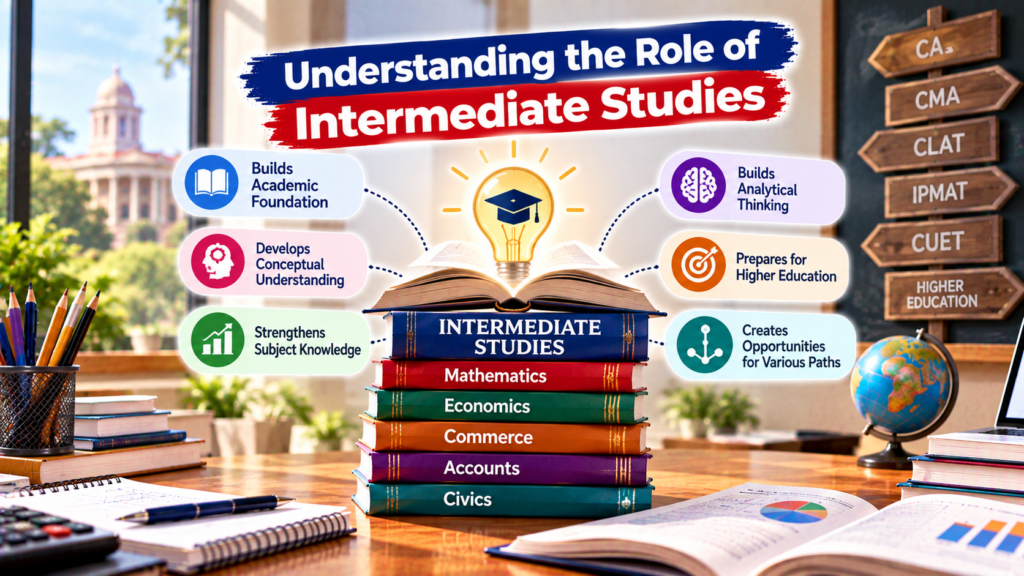
Intermediate provides the academic foundation on which students build their higher-education plans. MEC, CEC, and ACE students study subjects that can introduce them to mathematics, economics, commerce, accounts, and related areas.
A strong understanding of these subjects can make subsequent entrance preparation more manageable when the selected CUET programme requires or assesses related subjects. Students should first understand the eligibility and subject requirements of the undergraduate programmes they are interested in, because CUET requirements can vary depending on the university and programme.
Where Board Preparation and CUET Preparation Can Overlap
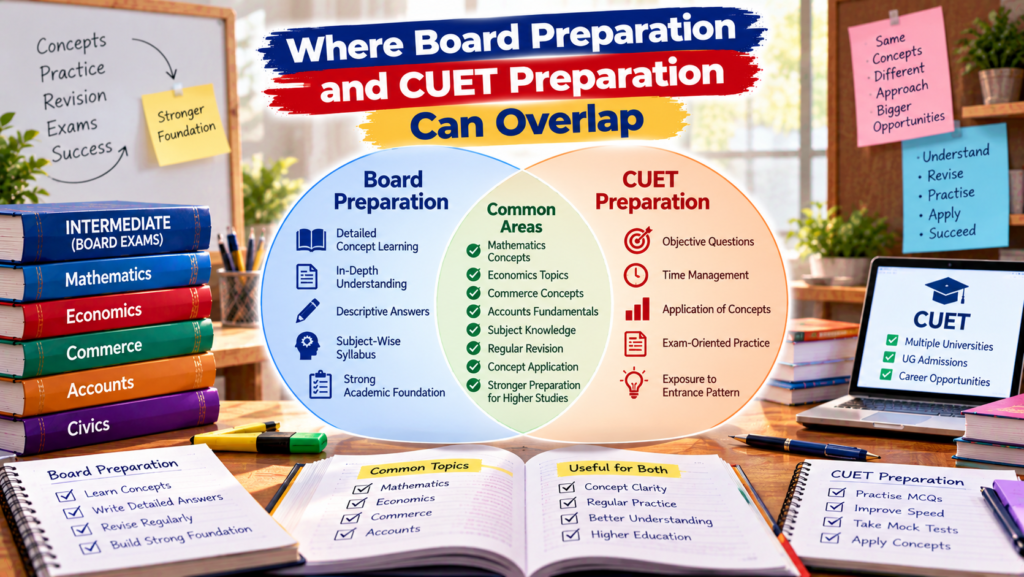
One of the biggest advantages of planning early is that students can identify areas where their Intermediate studies and CUET preparation overlap. Instead of studying the same concept twice using completely different methods, students can first understand the concept thoroughly through their regular academic preparation and then practise questions in the format required for CUET.
For example, an Economics concept studied for Intermediate can later be revised through objective questions. Similarly, Commerce or Accounts topics can be strengthened through regular revision before students practise entrance-oriented questions where applicable. This approach can reduce unnecessary duplication and make study time more productive.
MEC Students and CUET Preparation
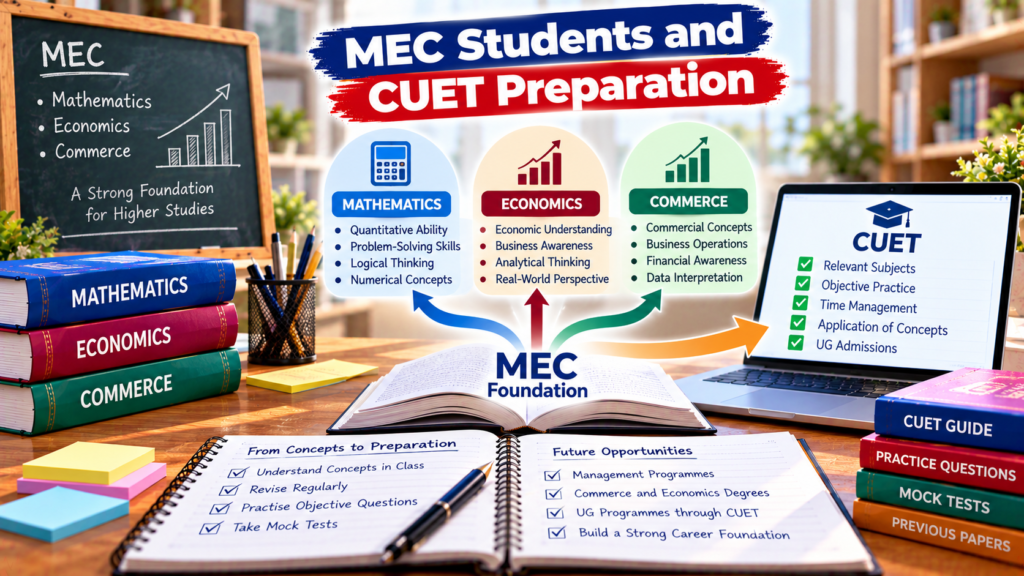
MEC students study Mathematics, Economics, and Commerce, giving them exposure to quantitative, economic, and commercial concepts. For students targeting undergraduate programmes where these subjects are relevant to CUET requirements, regular Intermediate preparation can provide an important knowledge base.
Students can gradually supplement their subject preparation with objective questions, timed practice, and revision based on the current CUET requirements for their chosen programme. Mathematics students, for example, can combine conceptual learning with regular problem-solving, while Economics and Commerce preparation can include both detailed understanding and objective-question practice.
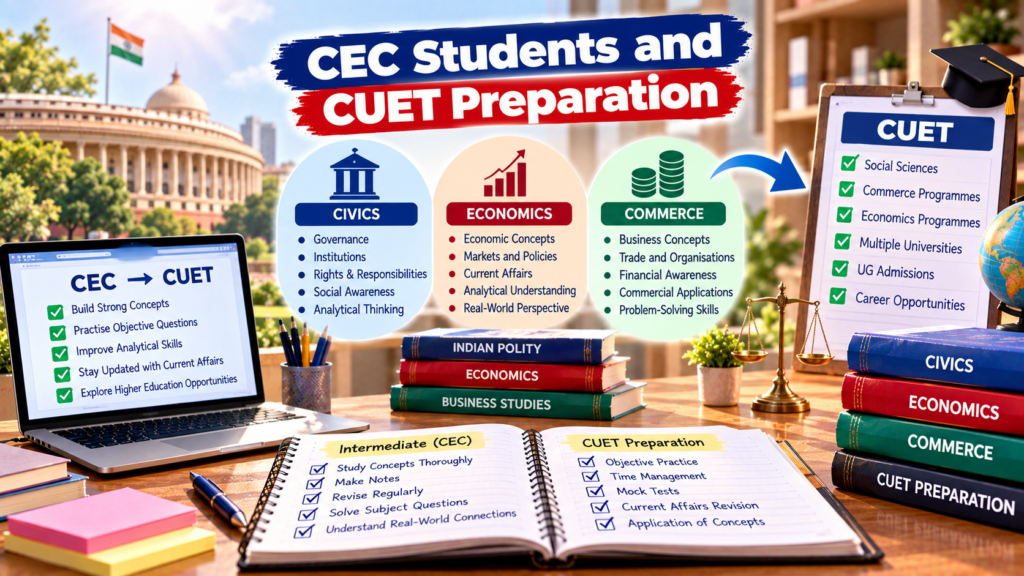
CEC Students and CUET Preparation
CEC students study Civics, Economics, and Commerce, giving them exposure to government and institutions along with economic and commercial concepts. These subjects can be relevant to students exploring undergraduate programmes in areas such as commerce, economics, social sciences, and related disciplines, depending on the specific university requirements.
Students can use their Intermediate preparation to build a strong understanding of the syllabus and then become familiar with the objective format and time constraints relevant to CUET. Regular revision can help students retain important concepts while practice questions can help them become comfortable applying that knowledge in an entrance-examination setting.
ACE Students and CUET Preparation
ACE, comprising Accounts, Commerce, and Economics, gives students a foundation in financial, commercial, and economic concepts. For students interested in undergraduate programmes connected with commerce, business, finance, economics, or related fields, these subjects can provide useful academic preparation, subject to the specific CUET and university requirements.
Students can first focus on understanding their Intermediate syllabus thoroughly. As CUET preparation progresses, they can add objective questions, timed exercises, revision tests, and mock examinations relevant to the subjects and programmes they have selected.
Build Concepts Before Focusing on Speed
Intermediate preparation generally requires students to understand topics in detail, while entrance examinations may place greater emphasis on answering questions accurately within a limited amount of time. This means students should not focus on speed before developing conceptual clarity.
A better approach is to understand a topic first, revise it regularly, and then gradually introduce timed practice. Once the fundamentals are strong, students can work on improving the speed at which they identify and answer questions.
Use Intermediate Revision as the First Layer of CUET Preparation
Students do not necessarily need to create a completely separate CUET timetable from the beginning. Regular revision of Intermediate subjects can serve as the first layer of preparation where the content overlaps.
After completing a topic, students can review the important concepts and then solve a small set of objective questions. This allows them to identify whether they can apply what they have learned rather than simply recall definitions or explanations from their textbook.
Understand the Difference in Question Approach
One important difference students may encounter is the way knowledge is tested. Intermediate examinations may include descriptive answers, explanations, step-by-step working, or longer responses depending on the subject and examination pattern. Entrance examinations generally require students to select the correct answer efficiently.
Students should therefore learn both approaches. They need enough conceptual understanding to explain a topic in their Intermediate examinations while also developing the ability to recognise and apply that knowledge quickly when solving objective questions.
Make a Weekly Study Plan
A weekly plan can help students divide their time between Intermediate academics and CUET preparation without making the schedule unnecessarily complicated.
Students can identify the Intermediate topics they need to complete during the week and then add short CUET-oriented practice sessions around them. For example, after completing a Commerce chapter, they may reserve a session for objective questions related to that topic. This creates a continuous connection between academic study and entrance preparation.
Increase CUET Practice Gradually
Students do not need to begin their preparation with full-length mock tests. During the earlier stages, topic-based practice can be more useful because it allows students to identify weaknesses while the concepts are still being learned.
As the examination approaches, students can gradually increase the number of mixed-topic tests and full-length mocks. This progression allows them to move from understanding concepts to applying them efficiently under examination conditions.
Give Greater Attention to Intermediate During Examination Periods
When Intermediate examinations are approaching, students may need to temporarily give greater attention to their academic syllabus. This does not mean abandoning CUET preparation completely.
Instead, students can maintain short revision or objective-practice sessions while concentrating primarily on their Intermediate examinations. Once the academic examination period is completed, they can increase the intensity of CUET-specific practice. This flexible approach can prevent students from feeling that they must maintain exactly the same study pattern throughout the year.
Use Short Practice Sessions Effectively
CUET preparation can be incorporated into smaller periods of available time. Students can use short sessions for vocabulary, formula revision, objective questions, current-affairs review where relevant, or quick topic tests.
These sessions should complement, not replace, focused study. Their purpose is to keep entrance preparation consistent while the majority of the student’s attention remains on building a strong academic foundation.
Practise With Time Limits
Once students become comfortable with individual topics, timed practice can help them understand how quickly they can solve questions. Time limits can also reveal which topics require additional revision.
Students should review their performance after every timed session. If a student answers quickly but makes several mistakes, accuracy may need more attention. If accuracy is high but the student takes too long, additional timed practice may be useful.
Use Mock Tests as a Progress Check
Mock tests can bring together different topics and provide students with an opportunity to practise examination conditions. They can also help students identify areas where their Intermediate understanding needs additional reinforcement.
A useful mock-test routine includes more than simply checking the score. Students can examine incorrect answers, identify the reason for each mistake, and revise the underlying concept. This makes the mock test a learning tool rather than simply a measure of performance.
Avoid Studying Two Completely Separate Syllabuses
One common source of stress is treating Intermediate and CUET as completely unrelated preparation programmes. Where the subjects overlap, students can use their academic preparation as a foundation and then adapt it to the entrance-examination format.
This does not mean that Intermediate preparation alone is automatically sufficient for CUET. Students still need to understand the current CUET pattern, subject requirements, question format, and other applicable conditions for the programmes they are targeting. The aim is simply to avoid unnecessary duplication wherever meaningful overlap exists.
Keep Track of the Current CUET Requirements
CUET requirements can differ depending on the undergraduate programme and university. Students should therefore identify their preferred courses and check the latest official eligibility and subject requirements before finalising their preparation plan.
This is particularly important for MEC, CEC, and ACE students because the subjects they choose and the undergraduate programmes they target may differ. Planning based on the actual requirements can help students spend their preparation time more effectively.
How CMS Can Support an Integrated Approach
For students who want to prepare for Intermediate examinations and entrance examinations together, a structured learning environment can make the process easier to organise. CMS offers MEC, CEC, and ACE programmes with integrated preparation options for CUET Coaching in Hyderabad and other pathways such as CA, CMA, CLAT, and IPMAT. This approach allows students to continue building their Intermediate subject knowledge while also developing examination-specific skills through practice, revision, assessments, and guidance.
The benefit of an integrated approach is that students can gradually connect what they learn in Intermediate with the requirements of their chosen entrance pathway. Rather than postponing all entrance preparation until the end of Intermediate, students can build familiarity with the relevant question formats and study habits over time.
Avoid Last-Minute Preparation
Waiting until Intermediate examinations are over to begin CUET preparation may leave students with limited time to become familiar with the entrance-examination format. Starting gradually allows students to develop familiarity without creating excessive pressure during the final stage.
Even a small amount of consistent preparation can make a difference to familiarity with objective questions, time management, revision, and mock-test practice. The intensity can then be increased as the examination approaches.
Maintain a Balanced Routine
Students preparing for both Intermediate and CUET should also make time for adequate sleep, breaks, physical activity, and personal responsibilities. A routine that is impossible to maintain for several months is unlikely to be useful in the long term.
Consistency is more important than creating an extremely demanding schedule for a few days. Students can aim for regular study sessions, weekly revision, periodic testing, and gradual improvement rather than trying to complete everything at once.
Conclusion
Intermediate examinations and CUET preparation do not necessarily have to be treated as two completely separate academic journeys. For students from MEC, CEC, and ACE, there can be useful overlap between their Intermediate subjects and the knowledge required for relevant undergraduate entrance pathways. Strong conceptual understanding can form the foundation, while objective practice, timed exercises, and mock tests can help students adapt that knowledge to an entrance-examination format.
The key is to start with a realistic plan, understand the current CUET requirements for the intended programme, and gradually build entrance-specific practice alongside Intermediate studies. With consistent revision and a flexible approach, students can work towards their Intermediate academic goals while also preparing for the next step in their higher-education journey.