
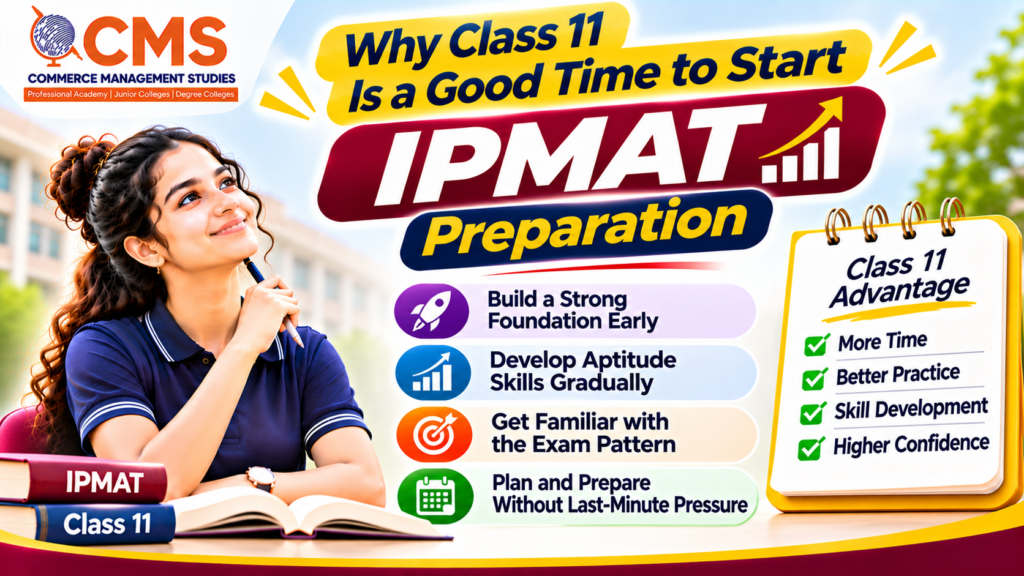
Why Class 11 Is a Good Time to Start IPMAT Preparation
Class 11 is an important stage for students who plan to pursue management education after Intermediate. Students interested in the Integrated Program in Management Aptitude Test (IPMAT) can use this time to understand the examination, develop essential academic skills and establish a consistent preparation routine. Starting during Class 11 allows students to become familiar with the entrance examination gradually instead of trying to cover everything during their final year of Intermediate.
For MEC students, preparing for IPMAT alongside Intermediate can provide an opportunity to strengthen mathematical understanding, reading comprehension and analytical thinking. These skills are useful for approaching different types of aptitude questions. Students can begin with the fundamentals, identify their strengths and gradually increase the level of practice while continuing to focus on their regular academic subjects.
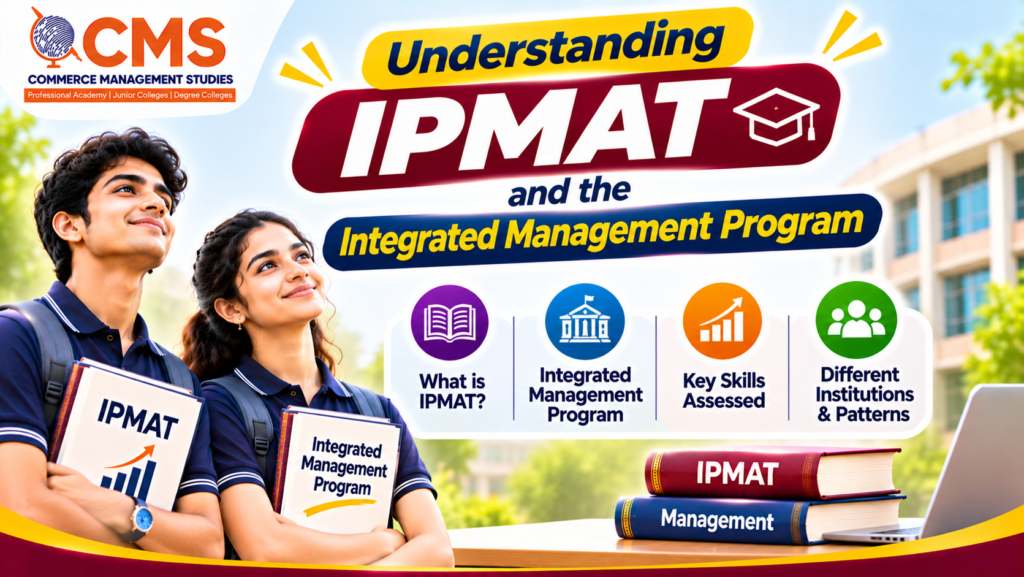
Understanding IPMAT and the Integrated Management Program
IPMAT is associated with admission to integrated management programs offered by institutions such as the Indian Institutes of Management. These programs provide an opportunity for students to pursue management education through a structured undergraduate-to-postgraduate pathway. The entrance examination is designed to assess abilities such as quantitative aptitude, verbal ability and other skills specified by the respective institution.
Students should understand that IPMAT is not a single identical examination conducted with the same pattern by every institution. The examination structure, eligibility requirements, selection process and admission criteria can differ. Therefore, students preparing during Class 11 should first identify the institutions they are interested in and review their official admission information.
Understanding the purpose of IPMAT helps students plan their preparation more effectively. Instead of focusing only on solving questions, they can work on developing the academic skills required for the examination and gradually become familiar with the admission process.
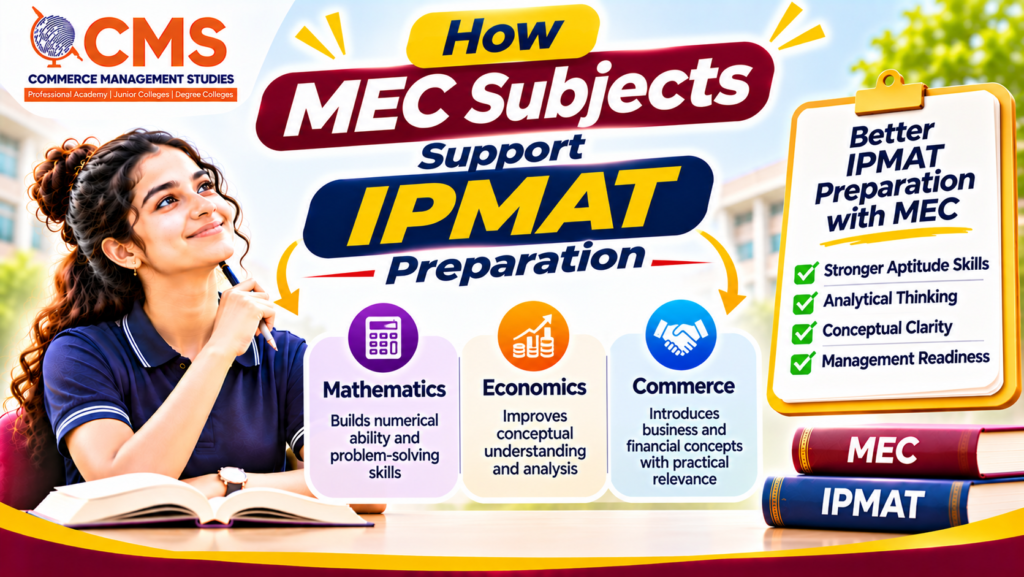
How MEC Subjects Support IPMAT Preparation
MEC Intermediate includes Mathematics, Economics and Commerce. These subjects help students develop academic knowledge and learning habits that can support their preparation for management entrance examinations. While MEC does not replace IPMAT-specific preparation, students can use their Intermediate learning as a foundation for building relevant skills.
Mathematics is particularly useful for strengthening numerical understanding and problem-solving ability. Economics encourages students to understand concepts, interpret information and analyse different situations. Commerce introduces students to business-related concepts and helps them become familiar with financial and commercial terminology.
Students should connect their Intermediate learning with aptitude practice wherever appropriate. This does not mean that every MEC chapter is directly tested in IPMAT. The entrance examination has its own syllabus and question formats, which students should study separately.
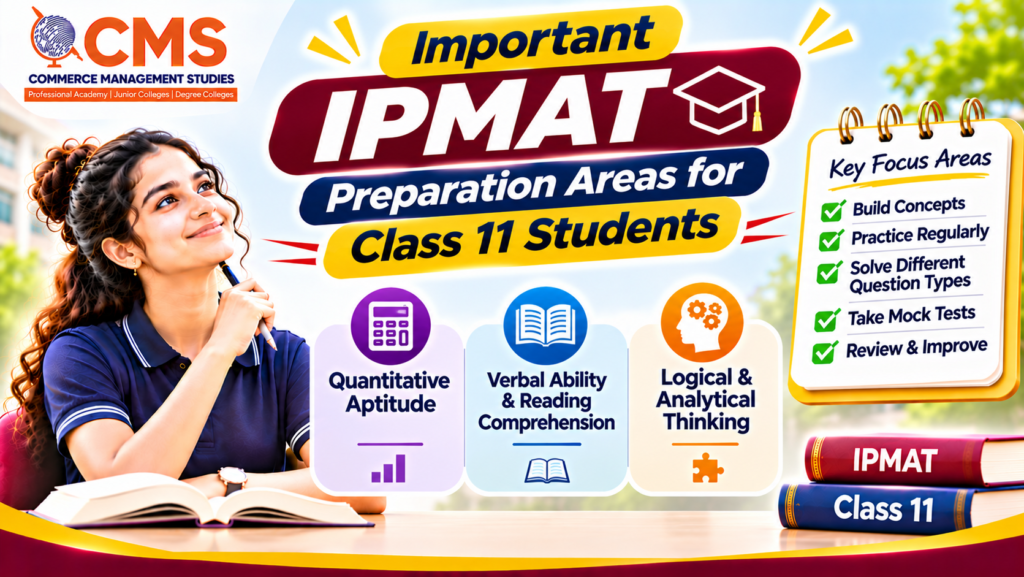
Important IPMAT Preparation Areas for Class 11 Students
IPMAT preparation generally involves developing quantitative and verbal skills, although the exact sections and question formats depend on the institution and examination year. Class 11 students can begin by understanding the commonly tested areas and practising questions at an appropriate level.
1. Quantitative Aptitude
Quantitative Aptitude is an important preparation area for students interested in management entrance examinations. It involves mathematical understanding, numerical reasoning and the ability to solve problems accurately. MEC students can use their Mathematics learning to strengthen their fundamentals and gradually develop the ability to solve aptitude-based questions.
Students should begin with basic concepts before moving towards more challenging problems. Understanding the method behind a question is more useful than memorising shortcuts without knowing when to apply them.
Important areas to practise include:
- Percentages and ratios
- Averages and basic arithmetic
- Profit, loss and related calculations
- Algebra and equations
- Number-based problems
- Data interpretation
- Time-based problem-solving questions
Regular practice helps students become familiar with different question formats. They should also review incorrect answers to understand whether the difficulty came from a concept, calculation or problem-solving approach.
2. Verbal Ability and Reading Comprehension
Verbal Ability evaluates how effectively students understand written information, interpret passages and use language. Reading comprehension is particularly important because students need to identify the main idea, understand arguments and draw conclusions from written material.
Class 11 students can improve these skills by reading regularly and practising questions based on unfamiliar passages. Reading different types of articles also helps students become comfortable with varied vocabulary, sentence structures and writing styles.
Useful preparation activities include:
- Reading informative articles and editorials
- Practising passage-based questions
- Identifying the main idea of a passage
- Understanding vocabulary through context
- Recognising arguments and supporting details
- Summarising what they have read
Students should focus on understanding the passage rather than reading quickly without comprehension. Consistent reading and question practice can gradually improve accuracy and confidence.
3. Logical and Analytical Thinking
Logical and analytical thinking helps students understand relationships between information, identify patterns and evaluate possible answers. These abilities can support aptitude preparation and improve the way students approach unfamiliar questions.
Students can develop these skills through reasoning exercises, numerical problems and activities that require them to compare information. They should practise identifying the conditions given in a question and understanding how those conditions influence the answer.
Useful practice activities include:
- Identifying patterns and relationships
- Solving reasoning-based questions
- Comparing different statements
- Analysing information presented in a problem
- Explaining the steps used to reach an answer
Students should avoid rushing through reasoning questions. Understanding why an answer is correct helps them develop a more reliable approach to solving similar problems.
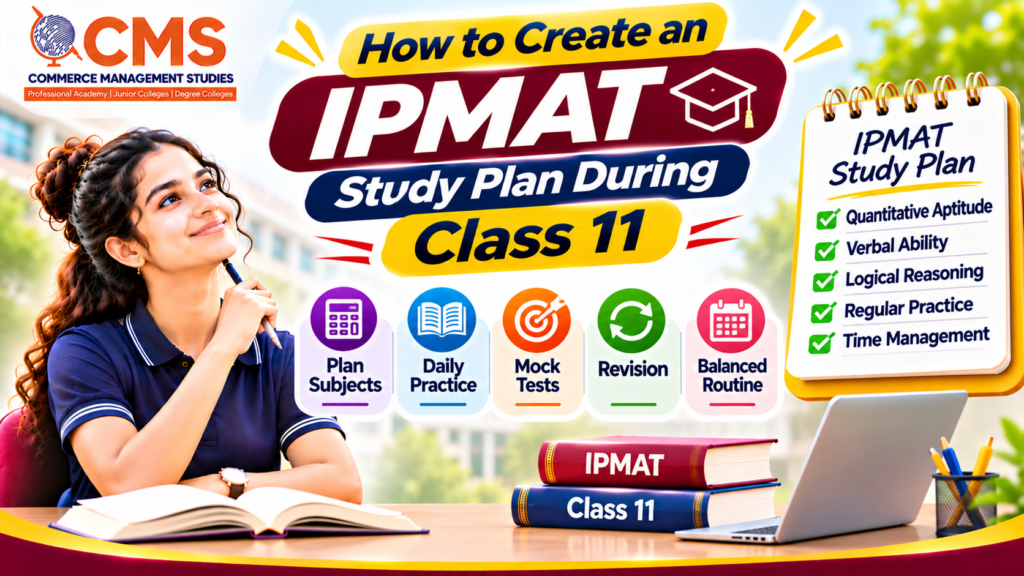
How to Create an IPMAT Study Plan During Class 11
A study plan helps students organise their preparation and maintain a balance between MEC subjects and entrance examination practice. Since Class 11 introduces students to new academic concepts, the preparation schedule should be realistic and flexible.
Students do not need to spend every available hour preparing for IPMAT. Instead, they should establish a routine that includes regular Intermediate study, aptitude practice, reading and revision.
A practical study plan can include the following activities:
- Mathematics: Revise MEC concepts and practise related quantitative aptitude questions.
- Verbal Ability: Read passages, learn vocabulary through context and practise comprehension.
- Reasoning: Solve analytical questions and review the steps used.
- Revision: Revisit topics that were difficult during practice.
- Practice tests: Attempt short tests to understand question formats and improve accuracy.
- Academic study: Maintain sufficient time for MEC assignments, examinations and classroom learning.
Students should adjust their preparation according to their academic schedule. During school or college examinations, Intermediate subjects may require greater attention. During comparatively lighter academic periods, students can increase their entrance examination practice.
Balancing MEC Intermediate and IPMAT Preparation
Balancing Intermediate studies and entrance examination preparation is an important consideration for students beginning IPMAT during Class 11. Both require regular effort, but students should avoid creating a schedule that becomes difficult to maintain.
MEC subjects provide the foundation for Intermediate examinations, while IPMAT preparation involves additional aptitude practice. Students should organise their time so that entrance preparation supports their academic development rather than interfering with their board-related responsibilities.
A balanced approach includes:
- Completing Intermediate assignments on time.
- Revising Mathematics concepts before practising related aptitude questions.
- Setting specific goals for reading and question practice.
- Avoiding excessive practice when academic examinations are approaching.
- Reviewing weekly progress and adjusting the study schedule.
- Maintaining regular breaks and sufficient rest.
Students should also understand that preparation does not need to be identical every day. Some days may be more suitable for Mathematics practice, while others may provide more time for reading comprehension or revision.
The Importance of Practice and Mock Tests
Practice is an important part of IPMAT preparation because it helps students become familiar with different question formats and identify areas that require improvement. During Class 11, students can begin with topic-wise exercises and gradually move towards timed practice.
Mock tests become more useful when students analyse their performance after completing them. Simply checking the score does not explain why certain questions were answered incorrectly. Students should review their mistakes and identify the concepts or skills that need additional attention.
Effective practice includes:
- Solving questions after learning the relevant concepts.
- Attempting exercises from different difficulty levels.
- Practising within a reasonable time limit.
- Reviewing incorrect and unanswered questions.
- Identifying recurring mistakes.
- Revising topics before attempting another test.
Students should not compare their early practice scores with final examination expectations. Class 11 is a learning stage, and the purpose of practice is to build familiarity, accuracy and confidence over time.
Common IPMAT Preparation Mistakes Class 11 Students Should Avoid
Students beginning IPMAT preparation may sometimes focus on completing large numbers of questions without understanding the concepts. Others may spend too much time on one preparation area and neglect reading comprehension or their regular Intermediate subjects.
Avoiding these mistakes can make preparation more organised and productive.
- Ignoring fundamentals: Students should understand basic mathematical and verbal concepts before attempting difficult questions.
- Practising without reviewing: Incorrect answers should be analysed to identify the reason for the mistake.
- Neglecting Intermediate studies: MEC examinations and classroom learning should remain part of the preparation schedule.
- Following an unrealistic timetable: A study plan should match the student’s available time and academic responsibilities.
- Relying only on mock tests: Topic-wise learning and practice are necessary before attempting full-length examinations.
- Using outdated exam information: Students should check the official examination pattern and admission requirements for their target institution.
A consistent preparation routine helps students avoid unnecessary pressure and focus on improving their skills gradually.
How CMS Supports IPMAT Preparation Alongside MEC Intermediate
CMS offers integrated IPMAT Coaching in Hyderabad alongside MEC Intermediate education. This allows students to work on their Intermediate subjects while developing the aptitude and preparation skills required for management entrance examinations.
For MEC students beginning IPMAT preparation during Class 11, integrated coaching can provide an organised learning approach that combines academic study with entrance examination practice. Students can work on quantitative aptitude, verbal ability and other relevant preparation areas while continuing their regular MEC education.
Through planned practice, revision and examination-oriented preparation, students can become familiar with aptitude questions and identify topics that need additional attention. This approach also helps students understand how to organise their preparation over the course of Intermediate rather than postponing entrance examination practice until Class 12.
For students looking for IPMAT Coaching in Hyderabad, CMS provides integrated IPMAT coaching with MEC Intermediate. Students can explore the coaching structure and academic approach to understand how the program fits their management education goals.
Conclusion
IPMAT preparation during Class 11 gives MEC students an opportunity to develop important aptitude skills while continuing their Intermediate education. By strengthening Mathematics, improving reading comprehension, practising analytical questions and following a realistic study plan, students can gradually become familiar with the entrance examination. Regular practice, mock tests and revision help identify areas for improvement and support a balanced preparation routine. With integrated IPMAT coaching alongside MEC Intermediate, CMS provides students with an opportunity to work towards their management entrance examination goals while building their academic foundation.