
Understanding CMA Preparation After Class 10
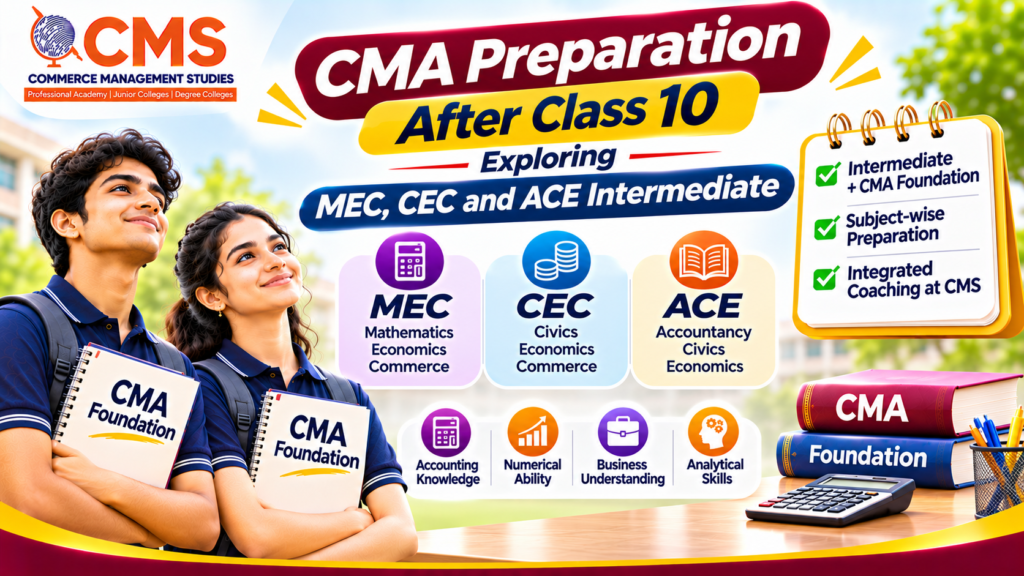
After completing Class 10, students begin exploring Intermediate streams and career pathways that match their interests. For students interested in accounting, finance, business and cost management, the Cost and Management Accountant (CMA) qualification is one option to consider. Starting to understand the CMA course during this stage can help students become familiar with its subjects, examination structure and preparation requirements before moving into higher classes.
CMA preparation involves developing accounting knowledge, numerical ability, business understanding and analytical skills. Students can begin building these abilities during Intermediate by strengthening their academic fundamentals and gradually becoming familiar with the CMA Foundation syllabus. MEC, CEC and ACE are three Intermediate options that students can explore while planning their CMA preparation. Understanding the subjects included in each stream helps students make informed decisions about their academic pathway and preparation routine.
What Is the CMA Course?
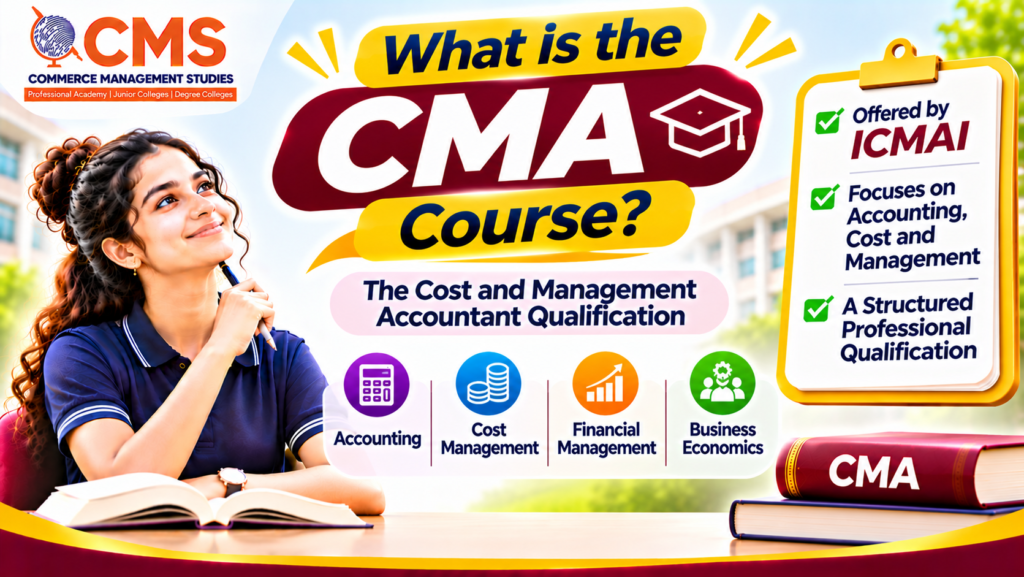
The Cost and Management Accountant qualification is offered by the Institute of Cost Accountants of India, commonly known as ICMAI. The course focuses on areas such as accounting, cost management, financial management, business economics and related professional knowledge. It is designed for students interested in understanding how financial information is used in business planning, cost control and management decision-making.
The CMA course follows a structured qualification pathway. Students generally progress through the Foundation, Intermediate and Final stages, subject to the applicable eligibility and registration requirements. Students who have completed Class 10 can explore Foundation registration requirements, while eligibility to appear for the Foundation examination depends on completing the required educational qualification, including Class 12, as specified by ICMAI.
Before beginning preparation, students should understand the current course structure and official eligibility requirements. This helps them plan their Intermediate education alongside CMA preparation and avoid confusion about registration, examination eligibility and the stages of the qualification.
Exploring MEC, CEC and ACE Intermediate
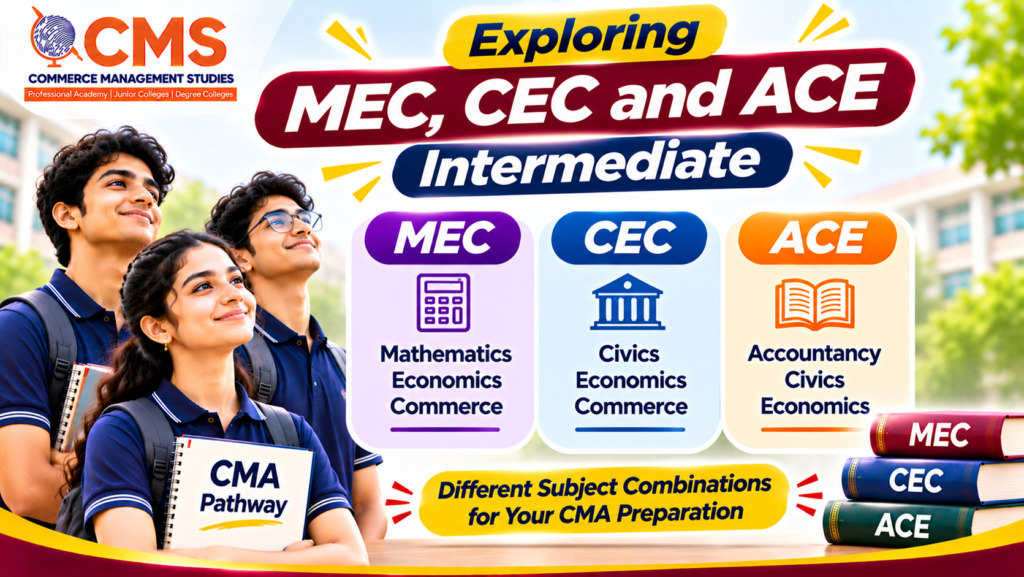
MEC, CEC and ACE are Intermediate streams that students can consider after Class 10. Each stream has a different subject combination, which influences the type of academic knowledge students develop during Intermediate. Students interested in CMA should understand these differences and consider how the subjects align with their learning preferences and future goals.
MEC includes Mathematics, Economics and Commerce. CEC includes Civics, Economics and Commerce, while ACE includes Accountancy, Civics and Economics. These streams provide different learning experiences, but students can explore CMA preparation alongside each of them through appropriate coaching and examination practice.
The choice of Intermediate stream should not be based only on the name of a professional course. Students should consider their interest in Mathematics, accounting, economics, business concepts and the academic subjects they will study throughout Intermediate.
How MEC Intermediate Supports CMA Preparation
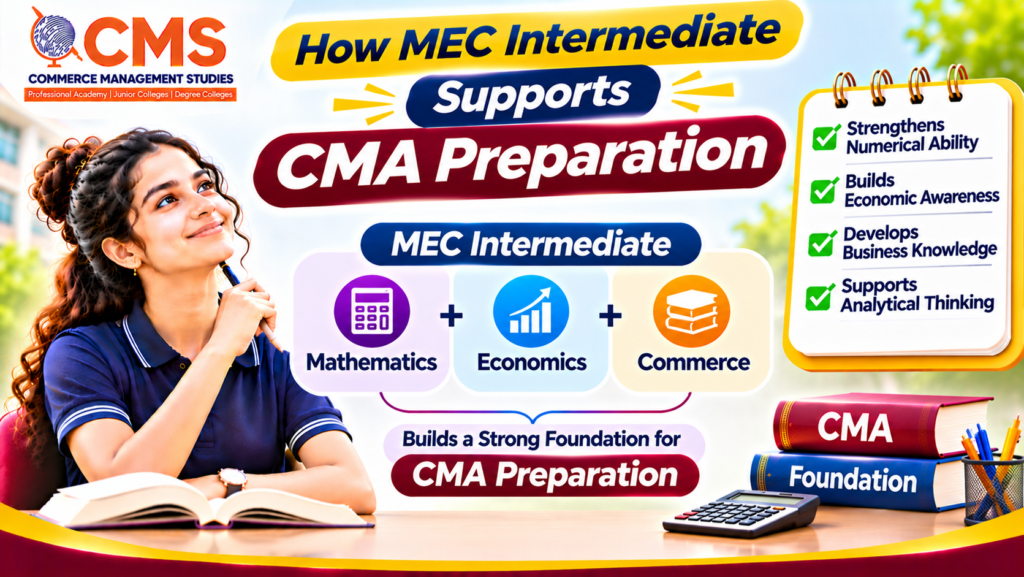
MEC is an Intermediate stream that includes Mathematics, Economics and Commerce. These subjects provide students with opportunities to develop numerical understanding, business knowledge and analytical thinking. For students planning CMA preparation, MEC can support the development of academic skills that are useful when studying accounting, economics and quantitative concepts.
Mathematics helps students strengthen their numerical ability and problem-solving approach. Economics introduces concepts related to markets, resources, production and economic activity, while Commerce helps students become familiar with business transactions and commercial terminology. Together, these subjects provide a useful academic foundation for students exploring cost and management accounting.
Students can connect their MEC learning with CMA preparation by following a regular study routine.
- Mathematics: Practise calculations, numerical problems and analytical questions.
- Economics: Understand economic concepts and their practical applications.
- Commerce: Develop familiarity with business activities and commercial concepts.
- CMA Foundation preparation: Study the relevant syllabus and practise examination-style questions.
MEC students should remember that Intermediate subjects and CMA Foundation subjects are not identical. The stream can support the development of relevant skills, but students still need to study the official CMA syllabus and prepare specifically for its examination requirements.
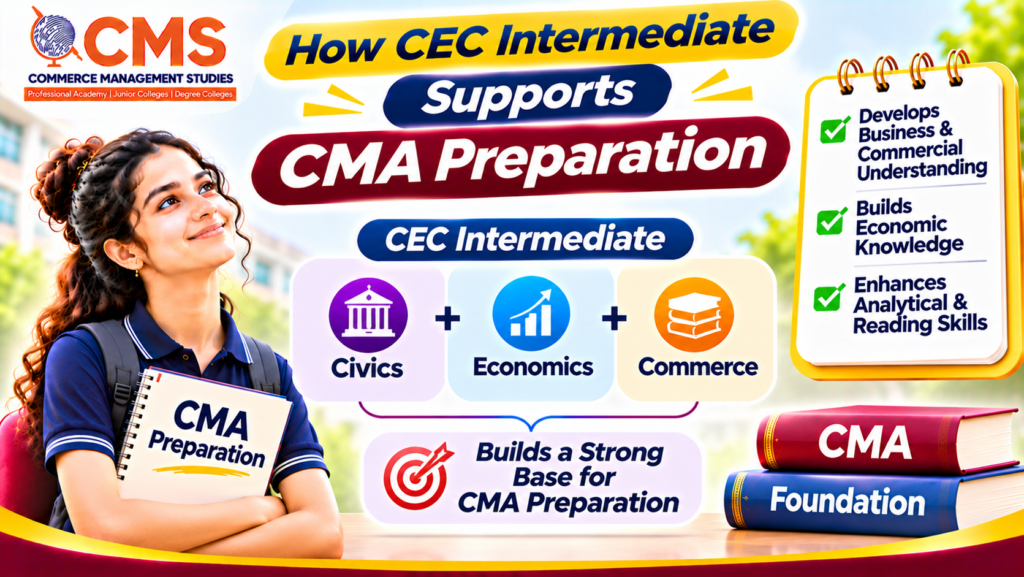
How CEC Intermediate Supports CMA Preparation
CEC includes Civics, Economics and Commerce. Students studying CEC can develop an understanding of commercial activities, economic concepts and the broader social and institutional environment. These subjects provide opportunities to improve comprehension, analytical thinking and familiarity with business-related information.
Commerce is particularly relevant for students interested in understanding business transactions, accounting-related concepts and commercial terminology. Economics helps students understand how resources, markets and economic activities operate. Civics develops awareness of institutions, governance and social structures, which can contribute to broader analytical and reading skills.
CEC students can approach CMA preparation by combining their Intermediate studies with dedicated professional-course learning.
- Commerce: Build familiarity with business activities and commercial concepts.
- Economics: Understand economic principles and their applications.
- Civics: Develop reading, comprehension and analytical habits.
- CMA Foundation preparation: Practise accounting, mathematics, economics and other subjects included in the official syllabus.
CEC students should focus on understanding the CMA Foundation requirements rather than assuming that their Intermediate subjects cover the complete examination syllabus. Consistent practice and subject-wise preparation remain important throughout the course.
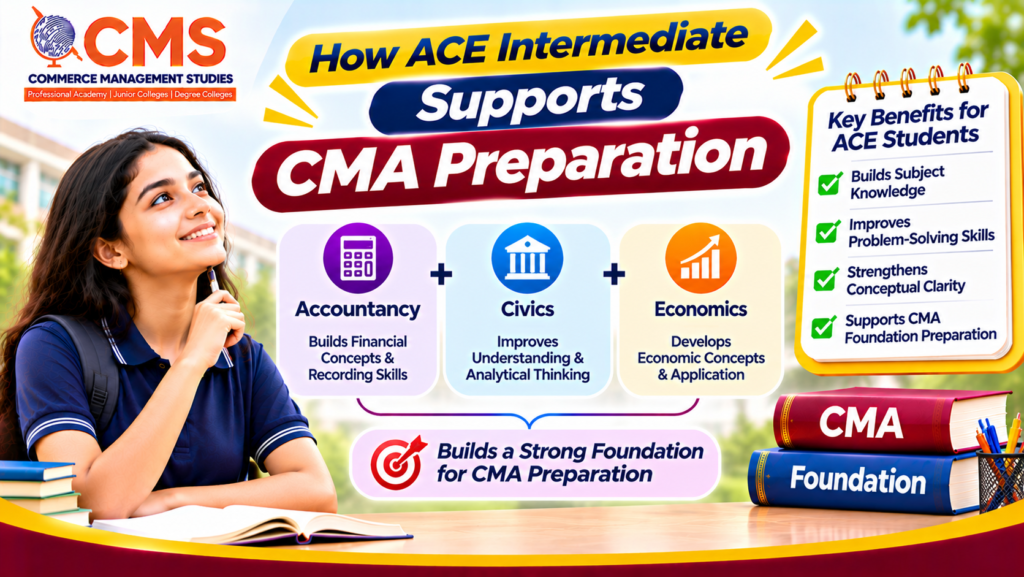
How ACE Intermediate Supports CMA Preparation
ACE includes Accountancy, Civics and Economics. Students interested in accounting and business-related subjects can explore how ACE learning connects with their preparation for CMA Foundation. The stream provides an opportunity to study accountancy alongside economic concepts and civics, helping students develop academic knowledge in different areas.
Accountancy introduces students to the recording and understanding of financial transactions. Economics provides an understanding of economic activities and resource allocation, while Civics develops knowledge of institutions and governance. These subjects can support the development of skills such as interpreting information, understanding concepts and approaching questions systematically.
ACE students can organise their CMA preparation around the following areas.
- Accountancy: Strengthen understanding of accounting concepts and financial transactions.
- Economics: Develop familiarity with economic principles and related applications.
- Civics: Improve comprehension and analytical skills through academic learning.
- CMA Foundation preparation: Practise the official examination subjects separately and revise concepts regularly.
Students should understand that ACE Accountancy and CMA Foundation accounting are not necessarily the same in syllabus coverage or examination approach. Reviewing the official CMA syllabus helps students identify additional topics and plan their preparation accordingly.
CMA Foundation Subjects Students Should Understand
CMA Foundation preparation includes subjects that introduce students to accounting, mathematics, economics and business-related knowledge. Students beginning preparation after Class 10 should become familiar with these areas and understand how their Intermediate education can support their learning.
The Foundation syllabus and examination structure should always be checked through the latest ICMAI information. Students can use the following subject areas as a starting point for understanding the course.
Fundamentals of Accounting
Accounting is an important area for students interested in cost and management accounting. It involves understanding financial transactions, recording business activities and interpreting accounting information. Students can begin by strengthening their basic concepts and learning how financial information is organised.
Important areas to develop include:
- Basic accounting concepts
- Financial transactions
- Journal entries and ledger concepts
- Accounting principles
- Understanding financial information
Students studying Commerce or Accountancy during Intermediate may become familiar with some related concepts. However, they should still follow the CMA Foundation syllabus and practise the specific question formats prescribed for the examination.
Business Mathematics and Statistics
Mathematical understanding is useful for solving numerical problems and interpreting information. Students preparing for CMA Foundation should strengthen their arithmetic, calculations and problem-solving ability before moving towards more advanced questions.
Important areas to practise include:
- Percentages and ratios
- Averages
- Basic algebra
- Mathematical calculations
- Statistical concepts
- Data interpretation
Students can improve their numerical ability by solving questions regularly and reviewing mistakes. Understanding the method behind a calculation helps them apply the same concept to different problems.
Business Economics
Business Economics introduces students to economic concepts and their relationship with business activities. It helps students understand how markets operate, how resources are allocated and how economic conditions influence decisions.
Students should focus on understanding concepts rather than memorising definitions without context. Regular revision and practice questions can help them develop familiarity with the subject and improve their ability to interpret economic information.
Business Laws and Ethics
Business Laws and Ethics introduces students to legal and ethical concepts relevant to business activities. Students should develop an understanding of the prescribed topics and learn how to interpret questions based on the relevant principles.
Reading carefully, understanding terminology and practising objective questions can help students become familiar with this area. Students should refer to the current ICMAI syllabus to identify the exact topics included in their examination.
How to Plan CMA Preparation During Intermediate
A well-organised study plan helps students manage Intermediate subjects and CMA preparation without creating unnecessary academic pressure. Students beginning in Class 11 can focus on building fundamentals and gradually increase their professional-course practice as they become more familiar with the syllabus.
The preparation schedule should include regular Intermediate study, CMA subject learning, practice questions and revision. Students should avoid attempting to complete the entire CMA syllabus immediately after Class 10 without considering their academic workload.
A practical preparation routine can include:
- Intermediate study: Complete classroom learning, assignments and regular revision.
- Accounting practice: Strengthen accounting fundamentals and solve relevant questions.
- Mathematics practice: Improve calculation accuracy and problem-solving ability.
- Economics revision: Understand concepts and practise application-based questions.
- CMA syllabus learning: Study the subjects prescribed by ICMAI.
- Weekly review: Identify topics that require more practice and adjust the study plan.
Students should make their timetable according to their learning pace and examination schedule. A consistent routine with realistic targets is generally more useful than an intensive plan that becomes difficult to maintain.
CMA Preparation During Class 11 and Class 12
Class 11 is a suitable stage for students to become familiar with CMA Foundation subjects and begin developing a regular preparation routine. Students can focus on understanding concepts, strengthening academic fundamentals and practising questions related to their learning.
During Class 12, students need to balance Intermediate examinations with their professional-course preparation. Their schedule should give sufficient importance to board examinations while continuing CMA revision and practice. Students should also review the official examination eligibility requirements before planning when to appear for the Foundation examination.
A balanced preparation approach can help students progress gradually.
- Class 11: Understand the CMA course, develop subject fundamentals and begin regular practice.
- Class 11 revision: Identify difficult concepts and strengthen areas that require additional attention.
- Class 12: Balance Intermediate examinations with CMA syllabus revision.
- After meeting eligibility requirements: Plan registration and examination preparation according to the latest ICMAI guidelines.
The exact examination timeline depends on the student’s educational status, registration and the applicable ICMAI examination schedule. Students should verify these details through official announcements.
How Integrated CMA Coaching Supports Intermediate Students
CMS Best Institute for CMA in Hyderabad offers integrated CMA coaching alongside MEC, CEC and ACE Intermediate education. This allows students to pursue their Intermediate subjects while also preparing for the CMA Foundation examination through a planned coaching approach.
Integrated coaching can help students organise their academic learning and professional-course preparation within their Intermediate schedule. Students can work on relevant CMA subjects, practise examination-style questions and revise concepts while continuing their regular classroom education.
For students exploring CMA Coaching in Hyderabad, CMS provides an option to consider integrated preparation during Intermediate. Students can understand the coaching structure, subject coverage and preparation schedule to determine how the programme fits their academic goals.
Beginning CMA preparation during Intermediate can help students become familiar with the course requirements and develop a consistent study routine. With appropriate guidance, regular practice and revision, students can work towards strengthening their foundation for the CMA qualification while completing their Intermediate education.
Conclusion
CMA preparation after Class 10 gives students an opportunity to explore cost and management accounting while planning their Intermediate education. MEC, CEC and ACE provide different subject combinations that can support the development of academic knowledge, numerical ability, business understanding and analytical skills. Students should choose their Intermediate stream based on their interests and understand that CMA Foundation requires dedicated preparation beyond regular Intermediate subjects. By following a realistic study plan, practising relevant questions and reviewing the official syllabus, students can gradually build their preparation. CMS offers integrated CMA coaching alongside MEC, CEC and ACE Intermediate, helping students organise their academic studies and professional-course preparation as they work towards their future goals.
Important: CMA registration, examination eligibility, syllabus and examination schedules may change. Students should check the latest official ICMAI guidelines before registering or planning to appear for the CMA Foundation examination.