
Why Class 11 Is a Good Time to Start CLAT Preparation
Class 11 is an important stage for students who are interested in pursuing law after Intermediate. Students who plan to appear for the Common Law Admission Test (CLAT) can use this time to understand the examination, develop essential academic skills and establish a consistent preparation routine. Starting during Class 11 allows students to become familiar with the examination gradually while continuing to focus on their regular Intermediate subjects.
CLAT preparation involves reading comprehension, logical reasoning, legal reasoning, current affairs and quantitative understanding. These skills require regular practice and the ability to interpret information carefully. Students studying MEC, CEC or ACE can begin developing these abilities during Intermediate by strengthening their academic fundamentals and practising CLAT-style questions. A balanced preparation approach helps students understand the examination requirements and build confidence before entering Class 12.
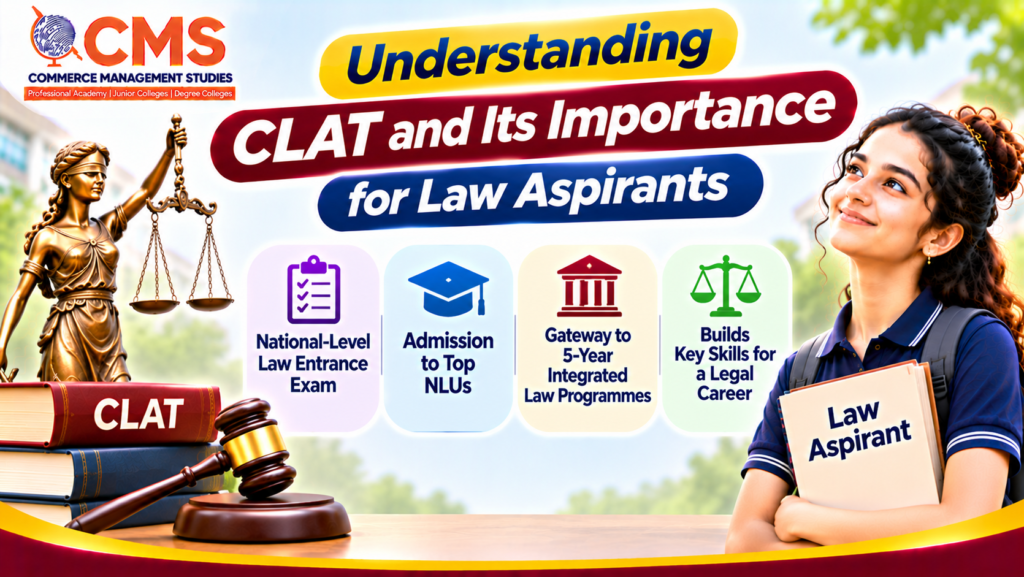
Understanding CLAT and Its Importance for Law Aspirants
The Common Law Admission Test is a national-level entrance examination conducted by the Consortium of National Law Universities for admission to undergraduate and postgraduate law programmes offered by participating institutions. CLAT UG is relevant for students who wish to pursue five-year integrated law programmes after completing their qualifying education.
The examination evaluates different abilities that are useful for legal education, including comprehension, reasoning, interpretation and awareness of important developments. Students need to understand passages, identify relevant information and apply logical thinking while answering questions. These skills are developed through consistent practice rather than memorisation alone.
Class 11 students should begin by understanding the CLAT UG examination structure and identifying the sections they need to prepare for. Since the examination pattern and admission requirements can change, students should check the latest official information from the Consortium of NLUs while planning their preparation.
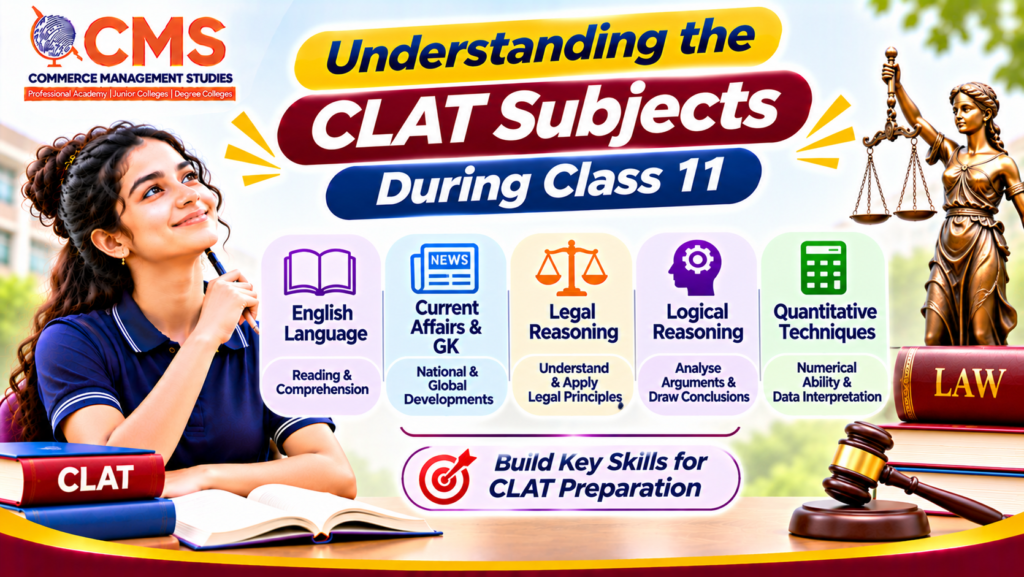
Understanding the CLAT Subjects During Class 11
CLAT UG preparation generally involves five major areas: English Language, Current Affairs Including General Knowledge, Legal Reasoning, Logical Reasoning and Quantitative Techniques. Each section evaluates a different skill, so students should understand the purpose of each subject before beginning regular practice.
Preparing during Class 11 gives students time to explore these areas gradually. Instead of attempting difficult questions immediately, students can begin with fundamental concepts, practise passage-based questions and develop an organised study routine.
1. English Language and Reading Comprehension
English Language preparation focuses on understanding written passages, identifying the main idea and interpreting information accurately. Students may need to recognise arguments, understand vocabulary in context and draw conclusions from the passage.
Reading comprehension is an important skill because CLAT questions often require candidates to understand information before selecting an answer. Students who develop a regular reading habit can become more familiar with different writing styles and improve their ability to interpret unfamiliar passages.
Important areas to practise:
- Reading comprehension
- Main ideas and supporting arguments
- Vocabulary in context
- Inferences and conclusions
- Author’s tone and purpose
- Passage-based questions
Students can improve their reading skills by regularly reading informative articles, editorials and other suitable material. After reading, they should summarise the passage and identify its central argument. This helps develop comprehension and the ability to answer questions based on written information.
2. Current Affairs and General Knowledge
Current Affairs and General Knowledge preparation involves understanding important national and international developments. Students should become familiar with major events, government initiatives, important institutions and other developments that may be relevant to the examination.
Starting this preparation during Class 11 helps students build a consistent habit of following the news. Instead of trying to memorise large amounts of information shortly before the examination, students can maintain short notes and revise important developments regularly.
Important areas to follow:
- National and international current affairs
- Government policies and initiatives
- Important appointments and awards
- Sports and significant events
- Major organisations and institutions
- Developments connected to important current affairs passages
Students should focus on understanding the background and significance of events. This approach helps them retain information more effectively and become familiar with the type of knowledge required for CLAT preparation.
3. Legal Reasoning
Legal Reasoning evaluates the ability to understand legal principles and apply them to situations described in a passage. Students are generally expected to identify the relevant principle, understand the facts and determine how the principle applies.
Students beginning CLAT preparation during Class 11 do not need to approach every question as if they already know the entire legal system. The important skill is learning how to interpret the information provided and reason carefully from the given principle.
Important areas to practise:
- Understanding legal principles
- Applying principles to factual situations
- Identifying relevant information
- Distinguishing facts from assumptions
- Evaluating the relationship between rules and situations
Students should practise passage-based legal reasoning questions and explain why a particular answer follows from the principle. Reviewing incorrect answers can help them identify whether they misunderstood the rule, overlooked a fact or selected an option that was not supported by the passage.
4. Logical Reasoning
Logical Reasoning helps students develop the ability to analyse arguments, recognise relationships and draw conclusions from information. This section requires careful thinking and an understanding of how different statements relate to one another.
Students can begin with basic reasoning exercises and gradually move towards more complex passage-based questions. Regular practice helps them become familiar with different question formats and understand how to evaluate arguments.
Important areas to practise:
- Identifying assumptions and conclusions
- Analysing arguments
- Recognising logical relationships
- Drawing conclusions from statements
- Evaluating the strength of arguments
Students should focus on understanding the reasoning behind each answer. Reviewing mistakes helps them recognise patterns in the questions and develop a more systematic approach to solving problems.
5. Quantitative Techniques
Quantitative Techniques evaluates the ability to interpret numerical information and solve mathematical problems. Questions may involve data presented through tables, graphs, charts or other numerical formats.
Students studying MEC, CEC or ACE can strengthen their mathematical understanding through regular practice. However, they should remember that CLAT Quantitative Techniques has its own question formats and requires preparation according to the official syllabus.
Important areas to practise:
- Percentages
- Ratios and proportions
- Averages
- Basic arithmetic
- Data interpretation
- Tables, graphs and charts
Students should begin by strengthening basic mathematical concepts and improving calculation accuracy. Once they understand the fundamentals, they can practise passage-based numerical questions and gradually develop their ability to solve them within a reasonable time.
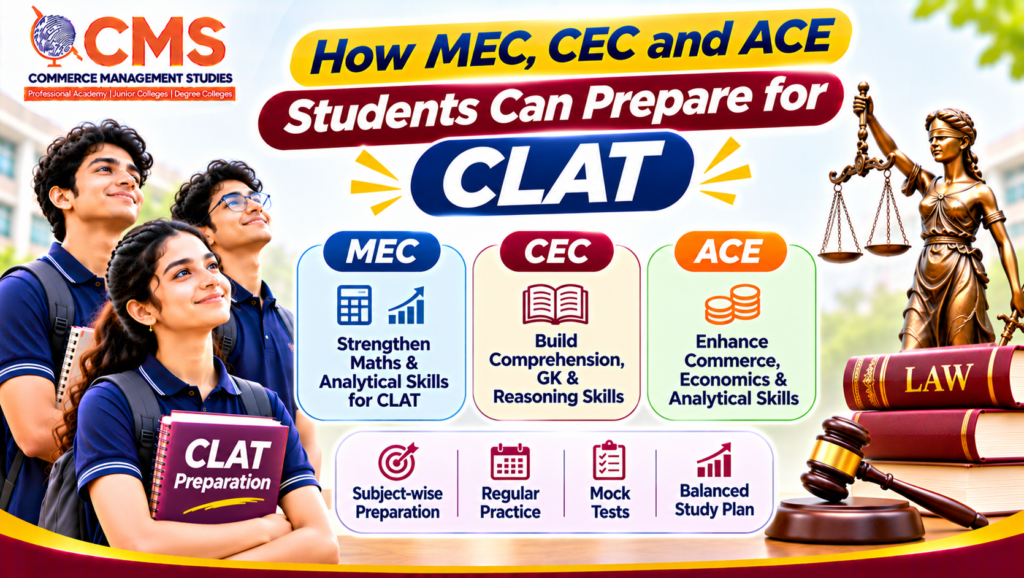
How MEC, CEC and ACE Students Can Prepare for CLAT
MEC, CEC and ACE Intermediate provide different subject combinations, but students from all three streams can prepare for CLAT by developing the skills required for the examination. Their Intermediate subjects can support academic learning, while CLAT preparation involves additional practice in reading comprehension, reasoning and examination strategy.
MEC includes Mathematics, Economics and Commerce. CEC includes Civics, Economics and Commerce, while ACE includes Accountancy, Civics and Economics. These subjects provide different academic experiences, but students should understand that CLAT has a separate syllabus and requires dedicated entrance examination preparation.
Students can organise their preparation according to their Intermediate stream.
- MEC students: Strengthen Mathematics, reading comprehension and analytical skills while practising CLAT questions.
- CEC students: Develop reading, comprehension, economic understanding and reasoning skills alongside entrance preparation.
- ACE students: Build familiarity with accounting concepts, economic information and analytical questions while preparing for CLAT.
The objective is to develop relevant skills without assuming that Intermediate subjects alone are sufficient for the examination. Students should follow the CLAT syllabus and practise questions from all required sections.
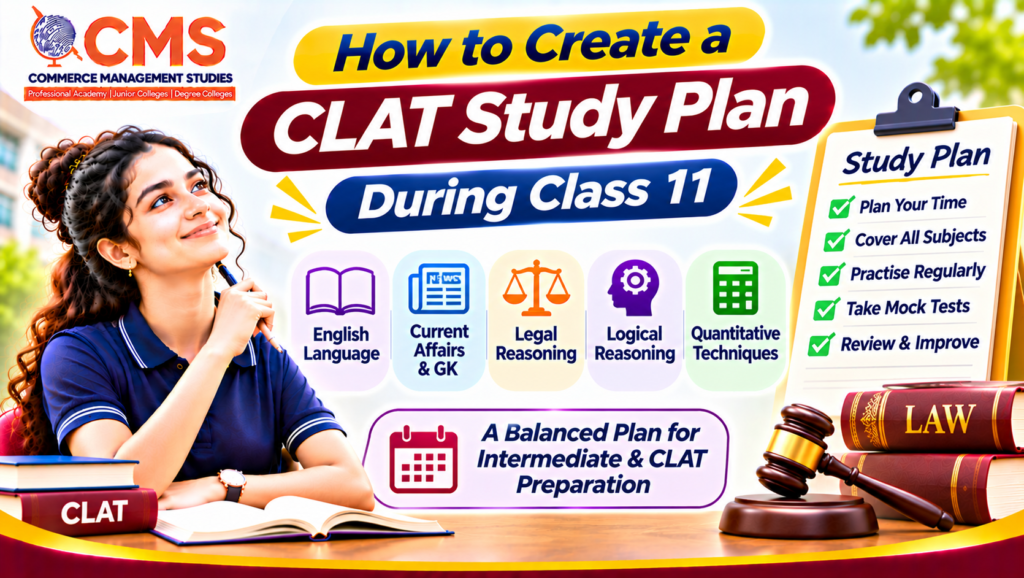
How to Create a CLAT Study Plan During Class 11
A study plan helps students organise their preparation and maintain a balance between Intermediate education and entrance examination practice. Class 11 introduces students to new academic concepts, so the preparation schedule should be realistic and flexible.
Students do not need to spend every available hour preparing for CLAT. Instead, they should establish a routine that includes regular Intermediate study, reading, reasoning practice and revision. The schedule can gradually become more detailed as students become familiar with the examination.
A practical study plan can include:
- English: Read passages and practise comprehension questions.
- Current Affairs: Follow important developments and maintain short revision notes.
- Legal Reasoning: Practise principle-based questions and review explanations.
- Logical Reasoning: Solve analytical questions and understand the reasoning behind answers.
- Quantitative Techniques: Strengthen mathematical concepts and practise calculations.
- Intermediate subjects: Complete assignments, revise lessons and prepare for academic examinations.
Students should review their progress regularly and adjust the timetable according to their strengths and weaknesses. A study plan should support consistent learning rather than create unnecessary pressure.
How to Balance CLAT Preparation and Intermediate Studies
Balancing CLAT preparation with Intermediate education is an important consideration for students beginning in Class 11. Both require regular effort, and students should avoid creating a schedule that becomes difficult to maintain.
Intermediate subjects help students develop academic knowledge, while CLAT preparation involves additional examination-specific practice. Students should organise their time so that entrance preparation supports their learning without interfering with board examination responsibilities.
A balanced approach includes:
- Completing Intermediate assignments on time.
- Revising classroom lessons regularly.
- Practising CLAT questions in planned study sessions.
- Maintaining reading and current affairs habits.
- Increasing revision during academic examination periods.
- Reviewing weekly progress and adjusting the schedule.
Students should also understand that preparation does not need to be identical every day. Some days may be more suitable for reading comprehension, while others may provide more time for reasoning or mathematics practice. Flexibility helps students maintain consistency throughout the academic year.
The Importance of CLAT Practice and Mock Tests
Practice is an important part of CLAT preparation because it helps students become familiar with the examination format and identify areas that require improvement. During Class 11, students can begin with topic-wise questions and gradually move towards timed practice.
Mock tests become more useful when students analyse their performance after completing them. Simply checking the score does not explain why certain questions were answered incorrectly. Students should review their mistakes and identify the concepts or skills that need additional attention.
Effective practice includes:
- Solving questions after learning the relevant concepts.
- Attempting exercises from different difficulty levels.
- Practising within a reasonable time limit.
- Reviewing incorrect and unanswered questions.
- Identifying recurring mistakes.
- Revising topics before attempting another test.
Students should not compare their early practice scores with final examination expectations. Class 11 is a learning stage, and the purpose of practice is to build familiarity, accuracy and confidence over time.
Common CLAT Preparation Mistakes Class 11 Students Should Avoid
Students beginning CLAT preparation may sometimes focus on completing large numbers of questions without understanding the concepts. Others may spend too much time on one section and neglect the remaining subjects or their regular Intermediate studies.
Avoiding these mistakes can make preparation more organised and productive.
- Ignoring fundamentals: Students should understand basic concepts before attempting difficult questions.
- Practising without reviewing: Incorrect answers should be analysed to identify the reason for the mistake.
- Neglecting current affairs: Regular reading and revision are more useful than last-minute preparation.
- Following an unrealistic timetable: A study plan should match the student’s available time and academic responsibilities.
- Relying only on mock tests: Topic-wise learning and practice are necessary before attempting full-length examinations.
- Using outdated exam information: Students should check the latest official examination pattern and admission requirements.
A consistent preparation routine helps students avoid unnecessary pressure and focus on improving their skills gradually.
How CMS Supports CLAT Preparation Alongside Intermediate
CMS offers integrated CLAT Coaching in Hyderabad alongside MEC, CEC and ACE Intermediate education. This allows students to work on their Intermediate subjects while also developing the reading, reasoning and examination skills required for CLAT UG.
For students beginning CLAT preparation during Class 11, integrated coaching can provide an organised approach to entrance examination learning. Students can practise relevant questions, understand the examination format and identify areas that require additional attention while continuing their regular Intermediate education.
Through planned preparation, practice questions and mock examinations, students can become familiar with CLAT-style questions and review their performance. Regular feedback can help students understand mistakes, strengthen weaker sections and improve their approach to timed tests.
For students exploring CLAT Coaching in Hyderabad, CMS provides an option to consider integrated preparation during MEC, CEC or ACE Intermediate. Students can review the coaching structure and preparation schedule to understand how the programme fits their academic goals.
Conclusion
CLAT preparation during Class 11 gives Intermediate students an opportunity to develop important skills before the entrance examination. By strengthening reading comprehension, current affairs knowledge, legal reasoning, logical reasoning and quantitative understanding, students can gradually become familiar with the examination requirements. A realistic study plan, regular practice and mock test analysis help students balance entrance preparation with Intermediate education. With integrated CLAT coaching alongside MEC, CEC and ACE Intermediate, CMS provides students with an opportunity to organise their academic learning and entrance examination preparation while working towards their future law education goals.