
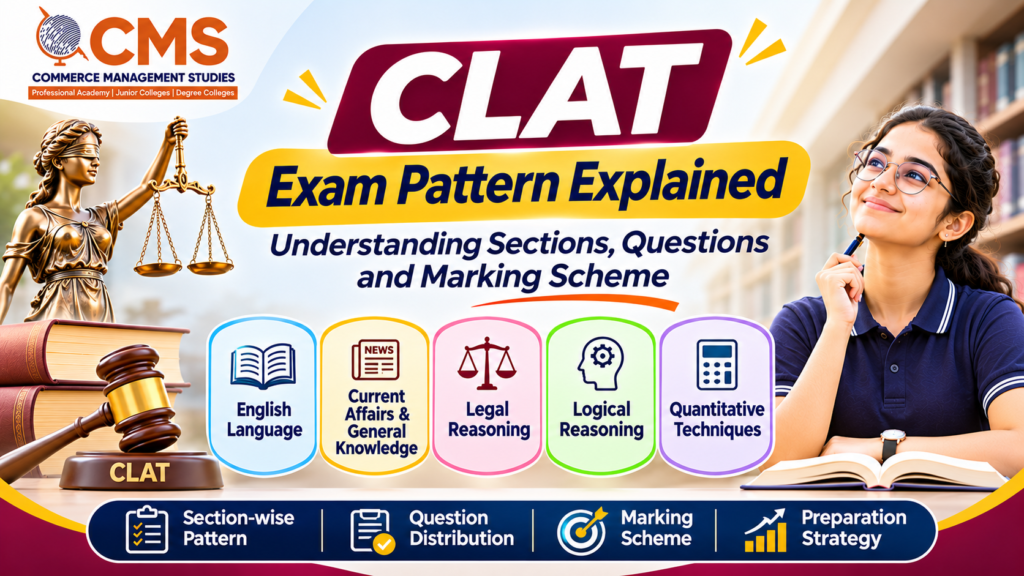
Understanding the CLAT Exam
The Common Law Admission Test (CLAT) is a national-level entrance examination conducted by the Consortium of National Law Universities for admission to undergraduate and postgraduate law programs offered by participating universities. For students planning to pursue a five-year integrated law course after Intermediate, the CLAT Undergraduate (UG) examination is an important step in the admission process. Understanding the exam pattern helps students become familiar with the subjects, question formats, time limit and marking scheme before beginning their preparation.
CLAT UG assesses skills that are useful for studying law, including reading comprehension, logical thinking, legal reasoning, awareness of current affairs and basic quantitative understanding. Rather than relying only on memorisation, students need to understand information presented in passages and apply their knowledge to the questions. Knowing how the examination is organised allows aspirants to plan their preparation, identify areas requiring improvement and practise each section with a clear objective.
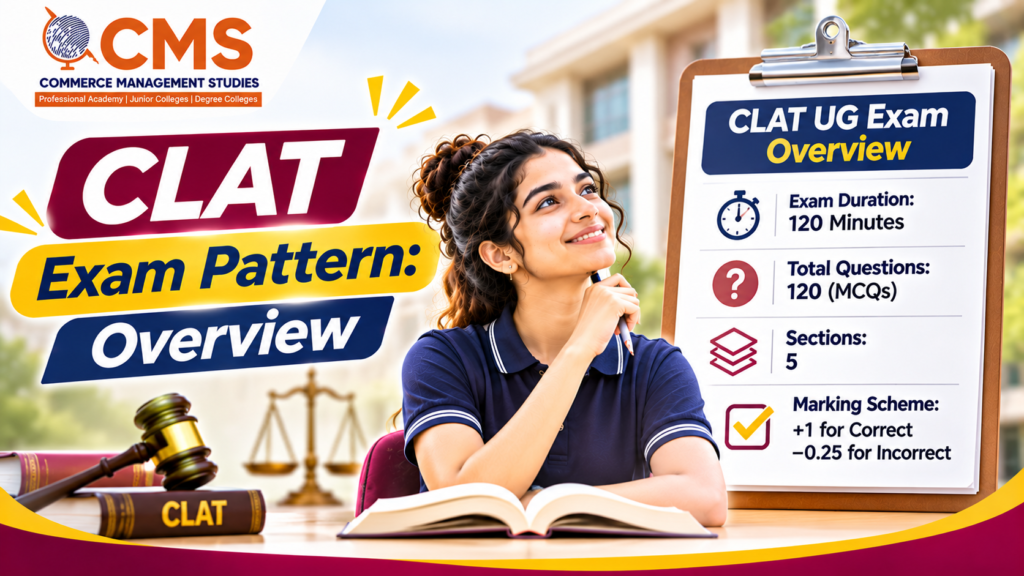
CLAT Exam Pattern: Overview
The CLAT UG examination has five major sections. These sections evaluate different abilities required for undergraduate legal education, and candidates need to prepare for all of them as part of their overall strategy.
The latest published CLAT UG pattern includes a two-hour examination with multiple-choice questions. The standard examination structure has been based on 120 questions, although the final evaluated marks can change if questions are withdrawn or the official answer key is revised. Candidates should always check the notification and instructions for their examination year.
- English Language: Reading comprehension, vocabulary in context and understanding written passages.
- Current Affairs and General Knowledge: Awareness of important events, developments and related information.
- Legal Reasoning: Understanding legal principles and applying them to given situations.
- Logical Reasoning: Identifying arguments, relationships, assumptions and logical conclusions.
- Quantitative Techniques: Interpreting numerical information and solving basic mathematical problems.
Each section requires a different approach. Students should understand the question formats and practise regularly rather than preparing for the examination as a single subject.
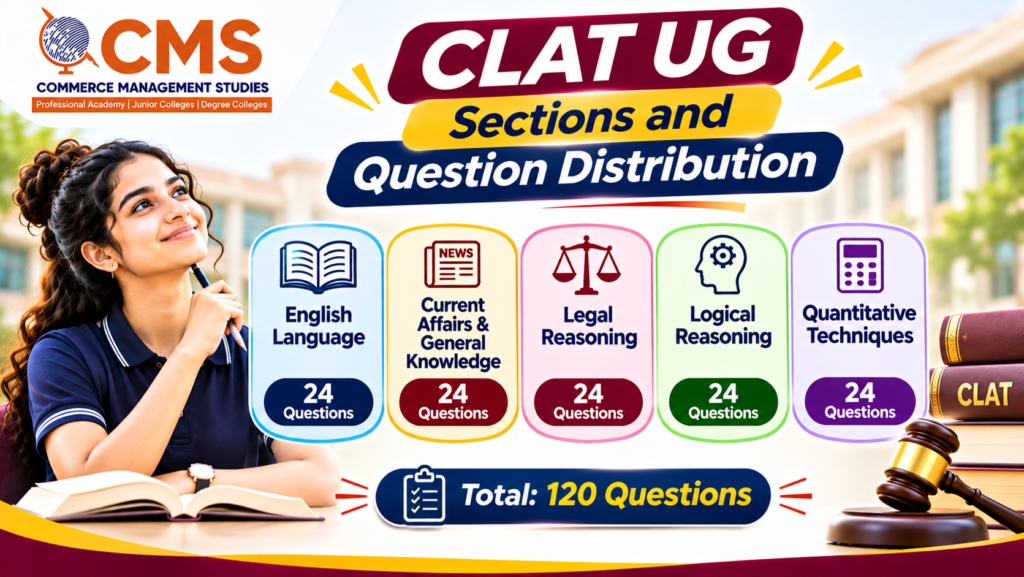
CLAT UG Sections and Question Distribution
The CLAT UG examination is divided into five sections. The official examination pattern and syllabus should be checked for the relevant year, because the Consortium may update the format or make changes to the evaluation.
The section-wise distribution below reflects the CLAT 2025 question booklet before final answer-key adjustments. It is useful as a preparation reference, but it should not be treated as a guaranteed distribution for every future examination.
1. English Language
The English Language section evaluates a candidate’s ability to understand written passages, identify the main idea and interpret information accurately. Questions are generally passage-based, making reading comprehension an important part of preparation.
Students may be asked to identify the central argument, understand the meaning of words in context, recognise the author’s perspective or draw conclusions from the passage. Strong English preparation involves reading regularly and practising questions that require careful interpretation.
Important areas to practise:
- Reading comprehension and passage analysis
- Main idea and supporting arguments
- Vocabulary in context
- Inferences and conclusions
- Author’s tone, purpose and perspective
Students can improve their performance by reading editorials, articles and other informative passages. After reading, they should summarise the main idea and identify the arguments supporting it. This practice helps develop the ability to understand unfamiliar passages under examination conditions.
2. Current Affairs Including General Knowledge
The Current Affairs and General Knowledge section evaluates awareness of important events and the ability to understand information related to those developments. Questions may be based on passages covering national and international events, government initiatives, important institutions, awards, sports and other significant topics.
This section requires consistent preparation because current affairs cannot be covered effectively through last-minute reading alone. Students should follow reliable news sources, revise important developments and understand the background of major events.
Important areas to prepare:
- National and international current affairs
- Government policies and important initiatives
- Significant awards and appointments
- Sports and major events
- Important organisations and developments
- General knowledge connected to current affairs passages
A useful preparation method is to maintain short notes on important events and revise them regularly. Students should focus on understanding the significance of an event instead of memorising isolated facts without context.
3. Legal Reasoning
Legal Reasoning is an important section of CLAT UG because it evaluates a candidate’s ability to understand legal principles and apply them to situations described in a passage. Students do not need to approach every question as if they already know the entire law. The focus is on reading the given information carefully and reasoning from the principles provided.
Questions may present a legal principle, a factual situation or a passage describing a legal issue. Candidates need to identify the relevant principle and determine how it applies to the facts. Careful reading is essential because small differences in the facts can affect the answer.
Important skills to develop:
- Understanding legal principles
- Applying principles to factual situations
- Identifying relevant information
- Distinguishing facts from assumptions
- Evaluating the relationship between a rule and its application
Students should practise passage-based legal reasoning questions and explain why an answer follows from the given principle. This helps them develop accuracy and avoid choosing options based only on personal opinions or general assumptions.
4. Logical Reasoning
The Logical Reasoning section evaluates the ability to analyse arguments, identify relationships and draw conclusions from the information provided. It tests how effectively students can recognise patterns in reasoning and distinguish strong arguments from weak ones.
Questions may involve assumptions, conclusions, argument structure, logical relationships or the interpretation of statements. Students should learn to identify what the passage actually supports and avoid adding information that is not provided.
Important areas to practise:
- Identifying assumptions and conclusions
- Evaluating arguments
- Recognising logical relationships
- Drawing conclusions from statements
- Understanding the strength and relevance of arguments
Regular practice is useful because students become more familiar with different question formats. Reviewing incorrect answers is equally important, as it helps identify whether the mistake occurred due to misunderstanding the passage, overlooking a condition or selecting an unsupported conclusion.
5. Quantitative Techniques
The Quantitative Techniques section evaluates the ability to understand numerical information and solve mathematical problems. Questions may include data presented through tables, graphs, charts or other forms of numerical information.
Students need to interpret the information carefully, identify what is being asked and apply the appropriate mathematical method. The section generally requires basic mathematical understanding combined with accuracy and time management.
Important areas to practise:
- Percentages
- Ratios and proportions
- Averages
- Basic arithmetic
- Data interpretation
- Tables, charts and graphs
Students should strengthen their fundamentals before attempting timed practice. Learning shortcuts can be useful, but they should not replace conceptual understanding. A clear approach to calculations helps reduce avoidable errors during the examination.
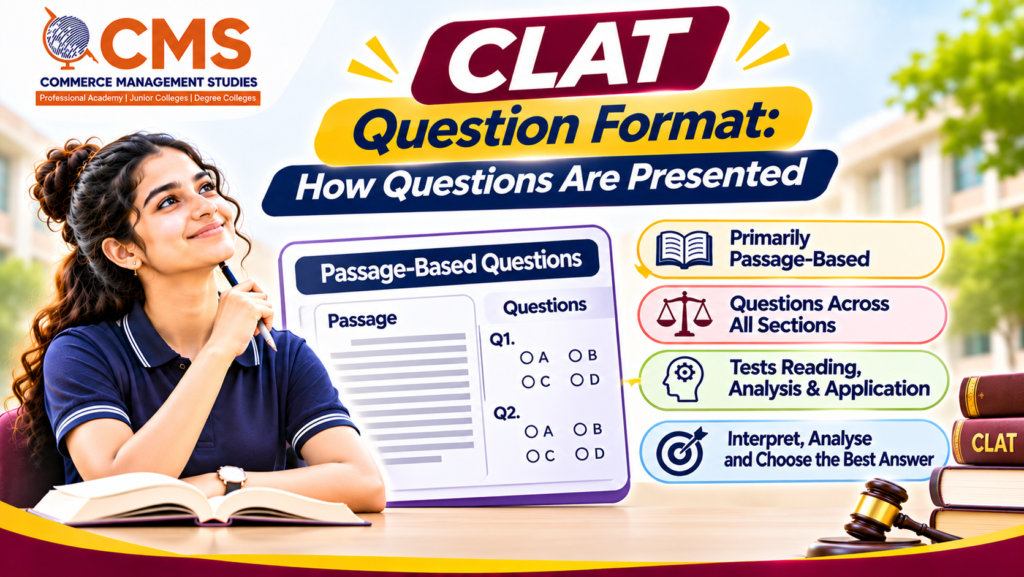
CLAT Question Format: How Questions Are Presented
CLAT UG is primarily a passage-based examination. Candidates are expected to read the passage carefully and answer questions using the information, arguments or principles presented in it.
This format makes reading comprehension and interpretation important across several sections. Even when a question appears to test legal knowledge, current affairs or logical reasoning, students may need to understand the passage before selecting the correct answer.
For effective practice, students should:
- Read the passage before attempting the questions.
- Identify the central idea or principle.
- Understand what each question is asking.
- Compare the options carefully.
- Avoid choosing an answer based only on outside assumptions.
- Review the explanation after completing the question.
Practising passage-based questions helps students become familiar with the examination style and develop the ability to make decisions based on the information provided.
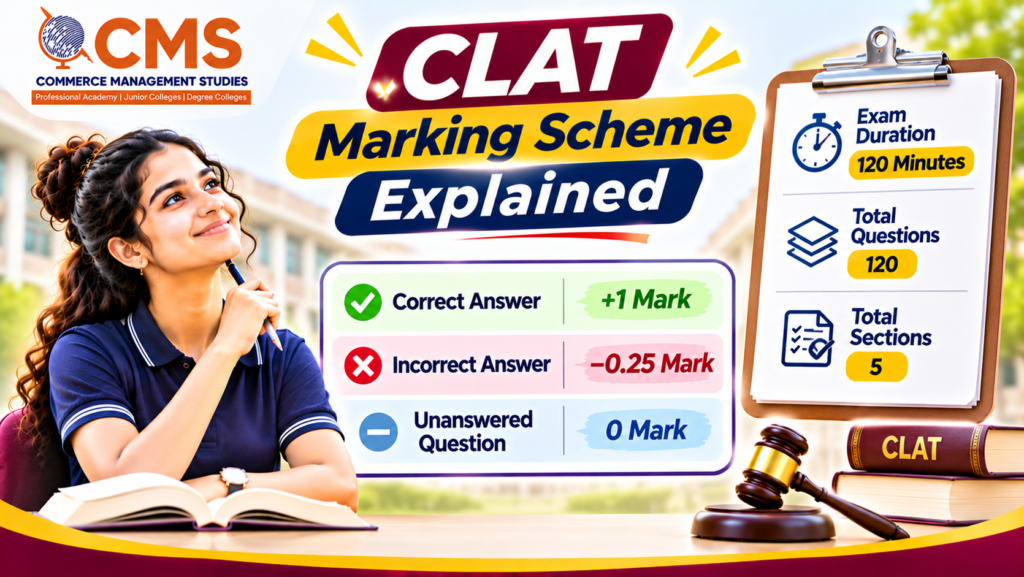
CLAT Marking Scheme Explained
Understanding the marking scheme is important because it helps students make informed decisions while attempting questions. In the standard CLAT UG marking scheme, candidates receive marks for correct answers and lose a small fraction of a mark for incorrect answers.
The published CLAT 2025 instructions specified the following marking scheme:
- Correct answer: +1 mark
- Incorrect answer: −0.25 mark
- Unanswered question: 0 marks
- Examination duration: 120 minutes
- Standard question count: 120 questions
The final number of evaluated marks may differ if questions are withdrawn or the answer key is modified. For example, the CLAT 2026 UG final answer-key notification stated that the evaluation would be out of 119 marks. Candidates should therefore refer to the official notification and final answer key for their examination year.
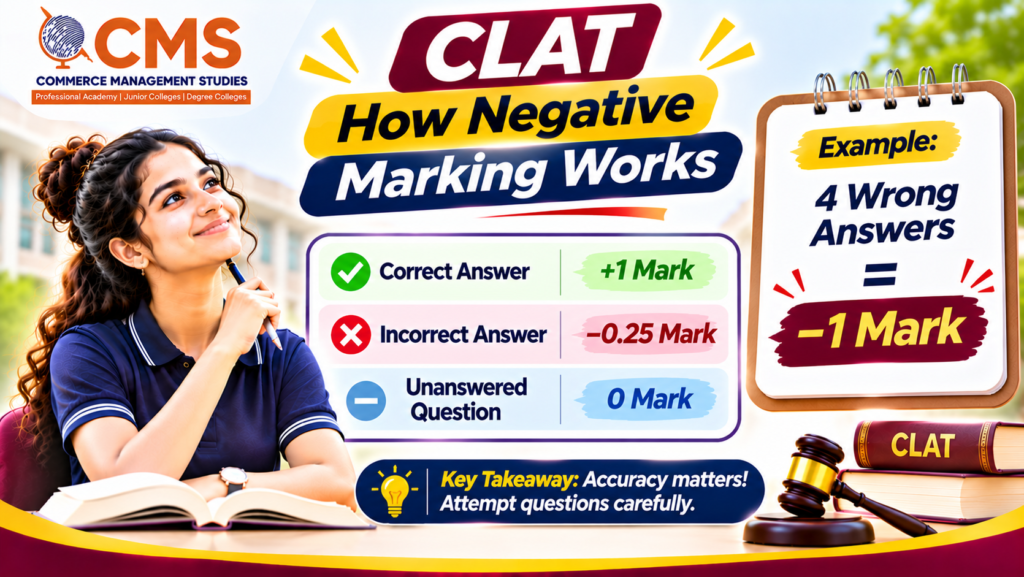
How Negative Marking Works
Negative marking means that an incorrect answer reduces the candidate’s score. For every four incorrect answers, the deduction totals one mark. This makes accuracy an important part of CLAT preparation.
Students should avoid answering questions without reading them carefully. However, they should also develop a practical approach to attempting questions instead of leaving every difficult question unanswered.
A useful strategy is to:
- Attempt questions you understand confidently.
- Read the passage and options carefully.
- Avoid spending too much time on one difficult question.
- Revisit questions when time permits.
- Analyse incorrect answers after mock tests.
- Follow the official marking instructions for the relevant year.
The aim is to improve both the number of correct answers and the ability to manage time effectively.
How to Manage Time During the CLAT Exam
Time management is an important part of CLAT because candidates must complete multiple sections within a fixed examination duration. Spending too much time on one passage or calculation can reduce the time available for other questions.
Students should practise completing full-length mock tests under timed conditions. This helps them understand how quickly they can read passages, answer questions and move between sections.
A practical time-management approach includes:
- Begin with a section or passage you can approach confidently.
- Read passages carefully without repeatedly returning to the same lines.
- Set a reasonable time limit for each passage.
- Move to the next question when a particular problem takes too long.
- Keep time for reviewing unanswered or uncertain questions.
- Practise the same strategy during mock examinations.
There is no single section order that works for every candidate. Students should experiment during practice tests and identify an approach that supports their accuracy and confidence.
How Intermediate Students Can Prepare for CLAT
Students studying MEC, CEC or ACE can begin developing CLAT-related skills during Intermediate. The key is to balance board examination preparation with entrance examination practice and avoid treating both as completely separate learning goals.
Intermediate subjects can help students develop useful academic habits, including reading, understanding concepts, interpreting information and solving problems. CLAT preparation adds regular practice in passage-based reasoning, current affairs and examination strategy.
Students can begin with the following steps:
- Build a regular reading habit.
- Practise English comprehension and logical reasoning.
- Follow current affairs and revise important events.
- Strengthen basic mathematical concepts.
- Solve CLAT-style questions regularly.
- Take mock tests and review performance.
- Maintain a balanced schedule for board exams and entrance preparation.
Starting early gives students time to understand the examination format and improve gradually. A consistent study routine is more useful than attempting to complete every topic shortly before the examination.
How CMS Supports CLAT Preparation Alongside Intermediate
CMS offers integrated CLAT Coaching in Hyderabad alongside MEC, CEC and ACE Intermediate education. This arrangement allows students to work on their board subjects while also developing the reading, reasoning and examination skills required for CLAT UG. Through planned preparation, practice questions and mock examinations, students can become familiar with the CLAT question format and identify areas that need additional attention. Regular feedback can help students review their mistakes, strengthen weaker sections and improve their approach to timed tests.
For students exploring CLAT Coaching in Hyderabad, CMS provides an option to consider integrated preparation during Intermediate. Students should review the course structure, teaching approach and practice schedule to understand how the coaching fits their academic goals.
Conclusion
Understanding the CLAT exam pattern, sections, question formats and marking scheme helps students prepare with greater clarity and confidence. By strengthening reading comprehension, current affairs, legal reasoning, logical reasoning and quantitative skills, aspirants can develop a balanced preparation strategy. For MEC, CEC and ACE students, starting CLAT preparation during Intermediate provides time to practise regularly while managing board examinations. With consistent effort, mock tests and proper guidance, students can improve their accuracy, time management and readiness for the CLAT examination. CMS offers integrated CLAT coaching alongside Intermediate education, helping students work towards their law entrance examination goals while continuing their academic journey.