
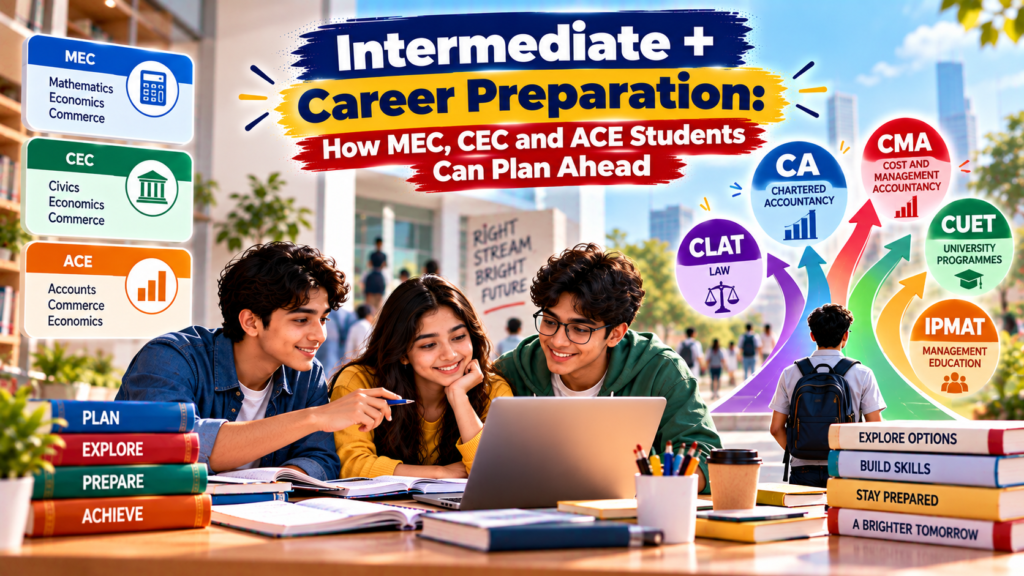
Intermediate is more than a stage between school and college. For students pursuing commerce-oriented streams, it can also be a period when academic interests begin to take shape into longer-term career plans. MEC, CEC and ACE provide different combinations of subjects, and each can give students a foundation from which they can explore professional courses, competitive examinations and undergraduate programmes.
Students do not necessarily have to wait until Intermediate is completed before thinking about their future. Career preparation can begin gradually alongside regular academics by understanding possible pathways, identifying the skills required and building a suitable study routine. For students considering CA, CMA, CLAT, CUET or IPMAT, planning during Intermediate can make the transition to the next stage more organised.
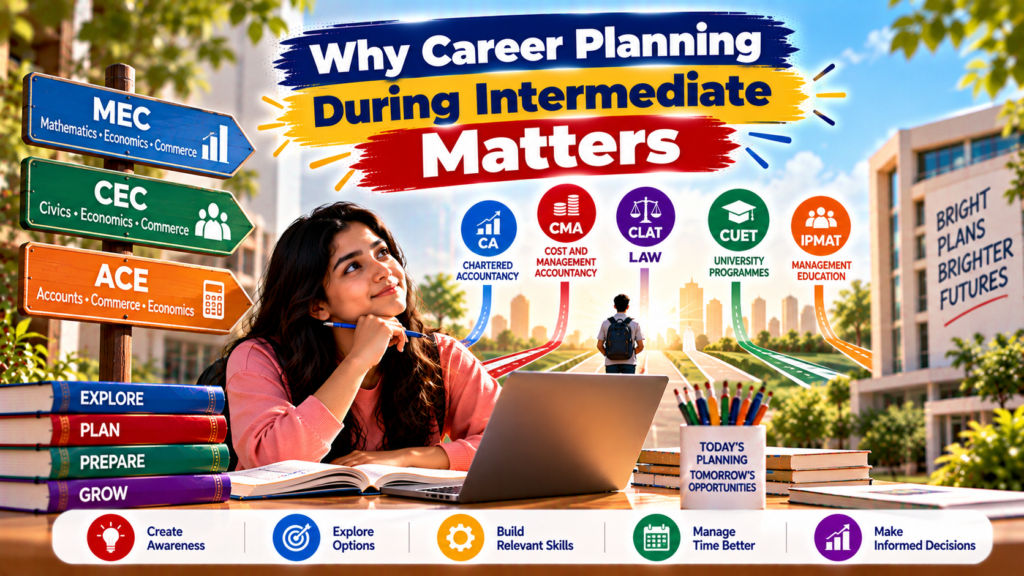
Why Career Planning During Intermediate Matters
Many students begin thinking seriously about careers only after their Intermediate examinations. While there is nothing wrong with making a decision later, early awareness gives students more time to understand their choices. They can explore different courses, learn about entrance examinations and identify the areas in which they need additional preparation.
Planning ahead does not mean that a student must finalise an entire career immediately. Instead, it means becoming aware of the possibilities and gradually building relevant skills. A student may begin Intermediate interested in CA and later discover an interest in management, or someone considering university education may eventually decide to explore CMA. Having some awareness of the available pathways makes such decisions easier to evaluate.
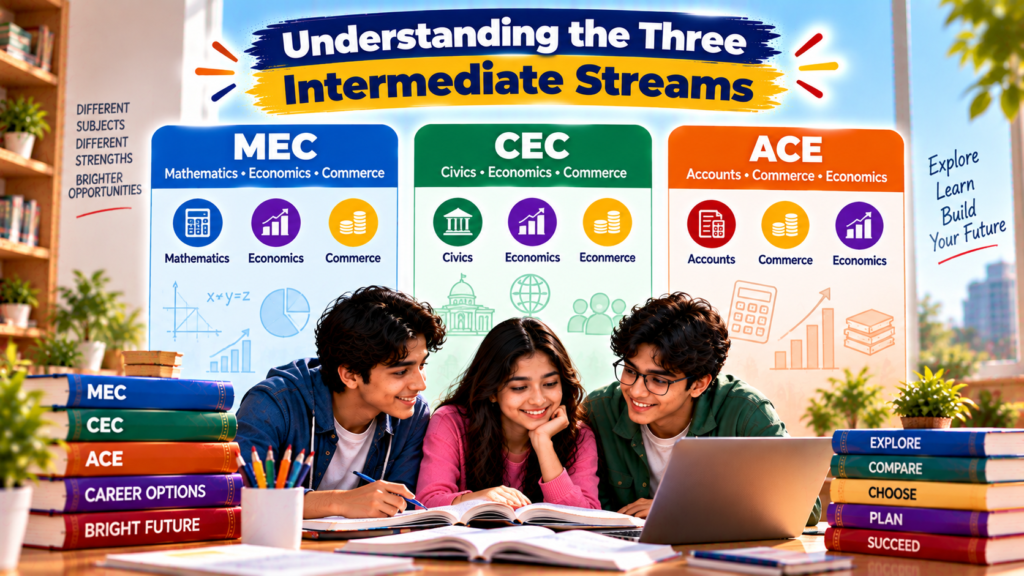
Understanding the Three Intermediate Streams
MEC, CEC and ACE offer different combinations of subjects and can develop different academic strengths. MEC combines Mathematics, Economics and Commerce, giving students exposure to quantitative reasoning, economic concepts and business-related learning. CEC combines Civics, Economics and Commerce, bringing together social institutions, economics and commercial understanding.
ACE combines Accounts, Commerce and Economics, providing a foundation around accounting, business and economic concepts. These differences can influence the areas students naturally enjoy, but they do not automatically determine a student’s career. A student’s interests, abilities and willingness to develop additional skills also play an important role in deciding the direction they eventually pursue.
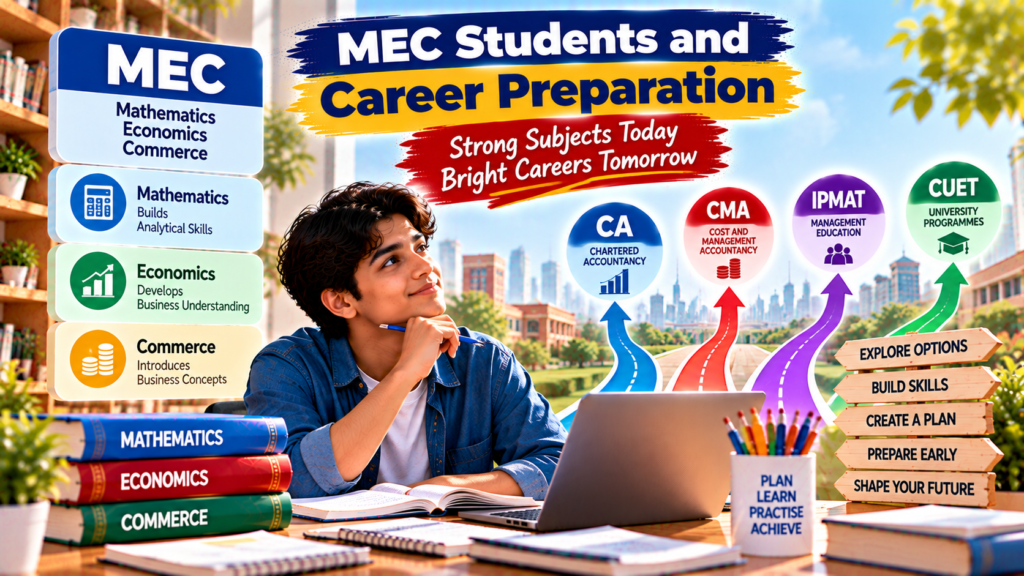
MEC Students and Career Preparation
MEC can be particularly relevant for students who enjoy Mathematics, Economics and Commerce and are interested in areas involving numbers, analysis and business. The stream can provide useful academic exposure for students considering CA, CMA, management education and suitable university programmes.
Students interested in management entrance examinations such as IPMAT can use their Mathematics background to strengthen quantitative ability while also developing verbal and logical reasoning. Those considering CA or CMA can build stronger foundations in Commerce and Economics while gradually becoming familiar with the requirements of professional-course preparation.
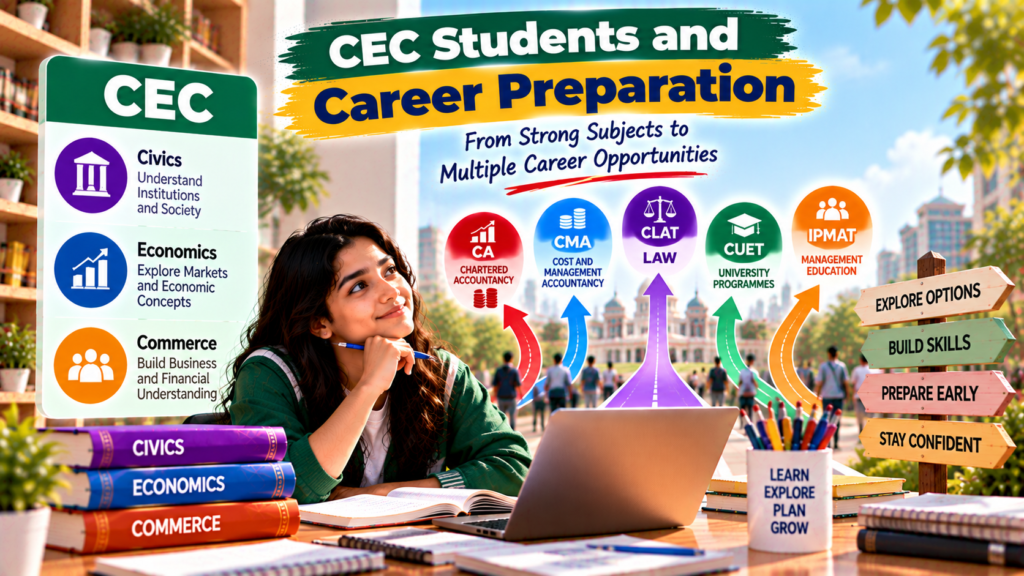
CEC Students and Career Preparation
CEC provides students with exposure to Civics, Economics and Commerce. This combination can be useful for students who enjoy understanding institutions, society, economic activity and business. It can also provide a foundation from which students can explore several different career directions.
Students interested in law can consider CLAT and begin developing reading comprehension, logical reasoning, legal reasoning and current affairs awareness. Students interested in CA or CMA can strengthen their Commerce and Economics concepts, while those considering university education or management can build additional quantitative, reasoning and communication skills alongside their regular academics.
ACE Students and Career Preparation
ACE combines Accounts, Commerce and Economics, giving students a foundation closely connected with business and financial concepts. Students who enjoy working with accounting concepts, understanding commercial activity and analysing economic ideas may find several professional and university pathways relevant to their interests.
CA and CMA can be natural areas for students to investigate because both involve significant exposure to accounting, finance and business-related concepts. ACE students can also explore CUET and suitable undergraduate programmes, while students interested in management can develop additional reasoning, quantitative and communication skills depending on the entrance pathway they choose.
Connecting Intermediate Subjects With Career Goals
One of the advantages of planning early is that students can understand how their regular subjects relate to future areas of study. Mathematics can support quantitative reasoning, Economics can develop understanding of markets and economic activity, Commerce can introduce business concepts, Accounts can build financial understanding and Civics can encourage awareness of institutions and society.
However, the connection is not always direct. A student does not have to choose a career simply because one Intermediate subject appears closely related to it. Instead, students can use their academic subjects as a starting point and develop additional skills required for their chosen course or examination.
Preparing for CA Alongside Intermediate
Students interested in Chartered Accountancy can use Intermediate to develop strong foundations in accounting, business concepts and economics. Regular conceptual study can make it easier to approach professional-level topics later, while consistent practice can improve accuracy and problem-solving ability.
An integrated approach can allow students to gradually introduce CA-oriented preparation without neglecting their Intermediate academics. The objective is not simply to study more hours but to organise learning so that regular Intermediate education and professional preparation complement each other wherever possible.
Preparing for CMA Alongside Intermediate
CMA can be explored by students interested in costing, financial management, business performance and decision-making. Intermediate subjects such as Commerce, Accounts, Economics and Mathematics can provide useful academic exposure depending on the student’s stream.
Students considering CMA can begin by strengthening their understanding of financial and business concepts. As they become more familiar with the professional pathway, they can gradually introduce specialised preparation and practice. Building analytical and numerical confidence during Intermediate can also be useful for future professional studies.
Preparing for CLAT Alongside Intermediate
Students interested in law can use their Intermediate years to develop the skills required for CLAT. Reading comprehension, logical reasoning, legal reasoning, current affairs awareness and quantitative ability require regular practice rather than last-minute preparation.
CEC students may naturally find Civics and Economics interesting in this context, but CLAT preparation is not limited to CEC. MEC and ACE students can also prepare for law entrance examinations by developing the required reading and reasoning skills. The important factor is consistent practice and understanding the examination requirements.
Preparing for CUET Alongside Intermediate
CUET can provide an entrance route to undergraduate programmes offered by participating universities. Students considering CUET should first identify the type of degree programme they are interested in and then understand the relevant university and programme requirements.
MEC, CEC and ACE students can use their Intermediate subjects as a foundation while preparing for the subjects or components relevant to their intended programmes. Since university and programme requirements can vary, students should always verify the latest eligibility and subject requirements before finalising their CUET preparation strategy.
Preparing for IPMAT Alongside Intermediate
Students interested in management education can explore IPMAT and other relevant management entrance pathways. Preparation can involve quantitative ability, logical reasoning and verbal ability, which means students need to develop skills beyond their regular Intermediate subjects.
MEC students may already have regular exposure to Mathematics, but students from CEC and ACE can also build quantitative skills through structured practice. Regardless of stream, reading, reasoning and communication should also be developed because management education requires students to work with information, make decisions and communicate ideas effectively.
Building Common Skills for Multiple Pathways
Although CA, CMA, CLAT, CUET and IPMAT have different objectives, some foundational skills can support preparation across several of them. Time management, reading comprehension, analytical thinking, problem-solving and consistent revision are valuable for students regardless of their eventual choice.
Developing these skills early can also make it easier for students to change direction if their interests evolve. A student who initially considers CA may later become interested in management, for example. Strong foundational skills remain useful even when the specific examination or course changes.
Creating a Practical Intermediate Study Plan
Career preparation should not completely take over Intermediate academics. Students still need to perform well in their regular subjects and build a strong academic foundation. A practical plan can therefore divide study time between Intermediate learning, career-specific preparation, revision and practice.
The exact schedule will depend on the student’s goals and current academic level. Students can begin with a manageable amount of career-oriented preparation and gradually increase it as they become more confident. Weekly planning can also help students identify which subjects or skills require additional attention rather than studying every area equally.
How CMS Supports an Integrated Approach
At CMS, students can pursue MEC, CEC and ACE as their Intermediate streams while exploring integrated preparation for pathways such as CA, CMA, CLAT, CUET and IPMAT. This approach brings regular Intermediate academics and future-oriented preparation into the same broader academic plan. CMS is one of the best MEC Colleges in Hyderabad.
The purpose of such an approach is to help students become familiar with their future options while they are still developing their Intermediate foundation. Instead of treating career preparation as something that begins only after Intermediate, students can gradually build relevant knowledge, examination skills and study habits during these two important academic years.
Planning Without Limiting Future Options
Early career planning should create clarity, not pressure. Students should be encouraged to explore different possibilities before deciding which direction suits them best. Understanding CA, CMA, CLAT, CUET and IPMAT can help students compare professional courses, law, management and university-based pathways.
It is also important to recognise that a student’s interests can change. Choosing MEC, CEC or ACE does not mean that every student must follow the same career route. The value of good planning lies in understanding the available choices, developing transferable skills and making decisions based on informed interests rather than assumptions.
Conclusion
MEC, CEC and ACE can provide strong academic foundations for students who want to explore a variety of professional and higher-education pathways. CA, CMA, CLAT, CUET and IPMAT each offer different opportunities, and students can begin understanding these options while completing Intermediate rather than waiting until the final stage.
The most effective approach is to combine strong Intermediate academics with gradual career preparation. By identifying their interests, understanding pathway requirements, building common skills and following a realistic study plan, students can make their Intermediate years more purposeful. Early awareness does not require an immediate career decision; it simply gives students more time to prepare thoughtfully for the direction they eventually choose.