
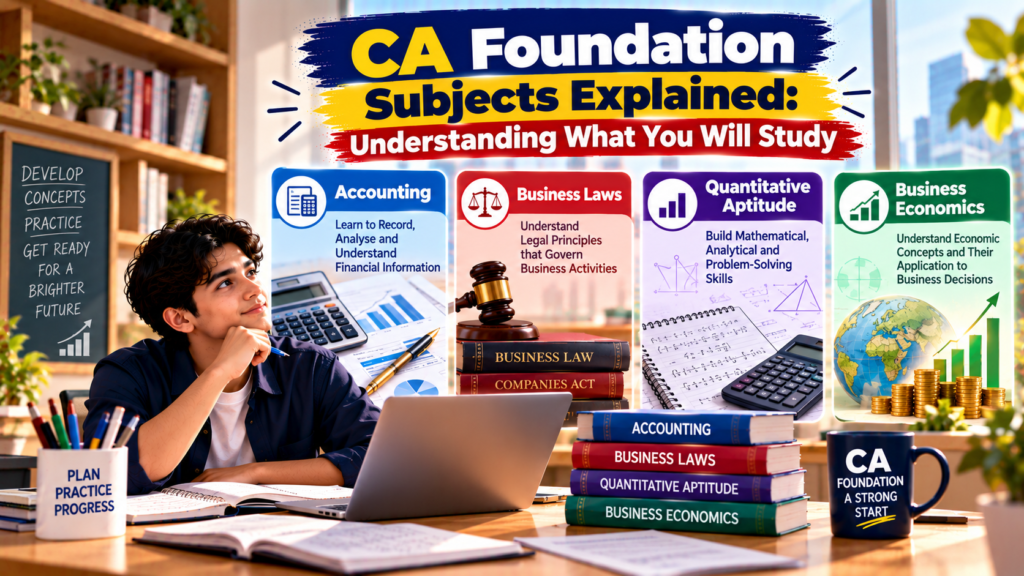
For students planning to pursue Chartered Accountancy after Intermediate, understanding the CA Foundation stage is an important first step. CA Foundation introduces students to several areas that form the basis for later professional studies, including accounting, business laws, quantitative concepts and economics. Knowing what each subject involves can help students understand the type of preparation required before they begin their CA journey.
Students from commerce-oriented Intermediate streams such as MEC and CEC may already have exposure to some related concepts through their regular studies. However, CA Foundation requires students to approach these subjects with greater conceptual clarity and examination-focused preparation. Understanding the purpose of each paper can therefore help students plan their preparation more effectively.
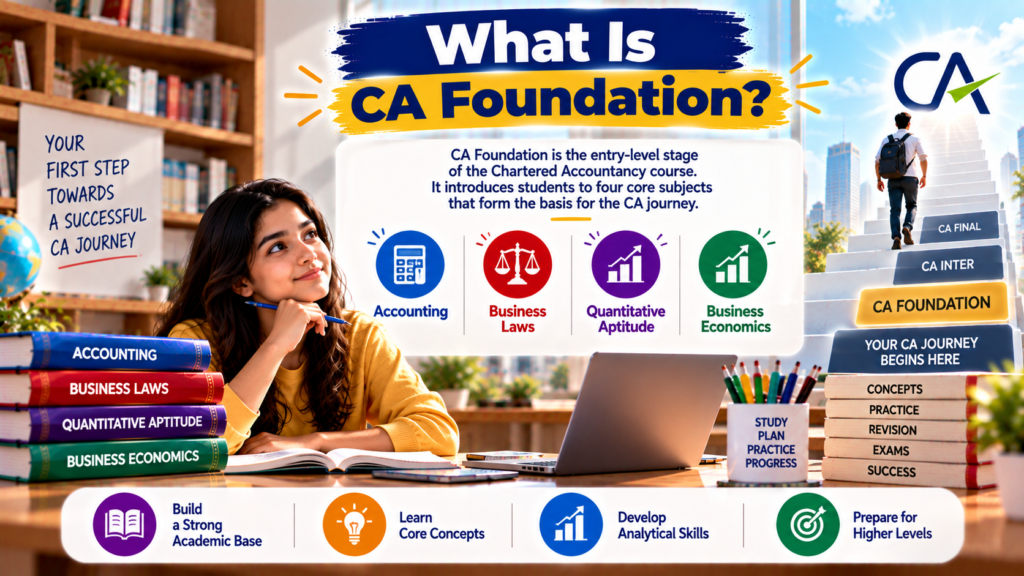
What Is CA Foundation?
CA Foundation is the entry-level stage of the Chartered Accountancy course. It introduces students to fundamental concepts that are relevant to accounting, business, law, quantitative aptitude and economics. The stage is designed to establish the academic base required for progressing into the subsequent levels of the CA course.
The Foundation stage is not simply an extension of Intermediate Commerce subjects. Students need to become comfortable with a broader range of concepts and learn how to apply them to examination questions. Regular practice, revision and conceptual understanding are therefore important from the beginning.
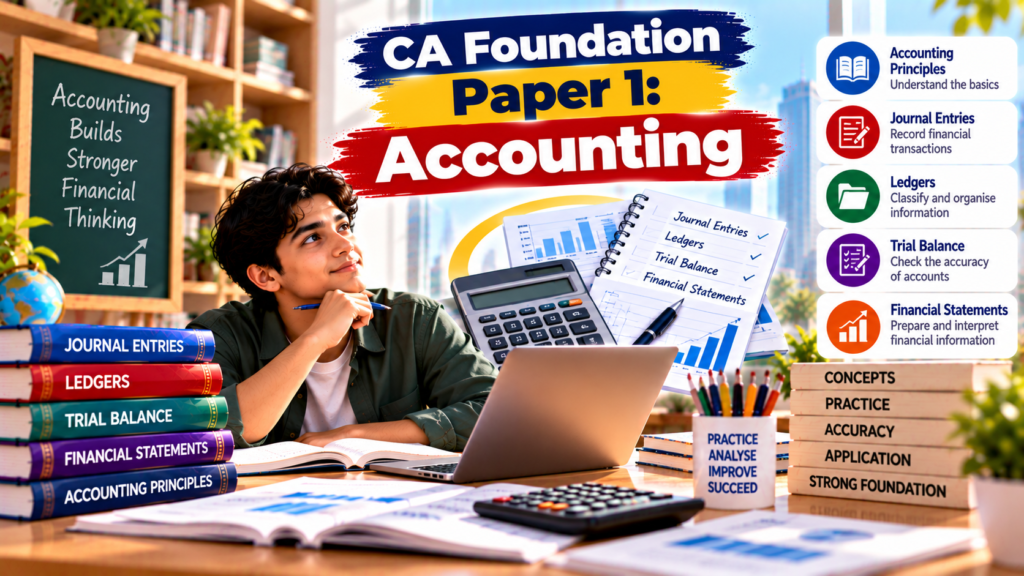
Paper 1: Accounting
Accounting is one of the core areas of CA education because Chartered Accountants work extensively with financial information. At the Foundation level, students are introduced to fundamental accounting concepts and the principles used to record and interpret financial transactions.
Students need to understand how accounting information is prepared rather than simply memorising procedures. Concepts such as accounting principles, journal entries, ledgers, trial balance and financial statements form an important foundation for further accounting studies. Regular numerical practice is particularly useful because students need to become comfortable applying concepts to different problems.
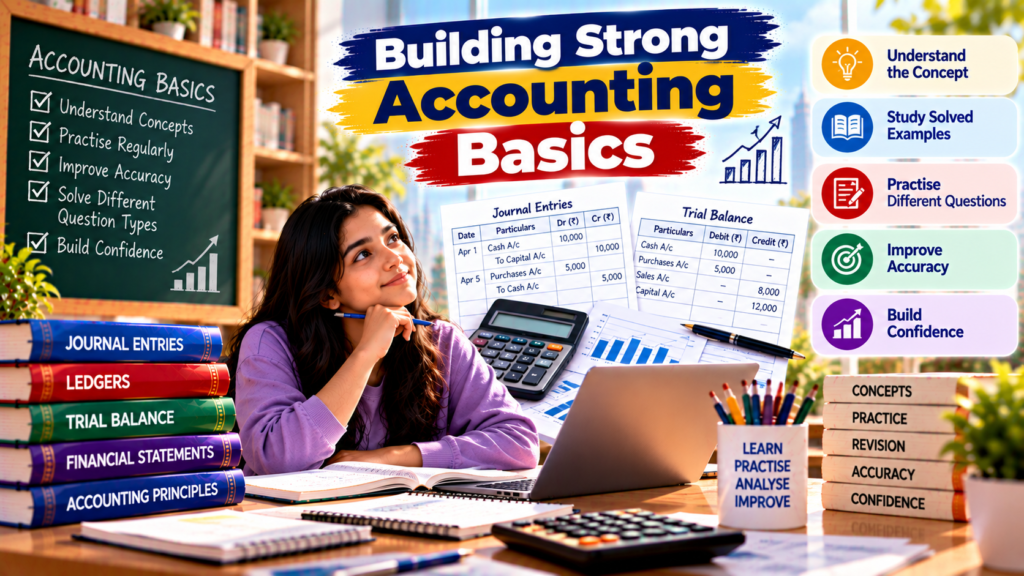
Building Strong Accounting Basics
Students who have studied Commerce or Accounts during Intermediate may already be familiar with some basic accounting concepts. However, Foundation preparation requires them to strengthen these concepts and improve accuracy. Small errors in calculations, journal entries or the interpretation of a question can affect the final answer.
A useful approach is to understand why an accounting treatment is used before attempting to memorise it. Students can first learn the concept, work through solved examples and then practise different types of questions. Over time, this helps build both speed and confidence.

Paper 2: Business Laws
Business Laws introduces students to the legal principles that influence business activities. The subject helps students understand how agreements, obligations and commercial relationships are governed by legal rules.
For students who have not previously studied law in depth, the terminology can initially appear unfamiliar. The key is to understand the meaning and application of legal principles rather than trying to memorise entire sections without context. Reading questions carefully and identifying the relevant legal principle are important skills for this paper.
Developing Legal Understanding
Business Laws requires a different style of preparation compared with numerical subjects. Students need to read carefully, understand the facts presented in a question and determine how the relevant principle applies. This makes comprehension and analytical thinking important parts of preparation.
CEC students may already have some exposure to institutions, government and social structures through Civics, which can help them develop an interest in legal and institutional concepts. However, CA Foundation Business Laws has its own specialised content, so students need dedicated preparation regardless of their Intermediate stream.
Paper 3: Quantitative Aptitude
Quantitative Aptitude brings mathematical and analytical concepts into CA Foundation preparation. The paper focuses on areas such as business mathematics, logical reasoning and statistical concepts, requiring students to work accurately while managing time.
Students from MEC may find the quantitative component familiar because Mathematics is part of their Intermediate stream. This can provide useful preparation experience, particularly when students are already accustomed to solving numerical problems. However, familiarity with Mathematics does not automatically guarantee performance in an entrance or professional examination; students still need to understand the specific question patterns and practise accordingly.
Building Speed Along With Accuracy
Quantitative preparation involves more than knowing formulas. Students need to identify the correct method, perform calculations accurately and reach the answer within the available time. This makes regular practice particularly important.
Students can improve gradually by starting with fundamental concepts and then moving towards mixed problem sets. Keeping track of recurring mistakes can also help. If a student repeatedly loses marks because of calculation errors, formula confusion or misunderstanding questions, identifying that pattern early makes revision more targeted.
Paper 4: Business Economics
Business Economics introduces students to economic concepts and their application to business decisions and markets. Students learn to understand how economic principles influence consumers, businesses and the broader market environment.
Students who have studied Economics during Intermediate may already have a foundation in some economic concepts. MEC and CEC students, in particular, may have encountered topics that encourage them to think about markets, resources, production and economic activity. CA Foundation preparation requires them to strengthen that understanding and apply concepts in the context expected by the examination.
Understanding Economics Instead of Memorising It
Economics can become easier when students understand the relationship between concepts rather than treating every topic as an isolated definition. For example, understanding why changes in demand or supply affect markets can make related questions easier to interpret.
Students should therefore combine conceptual study with question practice. After learning a topic, attempting relevant questions can reveal whether the concept has actually been understood. Regular revision is also important because Economics includes a considerable amount of terminology and interconnected concepts.
How the Four Papers Require Different Skills
One of the important things students notice during CA Foundation preparation is that the four papers do not require exactly the same study method. Accounting and Quantitative Aptitude involve substantial problem-solving and numerical practice. Business Laws requires careful reading, conceptual understanding and application of legal principles. Business Economics requires students to understand economic concepts and apply them appropriately.
This means students should avoid using one study strategy for every subject. A numerical subject may require repeated practice, while a theory-oriented subject may benefit more from structured reading, revision and question-based application. Understanding these differences can make a student’s overall preparation more efficient.
How MEC Students Can Build a Foundation
MEC combines Mathematics, Economics and Commerce, giving students academic exposure that can connect with several CA Foundation areas. Mathematics can support quantitative preparation, Economics provides relevant conceptual exposure and Commerce can help students become familiar with business and accounting-related concepts.
However, students should not assume that Intermediate preparation alone is sufficient for CA Foundation. Professional-course preparation requires students to understand the examination requirements and gradually move towards the appropriate level of practice. Using Intermediate as a foundation while adding focused CA preparation can make the transition more organised.
How CEC Students Can Build a Foundation
CEC combines Civics, Economics and Commerce. Economics and Commerce provide students with useful exposure to concepts that can overlap with parts of CA Foundation, while Civics can help develop awareness of institutions and structured reading.
CEC students may need to pay particular attention to areas such as quantitative preparation depending on their mathematical background and the specific requirements applicable to their CA Foundation attempt. Rather than viewing this as a disadvantage, students can identify the areas requiring additional practice and begin strengthening them during Intermediate.
Balancing CA Foundation With Intermediate
Students preparing for CA Foundation while completing Intermediate need to manage two academic responsibilities. The best approach is usually not to completely separate them but to identify areas where the learning can complement each other.
For example, students can strengthen their Intermediate concepts first and then gradually introduce CA Foundation-level questions and practice. A weekly schedule can include regular Intermediate study, dedicated Foundation preparation, revision and practice tests. As examinations approach, the balance can be adjusted according to the student’s immediate academic priorities.
How CMS Can Support CA Foundation Preparation
At CMS CEC Intermediate Colleges in Hyderabad, students pursuing MEC and CEC can explore integrated CA coaching alongside their Intermediate education. This approach allows students to continue their regular Intermediate studies while working towards the academic foundation required for CA preparation.
An integrated approach can also help students become familiar with professional-course expectations earlier. Instead of waiting until Intermediate is completed to understand the CA pathway, students can gradually develop relevant concepts, practise questions and build consistent study habits alongside their regular academics.
What Students Should Focus on Before Starting
Students do not need to master the entire CA Foundation syllabus before beginning the course. Instead, they can focus on developing the habits and foundational abilities that will make professional preparation easier. Regular study, accurate numerical work, careful reading, conceptual understanding and consistent revision are all valuable.
It is also useful to become comfortable with asking questions when a concept is unclear. Professional courses involve increasingly detailed concepts, so developing the habit of understanding a topic properly rather than simply memorising an answer can benefit students throughout their CA journey.
Conclusion
CA Foundation introduces students to four important areas: Accounting, Business Laws, Quantitative Aptitude and Business Economics. Each paper requires a different combination of conceptual understanding, practice, accuracy and application. Understanding these differences before beginning preparation can help students approach the course with greater confidence and a clearer study strategy.
For MEC and CEC students, Intermediate can provide a useful starting foundation, particularly through Commerce and Economics and, for MEC students, Mathematics. With focused preparation alongside Intermediate, students can gradually develop the academic skills required for CA Foundation and make a more organised transition towards the Chartered Accountancy pathway.