
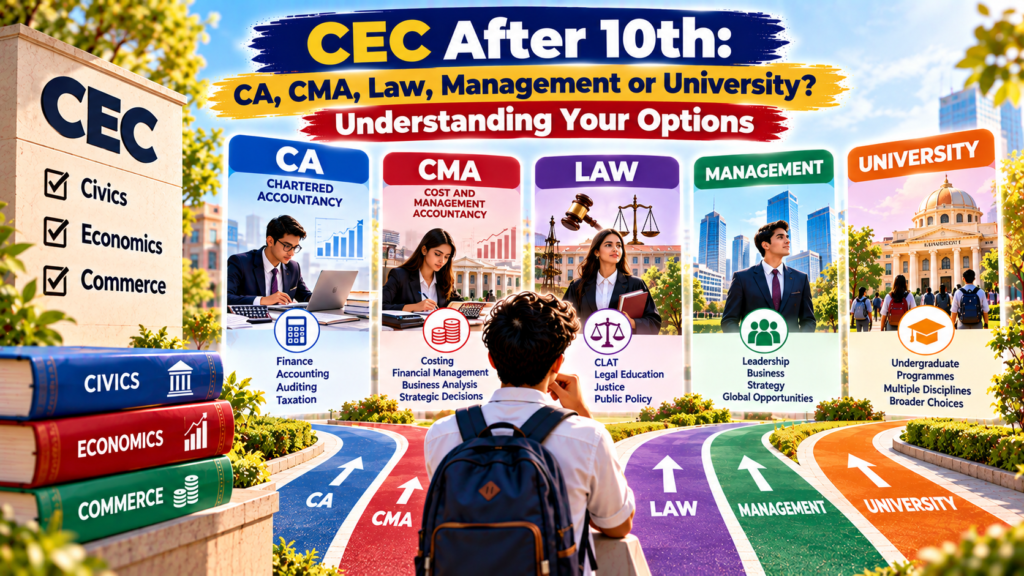
Choosing a stream after 10th can influence the subjects students study during their Intermediate years and the academic pathways they explore afterwards. For students interested in commerce, business, economics and social institutions, CEC can provide a combination of subjects that connects with several higher-education and career directions. However, choosing CEC does not mean that students have to commit to one particular career from the beginning.
CEC stands for Civics, Economics and Commerce, bringing together an understanding of institutions and society, economic activity and business concepts. After Intermediate, students can explore professional courses such as CA and CMA, law through pathways such as CLAT, management education through suitable entrance routes, or undergraduate programmes through university admissions. Understanding these options early can help students use their Intermediate years more purposefully.
What Does CEC Offer Students?
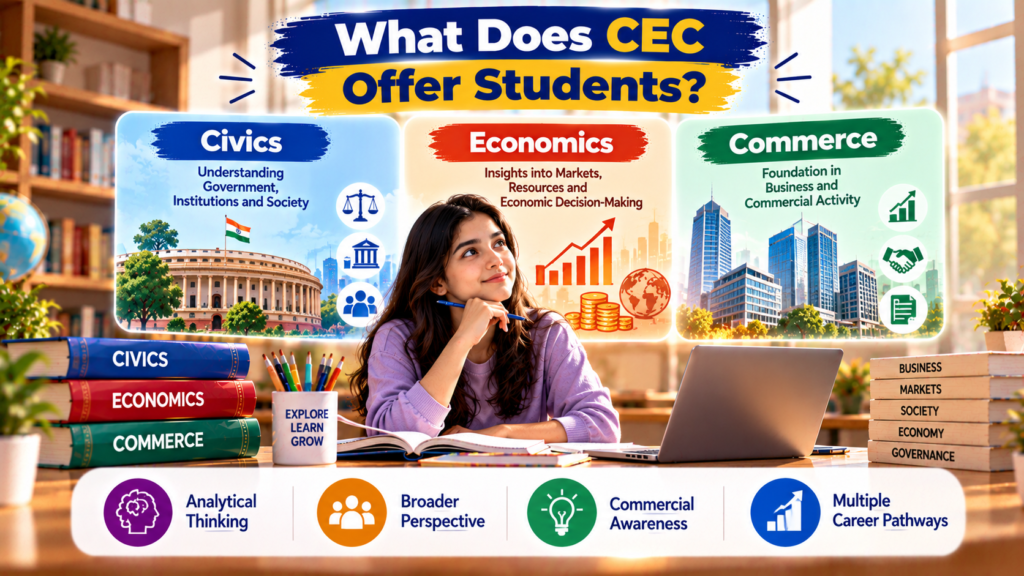
CEC combines three subjects that provide different but complementary perspectives. Civics introduces students to government, institutions, citizenship and the functioning of society. Economics helps students understand markets, resources, production, consumption and economic decision-making. Commerce introduces the fundamentals of business and commercial activity.
This combination can help students develop skills such as analytical thinking, understanding different perspectives, interpreting information and building commercial awareness. These skills can be useful across multiple career pathways. At the same time, students should remember that their Intermediate subjects are a foundation; professional courses and competitive examinations require additional preparation specific to the chosen pathway.
CEC and Chartered Accountancy
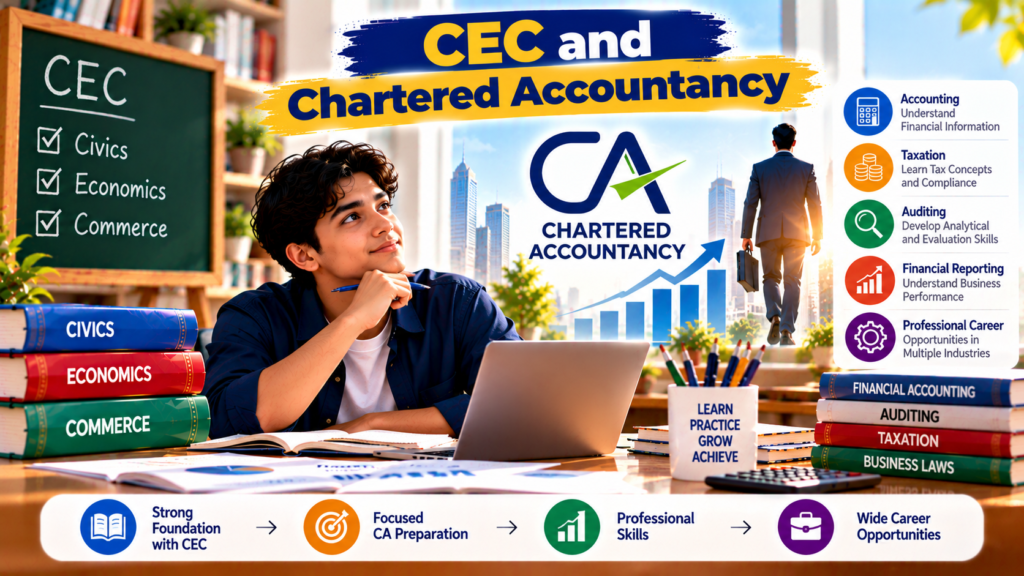
Chartered Accountancy can be considered by CEC students who are interested in accounting, taxation, auditing, financial reporting and finance-related careers. The profession requires students to develop strong conceptual understanding, accuracy, numerical ability and the discipline to work consistently with detailed financial concepts.
Commerce provides CEC students with an early exposure to business and financial concepts, while Economics can help them understand the wider economic environment in which businesses operate. Students interested in CA can use their Intermediate years to strengthen these fundamentals while beginning to understand the requirements of the professional pathway. Dedicated CA preparation is still necessary because the professional curriculum goes considerably beyond Intermediate-level learning.
CEC and Cost and Management Accountancy
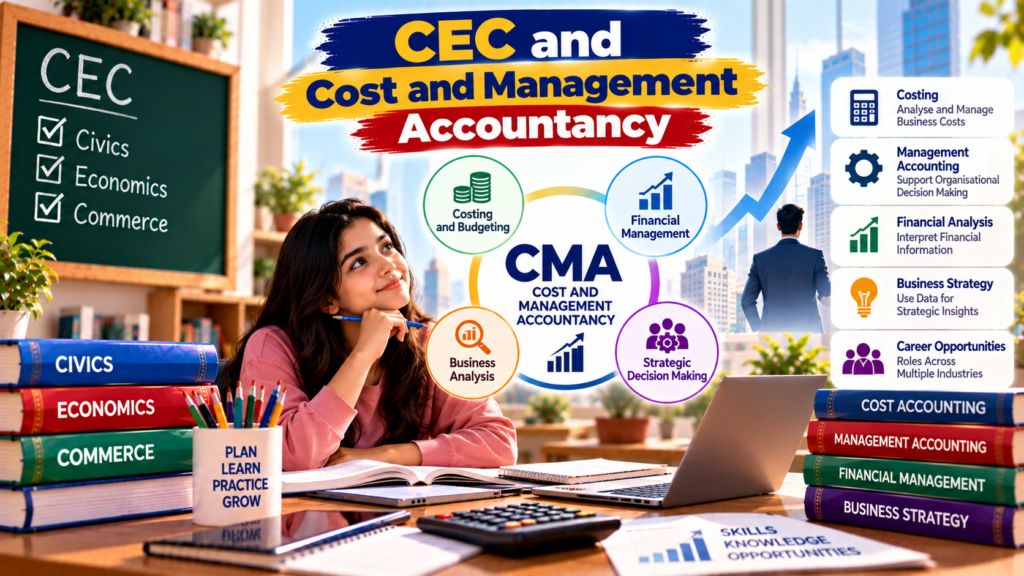
CMA is another professional pathway that students interested in finance and business can explore. Cost and Management Accountants work with areas such as costing, budgeting, financial analysis, management information and business performance. The field combines financial knowledge with the ability to interpret information for organisational decision-making.
CEC can provide useful exposure for students considering CMA. Commerce introduces business-related concepts, while Economics encourages students to understand how organisations operate within changing economic conditions. Students who enjoy analysing business performance and financial information can explore CMA while using Intermediate to strengthen their conceptual foundation.

CEC and a Career in Law
Law is one of the prominent directions CEC students can explore, particularly because Civics introduces students to government institutions, constitutional concepts, citizenship and the relationship between individuals and society. Economics and Commerce can also provide useful perspectives when students later encounter areas such as corporate law, commercial law, taxation or economic policy.
Students interested in undergraduate legal education can explore entrance pathways such as CLAT. Law entrance preparation requires skills beyond the Intermediate syllabus, including reading comprehension, logical reasoning, legal reasoning, current affairs awareness and quantitative ability. CEC students may find some of their existing academic exposure useful, but consistent entrance-oriented practice remains important.
CEC and CLAT Preparation
CLAT provides an entrance pathway to undergraduate law programmes at participating National Law Universities. Students considering law can begin developing relevant skills during Intermediate instead of waiting until the final stage of their education.
CEC students can use their exposure to Civics and Economics to develop an interest in institutions, public issues and current developments. However, successful preparation involves much more than knowing civics or legal concepts. Students need to become comfortable reading passages, identifying arguments, interpreting information and solving reasoning-based questions within a limited amount of time.
CEC and Management Education
Management is another broad career direction that CEC students can consider. Management careers can extend across finance, marketing, operations, human resources, business analytics, strategy and entrepreneurship. Students who enjoy understanding how organisations function and how people and resources are managed may find management education interesting.
CEC can provide a useful foundation because Economics develops awareness of markets and economic activity, while Commerce introduces business concepts. Civics can also encourage students to think about institutions, decision-making and how different stakeholders interact. Students considering management entrance examinations can build additional skills in quantitative ability, logical reasoning, verbal ability and communication.
CEC and IPMAT
Students interested in pursuing integrated management education can explore IPMAT and other relevant management entrance pathways. Such programmes can provide an opportunity to enter management education soon after Intermediate rather than completing a separate undergraduate programme first.
CEC students should not assume that a non-Mathematics stream prevents them from exploring management. Instead, they should examine the requirements of the particular entrance examination and identify the skills they need to strengthen. Quantitative ability, reasoning and verbal ability can all be developed through regular practice, allowing students to gradually build confidence in areas that may not receive as much emphasis in their Intermediate subjects.
CEC and University Education
Professional courses and competitive examinations are not the only choices after Intermediate. University education can provide a broad route into undergraduate study, allowing students to explore areas such as commerce, economics, business, social sciences and other disciplines according to their interests and eligibility.
Students may also explore entrance examinations such as CUET for participating universities and programmes. The exact eligibility criteria, subject requirements and admission processes can differ between universities and programmes. Therefore, students should identify the undergraduate courses they are interested in and check the latest requirements before planning their entrance preparation.
How Civics Can Influence a Student’s Career Perspective
Civics is a distinctive part of the CEC combination because it introduces students to institutions, governance, citizenship and the functioning of society. This can encourage students to think about how decisions are made, how institutions interact and how policies can affect individuals and organisations.
These ideas can be useful beyond careers directly associated with law or public affairs. Business decisions often operate within regulatory and institutional environments, while areas such as corporate governance, public policy and compliance require an understanding of institutions. Civics can therefore contribute to a broader way of thinking that students can carry into different higher-education pathways.
The Role of Economics in CEC
Economics gives students an opportunity to understand how resources, markets and decisions are connected. Concepts such as demand, supply, production, inflation, employment and economic growth can help students interpret developments that affect both businesses and individuals.
This foundation can be relevant to several future directions. CA and CMA students can benefit from understanding the economic environment surrounding businesses, while management students can use economic thinking to understand markets and business decisions. Students interested in law can also encounter economic issues in areas such as policy, regulation and commercial activity.
Why Commerce Matters in the CEC Combination
Commerce provides students with an introduction to business activities and financial concepts. It can help students understand how commercial organisations operate and how different business functions are connected. This can be especially relevant for students who later choose professional courses or undergraduate programmes related to finance, commerce or management.
The knowledge gained through Commerce can also complement the other two CEC subjects. Economics provides a wider view of markets and economic activity, while Civics introduces the institutional and social environment in which organisations operate. Together, the subjects can give students multiple perspectives rather than limiting them to a single type of career.
How to Choose Between CA, CMA, Law, Management and University
CEC gives students several possible directions, so choosing a pathway should begin with understanding personal interests and strengths. Students who enjoy accounting, finance and detailed financial concepts can investigate CA. Those interested in costing, financial analysis and business performance can explore CMA. Students who enjoy reading, reasoning, social institutions and legal issues may find law an interesting direction.
Management may appeal to students interested in business decisions, leadership, strategy and organisations, while university education can provide greater flexibility for students who want to explore an undergraduate subject before specialising. Students do not need to make every career decision immediately after 10th. The Intermediate years can be used to understand different options and gradually identify the direction that feels most suitable.
Building Skills During the Intermediate Years
CEC students can use their Intermediate years to develop skills that remain useful regardless of the final career choice. Reading regularly can strengthen comprehension and awareness, while analysing arguments and information can improve reasoning. Working consistently with Commerce and Economics concepts can strengthen business understanding, and writing and communication practice can help students express their ideas more clearly.
Students preparing for a professional course or entrance examination can gradually add specialised preparation to this foundation. For example, a CLAT aspirant may spend additional time on reading and reasoning, while an IPMAT aspirant may need to strengthen quantitative ability. A student considering CA or CMA can focus more deeply on accounting and finance-related concepts. The goal is to build the right skills without losing focus on Intermediate academics.
How Integrated Preparation Can Help CEC Students
Students who already have an idea about their future direction can begin preparing alongside Intermediate rather than treating career preparation as something that starts only after completing the course. An integrated approach can allow students to coordinate their academic studies with professional-course or entrance-examination preparation.
At CMS CEC Junior Colleges in Hyderabad, students pursuing CEC can explore integrated preparation options for CA, CMA, CLAT, IPMAT and CUET alongside their Intermediate education. This allows students to continue building their Intermediate foundation while gradually developing the skills and knowledge required for their chosen future pathway.
Making an Informed Choice After 10th
Choosing CEC after 10th can keep several possibilities open, but students should use the opportunity to understand those possibilities rather than simply following a popular career. Exploring what CA, CMA, law, management and university education actually involve can help students identify the options that match their interests.
It is also use