
Introduction
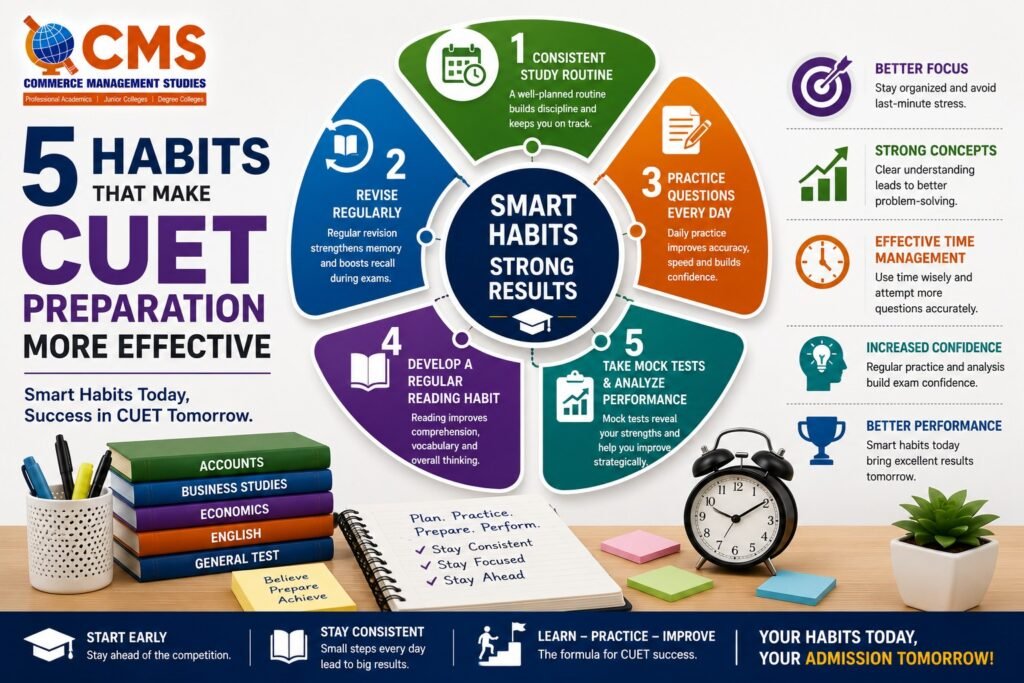
Preparing for CUET alongside Intermediate can be a positive step for students who are planning their undergraduate education through participating universities. The examination requires students to manage subject knowledge along with skills such as comprehension, accuracy, time management, and question-solving. While a good study plan provides direction, the habits students develop every day often have a major influence on how effectively they use their preparation time.
The good news is that effective CUET preparation does not necessarily require studying for extremely long hours every day. A consistent and organized approach can make preparation more manageable and productive. By developing habits such as regular revision, practicing questions, analyzing mistakes, reading consistently, and taking mock tests, students can gradually improve their confidence and examination readiness.
1. Follow a Consistent Study Routine
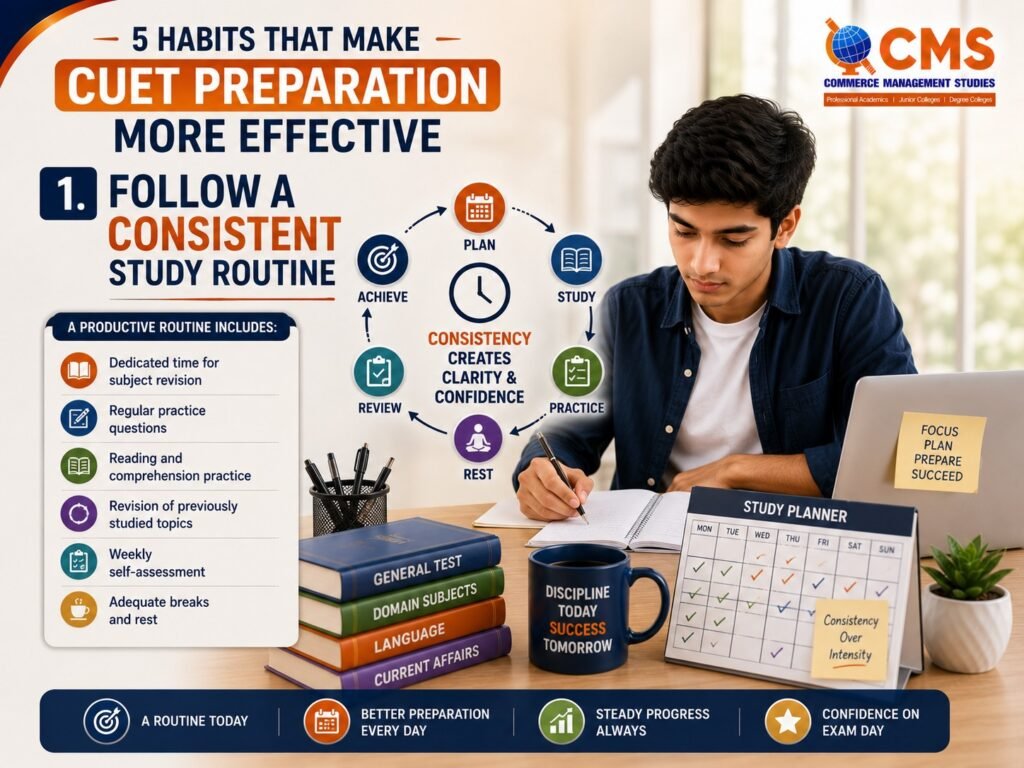
One of the most useful habits for CUET preparation is maintaining a consistent study routine. Students should create a realistic timetable that includes Intermediate academics, CUET preparation, revision, practice, and sufficient breaks. A routine helps students know what needs to be completed each day instead of spending time deciding what to study next.
Consistency is particularly important because CUET preparation involves multiple areas that may require different types of practice. Some topics may require conceptual revision, while others require question-solving or reading practice. Dividing preparation into manageable daily tasks can make the syllabus feel more approachable and reduce the tendency to postpone difficult topics.
A productive routine can include:
- Dedicated time for subject revision
- Regular practice questions
- Reading and comprehension practice
- Revision of previously studied topics
- Weekly self-assessment
- Adequate breaks and rest
The objective should be to create a routine that students can realistically follow over a long period rather than an extremely demanding schedule that becomes difficult to maintain.
2. Revise Regularly Instead of Waiting Until the End
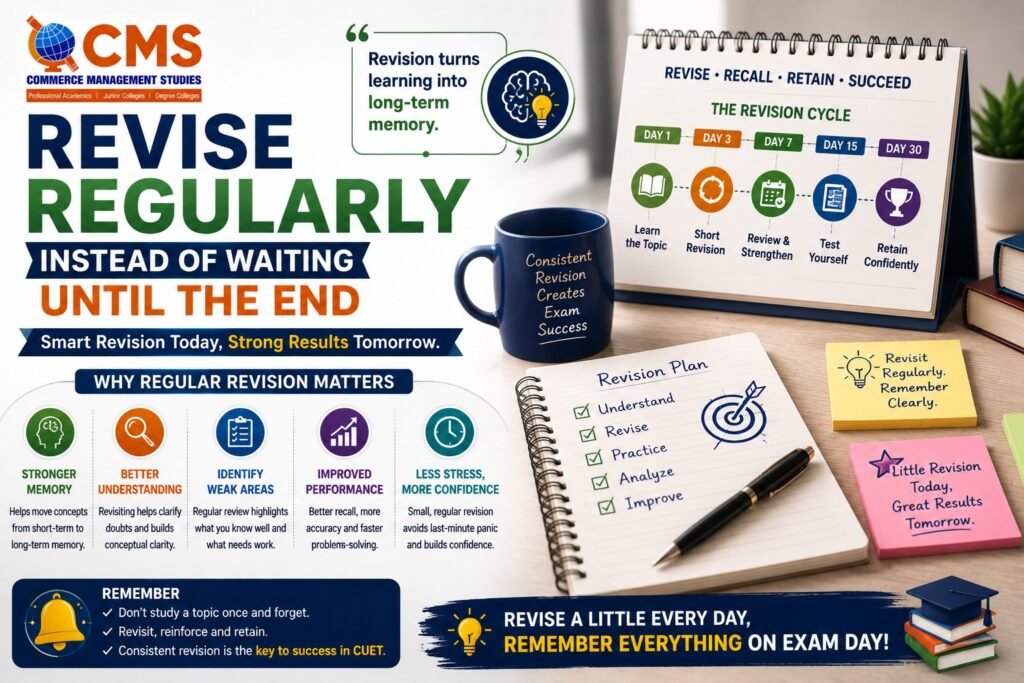
Revision is one of the most important parts of entrance-examination preparation. Learning a topic once does not guarantee that the information will remain accessible during the examination. Regular revision gives students repeated opportunities to recall concepts and identify areas that need additional attention.
Students can use short revision sessions throughout the week instead of leaving the entire syllabus for the final weeks. After completing a topic, they can revisit it after a few days and then review it again at a later stage. This approach can help strengthen memory and make it easier to recall important concepts when solving questions under time pressure.
Revision should also include mistakes made during practice. Maintaining a simple record of frequently repeated errors can help students recognize patterns in their preparation and prevent the same mistakes from occurring repeatedly.
3. Practice Questions Every Day
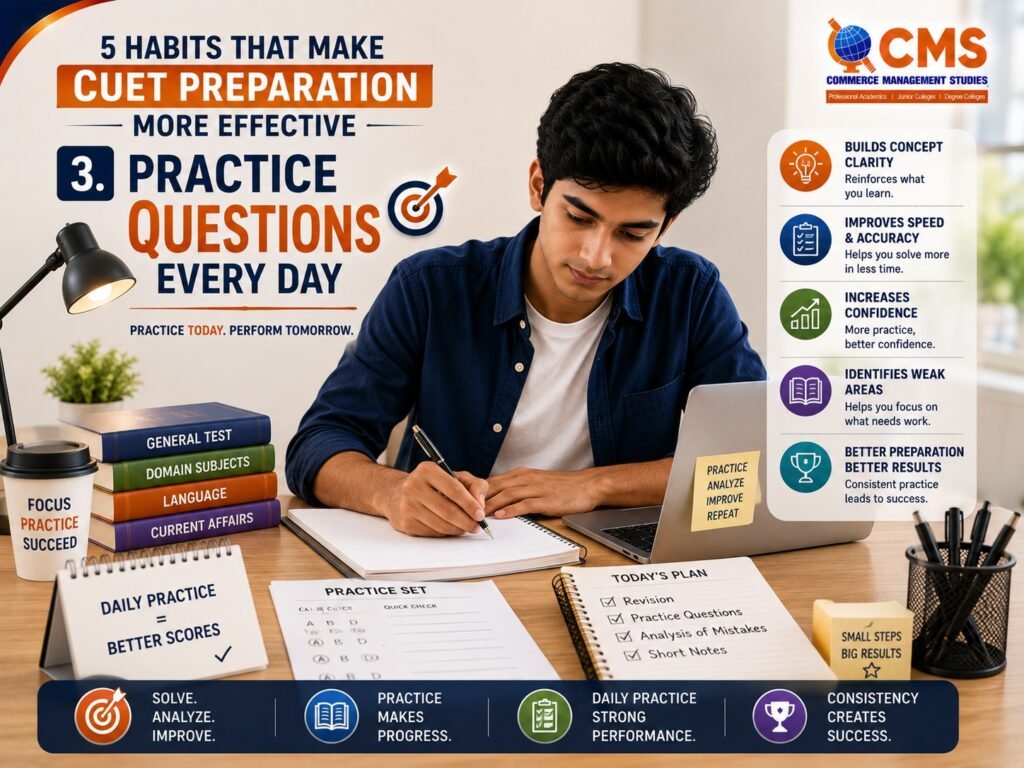
Understanding a concept is important, but students also need to learn how to apply that knowledge to questions. Regular practice can help students become familiar with different question formats, improve their speed, and identify areas where their understanding needs improvement.
Daily practice does not have to involve hundreds of questions. A smaller number of carefully selected questions solved consistently can be more useful when students take time to understand their mistakes. Students should focus on why an answer is correct, why another option is incorrect, and what concept or reasoning was required to reach the solution.
As preparation progresses, students can gradually introduce timed practice. This can help them develop the ability to solve questions accurately while working within examination time constraints.
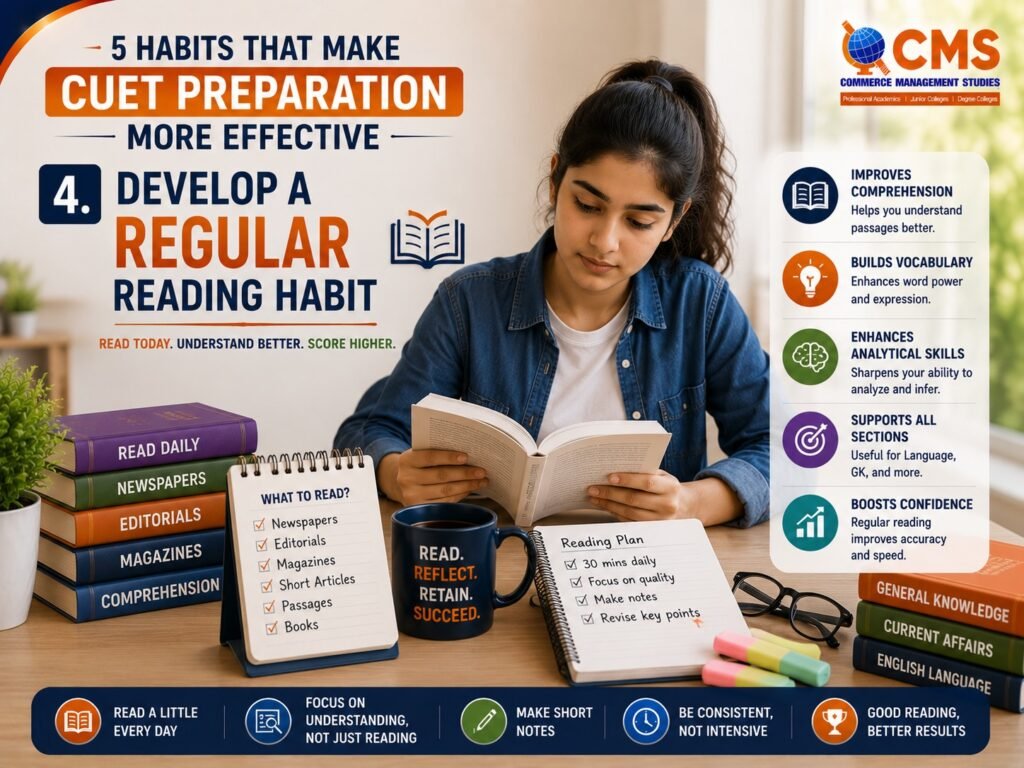
4. Develop a Regular Reading Habit
Reading is an important habit for students preparing for entrance examinations because it can improve comprehension, vocabulary, concentration, and the ability to process information quickly. Students can gradually develop this skill by reading newspapers, quality articles, essays, business-related content, and other informative material.
The objective is not simply to read more pages but to understand what is being read. Students can practice identifying the main idea, supporting arguments, important details, and the overall conclusion of an article. This can strengthen their ability to work with unfamiliar passages and information.
A regular reading habit can also benefit students beyond CUET. Strong comprehension and communication skills can support them during undergraduate education, where they may need to read textbooks, research material, reports, case studies, and other academic content.

5. Take Mock Tests and Analyze Performance
Mock tests are valuable because they allow students to practice under conditions that resemble an actual entrance examination. They can help students understand how they perform when questions must be solved within a specific time limit. Regular mock tests can also reveal which areas are strong and which require additional preparation.
However, simply taking mock tests is not enough. The most valuable part of a mock test is the analysis that follows. Students should review incorrect answers, questions they guessed, questions that took too long, and topics where they repeatedly make mistakes.
After each test, students can ask:
- Which topics caused the most mistakes?
- Were the mistakes caused by lack of knowledge or careless errors?
- Which questions took too much time?
- Did time management affect the final sections?
- Which areas improved compared with the previous test?
- What should be revised before the next test?
This process turns each mock test into a learning opportunity rather than simply a measurement of marks.
Balancing CUET Preparation with Intermediate
CUET preparation should not come at the expense of Intermediate academics. For many students, their Intermediate subjects can provide the conceptual foundation for relevant CUET domain preparation. Studying these subjects thoroughly can therefore support both academic performance and entrance preparation.
Students can create an integrated routine in which classroom learning is followed by revision and CUET-oriented practice. When a topic is completed in Intermediate, students can reinforce it through objective questions and timed practice where relevant. This approach can reduce duplication and help students use their study time more efficiently.
Making Preparation More Effective Through Self-Assessment
Self-assessment helps students understand whether their preparation is actually producing improvement. Instead of judging progress only by the number of hours studied, students can track measurable indicators such as practice accuracy, mock-test performance, time taken to solve questions, and improvement in previously weak areas.
Students can maintain a simple weekly review to identify what worked and what needs to change. If a particular topic continues to cause difficulty, additional revision or practice can be scheduled. Similarly, if a student consistently performs well in one area, more preparation time can be directed toward weaker sections.
This approach encourages students to take responsibility for their preparation and make adjustments based on actual performance.
The Importance of Maintaining a Positive Approach
Competitive examination preparation can sometimes feel demanding, particularly when students compare their progress with others. A healthier approach is to focus on individual improvement. Preparation is a gradual process, and students may perform differently from one test to another.
Instead of becoming discouraged by a low score, students can use it to identify what needs improvement. Every mistake can provide information about a weak concept, a time-management issue, or a careless error. Maintaining a positive mindset while remaining honest about areas that need work can make preparation more productive.
How Integrated CUET Preparation Can Help
Students who begin CUET preparation alongside Intermediate can benefit from a structured approach that connects academic learning with entrance-examination practice. Regular classroom learning can strengthen subject concepts, while objective-question practice, mock tests, and revision can help students become comfortable with the examination format.
At CMS CUET Coaching in Hyderabad, students can pursue Intermediate education with integrated CUET preparation, allowing them to work on their academic subjects while gradually developing the skills required for entrance examinations. A structured preparation routine can help students maintain consistency, track their progress, and approach the examination with greater confidence.
Conclusion
Effective CUET preparation is not only about how many hours a student studies. It is also about developing habits that make those study hours productive. Maintaining a consistent routine, revising regularly, practicing questions, reading every day, and taking mock tests with proper analysis can help students build stronger preparation over time.
Students should also remember that preparation works best when it is balanced with Intermediate academics, adequate rest, and a positive mindset. By starting early, monitoring their progress, learning from mistakes, and maintaining these five habits consistently, students can make their CUET preparation more organized, focused, and effective.