
Introduction
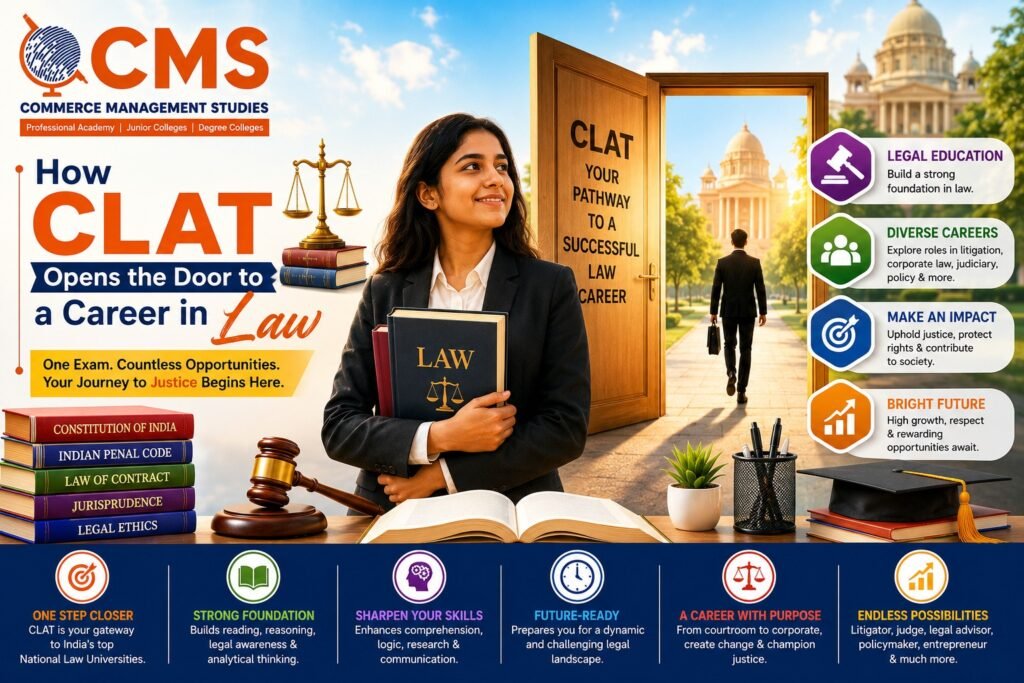
Law is a dynamic professional field that extends far beyond the traditional image of courtroom arguments. Today, legal professionals work across corporate organizations, law firms, government institutions, financial services, technology companies, consulting firms, and many other sectors. For students who are interested in law, public policy, business, social issues, and logical reasoning, pursuing legal education after Intermediate can open the door to a wide range of academic and career opportunities.
The Common Law Admission Test (CLAT) is one of the major entrance examinations for admission to undergraduate law programmes at participating National Law Universities (NLUs). It provides students with an opportunity to compete for admission into integrated undergraduate law programmes after completing their qualifying education. Preparing for CLAT also helps students develop skills such as reading comprehension, logical reasoning, legal awareness, and critical thinking, which can remain valuable throughout their legal education and professional careers.
What is CLAT?
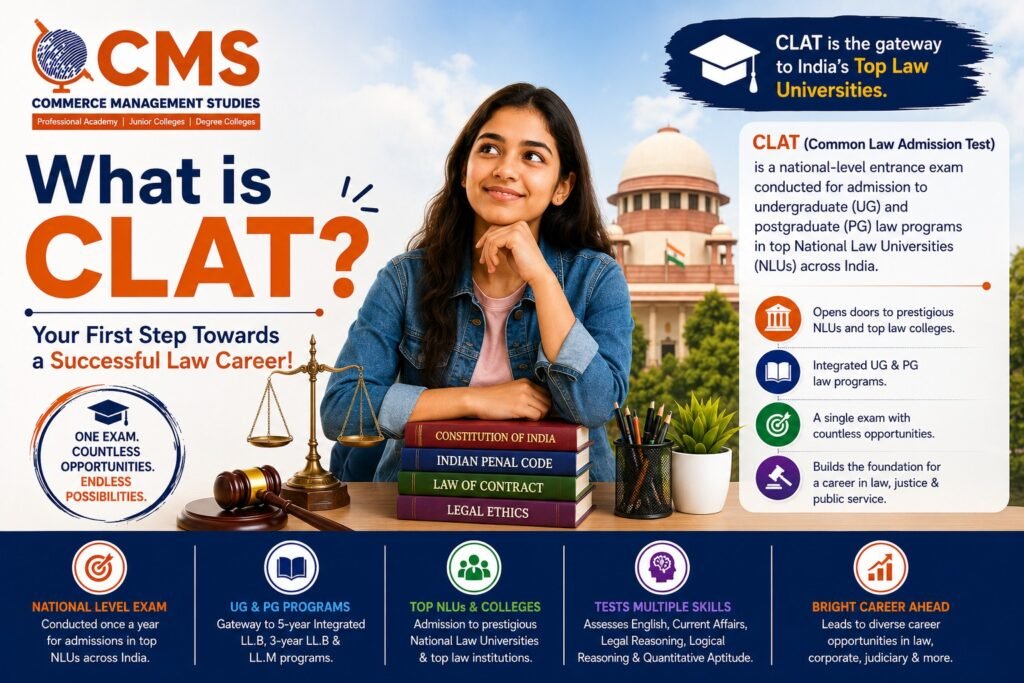
CLAT stands for Common Law Admission Test. It is a national-level entrance examination used by participating National Law Universities for admission to undergraduate and postgraduate law programmes. For undergraduate aspirants, the examination is designed to assess abilities that are relevant to studying law, including comprehension, reasoning, and awareness of current issues.
For students planning to pursue law after Intermediate, the undergraduate CLAT pathway can lead to integrated law programmes such as BA LL.B., BBA LL.B., B.Com LL.B., and other programmes depending on the participating institution. Students should always check the latest official CLAT notification and the specific university’s eligibility and programme details before applying.

Why CLAT is Important for Aspiring Law Students
CLAT provides students with a common entrance route to several participating National Law Universities. Admission through a competitive entrance examination allows students to compete for seats based on their performance rather than having to apply separately through completely different entrance processes for every participating institution.
Preparing for CLAT also introduces students to skills that are closely connected with legal education. Lawyers regularly read large amounts of information, interpret arguments, identify relevant facts, understand rules, evaluate evidence, and communicate their conclusions clearly. CLAT preparation can help students begin developing some of these abilities even before they enter law school.
Understanding the CLAT Undergraduate Examination
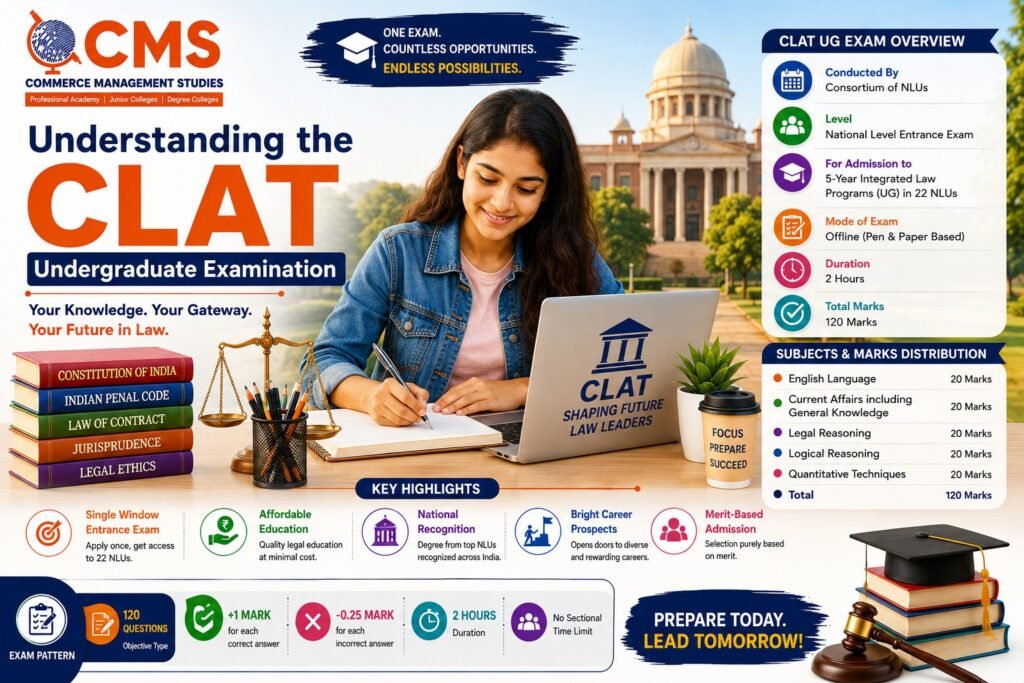
The undergraduate CLAT examination assesses multiple areas of aptitude. These broadly include English Language, Current Affairs including General Knowledge, Legal Reasoning, Logical Reasoning, and Quantitative Techniques. The examination therefore requires students to develop more than one type of academic ability.
A student who wants to prepare effectively should understand that CLAT is not simply a test of legal knowledge. Students do not need to become lawyers before entering law school. Instead, preparation focuses on the ability to understand passages, interpret information, reason logically, stay aware of important developments, and apply information to questions.
The Importance of English and Reading Skills
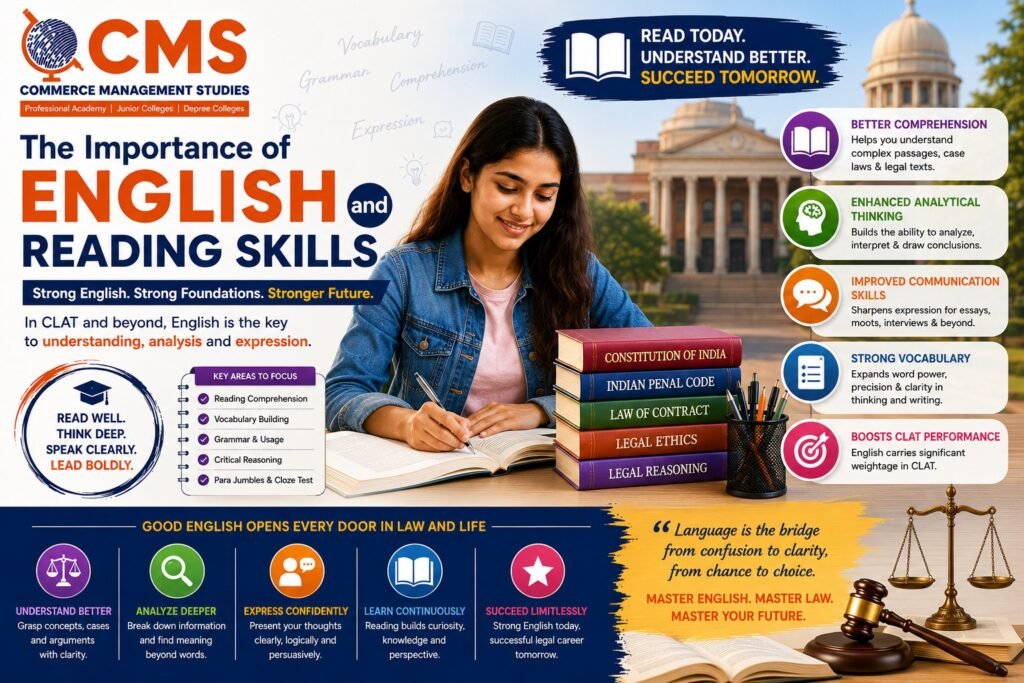
Strong reading ability is extremely valuable for both CLAT preparation and a future legal career. Students preparing for the examination regularly encounter passages that require careful reading and interpretation. They need to identify the central idea, understand arguments, recognize important details, and answer questions based on the information provided.
Developing a regular reading habit can therefore make preparation more effective. Students can read newspapers, magazines, editorials, quality articles, and other informative material. The goal should not simply be to increase reading speed but to understand what is being communicated and develop the ability to distinguish important information from supporting details.
Role of Current Affairs in CLAT
Law does not exist separately from society. Legal decisions and public policies can be influenced by developments in government, economics, international relations, technology, the environment, and social issues. This is one reason awareness of current affairs is an important component of CLAT preparation.
Students should develop the habit of following reliable news sources and understanding major developments rather than attempting to memorize large numbers of disconnected facts. Reading about an event, understanding its background, identifying the important issues involved, and connecting it with broader developments can make current-affairs preparation more meaningful.
Understanding Legal Reasoning
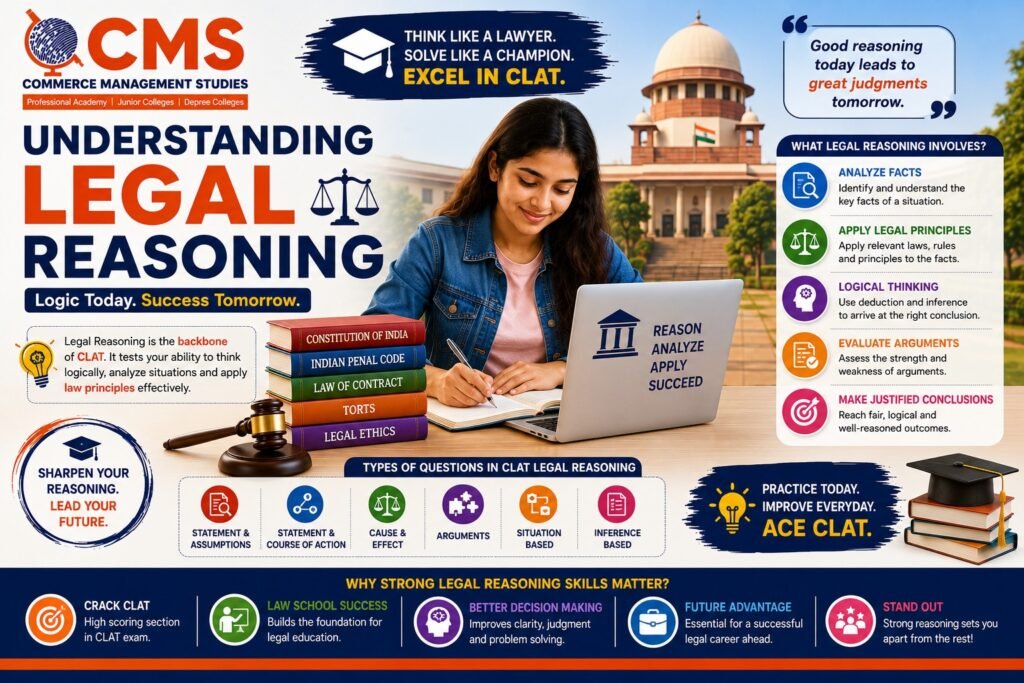
Legal Reasoning is an important component of CLAT preparation, but students do not need extensive prior legal education to begin preparing for it. Questions generally require students to understand a given legal principle or situation and apply reasoning to reach an appropriate conclusion.
This makes logical thinking particularly important. Students should focus on understanding the information presented in a question and applying the relevant principle rather than relying entirely on memorized legal terminology. Regular practice can help students become more comfortable with unfamiliar legal situations and strengthen their ability to reason systematically.
Importance of Logical Reasoning
Logical reasoning is useful for anyone considering a career in law because legal work frequently involves examining facts, identifying relationships, evaluating arguments, and reaching conclusions based on evidence. CLAT preparation provides students with an opportunity to develop these abilities through structured practice.
Students can improve their reasoning skills by solving different types of problems regularly. They should also spend time understanding why an answer is correct rather than simply checking the final option. Over time, this can help develop a more systematic approach to unfamiliar problems.
The Role of Quantitative Techniques
Although law is generally associated with reading, writing, and reasoning, basic quantitative ability is also part of the CLAT undergraduate examination. Students may need to interpret numerical information, tables, graphs, or data and answer questions based on it.
Students do not necessarily need advanced mathematical expertise to approach this section effectively. Strong fundamentals, careful interpretation, calculation practice, and time management can make a significant difference. Regular practice can help students become more comfortable working with numerical information within a limited time.
How CEC Can Support CLAT Preparation
CEC, which includes Civics, Economics, and Commerce, can provide students with an academic foundation that connects well with several areas relevant to law. Civics introduces students to government and institutions, Economics helps them understand markets and economic systems, and Commerce provides exposure to business and financial concepts.
This combination can be particularly useful for students who are interested in areas such as corporate law, commercial law, taxation, banking, finance, or public policy. However, students should remember that CLAT preparation requires dedicated practice in the specific examination areas, including reading comprehension, legal reasoning, logical reasoning, current affairs, and quantitative techniques.
How MEC Students Can Explore Law
MEC, which includes Mathematics, Economics, and Commerce, can also be a suitable Intermediate foundation for students who are interested in exploring law. Mathematics can strengthen numerical and analytical thinking, Economics can develop an understanding of markets and policy, and Commerce can introduce students to business and financial concepts.
For students interested in corporate and commercial legal careers, this combination can provide useful background knowledge. At the same time, students need to develop the language, reasoning, reading, and legal-awareness skills required for CLAT. The Intermediate stream does not determine whether a student can succeed in law; interest, preparation, and consistent skill development are much more important.

Career Opportunities After Studying Law
A law degree can lead to diverse career opportunities. While litigation remains an important area of legal practice, graduates can also explore careers in corporate law, legal consulting, compliance, intellectual property, taxation, arbitration, policy, and other specialized fields.
Some potential career areas include:
- Litigation and courtroom practice
- Corporate law
- Legal consulting
- Banking and financial law
- Intellectual property law
- Taxation law
- Arbitration and dispute resolution
- Compliance and regulatory affairs
- Public policy
- Legal research
- Government and public-sector roles
The career path a law graduate chooses can depend on their interests, specialization, internships, professional experience, and the skills they develop during law school.
Law and the Corporate World
The relationship between law and business has become increasingly important as companies operate within complex regulatory and commercial environments. Businesses require legal professionals to help them understand contracts, regulations, intellectual property, employment matters, taxation, corporate structures, and compliance requirements.
Students interested in both commerce and law can therefore explore corporate and commercial legal careers. A background in Economics and Commerce can provide useful business awareness, while legal education develops an understanding of laws and regulations. This combination can be valuable for students who want to work at the intersection of business and law.
Skills Every Future Law Student Should Develop
Success in law requires more than knowing legal provisions. Students need to be able to read carefully, communicate clearly, analyze arguments, understand different perspectives, and construct logical conclusions. These abilities can be developed gradually during Intermediate and CLAT preparation.
Important skills include:
- Reading comprehension
- Critical thinking
- Logical reasoning
- Written communication
- Verbal communication
- Research ability
- Time management
- Analytical thinking
- Attention to detail
- Awareness of current affairs
- Argument evaluation
- Problem-solving
Developing these skills early can help students not only with CLAT but also with their future academic and professional responsibilities.
How to Prepare for CLAT Alongside Intermediate
Students do not necessarily have to wait until after completing Intermediate to begin preparing for CLAT. Starting gradually can provide more time to strengthen reading, reasoning, current-affairs awareness, and quantitative skills while continuing with regular academic studies.
A balanced routine can include daily reading, regular reasoning practice, current-affairs revision, subject study, and periodic mock tests. The aim should be to build skills progressively rather than attempting to complete extensive preparation immediately before the examination.
The Importance of Mock Tests
Mock tests help students understand how they perform under examination conditions. Since CLAT involves multiple sections and time management is important, students need to learn how to distribute their time effectively and decide which questions to attempt first.
However, the value of a mock test goes beyond the score. Students should analyze incorrect answers, questions that took too long, and topics where they repeatedly face difficulty. This analysis helps them identify weaknesses and make their preparation more focused.
Integrated CLAT Preparation
An integrated approach can help students connect their Intermediate education with entrance-examination preparation. Instead of treating CLAT as completely separate from their academic studies, students can develop relevant skills alongside their regular subjects.
At CMS CLAT Coaching in Hyderabad, students can pursue MEC or CEC with integrated CLAT preparation, allowing them to continue their Intermediate education while developing the reading, reasoning, analytical, and examination skills required for law entrance preparation. A structured approach can help students manage both academic responsibilities and competitive-examination preparation more effectively.
Conclusion
CLAT can open an important pathway for students who want to pursue legal education after Intermediate. By providing an entrance route to participating National Law Universities, it gives aspiring law students an opportunity to compete for admission to integrated undergraduate law programmes. More importantly, the preparation process encourages students to develop skills such as reading comprehension, logical reasoning, legal reasoning, current-affairs awareness, and analytical thinking.
A career in law can extend into many areas, from litigation and corporate law to policy, compliance, intellectual property, taxation, and legal consulting. Students who are considering this field should therefore look beyond the entrance examination and explore the different opportunities available after law school. With consistent preparation, strong reading habits, analytical thinking, and a genuine interest in understanding law and society, CLAT can be an important first step toward a rewarding legal career.