
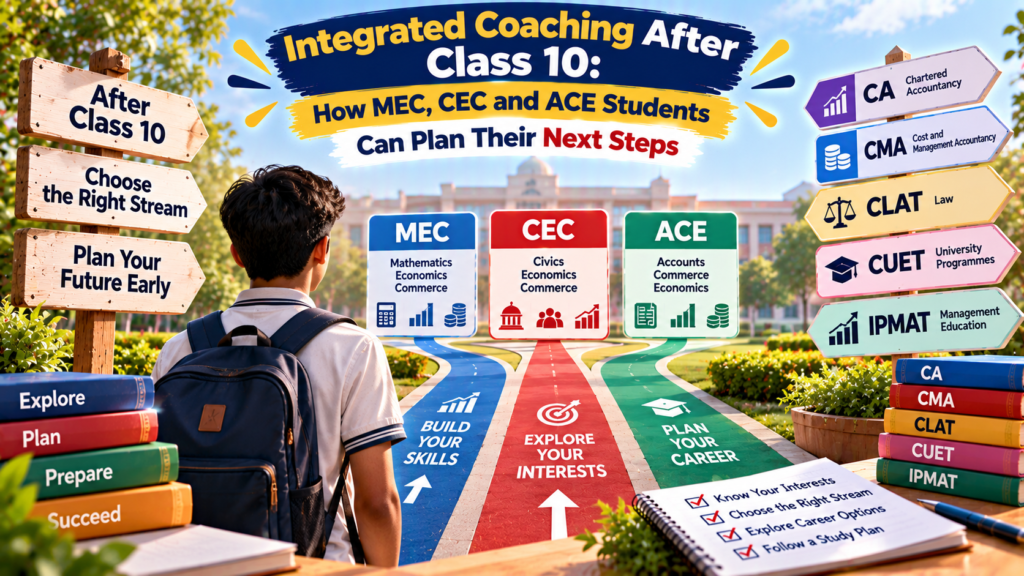
Completing Class 10 is an important milestone for students because it marks the beginning of a new stage in their academic journey. Choosing the right Intermediate stream can influence the subjects they study, the skills they develop and the higher-education opportunities they explore later. For students interested in commerce, finance, law, business or management, MEC, CEC and ACE offer different subject combinations that can help them begin exploring these areas while preparing for their Intermediate examinations.
Alongside selecting a stream, students may also consider preparing for professional courses and entrance examinations during Intermediate. Integrated coaching brings Intermediate studies together with structured preparation for a selected career pathway, helping students organise their learning around academic and entrance-exam goals. Understanding how MEC, CEC and ACE connect with CA, CMA, CLAT, CUET and IPMAT can help students and parents make informed decisions before beginning Intermediate.
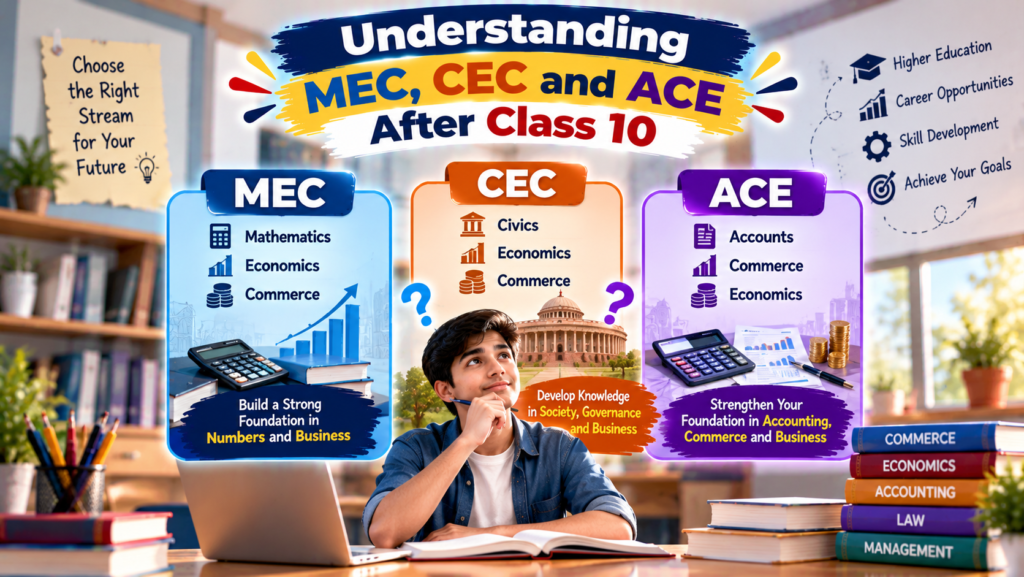
Understanding MEC, CEC and ACE After Class 10
MEC stands for Mathematics, Economics and Commerce. It can suit students who enjoy numerical problem-solving, economic concepts and business-related subjects. Mathematics helps develop quantitative reasoning, while Economics and Commerce introduce students to markets, financial activities and business fundamentals. Students interested in accounting, management, economics or quantitative entrance examinations may find MEC worth considering, depending on their interests and the eligibility requirements of their preferred programmes.
CEC stands for Civics, Economics and Commerce, while ACE combines Accounts, Commerce and Economics. CEC may appeal to students interested in governance, society, law, economics and business, whereas ACE may attract students who prefer accounting and commerce-related subjects. These streams provide different academic foundations, but students should not assume that a particular stream automatically determines their entire career. Understanding personal interests, academic strengths and future course requirements is essential when choosing an Intermediate combination.
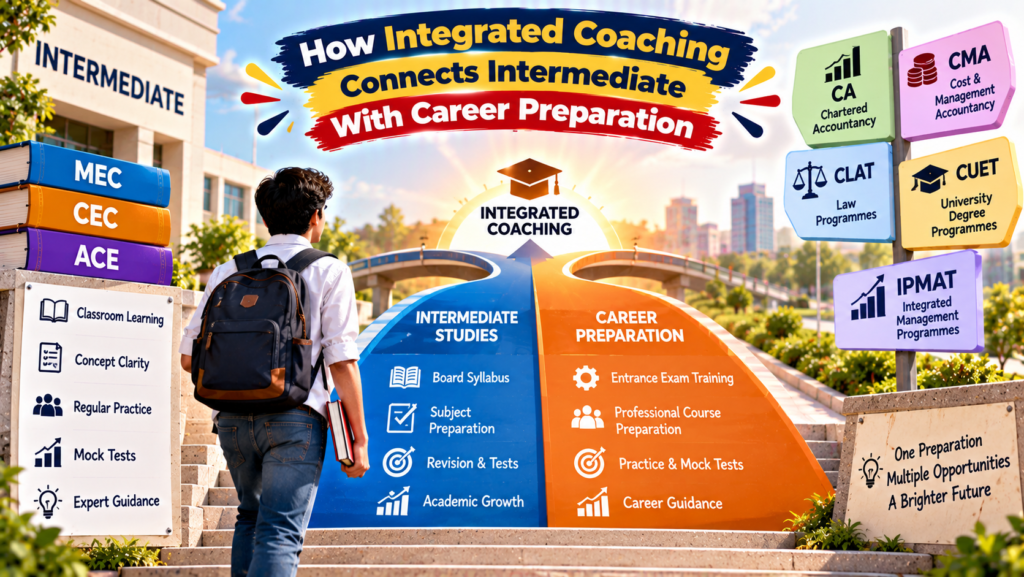
How Integrated Coaching Connects Intermediate With Career Preparation
Integrated coaching helps students work towards their Intermediate academic goals while preparing for a selected professional course or entrance examination. Instead of treating every learning goal as unrelated, students can follow a planned schedule that allocates time to their board syllabus, entrance-exam concepts, practice questions and revision. This structure can help students understand their priorities early and develop consistent study habits during the two years of Intermediate.
However, integrated preparation does not mean that every stream leads to every entrance examination in the same way. CA and CMA have professional-course syllabuses, while CLAT and CUET serve different admission purposes. IPMAT is included in the MEC preparation pathway at CMS. Students should understand the requirements of their chosen pathway and give it appropriate attention without neglecting Intermediate studies. The most useful preparation plan is one that matches the student’s stream, interests, academic workload and intended career direction.
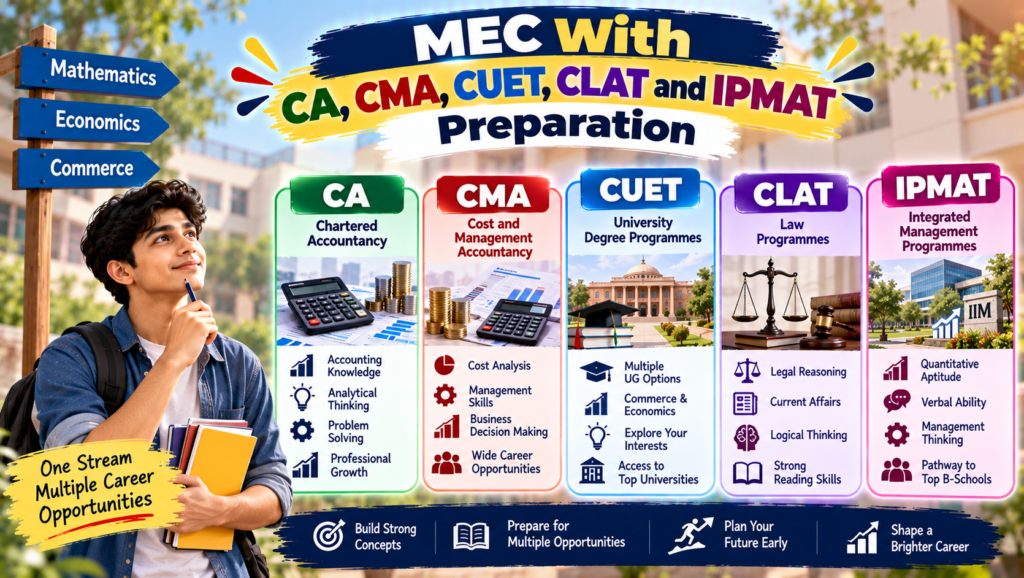
MEC With CA, CMA, CLAT, CUET and IPMAT Preparation
MEC students can explore several pathways connected with commerce, finance and management. Students interested in Chartered Accountancy can begin learning about the CA Foundation route and the subjects involved in professional accounting. Those interested in Cost and Management Accountancy can explore CMA as a pathway connected with costing, financial planning, performance analysis and business decision-making. In both cases, students should understand the official course structure and entry requirements before planning their preparation.
MEC students can also explore IPMAT preparation if they are interested in integrated management programmes. Mathematics can provide a useful foundation for quantitative aptitude, while Economics and Commerce introduce students to business and market concepts. However, IPMAT preparation also requires verbal ability and other skills specified by the institution conducting the examination. Students should not assume that Intermediate Mathematics alone covers the full entrance syllabus. A structured plan combining concept learning, aptitude practice, reading and mock tests can help students prepare while maintaining their academic progress. Students can also benefit from CLAT and CUET coaching as well.
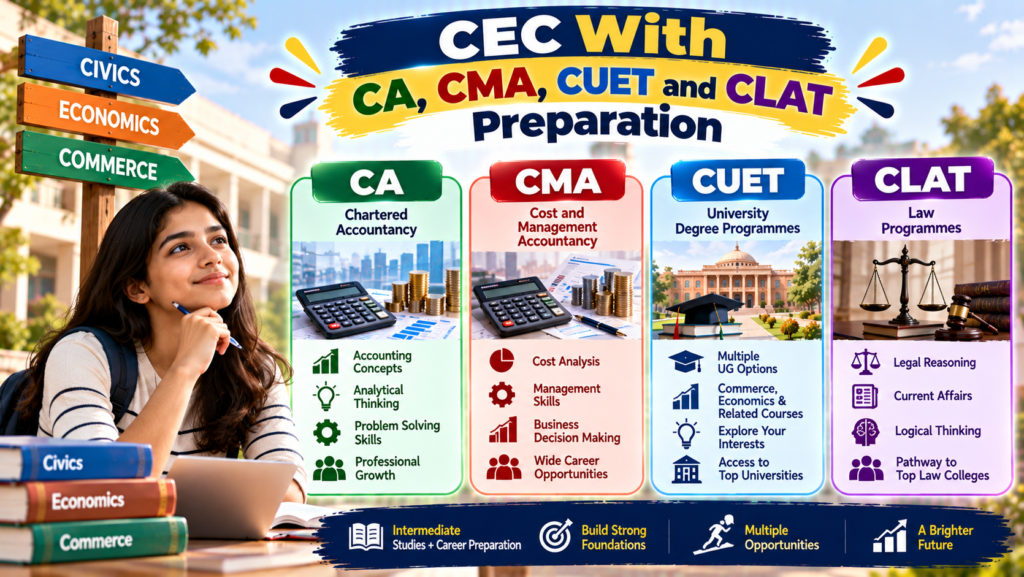
CEC With CA, CMA, CUET and CLAT Preparation
CEC students can explore CA and CMA if they are interested in accounting, finance, business operations or management accounting and meet the applicable entry requirements. Their Intermediate subjects can introduce them to commerce and economic concepts, while professional-course preparation provides additional learning in the areas required by the respective syllabuses. Students should assess their interest in accounting and numerical problem-solving, learn about the course commitments and understand how professional examinations differ from Intermediate assessments before choosing a pathway.
CEC can also be a relevant stream for students interested in law and CLAT. Civics can encourage an understanding of governance and institutions, while Economics and Commerce provide exposure to social and business issues. These subjects may complement a student’s broader awareness, but CLAT requires dedicated preparation in areas such as reading comprehension, current affairs, legal reasoning, logical reasoning and quantitative techniques under the applicable examination pattern. Students should build reading habits, practise reasoning questions and check the latest official CLAT requirements. Students can also benefit from the integrated CUET coaching along with CEC at CMS.
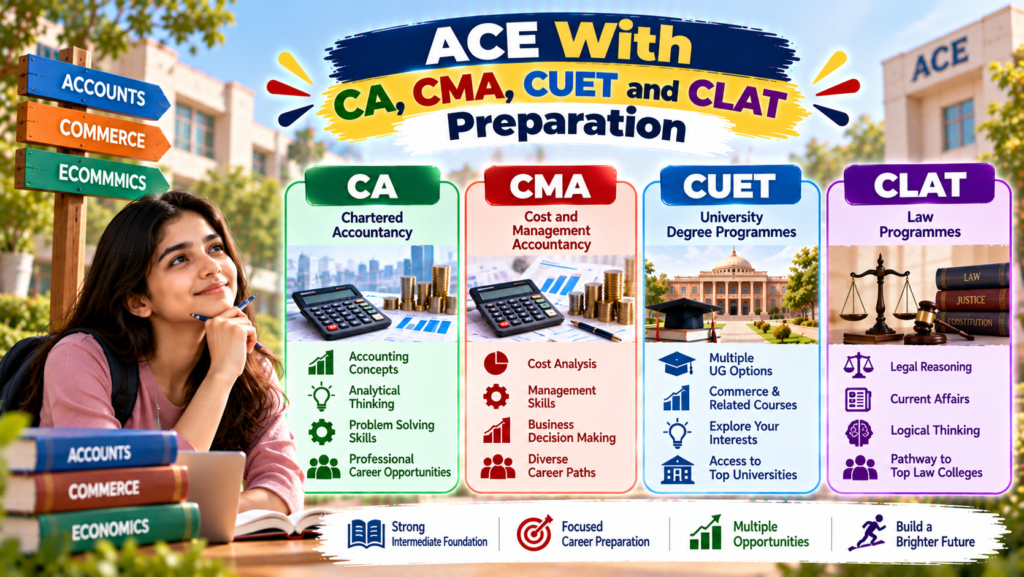
ACE With CA, CMA, CUET and CLAT Preparation
ACE combines Accounts, Commerce and Economics, making it an option for students interested in business, finance and related academic fields. Students considering Chartered Accountancy can explore how accounting concepts connect with the CA pathway and begin understanding the importance of consistent problem-solving and conceptual clarity. Those interested in CMA can learn about the role of cost analysis, budgeting, financial information and business performance in organisational decision-making. The stream can provide a relevant academic starting point, but success in either professional course requires preparation beyond the Intermediate syllabus.
ACE students may also consider CUET-UG when exploring undergraduate courses at participating universities. Depending on their interests and eligibility, potential options may include commerce, accounting, economics and other related disciplines. The subjects required for admission differ by university and programme, so students should research the specific courses they want to pursue and confirm their CUET subject requirements before selecting examination papers. Early research helps students align their subject choices with their intended university programmes. Law enthusiasts can also benefit from CMS integrated ACE with CLAT coaching.
How to Choose the Right Integrated Preparation Path
The first step is to identify the subjects and activities that interest you most. Students who enjoy Mathematics and quantitative problem-solving may want to explore MEC, while those drawn to civics, society and commerce may prefer CEC. Students who are particularly interested in accounting and business subjects may consider ACE. These preferences should be considered alongside academic performance, learning style and the subjects required for future courses rather than being treated as the only factors in a career decision.
The next step is to compare the professional courses and entrance examinations associated with the chosen stream. CA and CMA are professional qualifications with distinct syllabuses and career applications. CLAT is associated with undergraduate law admissions, while CUET-UG provides an admission route to participating universities and their undergraduate programmes. IPMAT is part of the MEC preparation pathway at CMS for students exploring integrated management admissions. Students should review applicable eligibility rules, examination patterns and course details before selecting a preparation plan.
Building Good Study Habits During Intermediate
Students preparing for Intermediate alongside professional-course or entrance-exam goals benefit from a timetable that reflects their actual workload. They can set weekly targets for classroom learning, revision, question practice and doubt clarification. Short, regular study sessions often make it easier to maintain progress than relying on occasional long sessions. Students should revisit difficult topics instead of repeatedly postponing them and leave time for rest so their routine remains manageable.
Progress should be reviewed regularly. Students can use chapter tests, practice questions and suitable mock tests to understand which topics they have mastered and which require more attention. When preparing for a professional or entrance examination, it is important to analyse errors and practise the underlying concepts rather than focusing only on scores. As board examinations approach, students may need to adjust their schedule to give more time to Intermediate revision. They can then increase entrance-specific practice according to their examination dates and preparation needs.
How CMS Supports Integrated Learning for Intermediate Students
At CMS, students can explore MEC, CEC and ACE alongside preparation options connected with CA, CMA, CLAT, CUET and IPMAT, with IPMAT preparation associated with MEC. This approach helps students think about their academic and career goals early and understand how their chosen subjects relate to further study. Students can use this stage to identify areas of interest, learn about the requirements of their target courses and build a preparation routine that accommodates both Intermediate studies and their selected professional or entrance pathway. CMS is the Best MEC Junior Colleges in Hyderabad and is backed by a team of expert commerce faculty.
An informed decision is more valuable than choosing a course only because it is popular among friends or relatives. Students and parents should discuss academic interests, understand the workload involved and confirm the eligibility requirements of the intended professional course or university programme. With suitable guidance and a clear plan, students can approach Intermediate with a better understanding of the opportunities they wish to explore and the skills they need to develop.
Conclusion
Integrated coaching after Class 10 can help students connect Intermediate education with longer-term academic and career goals. MEC, CEC and ACE provide different subject combinations, and each can be considered alongside suitable preparation pathways. MEC students can explore CA, CMA, CLAT, CUET and IPMAT preparation, CEC students can explore CA, CMA CUET and CLAT, and ACE students can consider CA, CMA, CLAT and CUET, subject to the relevant course and examination requirements.
Students do not need to finalise every detail of their future career immediately after Class 10. They can begin by choosing a stream that suits their interests, researching possible pathways and developing consistent study habits during Intermediate. By balancing board examinations with structured professional-course or entrance-exam preparation, students can make thoughtful progress and explore the opportunities most relevant to their chosen stream.