
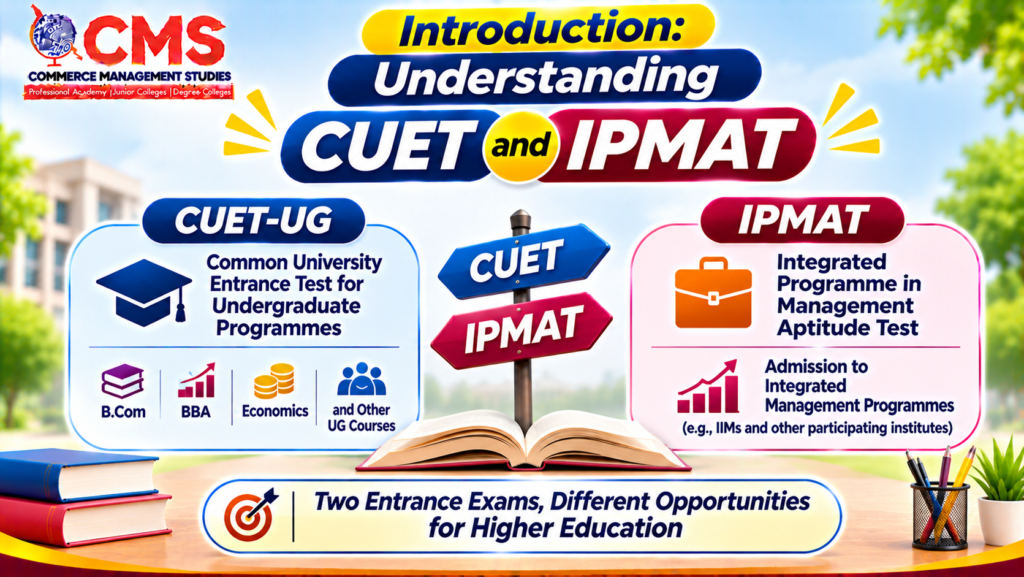
Introduction: Understanding CUET and IPMAT
Students completing their Intermediate education have several options when planning their higher studies. While some aim to pursue undergraduate degrees in commerce, economics, science or humanities, others are interested in management education and integrated programs. Two entrance examination options that students may explore during this stage are the Common University Entrance Test (CUET-UG) and the Integrated Program in Management Aptitude Test (IPMAT).
Although both examinations provide opportunities to enter higher education, they serve different admission purposes. CUET-UG is used by participating universities for admission to various undergraduate programs, whereas IPMAT is associated with admission to integrated management programs offered by specific institutions. Understanding their examination structures, subject requirements and future opportunities can help students choose a suitable preparation pathway. At CMS, students pursuing MEC, CEC and ACE can prepare for CUET alongside Intermediate education, while MEC students can also pursue integrated IPMAT coaching.
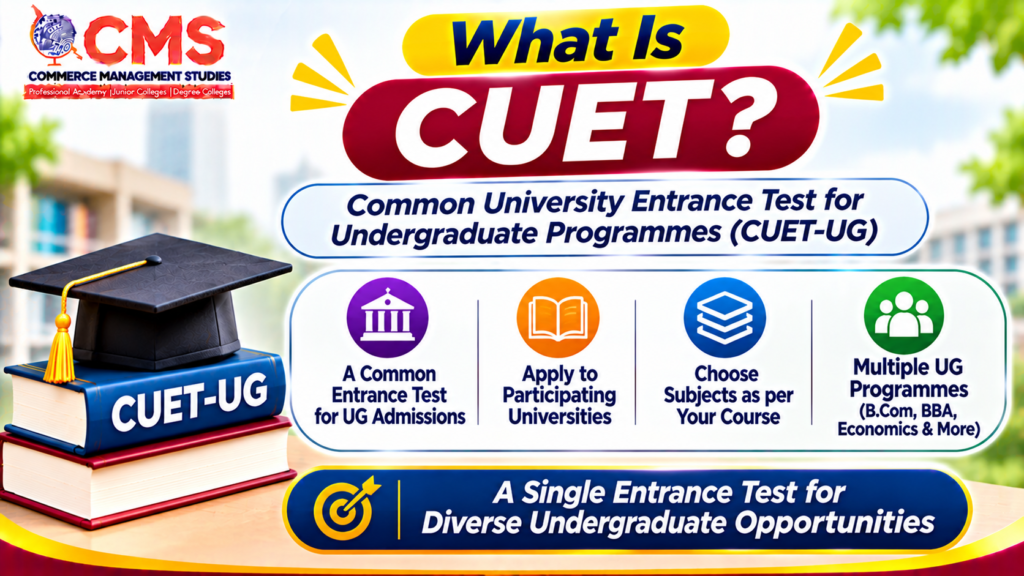
What Is CUET?
The Common University Entrance Test for Undergraduate programs, commonly known as CUET-UG, is conducted by the National Testing Agency (NTA). It provides a common entrance examination route for undergraduate admissions at participating universities and institutions.
CUET allows students to apply for different undergraduate programs based on the courses and subject combinations offered by participating universities. Depending on the university and program, students may need to select relevant language tests, domain-specific subjects and the General Aptitude Test.
Some important features of CUET include:
- It provides an entrance examination route for undergraduate admissions at participating universities.
- Students can select test subjects according to the examination rules and their intended courses.
- Universities use CUET scores as part of their admission process, subject to their individual eligibility and selection requirements.
- Course availability, subject combinations and admission criteria vary between institutions.
Students interested in programs such as B.Com, BBA, Economics and other undergraduate degrees can explore CUET requirements. However, they should check the eligibility criteria and subject combinations prescribed by their preferred universities before selecting their examination subjects.
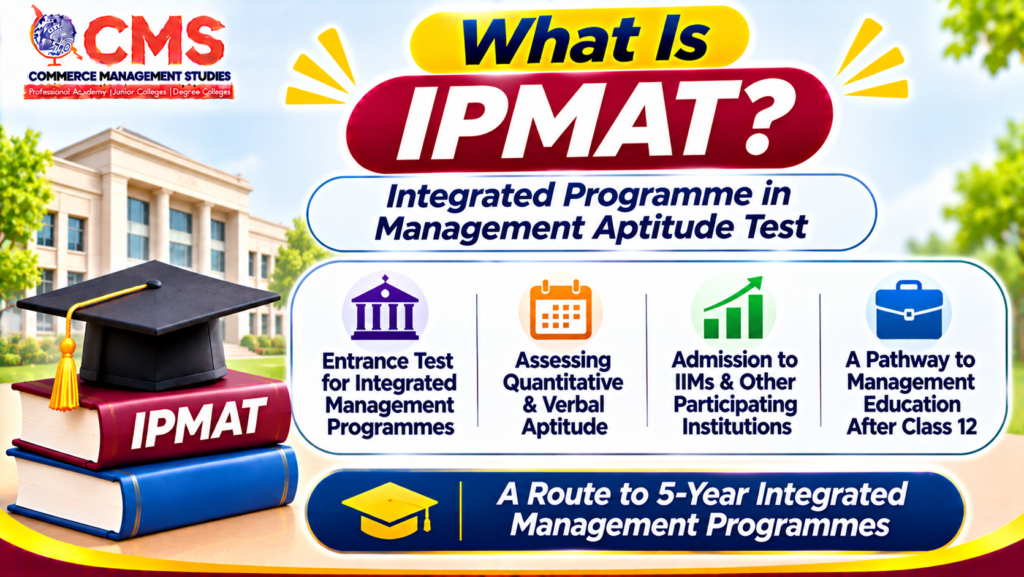
What Is IPMAT?
The Integrated Program in Management Aptitude Test (IPMAT) is an entrance examination associated with admission to five-year integrated management programs offered by participating institutions, including certain Indian Institutes of Management.
These programs generally combine undergraduate-level and postgraduate-level management education into a structured academic pathway. Students who have completed Class 12 can explore these programs if they meet the eligibility requirements of the respective institution.
IPMAT examinations assess skills that are important for management education. Depending on the institution, these may include quantitative ability, verbal ability and related aptitude areas.
Important features of IPMAT include:
- It provides an admission route to specific integrated management programs.
- Examination patterns and selection procedures differ between institutions.
- Quantitative aptitude and verbal ability are important preparation areas in several IPMAT examinations.
- Selection may involve additional stages, such as interviews or other assessments, depending on the institution.
Students interested in business, management, leadership and organisational decision-making can explore IPMAT as one possible route towards management education.
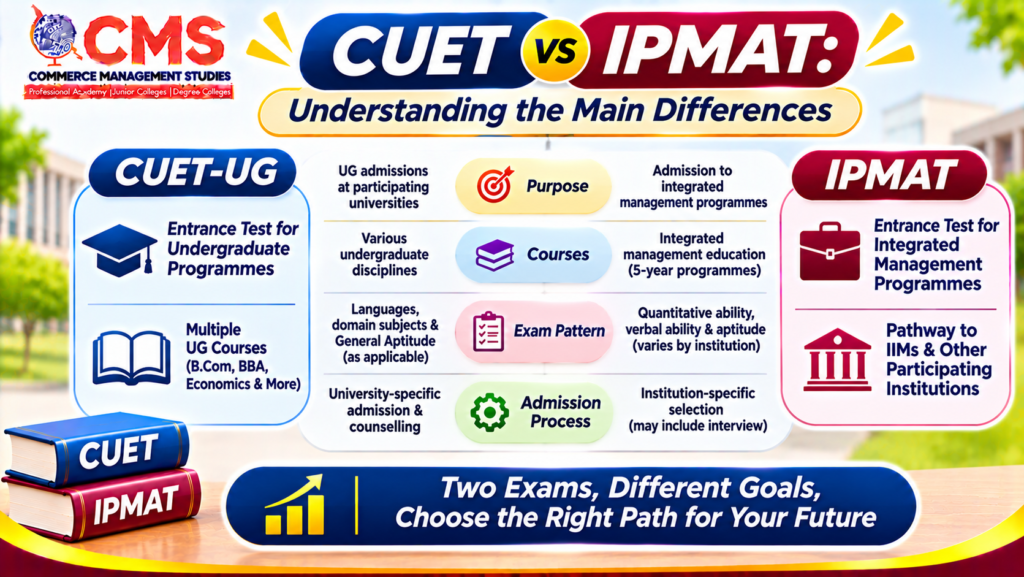
CUET vs IPMAT: Understanding the Main Differences
CUET and IPMAT are both entrance examinations, but their objectives, examination structures and admission opportunities are different. Students should understand these distinctions before deciding where to focus their preparation.
1. Purpose of the Examination
The primary purpose of CUET-UG is to support undergraduate admissions across participating universities. Students can use their scores to apply for eligible programs in different academic disciplines, depending on university requirements.
IPMAT, on the other hand, is associated with admission to integrated management programs at specific institutions. Its focus is on identifying students interested in pursuing a structured management education pathway after Class 12.
2. Courses and Programs Offered
CUET provides access to a range of undergraduate programs, depending on the participating university. These may include commerce, economics, business administration, humanities and other disciplines.
IPMAT is designed for students seeking admission to integrated management programs. These programs combine different stages of management education within a longer academic structure.
Therefore, students interested in exploring several undergraduate disciplines may consider CUET, while those specifically interested in integrated management education may explore IPMAT.
3. Examination Pattern
The CUET-UG examination includes different test components, such as languages, domain-specific subjects and the General Aptitude Test, depending on the applicable examination structure and the student’s selected subjects. The combination required for admission depends on the university and course.
IPMAT examination patterns vary between institutions. For example, the examination conducted for admission to IIM Indore’s integrated program may have a different structure from the examination used by IIM Rohtak. Quantitative ability and verbal ability are important areas in these examinations, but the number of sections, question types, marking schemes and selection procedures may differ.
Students should avoid assuming that every institution follows an identical IPMAT pattern. Reviewing the latest official examination notification is essential before beginning focused preparation.
4. Skills Tested
CUET assesses students through the test components relevant to their selected subjects. Depending on the combination, preparation may involve language comprehension, knowledge of domain subjects, general awareness, reasoning and aptitude.
IPMAT places considerable emphasis on quantitative and verbal aptitude. Students need to develop numerical problem-solving abilities, reading comprehension, vocabulary, logical thinking and the ability to work accurately under time constraints.
5. Admission Process
CUET scores are considered by participating universities according to their admission policies. Students may need to complete separate university application, counselling or admission procedures after the examination.
IPMAT admission generally involves an institution-specific selection process. Depending on the institute, candidates may be evaluated through entrance examination scores, interviews and other selection criteria.
These differences make it important for students to understand the complete admission process rather than focusing only on the entrance examination.
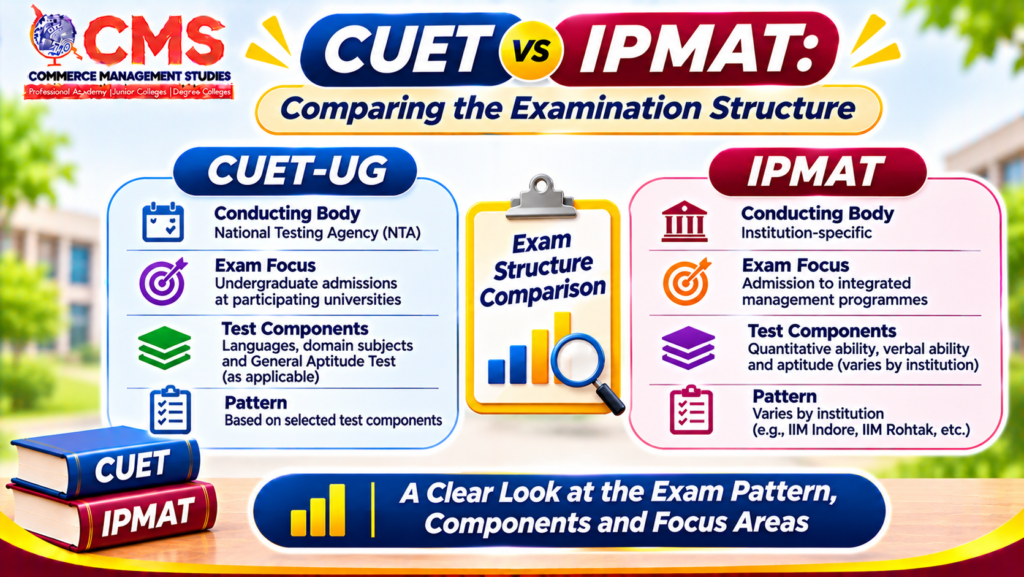
CUET vs IPMAT: Comparing the Examination Structure
The two examinations differ in their conducting bodies, objectives, preparation areas and admission procedures. Understanding these differences can help students identify which examination is more closely aligned with their academic interests.
CUET-UG Examination Structure
- Conducting body: National Testing Agency (NTA).
- Main purpose: Undergraduate admissions at participating universities.
- Academic opportunities: Various undergraduate disciplines, including commerce, economics, humanities and business-related courses.
- Main preparation areas: Languages, domain subjects and General Aptitude Test, as applicable.
- Examination structure: Based on the test components selected by students according to the examination rules and university requirements.
- Admission process: University-specific admission and counselling procedures.
IPMAT Examination Structure
- Conducting body: Institution-specific, depending on the integrated management program.
- Main purpose: Admission to integrated management programs.
- Academic opportunities: Integrated management education.
- Main preparation areas: Quantitative ability, verbal ability and aptitude, depending on the institution.
- Examination structure: Varies between institutions, including differences in sections, question types and marking schemes.
- Admission process: Institution-specific selection procedures, which may include interviews or additional assessments.
CUET is suitable for students exploring different undergraduate academic fields, whereas IPMAT is relevant to students interested in integrated management education. Students should refer to the latest NTA information bulletin and the individual institution’s admission notification for accurate examination details.
Career Pathways After CUET and IPMAT
One of the most important factors students should consider when comparing CUET and IPMAT is the type of education and career direction each route can support.
Career Opportunities Through CUET
CUET can help students seek admission to a variety of undergraduate programs offered by participating universities. The career opportunities available later depend on the degree selected, the institution, further education and individual professional development.
Some possible academic pathways include:
- Commerce: Students may pursue B.Com and related programs, which can support future interests in accounting, finance, taxation and business.
- Economics: Undergraduate economics programs can provide a foundation for careers and further studies in economic analysis, research, finance and policy-related fields.
- Business Administration: Eligible students may explore BBA and related programs that introduce business operations, marketing, finance and management.
- Humanities and Social Sciences: Depending on their interests, students can pursue subjects such as political science, psychology, sociology and other disciplines.
- Other Undergraduate Programs: CUET-participating universities may offer additional courses in different academic areas, subject to their admission requirements.
CUET does not lead to one specific profession. Instead, it provides an entrance route to different undergraduate courses from which students can build their future academic and career plans.
Career Opportunities Through IPMAT
IPMAT offers an admission route to integrated management programs at participating institutions. These programs are designed for students who want to begin their management education after Class 12 and continue through a structured academic pathway.
Students pursuing integrated management education may explore career areas such as:
- Business Management: Understanding business functions, organisational operations and management practices.
- Marketing: Exploring consumer behaviour, branding, market research and business promotion.
- Finance: Developing knowledge of financial management, investment concepts and business finance.
- Human Resource Management: Understanding recruitment, employee development and organisational behaviour.
- Consulting and Strategy: Learning how businesses identify challenges, evaluate opportunities and make strategic decisions.
- Entrepreneurship: Developing an understanding of business planning, innovation and venture development.
The career opportunities available to graduates depend on the program, specialisation, skills, experience and further academic or professional choices.
Which Examination Should Intermediate Students Choose?
The decision between CUET and IPMAT should be based on the student’s interests, preferred undergraduate education and long-term career plans. Both examinations serve different purposes, so students should first understand the programs they want to pursue.
Students who want to explore undergraduate courses across commerce, economics, business and other disciplines may consider CUET. It provides an opportunity to apply to participating universities based on their individual course requirements.
Students who are particularly interested in management education and want to pursue an integrated management program after Class 12 may explore IPMAT. They should research the participating institutions, examination patterns and selection procedures before choosing this pathway.
Students who are uncertain about their future direction can begin by researching eligible courses and institutions. Comparing program structures, subjects, admission requirements and future study opportunities can help them make a more informed decision.
How MEC Students Can Prepare for CUET and IPMAT
MEC, which includes Mathematics, Economics and Commerce, provides an academic foundation that students can connect with different higher education pathways. These subjects can support the development of numerical understanding, economic awareness and business knowledge.
For CUET, MEC students can identify the domain subjects and other test components required for their preferred undergraduate courses. They should select their CUET subjects according to the admission requirements of the universities they intend to apply to.
For IPMAT, Mathematics can help MEC students strengthen their numerical foundation, while regular reading and language practice can support verbal ability preparation. Students should also practise aptitude questions and become familiar with the examination pattern of their target institutions.
Preparing for both examinations requires a planned approach. Students should understand that CUET and IPMAT have different objectives and test requirements. Their preparation should therefore include examination-specific practice rather than relying on one common study plan.
How CMS Supports CUET and IPMAT Preparation
Preparing for entrance examinations during Intermediate gives students an opportunity to develop the skills required for higher education while continuing their regular academic studies. A coordinated preparation approach can help students manage different subjects, understand examination requirements and practise consistently.
CMS offers integrated Best CUET Coaching in Hyderabad alongside MEC, CEC and ACE Intermediate education. Students can work on relevant domain subjects, language skills and aptitude areas based on their intended undergraduate courses. Practice sessions, assessments and mock examinations can help students become familiar with entrance examination requirements and evaluate their progress.
For MEC students interested in management education, CMS also offers integrated IPMAT Coaching in Hyderabad. Preparation focuses on developing relevant quantitative and verbal skills while helping students understand the examination requirements of their preferred institutions.
By introducing entrance examination preparation alongside Intermediate education, CMS helps students use their academic years to explore higher education opportunities and work towards their chosen goals. Students can build their preparation around their interests instead of waiting until the completion of Class 12 to understand different admission pathways.
Can Students Prepare for CUET and IPMAT at the Same Time?
Students interested in both general undergraduate admissions and integrated management programs may consider preparing for CUET and IPMAT simultaneously, provided their academic schedule and target examination requirements allow it.
Some skills, such as reading comprehension, vocabulary, numerical ability and time management, may support preparation for both examinations. However, the domain-specific requirements of CUET and the institution-specific aptitude requirements of IPMAT need separate attention.
A practical preparation plan can include:
- Understanding the eligibility and admission requirements of the selected universities and management institutes.
- Identifying the CUET domain subjects required for preferred undergraduate courses.
- Studying quantitative and verbal aptitude topics relevant to the targeted IPMAT examination.
- Practising examination-specific mock tests and previous question papers where available.
- Maintaining a timetable that gives sufficient attention to Intermediate subjects.
- Reviewing performance regularly and adjusting preparation according to areas that need improvement.
Students should also remember that preparing for two examinations does not mean applying to every available program. Selecting realistic academic goals and prioritising suitable institutions can make preparation more effective.
Conclusion
CUET and IPMAT provide different opportunities for students planning their education after Intermediate. CUET offers an entrance route to undergraduate programs across participating universities, while IPMAT is associated with admission to integrated management programs at specific institutions. Their examination patterns, subject requirements, admission processes and academic outcomes differ, making it important for students to understand both pathways before deciding where to focus their preparation.
Students pursuing MEC, CEC and ACE can explore CUET preparation alongside their Intermediate education, while MEC students can also consider IPMAT as a route towards integrated management studies. At CMS, integrated CUET coaching is available with all three Intermediate streams, and integrated IPMAT coaching is available with MEC. With early planning, examination-specific practice and a clear understanding of admission requirements, students can make informed choices about their higher education and future careers.