
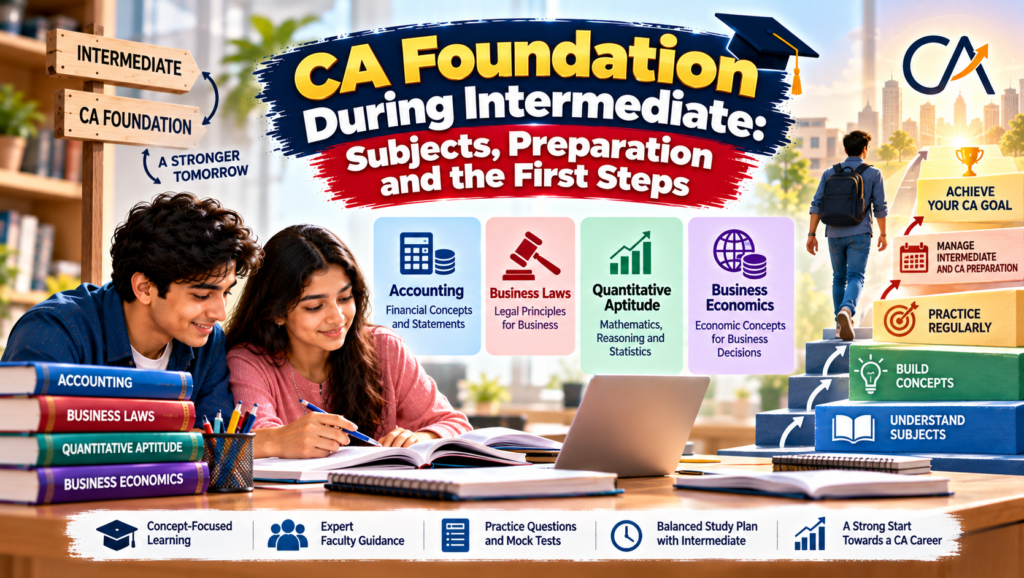
Starting preparation for Chartered Accountancy during Intermediate can help students understand the profession early and plan their studies more effectively. The CA course, conducted by the Institute of Chartered Accountants of India (ICAI), provides a pathway for students interested in accounting, taxation, auditing, finance and business management. For students pursuing MEC or CEC, beginning to understand the CA pathway during Intermediate can make it easier to become familiar with the course structure, develop useful study habits and prepare for the next stage of professional education.
However, preparing for CA Foundation while completing Intermediate requires a balanced approach. Students need to give sufficient attention to their board syllabus while gradually developing the conceptual understanding and problem-solving skills required for the CA examination. Understanding the CA Foundation subjects, knowing the registration process and following a realistic preparation routine can help students make an informed start without feeling overwhelmed by the demands of two academic commitments.
Understanding the CA Foundation Course
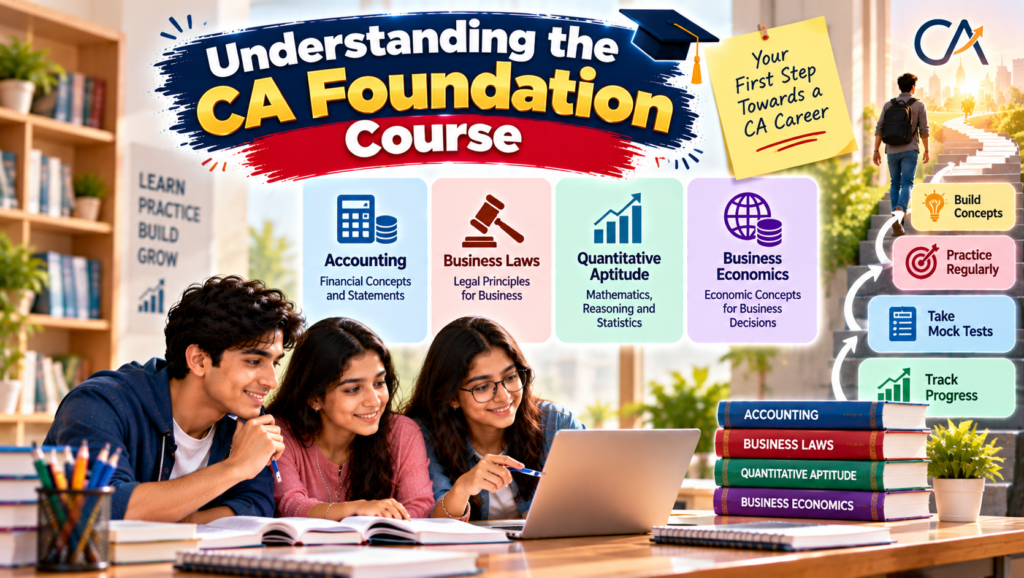
CA Foundation is the entry-level examination in the Chartered Accountancy course offered by ICAI. It introduces students to important concepts in accounting, business laws, quantitative aptitude and business economics. The course helps students develop a foundation for further professional studies and understand how financial information, business regulations and economic principles apply in the commercial world.
Students can begin exploring the CA pathway while studying Intermediate, provided they understand the eligibility requirements and applicable registration rules. Under the current ICAI scheme, students generally become eligible to register for CA Foundation after completing Class 10, but appearing for the examination requires meeting the prescribed conditions relating to Class 12 and the applicable examination cycle. Students should check the latest ICAI announcements for registration deadlines, examination dates and eligibility requirements before planning their attempt.
CA Foundation Subjects Students Should Know
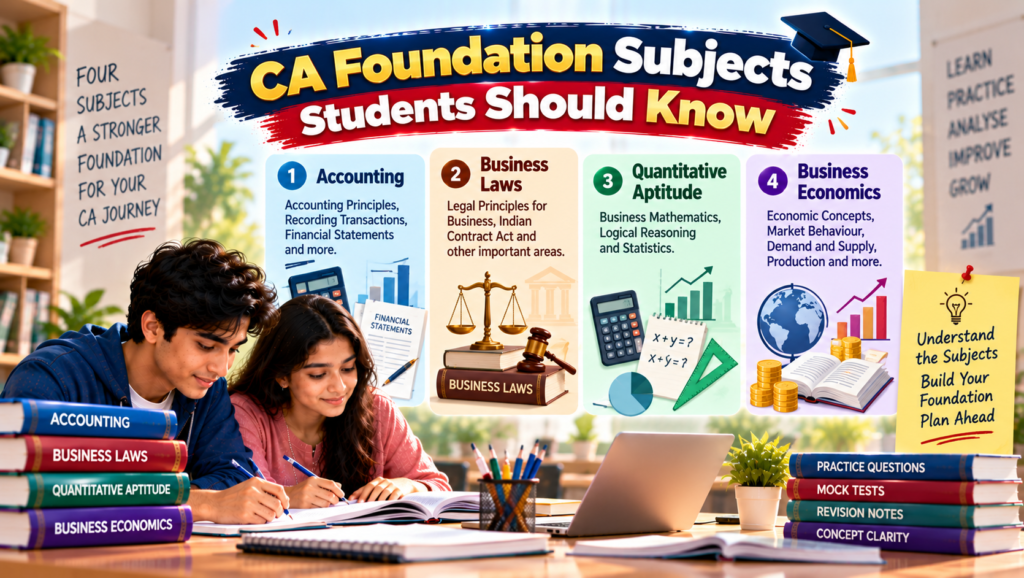
Understanding the CA Foundation syllabus is one of the first steps towards effective preparation. Under ICAI’s New Scheme of Education and Training, the CA Foundation course covers four papers that introduce students to the core areas of commerce and professional accountancy.
The four papers are:
- Paper 1: Accounting – Covers accounting principles, recording transactions, preparation of financial statements and other fundamental accounting concepts.
- Paper 2: Business Laws – Introduces important legal principles relevant to business, including the Indian Contract Act and other prescribed areas.
- Paper 3: Quantitative Aptitude – Covers business mathematics, logical reasoning and statistics, helping students develop numerical and analytical skills.
- Paper 4: Business Economics – Introduces economic concepts, market behaviour, demand and supply, production and other prescribed topics related to business decisions.
Students should refer to the latest official ICAI syllabus and study material for the detailed topics in each paper. Understanding the subject structure early can help students identify familiar areas, recognise topics that require additional effort and organise their preparation around the actual examination requirements.
How Intermediate Students Can Begin CA Foundation Preparation
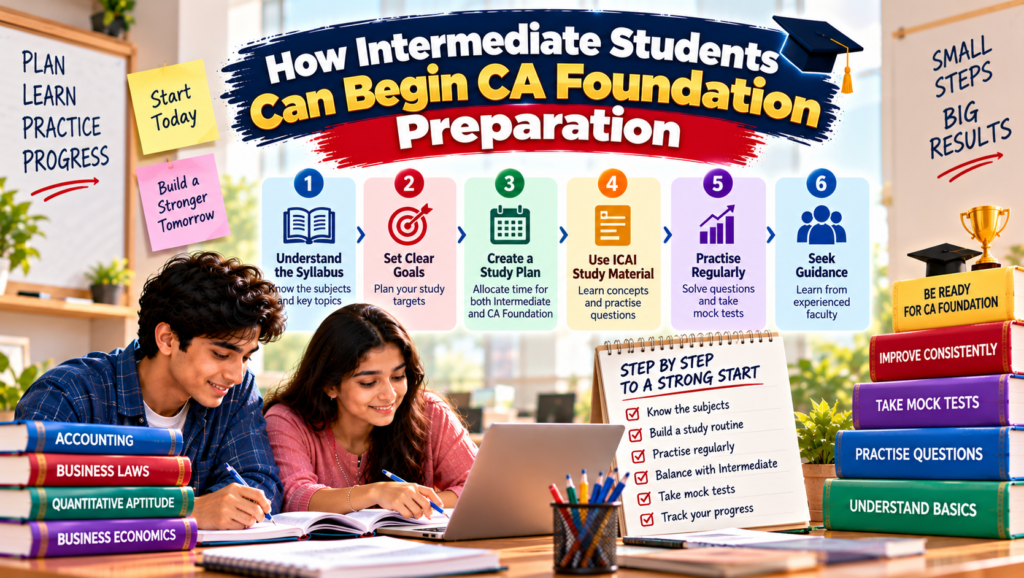
Students do not need to master the entire CA Foundation syllabus immediately. A better approach is to begin with the fundamentals, understand the topics covered in each paper and gradually develop a consistent study routine. Students from MEC may find certain mathematical and economic concepts familiar, while students from CEC may need to spend additional time developing their numerical skills, depending on their previous learning experience. Regardless of their stream, a clear understanding of the fundamentals is more useful than rushing through topics without proper revision.
A practical starting plan can include setting weekly study targets, allocating time to each subject and revisiting concepts covered during the week. Students can use ICAI study material to understand the prescribed syllabus and practise relevant questions after completing each topic. Keeping a record of difficult questions and recurring mistakes can also help them focus on areas that need more attention. This gradual approach allows students to build familiarity with CA Foundation while maintaining their Intermediate studies.
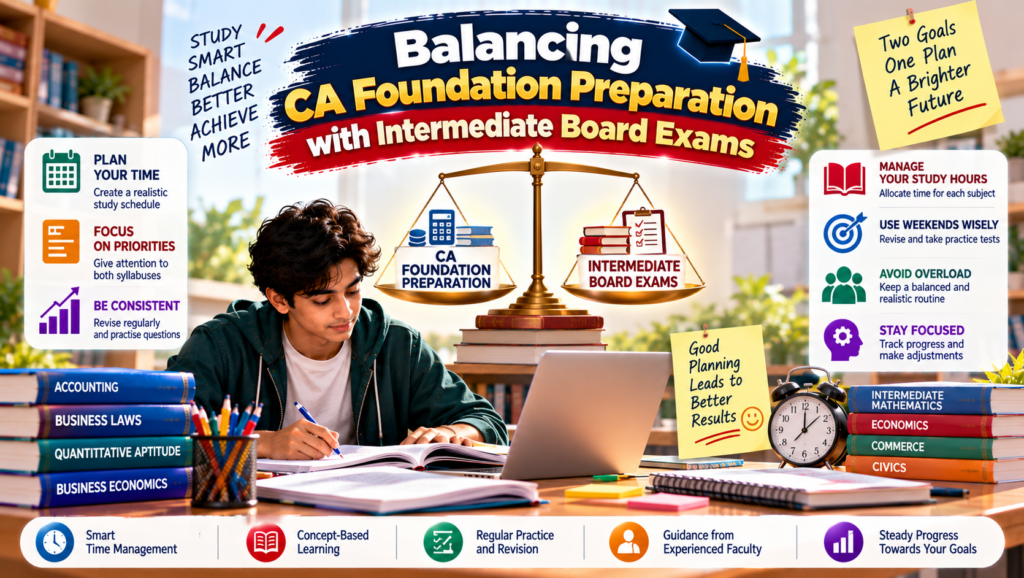
Balancing CA Foundation Preparation with Intermediate Board Exams
Managing CA Foundation preparation alongside Intermediate requires realistic planning. Board examinations remain an important academic responsibility, so students should avoid creating a timetable that leaves insufficient time for classroom lessons, assignments and revision. Instead, they can divide their available study hours according to their academic schedule, giving priority to immediate deadlines while maintaining steady progress in CA Foundation subjects.
During regular academic weeks, students can reserve specific periods for CA Foundation preparation and use weekends or available study sessions for revision and question practice. As board examinations approach, they may need to give greater attention to their Intermediate syllabus and adjust their CA preparation accordingly. Once their board examinations are completed, they can review their CA Foundation progress and plan the next phase based on their target examination date and the remaining syllabus.
Effective Study Strategies for CA Foundation
Successful preparation involves understanding concepts, practising questions and reviewing performance rather than relying entirely on memorisation. In Accounting, students should work through problems step by step and understand why each entry or calculation is required. For Business Laws, regular reading, clear notes and practice applying legal principles to questions can help improve understanding. Quantitative Aptitude requires repeated practice, while Business Economics benefits from conceptual clarity and regular revision of important topics.
Students can also use mock tests and timed practice sessions to become familiar with examination conditions. Reviewing the answers afterwards is equally important because it helps identify whether mistakes are caused by gaps in understanding, calculation errors or poor time management. A weekly review of completed topics and pending work can help students adjust their preparation plan before small difficulties become larger gaps. Consistency, active practice and thoughtful revision can make study time more productive.
The Role of Integrated CA Coaching During Intermediate
Students considering CA alongside Intermediate may find an integrated coaching approach useful because it coordinates board education with preparation for professional entrance examinations. Instead of managing two entirely separate study plans, students can follow a more organised schedule that makes space for classroom learning, CA Foundation topics, practice and revision. The suitability of such a program depends on its teaching approach, timetable, faculty support and how effectively it accommodates students’ academic responsibilities.
At CMS Best CA Foundation Coaching in Hyderabad, students pursuing MEC or CEC can explore integrated coaching options that connect their Intermediate education with CA preparation. Experienced faculty, concept-focused teaching, practice questions and mock examinations can support students as they develop their understanding of relevant subjects. Before choosing an integrated program, students and parents should consider the course structure, teaching schedule, assessment methods and available academic support to ensure that the program suits the student’s learning needs.
Common Mistakes to Avoid During Early CA Preparation
One common mistake is trying to complete the entire CA Foundation syllabus too quickly without building a sound understanding of the basics. Students may also spend too much time reading notes without solving enough questions or reviewing their mistakes. Another difficulty is following an unrealistic timetable that does not account for Intermediate classes, school assignments and board examination preparation. These habits can make preparation stressful and reduce the time available for understanding difficult concepts.
Students can avoid these problems by setting achievable weekly targets, practising questions regularly and reviewing their progress honestly. They should use reliable study resources, follow the applicable ICAI syllabus and avoid depending only on unofficial summaries or outdated examination information. It is also important to understand that every student’s preparation pace is different. A steady routine that allows time for both learning and revision is generally more sustainable than an intense schedule that is difficult to maintain.
Taking the First Steps Towards a CA Career
Students interested in Chartered Accountancy can use their Intermediate years to understand the profession, explore the CA Foundation syllabus and build the study habits needed for further professional education. Learning the basics of accounting, strengthening quantitative skills and becoming familiar with business laws and economics can help them approach the course with a clearer understanding of its academic demands. At the same time, maintaining a balance between Intermediate and CA preparation helps students make progress without neglecting their board examinations.
CMS supports students exploring the CA pathway through its integrated Intermediate coaching options for MEC and CEC. With appropriate academic planning, subject guidance and consistent practice, students can begin preparing for their professional ambitions while completing their school education. If you are planning to pursue Chartered Accountancy after Class 12, take the first step by understanding the CA Foundation requirements and choosing an academic program that supports both your Intermediate studies and your long-term goals.