
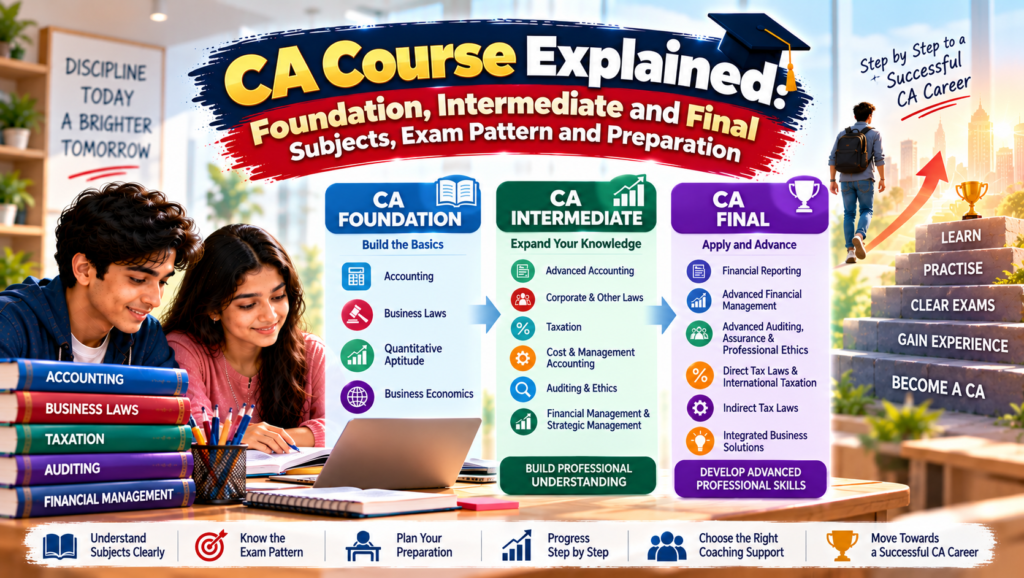
Chartered Accountancy (CA) is a professional course for students interested in accounting, taxation, auditing, finance and business management. Conducted by the Institute of Chartered Accountants of India (ICAI), the course develops knowledge and skills required to understand financial systems, business regulations and organisational decision-making. For students planning to pursue CA after Class 12, understanding the course structure, examination pattern and subjects at each level can make it easier to plan their academic journey from the beginning.
The CA course consists of three main levels: Foundation, Intermediate and Final, followed by the applicable practical training and other requirements for qualification. Each level introduces students to more advanced concepts and professional responsibilities. Starting to understand the CA pathway during Intermediate can give students time to explore the subjects, develop effective study habits and prepare for the transition from school education to professional studies. With a clear understanding of the stages involved, students can make more informed decisions about CA coaching and their future goals.
1. Understanding the CA Course and Its Three Levels
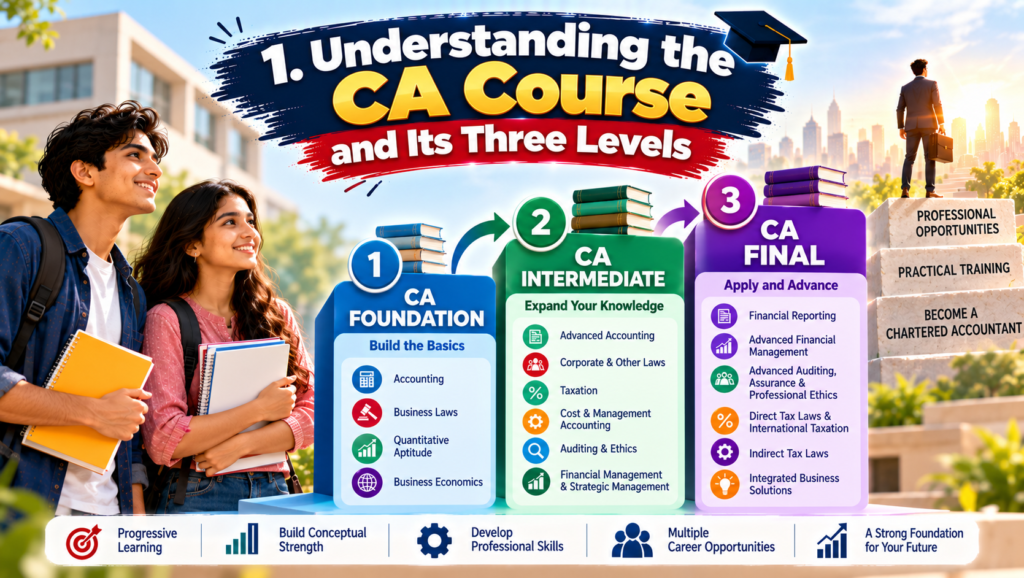
The CA course is designed to develop a student’s knowledge progressively, beginning with basic accounting and business concepts and moving towards advanced financial reporting, taxation, auditing and professional decision-making. CA Foundation introduces the fundamental subjects, CA Intermediate builds a deeper understanding of accounting and related disciplines, and CA Final focuses on advanced professional applications. Students must meet the applicable eligibility, examination, practical training and other requirements prescribed by ICAI to progress through the course.
Each level requires a different preparation strategy. Foundation students need to establish strong conceptual basics, Intermediate students must manage a broader and more demanding syllabus, and Final students need to apply their knowledge to complex professional situations. Understanding these differences early can help students set realistic expectations and prepare in stages. It also helps them recognise why consistent study, regular revision and examination practice are important throughout the CA journey.

2. CA Foundation: Subjects, Exam Pattern and Preparation
CA Foundation is the entry-level examination for students following the Foundation route into Chartered Accountancy. It introduces students to accounting principles, business laws, quantitative aptitude and economics. These subjects help develop the numerical ability, conceptual understanding and analytical thinking required for further professional studies. Students interested in CA can begin learning about the syllabus during Intermediate so they have a clearer idea of what the course involves before planning their examination attempt.
Under ICAI’s current scheme, CA Foundation consists of four papers:
- Paper 1: Accounting – Covers fundamental accounting concepts, accounting principles, recording transactions and preparation of financial statements.
- Paper 2: Business Laws – Introduces legal principles relevant to business, including the prescribed areas of business law.
- Paper 3: Quantitative Aptitude – Covers business mathematics, logical reasoning and statistics.
- Paper 4: Business Economics – Introduces economic concepts, market behaviour and principles relevant to business decisions.
The examination pattern includes descriptive papers for Accounting and Business Laws, and objective papers for Quantitative Aptitude and Business Economics. Under the applicable pattern, Papers 1 and 2 carry 100 marks each and have a three-hour duration, while Papers 3 and 4 carry 100 marks each and have a two-hour duration. Objective papers have negative marking for incorrect answers, so students should practise carefully and understand the current examination instructions. Candidates generally need at least 40% in each paper and 50% in aggregate to pass, subject to ICAI’s applicable rules.
Effective Foundation preparation starts with understanding each concept before moving to extensive question practice. Students should solve accounting problems step by step, revise business law provisions, practise quantitative aptitude regularly and strengthen their understanding of economic principles. Timed practice and mock examinations can help them become familiar with the examination format and identify topics that need more attention. Reviewing mistakes after each practice session is equally important because it helps students improve accuracy and develop a more reliable preparation strategy.
3. CA Intermediate: Subjects, Groups and Examination Structure
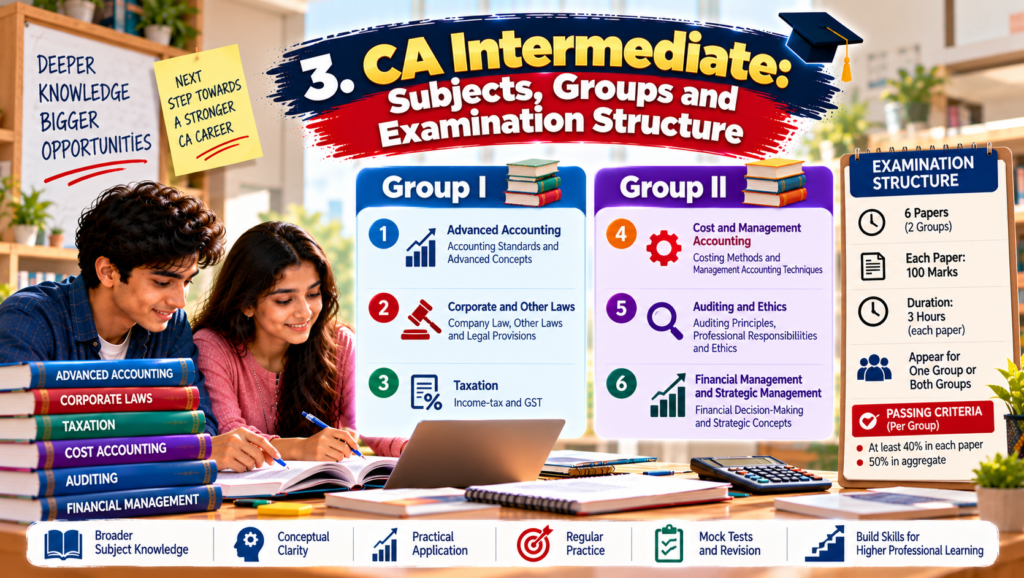
CA Intermediate is the next major stage in the CA course and introduces students to more detailed professional concepts. The syllabus covers advanced accounting, corporate and other laws, taxation, cost and management accounting, auditing, financial management and strategic management. These subjects help students understand how financial information is prepared, how businesses operate within legal and tax frameworks, and how organisations manage resources and evaluate performance. The level requires consistent preparation because students must understand concepts and apply them to practical questions.
Under ICAI’s New Scheme of Education and Training, CA Intermediate consists of six papers divided into two groups:
Group I
- Paper 1: Advanced Accounting – Develops knowledge of accounting standards and advanced accounting treatments.
- Paper 2: Corporate and Other Laws – Covers prescribed corporate law and other relevant legal provisions.
- Paper 3: Taxation – Covers the prescribed areas of income-tax law and goods and services tax (GST).
Group II
- Paper 4: Cost and Management Accounting – Focuses on costing methods, cost analysis and management accounting techniques.
- Paper 5: Auditing and Ethics – Introduces auditing principles, professional responsibilities and ethical requirements.
- Paper 6: Financial Management and Strategic Management – Covers financial decision-making, investment and financing concepts, and strategic management.
Each Intermediate paper is generally three hours long and carries 100 marks. Students can appear for one group or both groups, subject to the applicable examination rules. Passing a group generally requires at least 40% in each paper and 50% in aggregate for that group. Students should check ICAI’s latest syllabus, examination guidance and applicable assessment pattern before preparing for a specific examination session.
Preparation for Intermediate requires more than memorising definitions or formulas. Students need to practise numerical questions, understand the application of laws and taxation provisions, and develop the ability to present clear, well-structured answers. A subject-wise timetable can help distribute study time according to the difficulty of each paper, while regular revision can reduce the burden of relearning topics before examinations. Mock tests and detailed review of answers can also help students improve their speed, accuracy and understanding of exam expectations.
4. CA Final: Subjects, Exam Pattern and Advanced Learning
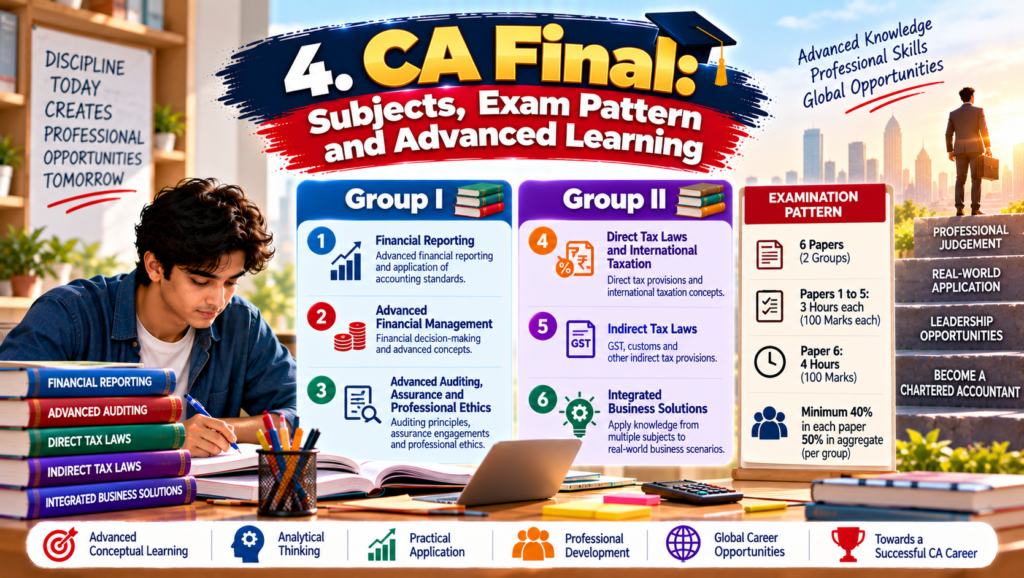
CA Final is the advanced academic stage of the course and focuses on the professional knowledge required for complex financial and business situations. Students study advanced financial reporting, financial management, auditing, taxation and integrated business problem-solving. The subjects require them to connect different areas of accounting and business knowledge rather than approach every topic in isolation. This stage also develops the ability to evaluate information, apply professional judgement and analyse business situations using the concepts learned throughout the CA course.
Under the current scheme, CA Final consists of six papers divided into two groups:
Group I
- Paper 1: Financial Reporting – Focuses on advanced financial reporting and the application of relevant accounting standards.
- Paper 2: Advanced Financial Management – Covers advanced financial decision-making and financial management techniques.
- Paper 3: Advanced Auditing, Assurance and Professional Ethics – Covers advanced auditing practices, assurance engagements and professional ethics.
Group II
- Paper 4: Direct Tax Laws and International Taxation – Covers prescribed direct tax provisions and international taxation concepts.
- Paper 5: Indirect Tax Laws – Focuses on indirect taxation, including the prescribed GST and customs-related areas.
- Paper 6: Integrated Business Solutions – Requires students to apply knowledge from multiple CA subjects to integrated business scenarios.
Under the applicable examination pattern, Papers 1 to 5 are generally three hours long, while Paper 6, Integrated Business Solutions, has a four-hour duration. Each paper carries 100 marks. The group-wise passing requirements and any applicable exemptions or other examination provisions should be checked in ICAI’s current guidance for the relevant examination session.
Preparation for CA Final calls for detailed subject knowledge, regular revision and the ability to apply concepts to practical situations. Students should work through case-based questions, practise integrating knowledge across subjects and review the reasoning behind their answers. Staying updated with applicable amendments, standards and examination-specific study material is also important. A disciplined preparation routine helps students manage the depth of the syllabus and approach the examination with a clearer understanding of the professional judgement expected at this level.

5. Difference Between CA Foundation, Intermediate and Final
Although all three levels are part of the same professional course, each has a distinct purpose. Foundation establishes the basics of accounting, law, quantitative aptitude and economics. Intermediate expands that foundation into more specialised areas such as taxation, auditing, cost accounting and financial management. Final takes students further into advanced reporting, professional assurance, taxation and integrated business analysis. Understanding this progression helps students appreciate how the subjects build upon one another throughout the course.
The preparation required also changes at each level. Foundation places significant emphasis on conceptual clarity and fundamental problem-solving, while Intermediate requires more detailed subject knowledge and consistent practice across a wider syllabus. Final places greater emphasis on advanced application, professional judgement and connecting knowledge across disciplines. Students who develop good study habits early can carry those habits forward as the syllabus becomes more demanding. Rather than treating each examination as an isolated goal, students should view the three levels as connected stages of professional learning.
6. How to Progress from One CA Level to the Next
Students need to satisfy ICAI’s applicable eligibility and progression requirements at each stage of the CA course. After meeting the requirements for Foundation, students can proceed to Intermediate through the prescribed route. Eligible graduates and postgraduates may also have access to the Direct Entry Route, subject to ICAI’s conditions. After clearing the required Intermediate groups and completing the applicable requirements, students progress through practical training and the remaining stages prescribed under the scheme before becoming eligible for CA Final and, eventually, membership.
Because registration, examination eligibility, practical training and course requirements can change, students should rely on the latest ICAI notifications rather than older study guides or informal advice. Keeping track of registration deadlines and examination announcements helps prevent avoidable delays. Students should also understand the practical training requirements and plan their academic commitments accordingly. Knowing the full pathway gives aspiring CAs a realistic picture of the time, effort and professional development involved in completing the course.
7. When Should Students Start CA Coaching? Why Intermediate Is the Right Time
Starting CA preparation early can give students more time to understand the course, develop a study routine and build the foundational skills needed for professional education. Intermediate is a particularly useful time to begin exploring CA because students are already studying subjects that may connect with areas of the course, especially those interested in commerce, accounting, economics or mathematics. Early exposure can help them become familiar with the CA Foundation syllabus and identify topics that require additional attention before planning their examination attempt.
Beginning during Intermediate does not mean students should neglect their board examinations or rush through the CA syllabus. Instead, they can follow a balanced schedule that prioritises classroom studies while gradually introducing CA Foundation concepts and practice. Students can start by strengthening accounting basics, improving numerical skills, understanding business concepts and learning how to study consistently. With a realistic timetable and appropriate guidance, Intermediate students can build familiarity with the CA pathway before moving into more intensive preparation after Class 12.
8. How MEC and CEC Students Can Plan for CA
MEC and CEC are both Intermediate streams that can lead students towards a future in Chartered Accountancy, provided they meet the applicable course requirements. MEC includes Mathematics, Economics and Commerce, while CEC includes Civics, Economics and Commerce. Students from either stream can explore CA preparation, although their familiarity with particular topics may differ according to their previous studies. The important factors are their interest in accounting and business, willingness to practise regularly and ability to manage the academic workload.
Students can begin by understanding the CA Foundation subjects and creating a study plan that works alongside their Intermediate syllabus. Those who find numerical questions challenging can allocate extra time to mathematics and accounting practice, while students who are comfortable with calculations can focus on building conceptual understanding and answer-writing skills in other subjects. Choosing integrated CA coaching can help students coordinate their Intermediate learning and CA preparation under a planned schedule. At CMS CA Coaching Centers in Hyderabad, students can explore CA coaching integrated with MEC or CEC as part of their Intermediate education.
9. How to Choose the Right CA Coaching Program
Choosing CA coaching involves more than comparing class schedules or the number of subjects covered. Students should consider faculty expertise, clarity of teaching, doubt-resolution support, the quality of study material and the way the program helps them monitor their preparation. A suitable program should provide a structured approach to learning, allow sufficient time for practice and revision, and help students understand difficult concepts instead of simply moving quickly through the syllabus. It should also fit alongside their school or Intermediate responsibilities.
Mock examinations, regular assessments and useful performance feedback can make preparation more focused by showing students which areas require improvement. Students and parents should also understand the course structure, timetable and academic support available before making a decision. At CMS, integrated CA coaching options for MEC and CEC students can help connect Intermediate studies with CA preparation. Evaluating these features carefully can help students choose a program that suits their learning style and supports their long-term academic goals.
10. Starting Your CA Journey with CMS
A clear understanding of CA Foundation, Intermediate and Final helps students approach the course with realistic expectations. Each stage introduces new subjects and requires students to strengthen their conceptual knowledge, problem-solving ability and examination skills. Starting to explore CA during Intermediate gives students an opportunity to understand the course structure, establish productive study habits and plan their preparation without losing sight of their board examinations. Early planning can also help students identify the academic support and learning approach that best suit their needs.
CMS offers integrated CA coaching options for students pursuing MEC and CEC, giving them an opportunity to connect their Intermediate education with preparation for the CA pathway. With suitable academic planning, subject guidance and consistent effort, students can begin developing the foundation needed for professional studies while completing Class 11 and Class 12. If you are considering Chartered Accountancy as your future career, take the first step with CMS by exploring the integrated CA coaching options and choosing a study plan that supports your Intermediate education and long-term ambitions.