
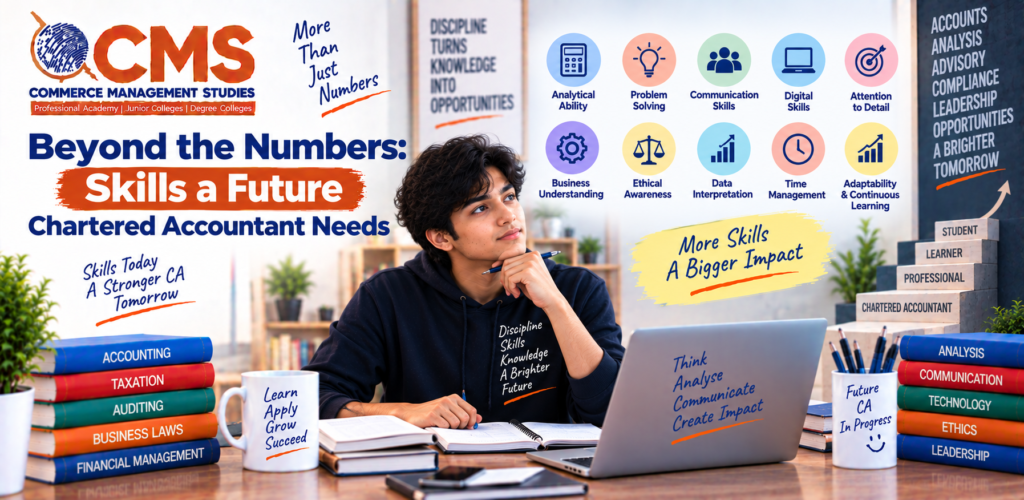
Introduction
Chartered Accountancy is often associated with numbers, accounting, taxation, auditing, and financial statements. These areas are certainly important parts of the profession, but becoming a Chartered Accountant involves much more than being comfortable with calculations. Professionals working in accounting and finance need to analyse information, understand business situations, communicate findings, solve problems, work with technology, and make careful decisions based on financial and non-financial information.
For students considering CA as a career, developing these abilities early can complement their academic preparation. Many of these skills do not appear as separate subjects on a timetable; they develop gradually through reading, problem-solving, discussions, presentations, practical examples, and consistent practice. Building them alongside subject knowledge can help students develop a broader understanding of what working in the accounting and finance profession involves.
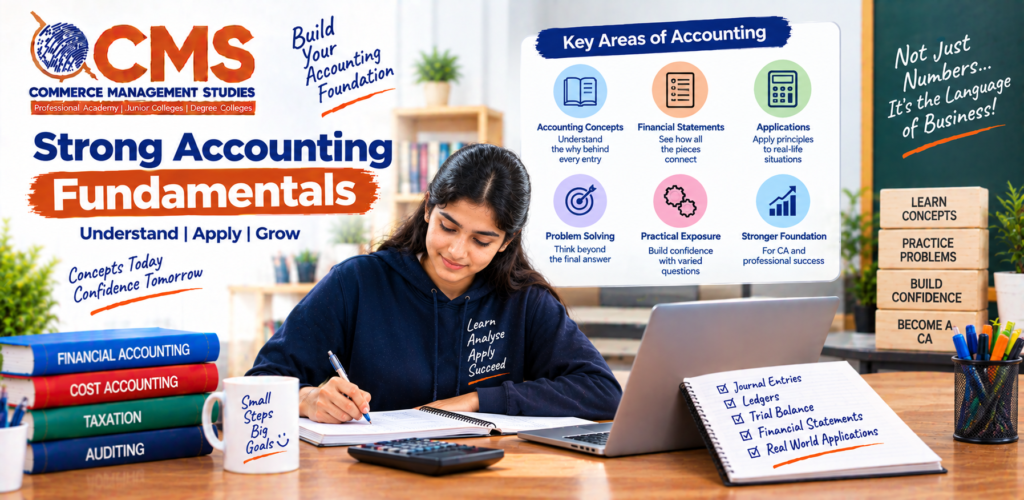
Strong Accounting Fundamentals
Accounting knowledge forms one of the fundamental pillars of Chartered Accountancy. Students need to understand concepts rather than simply memorise accounting treatments because professional-level questions often require them to apply principles to different situations.
A strong foundation begins with understanding why a transaction is recorded in a particular way, how different financial statements are connected, and how accounting information represents the financial activities of an organisation. Students can strengthen this foundation by solving different types of problems and reviewing the reasoning behind each answer rather than focusing only on the final result.
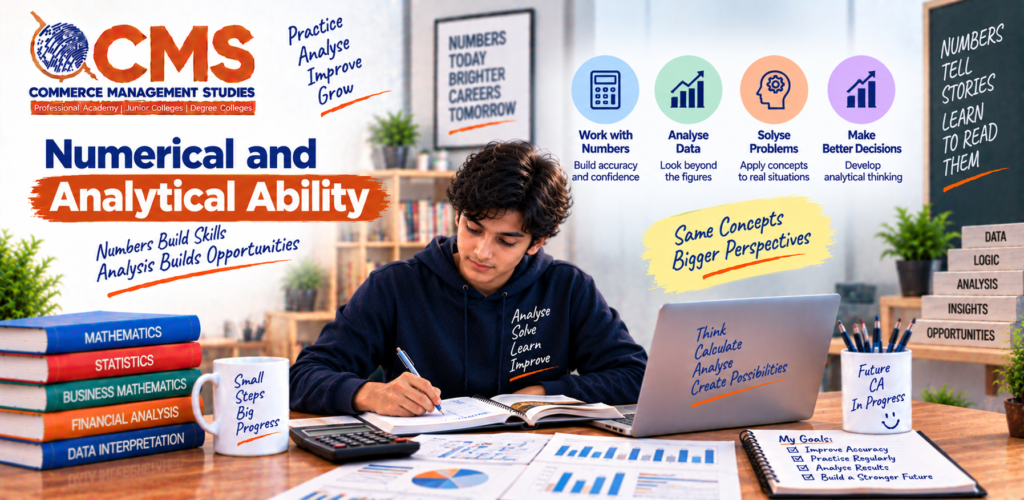
Numerical and Analytical Ability
Numbers remain an important part of CA preparation and professional work. Students need to be comfortable working with calculations, financial information, ratios, percentages, and other quantitative concepts. Accuracy is particularly important because even a small numerical error can affect financial analysis.
However, numerical ability is not limited to performing calculations quickly. Analytical ability involves interpreting the numbers and understanding what they indicate. A change in revenue, expenses, profit, or working capital may raise questions about the underlying business situation. Learning to ask these questions can help students move from simply calculating figures to understanding them.
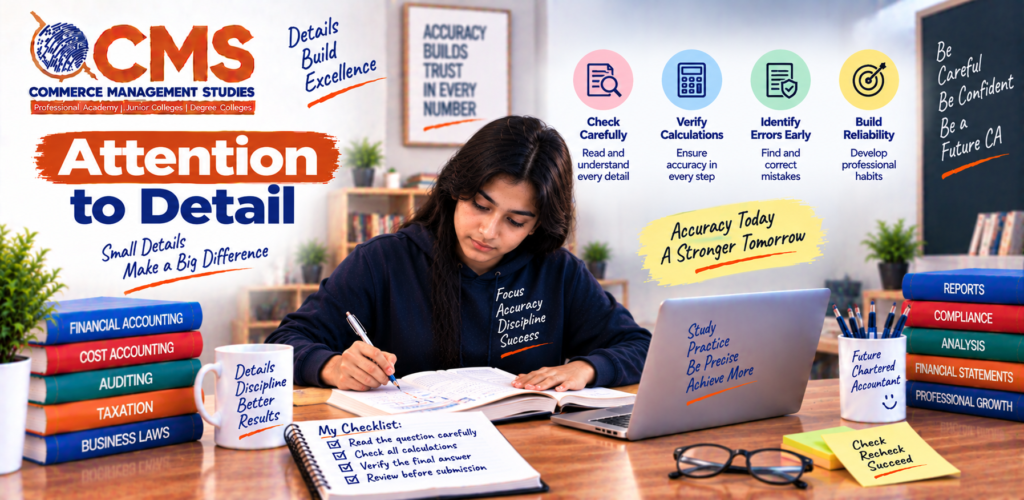
Attention to Detail
Accounting and financial work often involves reviewing large amounts of information. Missing a small detail in a document, calculation, transaction, or financial record can sometimes lead to a larger issue. Developing attention to detail can therefore be valuable for future accounting professionals.
Students can begin building this habit during their academic preparation. When solving questions, they can carefully read every condition, check calculations, verify units, and review their answers before moving on. Developing a habit of checking work can improve accuracy and also teach students to approach financial information carefully.
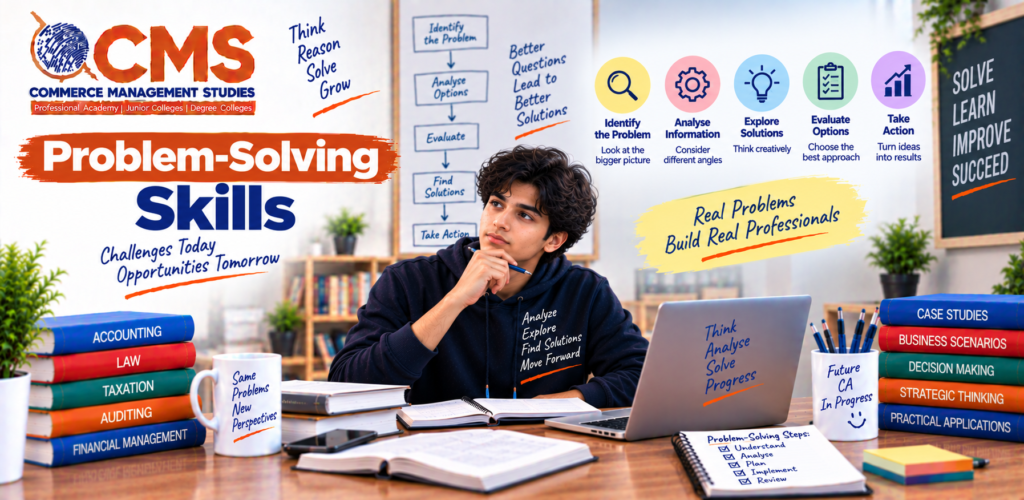
Problem-Solving Skills
Professional accounting work can involve situations that do not have a straightforward answer. A financial discrepancy, unusual transaction, unexpected expense, or difference between planned and actual performance may require investigation before the underlying issue becomes clear.
Problem-solving involves identifying the issue, collecting relevant information, considering possible explanations, and evaluating the available solutions. Students can develop this skill by attempting application-based questions and case studies instead of relying entirely on direct textbook exercises. Even everyday business examples can provide opportunities to think about how a problem might be analysed.
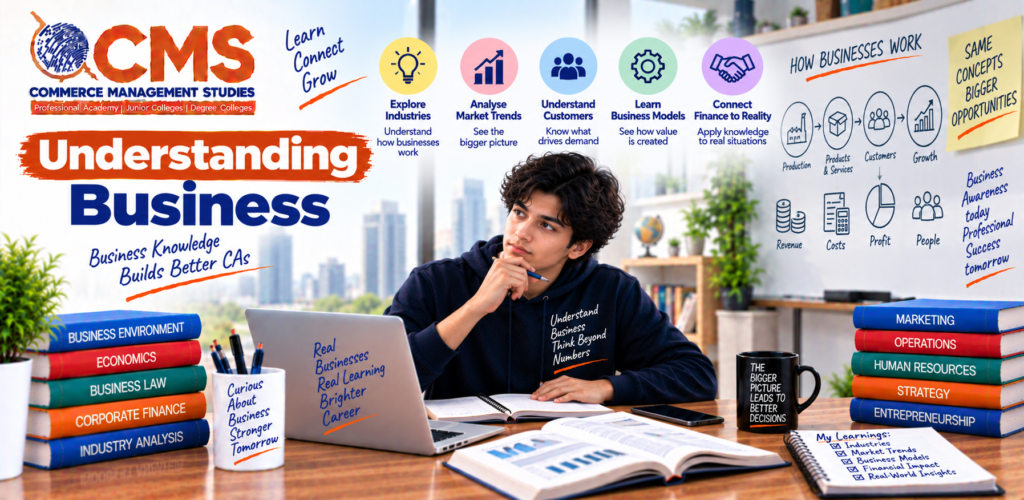
Understanding Business
A Chartered Accountant does not work with numbers in isolation. Financial information is connected to the activities of the organisation that generates it. Understanding how a business earns revenue, manages costs, serves customers, employs people, and competes in its market can therefore make financial information easier to interpret.
Students can develop business awareness by observing companies and reading about different industries. They can consider questions such as how a company makes money, what its major expenses might be, what risks it faces, and how changes in the market could affect its financial performance. This connects classroom concepts with real-world business activity.
Communication Skills
Financial information often needs to be communicated to people who may not have a finance or accounting background. A professional may need to explain a financial result, describe a risk, present findings, or discuss an accounting issue with management or a client.
Good communication involves more than speaking confidently. It includes organising information logically, choosing appropriate language, listening carefully, and explaining technical concepts in a way that the audience can understand. Students can begin developing these skills through presentations, group discussions, written assignments, and explaining concepts to others.
Written Communication
Written communication is particularly relevant in professional environments where reports, emails, documentation, financial explanations, and formal communications are part of everyday work. The ability to write clearly can make complex information easier for others to understand.
Students can practise by summarising chapters in their own words, writing short explanations of accounting concepts, or preparing structured answers. Clear writing generally comes from clear thinking, so practising how to organise ideas can benefit both academic performance and future professional communication.
Time Management
CA preparation involves multiple subjects and a substantial amount of study material. Students therefore need to learn how to manage their available time effectively. This becomes particularly important when balancing Intermediate education with professional-course preparation.
Time management does not necessarily mean studying continuously for long hours. It involves setting priorities, dividing large tasks into smaller targets, allocating sufficient time for difficult subjects, and leaving room for revision and testing. A realistic schedule that can be followed consistently is generally more useful than an extremely demanding timetable.
Consistency and Discipline
Professional courses require sustained preparation over an extended period. Students may experience days when they feel highly motivated and other days when studying feels more difficult. Building a consistent routine helps ensure that preparation does not depend entirely on short-term motivation.
Small daily habits can contribute significantly over time. Regular revision, question practice, reading, and self-assessment can gradually strengthen knowledge. Developing this discipline during Intermediate can also help students adjust to the demands of professional education later.
Critical Thinking
Critical thinking involves examining information carefully instead of accepting every statement at face value. In accounting and finance, professionals may need to review information, identify inconsistencies, consider different interpretations, and evaluate evidence before reaching a conclusion.
Students can develop this ability by asking questions about the information they study. Instead of only asking what the answer is, they can ask why it is correct, what assumptions are involved, and whether the same principle would apply in a different situation. This approach encourages deeper learning and stronger conceptual understanding.
Ethical Awareness
Accounting and financial information can influence important decisions made by businesses, investors, regulators, and other stakeholders. This makes professional ethics an important part of the accounting profession.
Students considering CA should understand that technical knowledge and professional responsibility go together. Accuracy, integrity, confidentiality, objectivity, and responsible handling of information are important professional principles. Developing an ethical mindset early can help students appreciate the responsibilities associated with working with financial information.
Digital and Technology Skills
The accounting profession has changed significantly with the development of digital tools. Organisations use accounting software, spreadsheets, enterprise systems, data-analysis tools, cloud platforms, and other technologies to manage financial information and business processes.
Future accounting professionals therefore benefit from being comfortable with technology. Students can begin by developing basic spreadsheet skills, learning how financial information can be organised digitally, and becoming familiar with common productivity tools. Technology does not replace accounting knowledge; instead, it increasingly provides professionals with tools for performing and analysing their work more efficiently.
Data Interpretation
Businesses generate large amounts of financial and operational data. Chartered Accountants may encounter information in the form of financial statements, reports, ratios, budgets, forecasts, charts, and other analytical formats.
Being able to interpret this information is different from simply reading it. Students should learn to identify trends, compare figures, recognise unusual changes, and understand what the data could indicate. Practising data interpretation through financial examples and aptitude-based questions can help develop this ability.
Research Skills
Accounting, taxation, regulations, and business practices can involve detailed information that professionals may need to research before reaching a conclusion. Developing the ability to locate reliable information, understand it, compare sources, and apply relevant information is therefore useful.
Students can practise research skills through academic projects and by reading reliable educational and professional resources. They should also learn to distinguish between authoritative information and unverified online content, particularly when researching technical or regulatory subjects.
Adaptability and Continuous Learning
The business and financial environment continues to change due to technology, regulations, economic conditions, and evolving business models. Professionals therefore need to remain willing to learn throughout their careers.
For students, this means developing an attitude of continuous learning rather than viewing education as something that ends with an examination. Reading about changes in business, technology, finance, and accounting can gradually build awareness of how the profession is evolving.
Teamwork and Collaboration
Although accounting can involve individual analytical work, many professional assignments require collaboration. Accountants may work with auditors, finance teams, management, legal professionals, technology teams, and clients.
Students can develop teamwork skills through group projects, discussions, presentations, and collaborative activities. Learning to listen to different viewpoints, divide responsibilities, meet deadlines, and contribute constructively can prepare students for professional environments where results often depend on coordinated efforts.
Decision-Making Skills
Financial professionals may provide information that helps managers make important decisions. To contribute effectively, they need to understand the available information, identify relevant factors, consider risks, and communicate the implications of different choices.
Students can practise decision-making by analysing simple business situations. For example, they might consider whether a company should increase production, introduce a new product, invest in technology, or reduce a particular expense. The purpose is not always to find one perfect answer but to learn how to evaluate information systematically.
Building These Skills During Intermediate
Students do not have to wait until professional CA studies begin to develop these abilities. Intermediate education can provide many opportunities to strengthen numerical reasoning, accounting knowledge, communication, reading, and analytical thinking.
Students pursuing MEC or CEC can build their Commerce and Economics foundation while gradually developing additional skills through practice and real-world observation. At CMS CA Coaching in Hyderabad, students interested in CA can pursue Intermediate education with integrated CA coaching, giving them an opportunity to work on academic fundamentals while becoming familiar with the demands of professional preparation.
Combining Skills With CA Preparation
Academic preparation and skill development can complement each other. Solving accounting problems can improve numerical accuracy and attention to detail, while analysing business examples can develop critical thinking and commercial awareness. Reading articles can strengthen comprehension, and presenting an explanation can improve communication.
Students can therefore incorporate skill-building into their existing study routine rather than treating it as a completely separate task. A well-rounded approach can involve concept learning, question practice, revision, mock tests, reading, discussions, and periodic self-assessment.
Conclusion
Becoming a Chartered Accountant requires a strong understanding of accounting, finance, taxation, auditing, and related areas, but professional development extends beyond technical knowledge. Analytical thinking, attention to detail, communication, problem-solving, time management, ethical awareness, digital literacy, teamwork, and adaptability can all contribute to becoming a well-rounded accounting professional.
Students interested in CA can begin developing these skills during their Intermediate years through small but consistent activities. The objective is not to master every professional skill immediately, but to gradually build habits that support learning and practical understanding. When strong subject knowledge is combined with these broader abilities, students can develop a more complete picture of what a career in Chartered Accountancy involves.