
Introduction
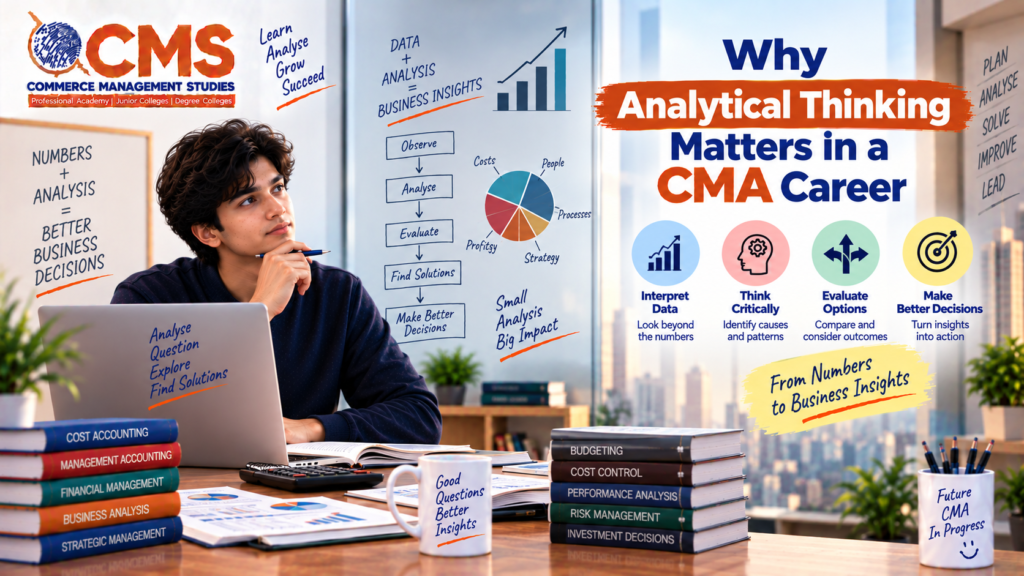
Cost and Management Accountancy is closely connected with numbers, financial information, costing, budgeting, and business performance. However, working with numbers is only one part of the profession. A CMA professional also needs to understand what those numbers mean, why they changed, how different factors are connected, and what the information may indicate about an organisation’s performance. This is where analytical thinking becomes particularly important.
Analytical thinking involves breaking information into smaller parts, identifying patterns, comparing alternatives, examining causes, and drawing logical conclusions from available evidence. In a CMA career, these skills can be applied across areas such as cost management, financial planning, budgeting, performance evaluation, risk analysis, and management decision-making. Developing this ability can therefore help students understand how financial information can be transformed into useful business insights.
What Is Analytical Thinking?
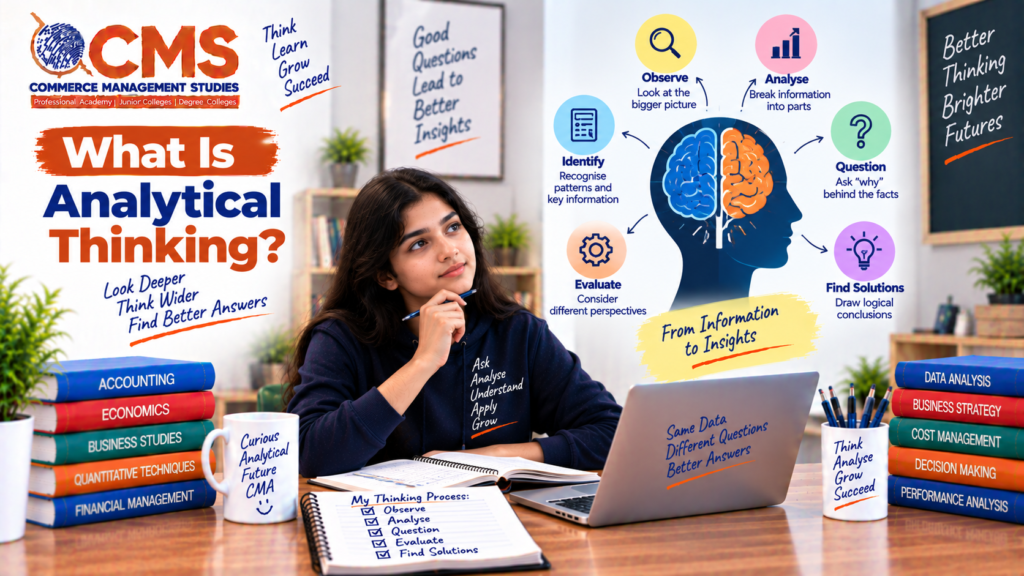
Analytical thinking is the ability to examine information systematically rather than accepting it at face value. When looking at a financial figure, an analytical thinker does not stop at identifying whether it increased or decreased. They also consider what caused the change, whether the change is significant, whether it is temporary or recurring, and what other information should be examined.
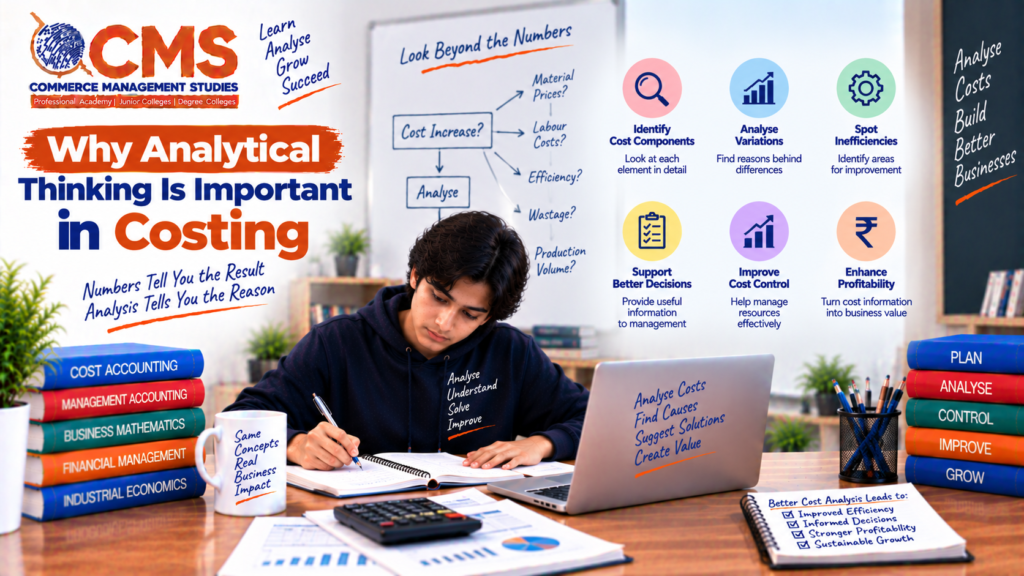
For example, if the cost of producing a product increases, there could be several reasons. Raw-material prices may have increased, production efficiency may have declined, labour costs may have changed, or production volume may have fallen. Analytical thinking encourages professionals to investigate these possibilities before drawing conclusions.
Why Analytical Thinking Is Important in Costing
Costing is one of the central areas associated with management accounting. Businesses need to understand how much they spend on producing goods or delivering services and how different costs affect profitability. Simply calculating the total cost does not always explain whether the business is operating efficiently.
A CMA professional may need to examine the components of a cost, compare actual costs with planned costs, identify variations, and understand the reasons behind those variations. Analytical thinking helps in breaking down these figures and determining which factors are contributing most significantly to changes in overall costs.
Analysing Cost Variations
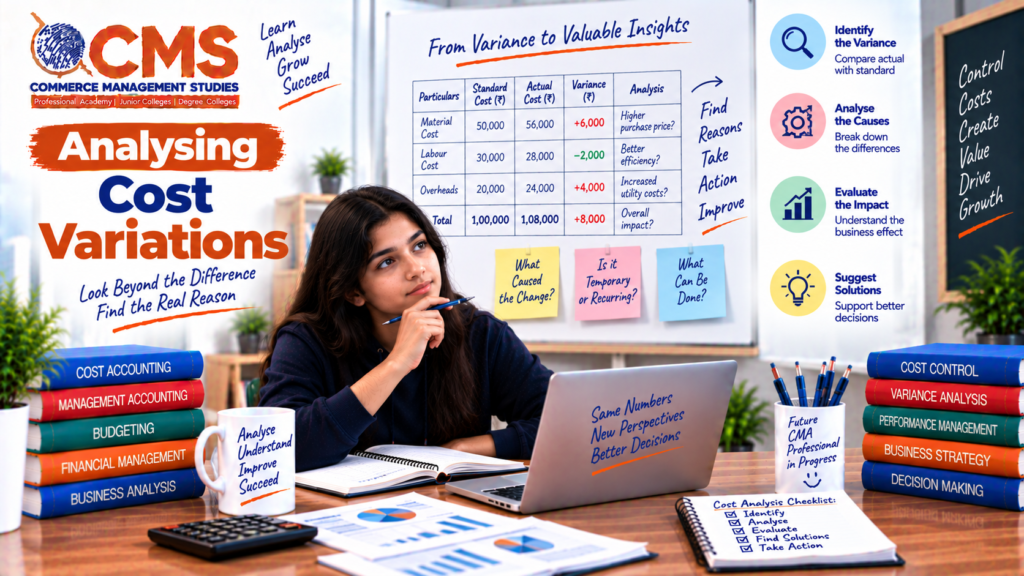
Businesses often compare actual performance with budgets or predetermined standards. Differences between expected and actual costs can provide useful information about operations. However, the difference itself is only the starting point of the analysis.
For instance, if actual material costs are higher than the budgeted amount, the professional may need to examine whether the increase resulted from higher purchase prices, greater material consumption, wastage, changes in production volume, or other factors. This type of investigation demonstrates why analytical thinking is important in converting financial differences into meaningful information.
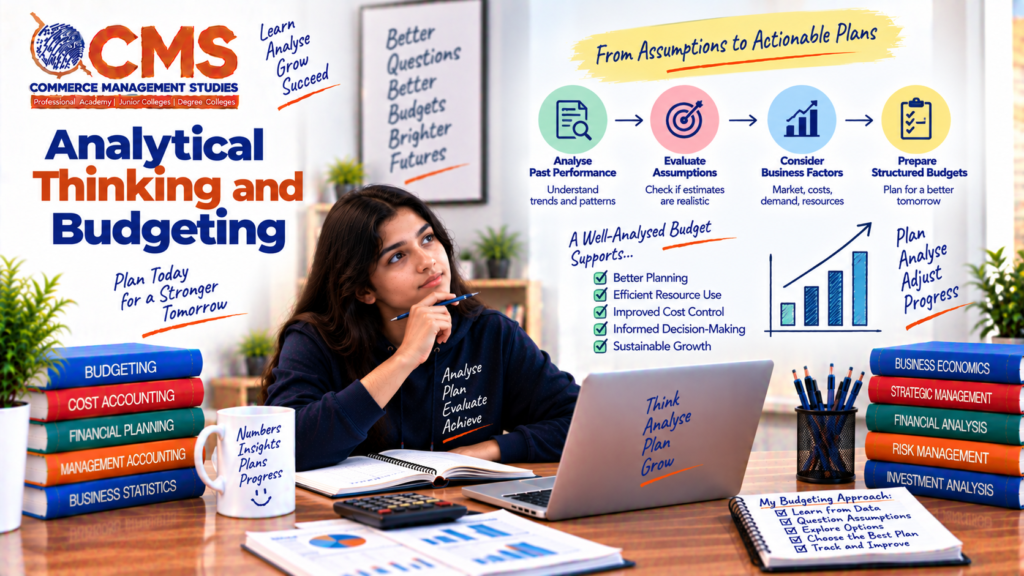
Analytical Thinking and Budgeting
Budgets are used by organisations to plan future income, expenditure, investments, and resource requirements. Preparing a budget involves estimating what may happen in the future, which means professionals need to consider historical information as well as expected changes in the business environment.
Analytical thinking helps professionals evaluate whether assumptions used in a budget are reasonable. They may examine previous performance, expected sales, cost trends, market conditions, and operational requirements before developing financial estimates. This can make budgeting more structured and evidence-based.
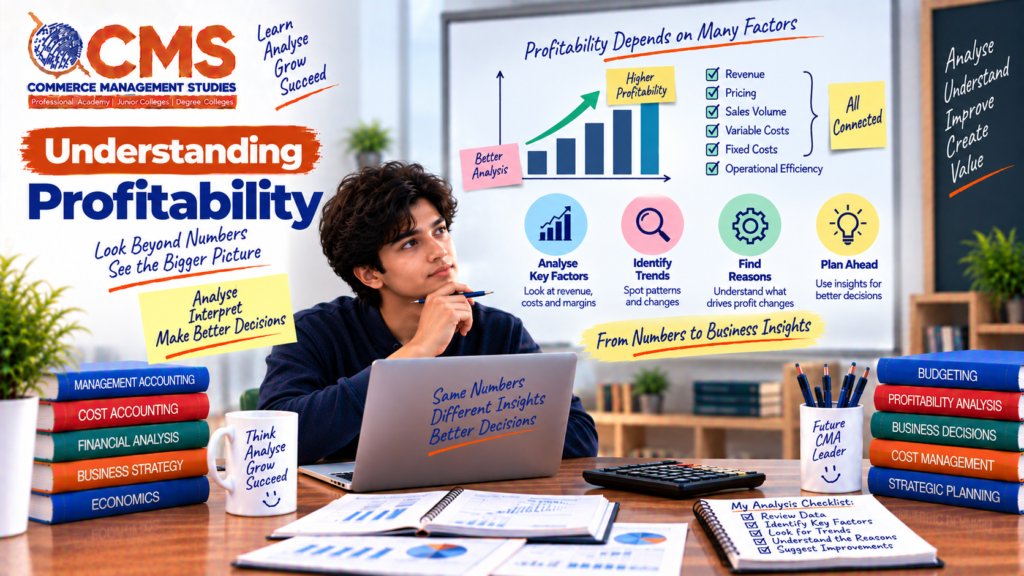
Understanding Profitability
Profitability is influenced by several factors, including revenue, pricing, sales volume, variable costs, fixed costs, and operational efficiency. A change in profit therefore does not always have a single explanation.
A CMA professional may analyse profitability by looking at individual products, business units, markets, or activities. This can help management understand which areas are contributing to financial performance and where changes may need to be considered. The ability to examine multiple factors together is a key part of analytical thinking.
The Role of Analytical Thinking in Pricing
Pricing decisions often involve balancing customer demand, competition, costs, and profitability. A price that appears attractive to customers may not generate sufficient margin, while a higher price may affect demand depending on market conditions.
CMA-related knowledge can help professionals examine the financial implications of different pricing scenarios. Analytical thinking allows them to consider how changes in price, sales volume, and costs could affect overall profitability instead of evaluating the price in isolation.
Using Data for Business Decisions
Modern organisations generate significant amounts of financial and operational data. Sales figures, production information, inventory levels, customer data, expenses, budgets, and performance indicators can all contribute to business analysis.
The challenge is not simply having access to data but knowing how to interpret it. Analytical thinking helps professionals identify useful patterns, compare relevant figures, recognise unusual movements, and distinguish important information from background data. This can make financial analysis more meaningful for management.
Analytical Thinking and Performance Evaluation
Businesses need to know whether their operations are performing according to expectations. Performance evaluation may involve comparing actual results with budgets, previous periods, targets, or other relevant benchmarks.
A CMA professional can examine these comparisons and investigate the reasons for significant differences. For example, a department may achieve higher revenue but experience an even greater increase in operating costs. Looking only at revenue could give an incomplete picture, whereas analysing both revenue and costs provides a more comprehensive understanding of performance.
Risk Analysis Requires Logical Thinking
Business decisions involve uncertainty. Companies may face changes in customer demand, input costs, interest rates, regulations, technology, competition, or economic conditions. Financial professionals need to consider how such changes could affect the organisation.
Analytical thinking helps professionals examine different scenarios and identify potential financial consequences. Instead of assuming that one expected outcome will definitely occur, they can consider multiple possibilities and evaluate the information available for each situation. This can support more informed planning and risk management.
Analytical Thinking in Investment Decisions
Businesses may need to decide whether to invest in machinery, technology, infrastructure, new projects, or expansion. Such decisions can involve substantial financial resources and long-term consequences.
CMA professionals can contribute by examining expected costs, potential returns, cash flows, risks, and other relevant factors. Analytical thinking helps them compare alternatives and understand the financial implications of different investment scenarios. The final business decision may involve several considerations, but a structured financial analysis can provide an important part of the decision-making process.
Connecting Financial and Operational Information
Financial figures often reflect what is happening within the organisation’s operations. An increase in production costs, for example, may be connected to changes in production efficiency, supplier prices, machine utilisation, or labour requirements.
A strong analytical approach therefore involves looking beyond financial statements and understanding the operational factors behind the numbers. This broader perspective can help a CMA professional communicate more meaningful information to management.
Analytical Thinking and Problem-Solving
Many professional situations begin with a problem rather than a clearly defined question. A company may notice that profits have declined, costs have increased, or cash flow has become tighter. The professional may then need to investigate the underlying reasons.
Analytical problem-solving generally involves identifying the issue, collecting relevant information, separating facts from assumptions, examining possible causes, and evaluating potential solutions. Developing this structured approach can be useful for CMA students because professional questions often require application rather than simple recall.
Communication of Analytical Findings
Analysis becomes useful only when its conclusions can be communicated clearly. A CMA professional may need to present financial findings to managers, business owners, department heads, or other stakeholders who may not have specialised accounting knowledge.
This requires the ability to explain complex information in simple and logical terms. Instead of presenting a large collection of figures, a professional may need to identify the most important findings, explain the reasons behind them, and describe their potential implications. Analytical thinking and communication therefore work together in professional environments.
Technology and Analytical Skills
Technology has changed the way financial information is collected, processed, and analysed. Spreadsheets, accounting software, enterprise systems, data visualisation tools, and other digital platforms can help professionals work with large amounts of information more efficiently.
However, technology does not replace analytical thinking. Software can identify patterns or produce reports, but professionals still need to determine which information matters, whether the data is reliable, and what conclusions can reasonably be drawn. Developing both digital literacy and analytical judgement can therefore be valuable for future CMA professionals.
Developing Analytical Thinking as a Student
Analytical thinking can be developed gradually through everyday academic activities. Students do not need to wait until they enter professional education to begin building this skill. Solving application-based questions, comparing different approaches, analysing business examples, and explaining the reasoning behind answers can all contribute to analytical development.
Students can also practise by asking additional questions while studying. Instead of asking only “What is the answer?”, they can ask “Why is this the answer?”, “What would happen if one factor changed?”, and “How would this affect the final result?” Such questions encourage deeper understanding and reduce dependence on memorisation.
Connecting MEC With CMA Preparation
Students pursuing MEC can find several natural connections between their Intermediate subjects and the analytical skills used in CMA-related studies. Mathematics can strengthen quantitative reasoning, Economics can help students understand markets and economic relationships, and Commerce can introduce accounting and business concepts.
At CMS CMA Coaching in Hyderabad, students pursuing MEC can combine their Intermediate education with integrated CMA coaching. This approach can allow students to build academic fundamentals while gradually developing the numerical, conceptual, and analytical skills relevant to professional commerce education.
Analytical Thinking Beyond the Examination
Although analytical thinking is useful for examinations, its importance extends beyond academic performance. A CMA professional may encounter new business situations that cannot be solved simply by recalling a textbook example. The ability to analyse unfamiliar information and apply established principles to a new situation can therefore be valuable throughout a professional career.
The business environment also changes over time. New technologies, business models, regulations, and market conditions can create situations that professionals have not encountered before. Strong analytical habits can help professionals approach these new situations systematically rather than relying only on previous examples.
Building a Habit of Asking Better Questions
One of the simplest ways to strengthen analytical thinking is to develop the habit of asking better questions. When students encounter a financial or business problem, they can look beyond the immediate calculation and examine the reasons, relationships, assumptions, and possible consequences involved.
For example, if a company’s sales increase, students can ask whether profits increased at the same rate, whether costs also increased, whether the growth came from higher prices or higher sales volume, and whether the change is likely to continue. These questions turn a basic financial observation into a broader analytical exercise.
Conclusion
Analytical thinking is an important skill in a CMA career because the profession involves more than recording or calculating financial information. Costing, budgeting, profitability analysis, performance evaluation, pricing, investment analysis, and business planning all require professionals to examine information carefully and understand the factors behind financial results.
For students considering CMA, analytical thinking can be developed gradually alongside academic preparation. By practising problem-solving, understanding concepts, analysing real-world business situations, questioning assumptions, and learning to interpret financial information, students can build a stronger foundation for professional studies. The ability to move from numbers to explanations, and from explanations to informed business insights, is one of the skills that gives management accounting its practical character.