
Introduction
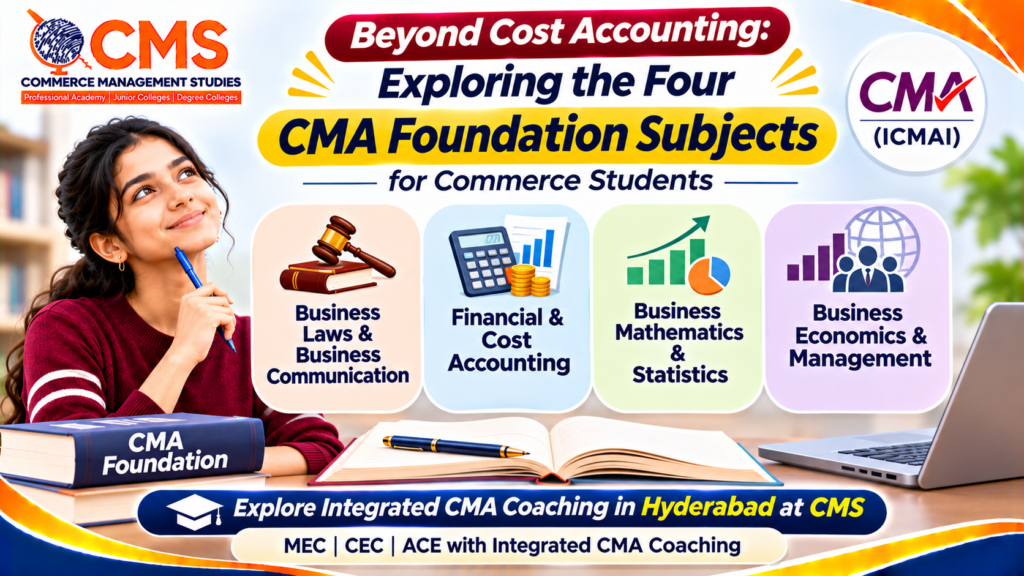
When commerce students think about Cost and Management Accountancy (CMA), cost accounting and financial calculations are often the first topics that come to mind. However, CMA Foundation introduces students to a much broader range of business concepts. It includes business laws, communication, financial and cost accounting, mathematics, statistics, economics and management, helping students understand how organisations operate and make financial decisions.
The four CMA Foundation papers are designed to develop different but connected skills. Business Laws and Business Communication introduces legal principles and professional communication, Financial and Cost Accounting develops financial understanding, Business Mathematics and Statistics strengthens numerical and analytical ability, and Business Economics and Management explains business decisions and organisational activities. Understanding these subjects can help commerce students approach CMA Foundation preparation with greater clarity and recognise how each paper contributes to their professional learning.
What Are the Four Subjects of CMA Foundation?
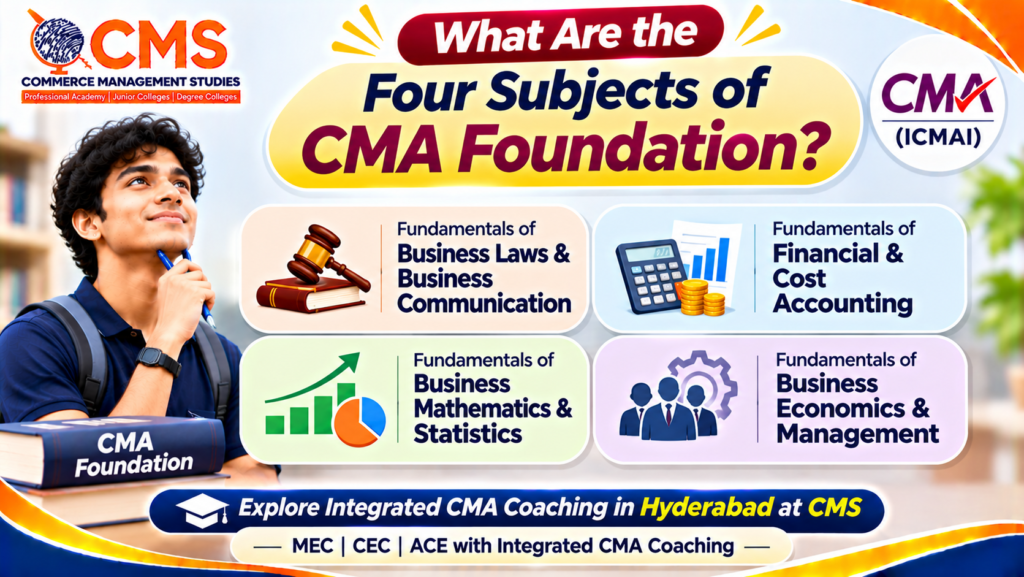
CMA Foundation is the entry-level course in the Cost and Management Accountancy qualification offered by the Institute of Cost Accountants of India (ICMAI). Under the CMA Syllabus 2022, the Foundation course includes four papers:
- Fundamentals of Business Laws and Business Communication
- Fundamentals of Financial and Cost Accounting
- Fundamentals of Business Mathematics and Statistics
- Fundamentals of Business Economics and Management
Each paper carries 100 marks. Together, they provide an introduction to the legal, financial, mathematical and managerial concepts that are relevant to cost and management accounting.
1. Fundamentals of Business Laws and Business Communication: Understanding Rules and Professional Communication
Business Laws and Business Communication introduces students to the legal framework that supports business transactions and the communication skills required in professional environments.
Businesses enter into agreements, purchase and sell goods, receive payments and maintain relationships with customers, suppliers and other organisations. Understanding the legal principles behind these activities helps students recognise the importance of valid contracts, business responsibilities and proper documentation.
What Does Business Laws and Business Communication Cover?
This paper includes two broad sections:
Fundamentals of Business Laws
Students are introduced to important legal concepts and business legislation, including:
- Introduction to the Indian legal system.
- Indian Contract Act, 1872.
- Sale of Goods Act, 1930.
- Negotiable Instruments Act, 1881.
These topics help students understand the legal requirements associated with agreements, commercial transactions and financial instruments.
Business Communication
The communication section introduces students to the principles of effective business communication. It helps them understand how information is exchanged in professional settings and why clarity, accuracy and appropriate language are important.
Why Is This Subject Important for Commerce Students?
Business Laws develops the ability to understand legal rules and apply them to business situations. For example, when a company enters into an agreement with a supplier, the parties must understand the terms and conditions of the contract and their respective responsibilities.
Business Communication complements this knowledge by helping students express information clearly. Whether preparing a business letter, communicating with a client or presenting financial information, effective communication is an important professional skill.
The paper therefore introduces students to both the legal and communication aspects of business operations.
2. Fundamentals of Financial and Cost Accounting: Understanding Financial Records and Business Costs
Financial and Cost Accounting is one of the central papers in CMA Foundation. It introduces students to the recording of financial transactions and the methods used to understand and analyse business costs.
Financial Accounting focuses on recording transactions and preparing financial information, while Cost Accounting helps businesses identify and understand the costs involved in producing goods or providing services.
What Does Financial and Cost Accounting Cover?
The paper includes two main sections:
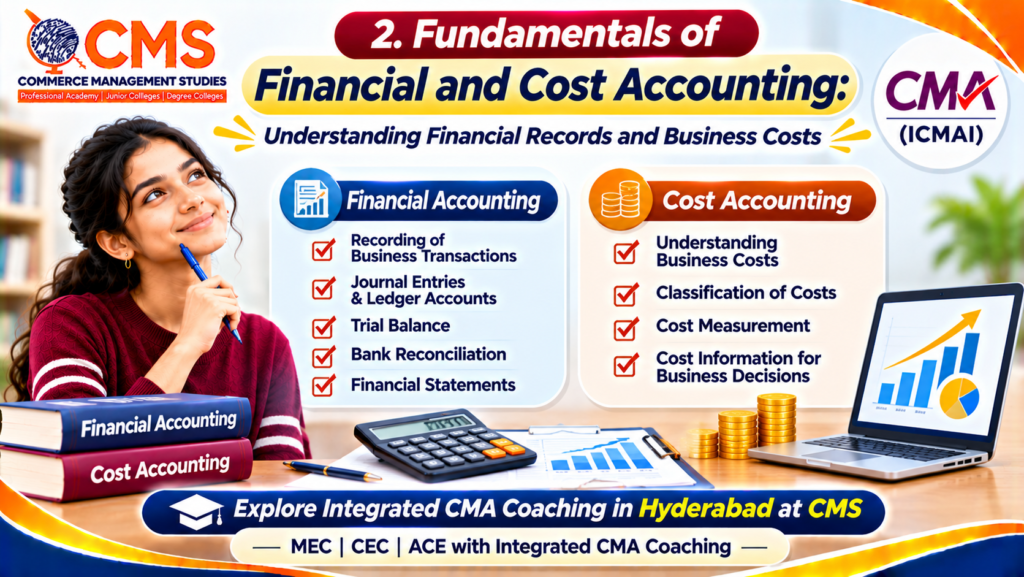
Fundamentals of Financial Accounting
Students learn the basic principles and procedures used to record financial transactions. Topics may include:
- Accounting principles and concepts.
- Journal entries and ledger accounts.
- Trial balance.
- Bank reconciliation.
- Depreciation and inventory-related concepts.
- Preparation of financial statements.
- Other accounting topics prescribed in the syllabus.
Fundamentals of Cost Accounting
Students are introduced to the basic concepts used to identify and classify costs. The section helps them understand how costs are measured and how cost information can support business decisions.
Topics include the fundamentals of cost classification, cost concepts and other cost accounting areas prescribed by ICMAI.
Why Is Financial and Cost Accounting Important for Commerce Students?
Financial Accounting helps students understand how business transactions are recorded and how financial statements reflect the performance and position of an organisation.
Cost Accounting introduces a different perspective. It helps students understand the expenses involved in business activities and why organisations need to monitor the cost of materials, labour and other resources.
For example, a manufacturing business needs to know how much it spends on raw materials, employee wages and production-related expenses. Cost information helps the business evaluate its production expenses and identify areas where resources may be used more efficiently.
These concepts provide a foundation for the specialised cost management and management accounting subjects students encounter as they progress through the CMA course.
3. Fundamentals of Business Mathematics and Statistics: Developing Numerical and Analytical Skills
Business Mathematics and Statistics helps students develop the numerical skills required to understand financial information, solve business problems and interpret data.
Mathematics supports calculations involving ratios, percentages, interest and other business-related values. Statistics helps students organise and analyse data to identify patterns and understand information more effectively.
What Does Business Mathematics and Statistics Cover?
This paper includes two broad sections:
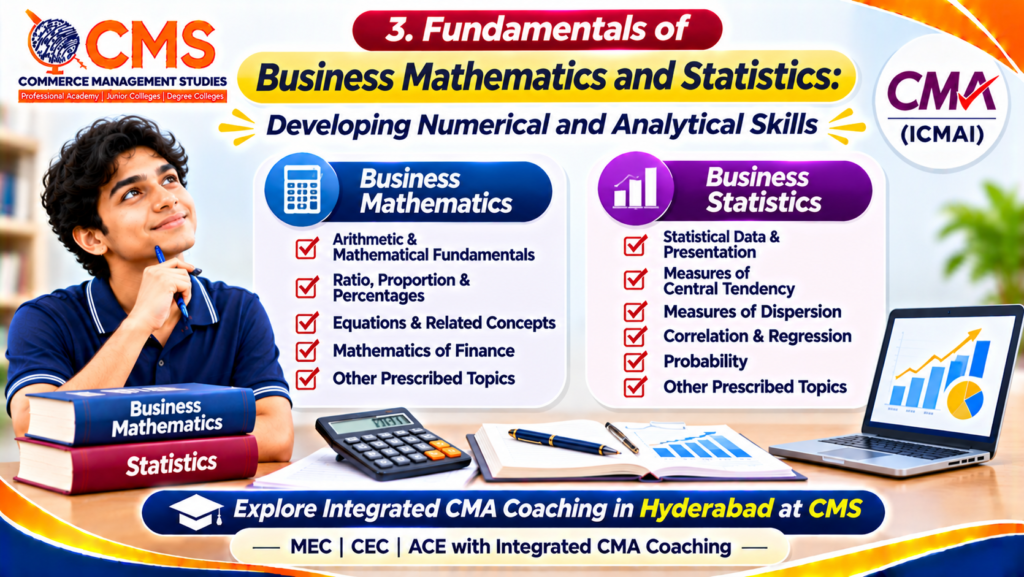
Fundamentals of Business Mathematics
Business Mathematics introduces mathematical concepts used in financial and business situations. Topics may include:
- Arithmetic and mathematical fundamentals.
- Ratio, proportion and percentages.
- Equations and related mathematical concepts.
- Mathematics of finance.
- Other prescribed business mathematics topics.
Students learn how mathematical methods can be applied to practical business calculations.
Fundamentals of Business Statistics
Statistics focuses on the collection, presentation, analysis and interpretation of numerical information. Topics may include:
- Statistical data and its presentation.
- Measures of central tendency.
- Measures of dispersion.
- Correlation and regression.
- Probability.
- Other statistical concepts prescribed by ICMAI.
Why Is Business Mathematics and Statistics Important for Commerce Students?
Business Mathematics develops the ability to solve numerical problems logically and accurately. These skills can support students when working with financial calculations, cost information and business-related figures.
Statistics helps students understand data rather than viewing numbers as isolated values. For example, a business may compare sales figures across different months to identify trends or analyse customer information to understand purchasing patterns.
These skills are relevant to cost and management accounting because professionals often use numerical information to evaluate performance, prepare reports and support business decisions.
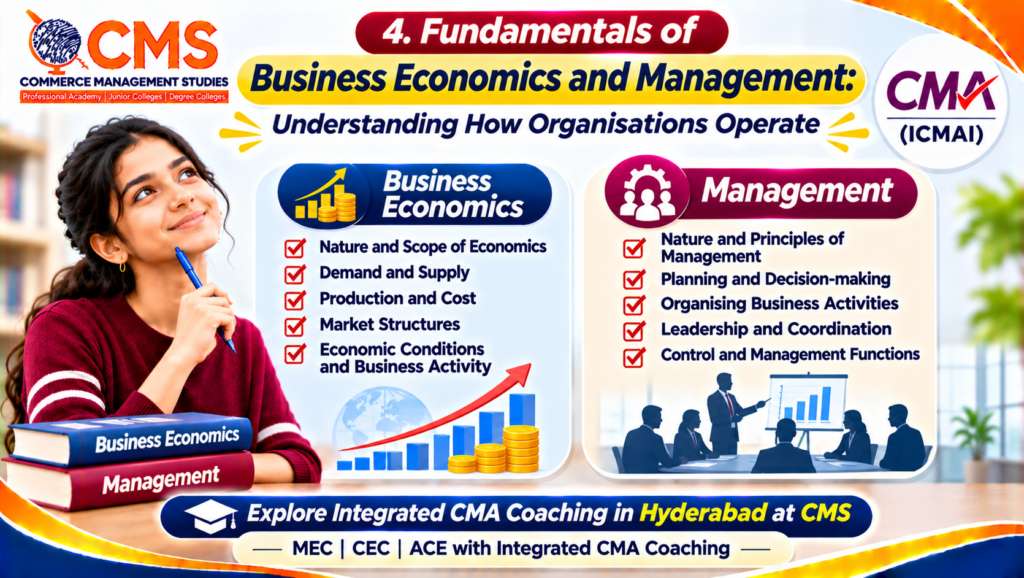
4. Fundamentals of Business Economics and Management: Understanding How Organisations Operate
Business Economics and Management introduces students to the economic principles and management concepts that influence business activities.
Economics helps explain how consumers, producers and markets behave. Management introduces the methods organisations use to plan activities, coordinate resources and achieve their objectives.
What Does Business Economics and Management Cover?
The paper includes two main sections:
Fundamentals of Business Economics
Business Economics introduces students to concepts such as:
- Nature and scope of economics.
- Demand and supply.
- Production and cost.
- Market structures.
- Economic conditions and business activity.
- Other topics prescribed in the syllabus.
These concepts help students understand how market conditions influence business decisions.
Fundamentals of Management
Management introduces students to the principles and functions involved in running an organisation. Topics may include:
- Nature and principles of management.
- Planning and decision-making.
- Organising business activities.
- Leadership and coordination.
- Control and management functions.
Students learn how organisations coordinate people, money, materials and other resources to achieve their goals.
Why Is Business Economics and Management Important for Commerce Students?
Business Economics helps students understand why businesses make particular decisions. Changes in demand, competition, production costs and market conditions can influence the prices businesses charge and the quantity they produce.
Management explains how businesses organise their activities and use resources effectively. For example, a company may need to plan its production schedule, assign responsibilities to employees and monitor whether its targets are being achieved.
Together, Economics and Management provide students with a broader understanding of how businesses function beyond financial records.
How the Four CMA Foundation Subjects Connect with Each Other
Although the four papers are studied separately, their concepts are closely connected. Each subject provides a different perspective on the activities of a business.
Consider a company planning to manufacture and sell a new product. The four CMA Foundation papers can help students understand different aspects of this situation.
Financial and Cost Accounting with Business Economics
Business Economics helps explain demand, production costs and pricing decisions. Financial and Cost Accounting records the financial transactions involved and helps the company understand its expenses and financial performance.
Business Laws with Business Communication
Business Laws explains the legal requirements associated with agreements and commercial transactions. Business Communication helps individuals and organisations communicate the terms, responsibilities and information involved in those transactions clearly.
Mathematics and Statistics with Cost Accounting
Business Mathematics supports calculations involving costs, quantities and financial values. Statistics helps businesses analyse cost information, compare performance and understand numerical trends.
Economics with Management
Economics explains the market conditions in which a business operates, while Management focuses on planning and organising the business’s response to those conditions.
Understanding these connections helps students recognise that CMA Foundation is not limited to learning accounting formulas. It introduces a combination of skills that can support the study of cost management and business decision-making.
How Commerce Students Can Begin Preparing for CMA Foundation
Commerce students can start developing the skills required for CMA Foundation while studying their academic subjects. Early preparation gives them time to understand concepts, practise questions and become familiar with the expectations of professional course examinations.
1. Build a Strong Foundation in Accounting
Students should understand basic accounting concepts, journal entries, ledger accounts and financial statements. A clear understanding of accounting fundamentals can make it easier to approach Financial and Cost Accounting in CMA Foundation.
2. Develop Numerical Confidence
Business Mathematics and Statistics require regular practice. Students should work on calculations, understand the methods behind formulas and practise applying concepts to different types of questions.
3. Learn Laws Through Concepts and Examples
Business Laws becomes easier to understand when students connect legal principles with practical situations. Instead of memorising definitions alone, they should understand the meaning of each rule and how it applies to business transactions.
4. Connect Economics with Real Business Activities
Students can improve their understanding of Business Economics by observing how demand, supply, prices and competition influence everyday business activities.
5. Practise and Revise Regularly
Regular question-solving, revision and assessments help students identify their strengths and areas that need more attention. A consistent preparation routine can also help them manage their academic studies alongside CMA Foundation preparation.
Which Commerce Streams Can Help Students Explore CMA Foundation?
Commerce students can choose MEC, CEC or ACE based on their academic interests and future goals. Each stream offers a different combination of subjects, and students should consider how their chosen subjects connect with their preferred professional pathway.
MEC – Mathematics, Economics and Commerce
MEC combines Mathematics, Economics and Commerce. Mathematics can help students develop numerical and analytical skills, while Economics and Commerce introduce them to business activities and financial concepts.
These subjects can provide useful background for CMA Foundation, particularly in Business Mathematics and Statistics, Business Economics and accounting-related learning. Students still need focused preparation for the complete CMA Foundation syllabus.
CEC – Civics, Economics and Commerce
CEC combines Civics, Economics and Commerce. Economics and Commerce introduce students to business fundamentals, economic systems and commercial activities.
Students choosing CEC can build on their commerce-related subjects while developing the numerical, accounting and analytical skills required for CMA Foundation.
ACE – Accounting, Commerce and Economics
ACE includes Accounting, Commerce and Economics. These subjects introduce students to financial records, business operations and economic concepts.
Students interested in cost and management accounting can use this academic foundation to explore CMA Foundation subjects and begin developing the skills required for professional course preparation.
At CMS, commerce students can choose MEC, CEC or ACE with integrated CMA coaching alongside their academic education. This allows students to work on their academic subjects while beginning to develop the knowledge required for CMA Foundation.
How CMS Supports CMA Foundation Preparation
At CMS Best CMA Institute in Hyderabad, students pursuing MEC, CEC or ACE can explore integrated CMA coaching alongside their academic education. The preparation focuses on strengthening subject fundamentals and helping students understand the concepts required for professional course examinations.
Students can develop their understanding of Business Laws and Business Communication, Financial and Cost Accounting, Business Mathematics and Statistics, and Business Economics and Management through structured learning and regular practice.
Assessments and examination-oriented practice can help students review their progress, identify areas that require additional attention and become familiar with the expectations of CMA Foundation.
For students looking for CMA coaching in Hyderabad, understanding the four CMA Foundation papers is an important first step. With a clear study plan and consistent preparation, commerce students can gradually develop the knowledge and skills needed to pursue Cost and Management Accountancy.
Conclusion
CMA Foundation goes beyond cost accounting and introduces students to the legal, financial, mathematical, economic and managerial concepts that support business operations. Its four papers develop different skills, helping students understand how organisations record transactions, manage costs, communicate professionally and make informed decisions.
Commerce students who understand the purpose of each paper can plan their preparation more effectively and recognise how their academic subjects connect with CMA Foundation. At CMS, students can choose MEC, CEC or ACE with integrated CMA coaching, giving them an opportunity to explore professional course preparation alongside their academic education and take informed steps towards a future in cost and management accounting.