
Introduction
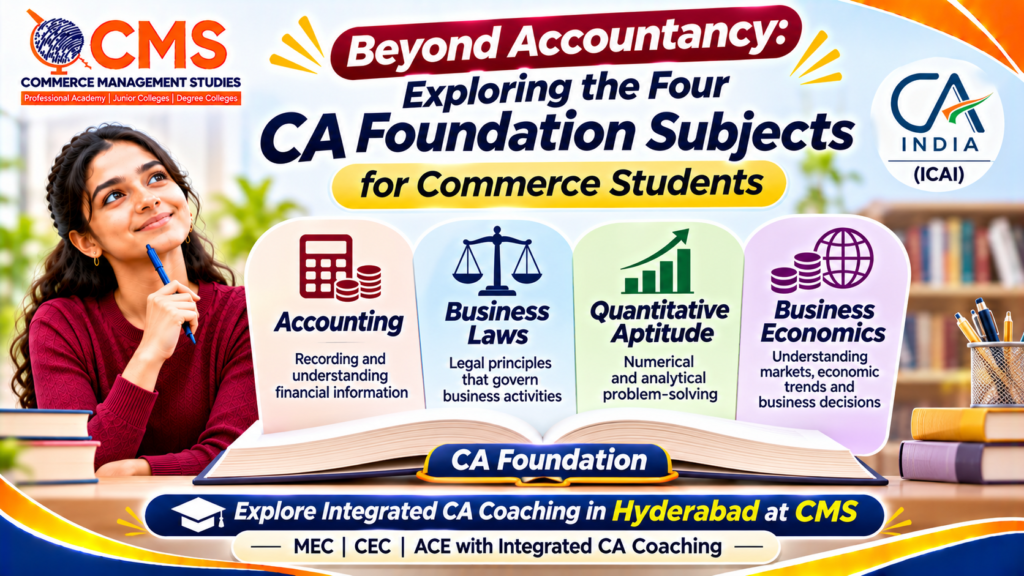
When commerce students think about Chartered Accountancy, Accounting is often the first subject that comes to mind. However, the CA Foundation examination goes beyond financial records and calculations. It introduces students to business laws, quantitative aptitude and economics, helping them understand how businesses operate, how financial decisions are made and how professional knowledge is applied in real situations.
The four subjects of CA Foundation are designed to develop different but connected skills. Accounting builds financial understanding, Business Laws introduces legal principles, Quantitative Aptitude strengthens numerical and analytical ability, and Business Economics explains economic behaviour and market decisions. Understanding the purpose of each subject can help commerce students approach CA Foundation preparation with greater clarity and confidence.
What Are the Four Subjects of CA Foundation?
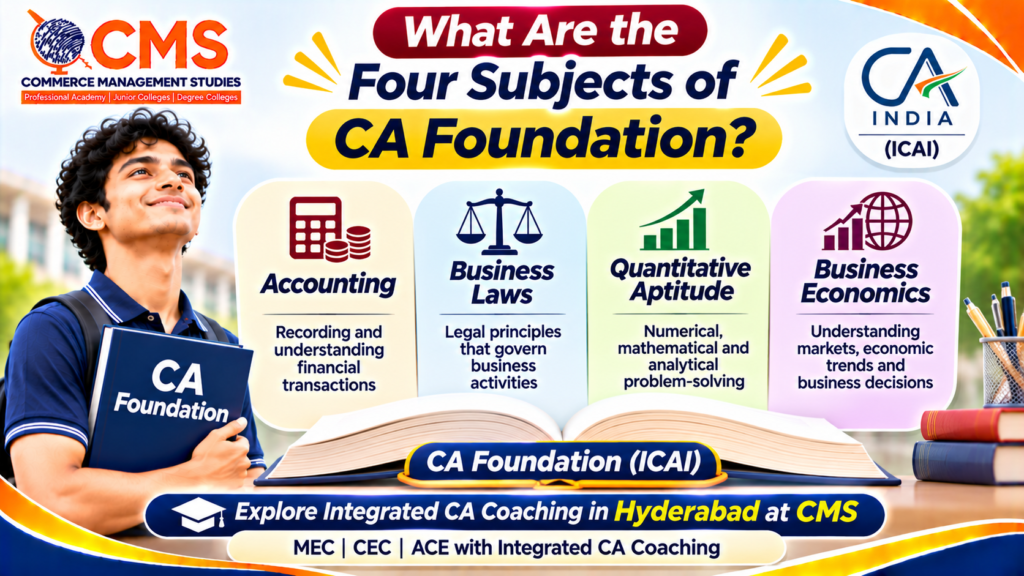
CA Foundation is the entry-level examination in the Chartered Accountancy course offered by the Institute of Chartered Accountants of India (ICAI). Under the current scheme, the examination includes four papers:
- Accounting
- Business Laws
- Quantitative Aptitude
- Business Economics
Each paper contributes to a different area of learning. Students should not consider Accounting as the only important subject simply because it is closely associated with the CA profession. The other three papers also develop knowledge and skills that are relevant to professional studies.
1. Accounting: Understanding How Businesses Record Financial Information
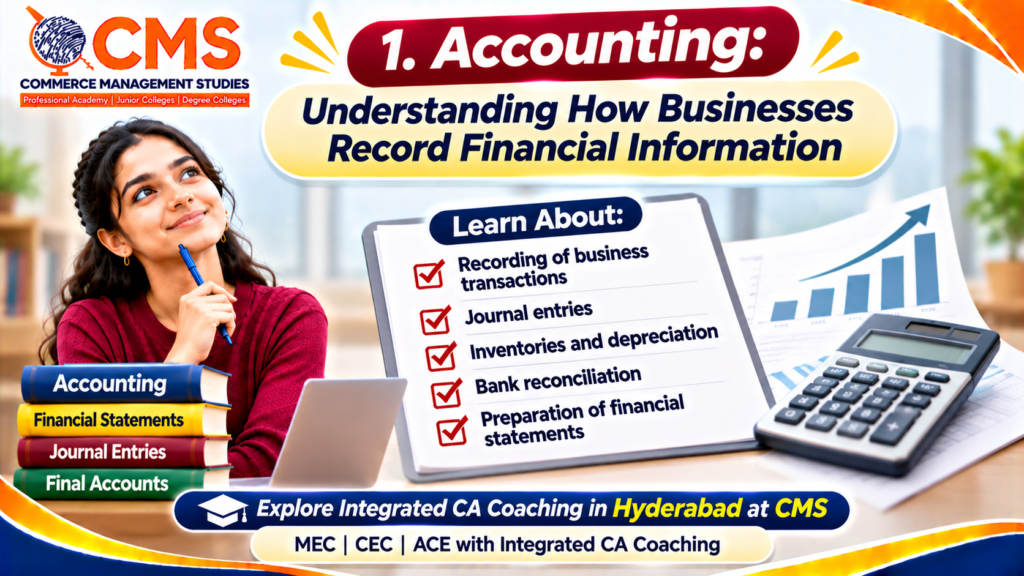
Accounting is one of the core subjects of CA Foundation. It introduces students to the principles and methods used to record, classify, summarise and interpret financial transactions.
Students learn how business activities are converted into financial information. For example, when a business purchases goods, receives money from customers, pays expenses or acquires equipment, each transaction has to be recorded appropriately. Accounting helps students understand how these transactions affect the financial position and performance of an organisation.
What Does Accounting Cover?
The Accounting paper includes concepts such as:
- Theoretical framework of accounting.
- Accounting process and journal entries.
- Bank reconciliation statements.
- Inventories and depreciation.
- Bills of exchange and accounting for special transactions.
- Preparation of financial statements.
- Accounting for partnerships and other prescribed topics.
The exact coverage follows the applicable ICAI syllabus.
Why Is Accounting Important for Commerce Students?
Accounting develops the ability to understand financial records rather than simply memorising formats. Students learn how transactions are recorded, why particular accounts are affected and how financial statements are prepared.
A strong understanding of Accounting can also support further studies in taxation, auditing, financial reporting and other areas of Chartered Accountancy. Students who practise regularly can gradually improve their accuracy, problem-solving ability and confidence in handling accounting questions.

2. Business Laws: Understanding the Legal Side of Business
Business Laws introduces students to the legal principles that influence business activities. Businesses operate within a framework of rules and regulations, and understanding these rules is important for making responsible decisions and maintaining proper business practices.
This paper helps students develop an awareness of how agreements are formed, what makes a contract legally significant and how business relationships are governed.
What Does Business Laws Cover?
The Business Laws paper includes topics prescribed by ICAI, such as:
- Indian Contract Act, 1872.
- Sale of Goods Act, 1930.
- Indian Partnership Act, 1932.
- Limited Liability Partnership Act, 2008.
- Companies Act, 2013, as covered in the applicable syllabus.
Students learn important legal concepts, definitions, conditions and principles related to business transactions.
Why Is Business Laws Important for Commerce Students?
Business Laws develops logical thinking and the ability to understand situations through legal principles. Instead of learning definitions alone, students need to understand how a rule applies to a particular case.
For example, a business agreement may involve an offer, acceptance, consideration and other legal requirements. Understanding these concepts helps students analyse whether an agreement meets the relevant legal conditions.
The subject also introduces students to the legal responsibilities associated with business operations. This knowledge can become useful as they progress through professional studies in accountancy, taxation, corporate law and compliance.
3. Quantitative Aptitude: Developing Numerical and Analytical Skills
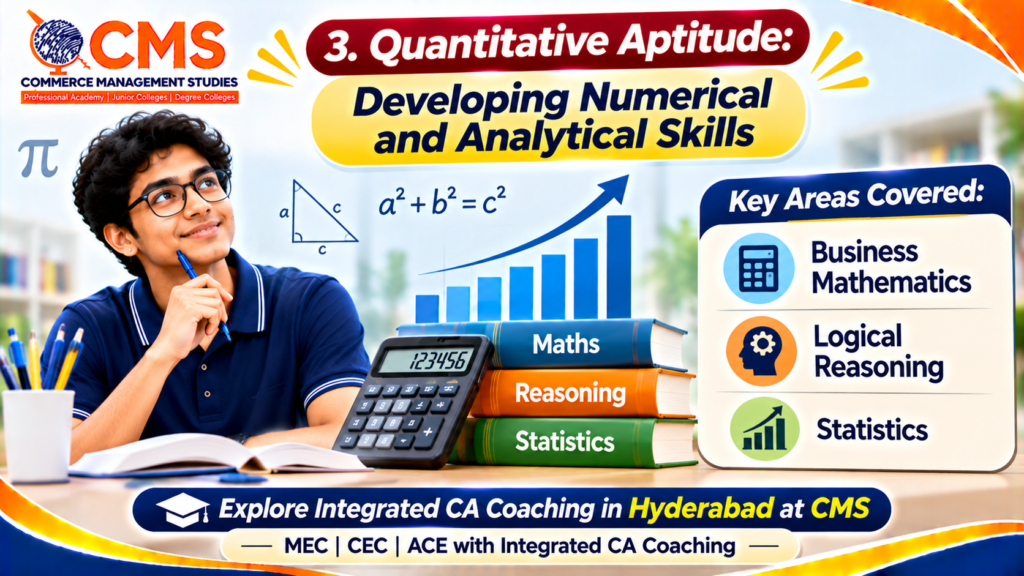
Quantitative Aptitude is an important part of CA Foundation because financial and business decisions often involve numbers, calculations and data interpretation. This paper develops students’ ability to solve numerical problems accurately and logically.
Unlike Accounting, which focuses on recording and reporting financial transactions, Quantitative Aptitude covers mathematical and analytical concepts that can be applied across different business situations.
What Does Quantitative Aptitude Cover?
The paper is divided into three broad areas:
Business Mathematics
Business Mathematics includes mathematical concepts used in business and financial situations. Topics may include:
- Ratio and proportion.
- Equations and inequalities.
- Mathematics of finance.
- Permutations and combinations.
- Sequence and series.
- Sets, relations and functions.
Logical Reasoning
Logical Reasoning helps students identify patterns, analyse relationships and draw conclusions. It includes topics such as:
- Number and letter series.
- Direction sense.
- Seating arrangements.
- Coding and decoding.
- Odd-one-out and related reasoning questions.
Statistics
Statistics introduces students to the collection, organisation, interpretation and analysis of numerical data. Topics may include:
- Statistical representation of data.
- Measures of central tendency.
- Measures of dispersion.
- Probability.
- Correlation and regression.
- Index numbers and other prescribed concepts.
Why Is Quantitative Aptitude Important for Commerce Students?
Quantitative Aptitude helps students become comfortable with numerical problem-solving. It develops speed, accuracy and the ability to interpret information logically.
These skills can support students in Accounting, financial management, economics and other areas where calculations and data analysis are required. Regular practice is particularly important because students need to understand the method behind a question and apply it within the examination time.
4. Business Economics: Understanding Markets and Business Decisions
Business Economics introduces students to the economic principles that influence businesses, consumers and markets. It helps students understand how demand, supply, prices, production and costs affect business decisions.
The subject connects classroom concepts with real-world economic activities. For example, changes in consumer demand can influence the quantity a business produces, while changes in production costs can affect pricing and profitability.
What Does Business Economics Cover?
The Business Economics paper includes concepts prescribed by ICAI, such as:
- Nature and scope of Business Economics.
- Demand and supply.
- Theory of production and cost.
- Price determination in different market structures.
- Business cycles.
- Basic economic concepts and related topics.
Students learn how economic conditions influence business activity and how firms make decisions about production, pricing and resource allocation.
Why Is Business Economics Important for Commerce Students?
Business Economics helps students understand the reasoning behind business decisions. It explains why prices change, how consumers respond to different market conditions and how businesses decide what to produce.
The subject also encourages students to connect economic theory with current business developments. Understanding demand, supply, competition and costs can help students develop a broader perspective on commerce and business operations.
How the Four CA Foundation Subjects Connect with Each Other
Although the four papers are studied separately, their concepts are connected through the way businesses function.
Consider a company planning to launch a new product. Each CA Foundation subject can help students understand a different part of the situation.
Accounting and Business Economics
Business Economics helps explain demand, production costs and pricing decisions. Accounting records the financial transactions resulting from those decisions and shows how they affect the company’s financial performance.
Business Laws and Accounting
Business Laws explains the legal requirements associated with contracts and business transactions. Accounting records the financial impact of those transactions in the books of the business.
Quantitative Aptitude and Business Economics
Quantitative Aptitude develops mathematical and statistical skills that can help students understand economic data, calculate values and analyse numerical information.
Quantitative Aptitude and Accounting
Both subjects require accuracy and logical thinking. While Accounting focuses on financial transactions and statements, Quantitative Aptitude strengthens the mathematical skills needed to solve numerical problems.
Understanding these connections can help students see CA Foundation as a complete learning experience rather than four unrelated examination papers.
How Commerce Students Can Begin Preparing for CA Foundation
Commerce students can begin developing the skills required for CA Foundation while studying their academic subjects. Early preparation gives them time to understand concepts, practise questions and identify areas that need improvement.
A balanced preparation approach can include the following:
1. Strengthen the Basics
Students should first understand the fundamental concepts in Accounting, Mathematics, Economics and business-related subjects. A clear foundation makes it easier to approach more advanced topics.
2. Understand Each Subject’s Requirements
Accounting requires regular problem-solving, Business Laws requires conceptual understanding and application, Quantitative Aptitude needs consistent numerical practice, and Business Economics requires clarity in economic principles.
Students should use a different study approach for each subject rather than preparing all four in the same way.
3. Practise Questions Regularly
Solving questions helps students identify whether they can apply a concept independently. Regular practice also helps improve accuracy and familiarity with different question formats.
4. Revise and Evaluate Progress
Revision helps students retain concepts and recognise important connections between topics. Practice tests and assessments can help students understand their strengths and areas that need more attention.
5. Balance Academic Studies and CA Preparation
Students should plan their preparation around their academic timetable. A consistent study routine, realistic targets and regular revision can help them manage both academic and professional course preparation.
Which Commerce Streams Can Help Students Explore CA Foundation?
Commerce students can choose MEC, CEC or ACE based on their academic interests and future goals. Each stream provides a different combination of subjects, and students should consider how their chosen subjects align with their preferred professional pathway.
MEC – Mathematics, Economics and Commerce
MEC combines Mathematics, Economics and Commerce. Mathematics can help students develop numerical and analytical skills, while Economics and Commerce introduce them to business activities and financial concepts.
These subjects can provide useful background for CA Foundation, particularly in areas involving accounting concepts, economics and quantitative ability. Students still need focused preparation for the complete CA Foundation syllabus.
CEC – Civics, Economics and Commerce
CEC combines Civics, Economics and Commerce. Economics and Commerce introduce students to business fundamentals, economic systems and financial concepts.
Students choosing CEC can build on their commerce-related subjects while developing the additional numerical and analytical skills required for CA Foundation.
ACE – Accounting, Commerce and Economics
ACE includes Accounting, Commerce and Economics. These subjects provide exposure to financial records, business operations and economic concepts.
Students interested in accountancy can use this academic foundation to explore CA Foundation subjects and begin developing the skills needed for professional course preparation.
At CMS Top CA Coaching Institute in Hyderabad, commerce students can choose MEC, CEC or ACE with integrated CA coaching alongside their academic education. This provides an opportunity to work on academic subjects while building a foundation for CA Foundation preparation.
How CMS Supports CA Foundation Preparation
At CMS, students pursuing MEC, CEC or ACE can explore integrated CA coaching alongside their academic education. The preparation focuses on strengthening subject fundamentals and helping students understand the concepts required for professional course examinations.
Students can work on Accounting, Business Laws, Quantitative Aptitude and Business Economics through structured learning and regular practice. Assessments and examination-oriented preparation can help them review their progress, identify areas that require further attention and become familiar with the expectations of CA Foundation.
For students looking for CA coaching in Hyderabad, understanding the four CA Foundation subjects is an important first step. With a clear study plan and consistent preparation, commerce students can gradually develop the knowledge and skills required to pursue Chartered Accountancy.
Conclusion
CA Foundation is more than an examination focused on Accounting. Its four subjects introduce students to financial recording, legal principles, numerical reasoning and economic decision-making. Each subject develops a different skill, and together they provide a broad foundation for professional accountancy studies.
Commerce students who understand the purpose of each paper can plan their preparation more effectively and recognise how their academic subjects connect with CA Foundation. At CMS, students can choose MEC, CEC or ACE with integrated CA coaching, allowing them to explore professional course preparation alongside their academic education and take informed steps towards a future in Chartered Accountancy.