
Introduction
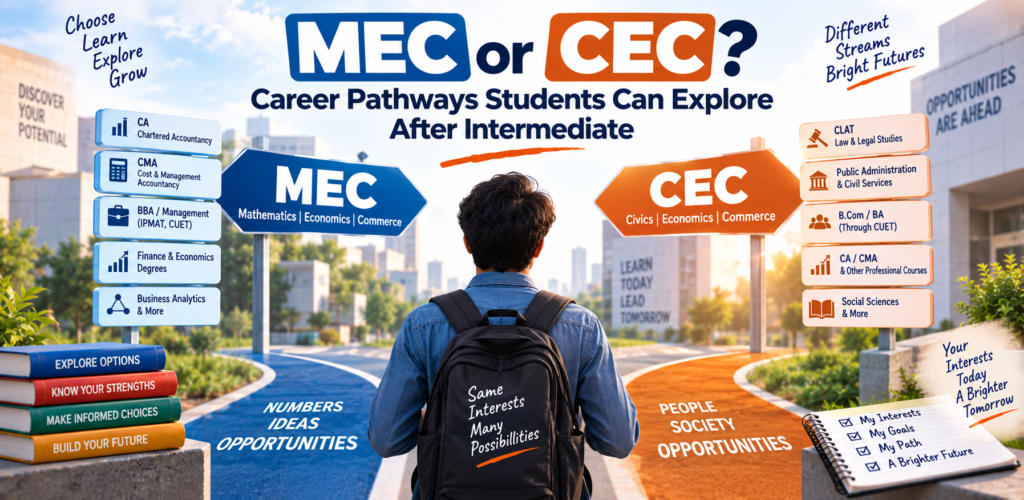
Choosing a stream after Class 10 is an important academic decision because the subjects students study during Intermediate can influence the areas they become familiar with before entering higher education. In the commerce stream, MEC and CEC are two combinations that offer exposure to different subjects while keeping several academic and professional pathways open. MEC generally combines Mathematics, Economics, and Commerce, while CEC combines Civics, Economics, and Commerce.
Neither stream determines a student’s career by itself. Students from both MEC and CEC can pursue a variety of degree programmes, professional courses, entrance examinations, and career areas after Intermediate. The more useful approach is to understand what each combination involves, what skills it can help develop, and how those subjects may connect with different interests and future goals.
Understanding MEC
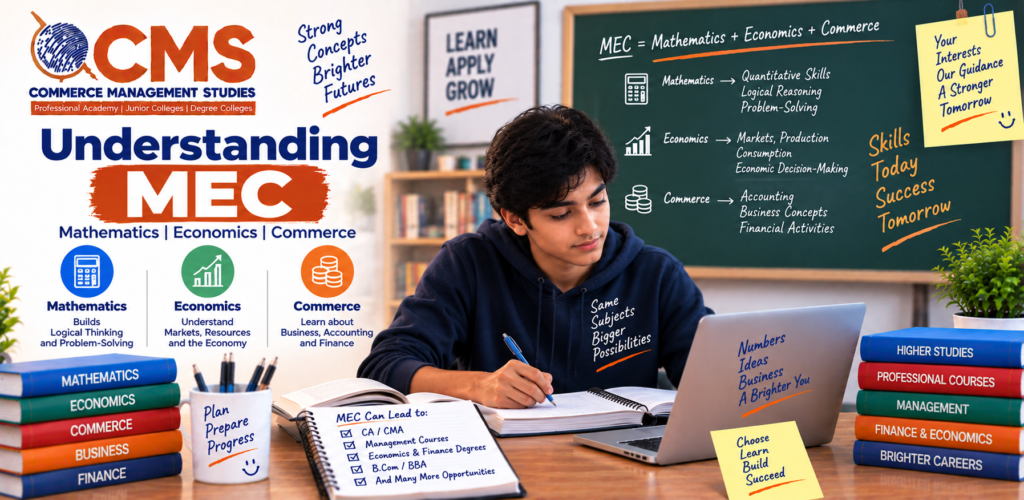
MEC stands for Mathematics, Economics, and Commerce. It brings together quantitative skills, economic concepts, and fundamental knowledge of commerce and business. Mathematics can help students develop logical reasoning, numerical ability, and problem-solving skills, while Economics provides an understanding of markets, resources, production, consumption, and economic decision-making.
Commerce adds another dimension by introducing students to areas related to accounting, business, and financial activities. This combination can be particularly relevant for students who enjoy working with numbers and are interested in finance, business, economics, accounting, or management. The presence of Mathematics can also provide useful preparation for certain aptitude-based entrance examinations and quantitative areas of higher education.
Understanding CEC
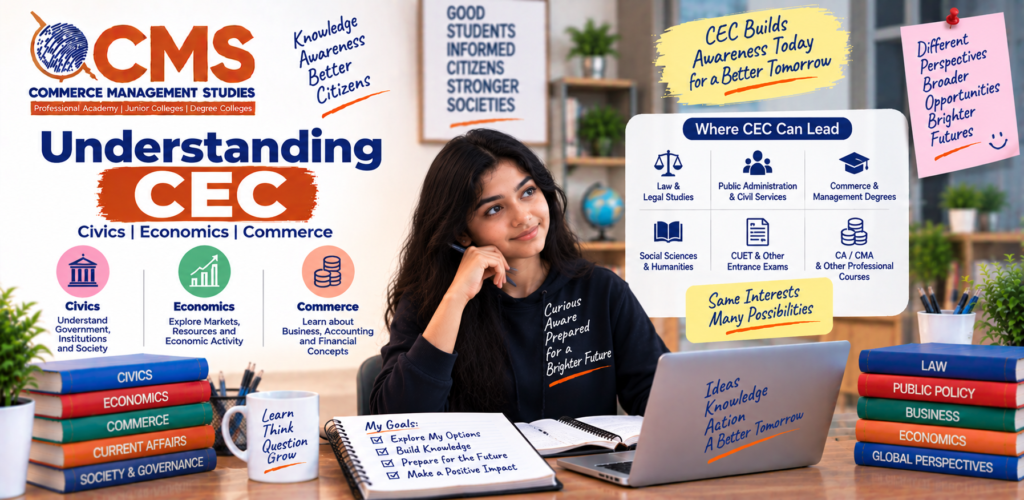
CEC combines Civics, Economics, and Commerce, bringing together an understanding of public systems, economic concepts, and commercial activities. Civics introduces students to government, institutions, citizenship, constitutional concepts, and the functioning of public systems, while Economics provides a broader understanding of markets and economic activity.
The Commerce component gives students exposure to accounting, business, and related concepts. CEC can therefore appeal to students who are interested in commerce but also enjoy subjects connected with society, government, law, public affairs, and current issues. Its combination can provide a useful foundation for students considering professional courses and degree programmes where communication, social awareness, commerce, and analytical understanding are relevant.
Career Pathways After MEC
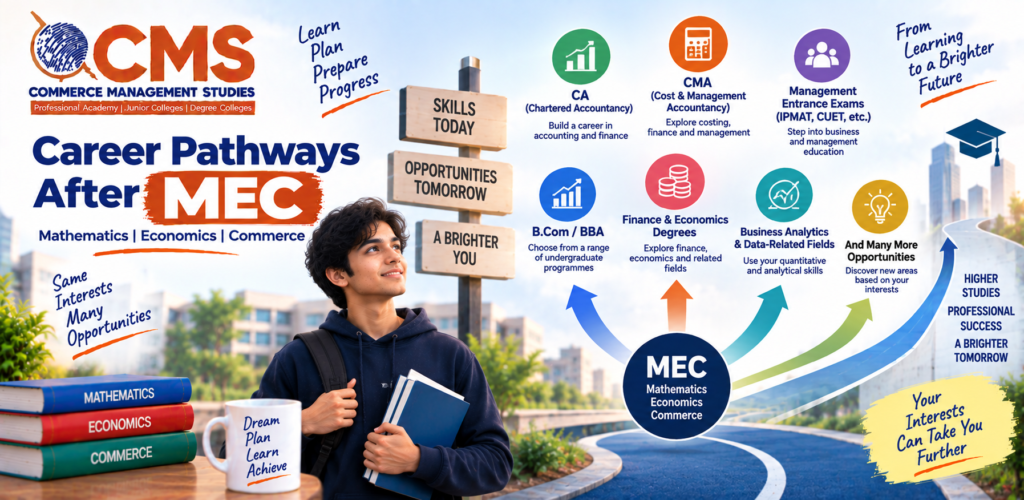
MEC can provide a foundation for several professional and academic directions. Students may choose professional courses such as Chartered Accountancy or Cost and Management Accountancy, or explore undergraduate programmes in commerce, economics, finance, management, and related areas.
The Mathematics component can also be useful for students considering management entrance examinations and other aptitude-based tests. Depending on eligibility requirements for a particular programme, MEC students may explore pathways such as IPMAT, CUET-based undergraduate programmes, finance-related degrees, economics programmes, and management education. Students should always check the latest eligibility criteria of the specific institution or examination before making a decision.

Career Pathways After CEC
CEC students can also explore a broad range of options after Intermediate. Commerce provides a foundation for areas such as accounting, finance, business, and management, while Economics can support further study in economics and related fields. The Civics component can be particularly relevant for students who are interested in law, public administration, governance, and social sciences.
Students may consider professional pathways such as CA and CMA, while those interested in law can explore CLAT and other law entrance routes where applicable. CUET can also provide access to a variety of undergraduate programmes, depending on the subjects and eligibility requirements of individual universities. The appropriate pathway ultimately depends on the student’s interests and the admission requirements of the chosen course.
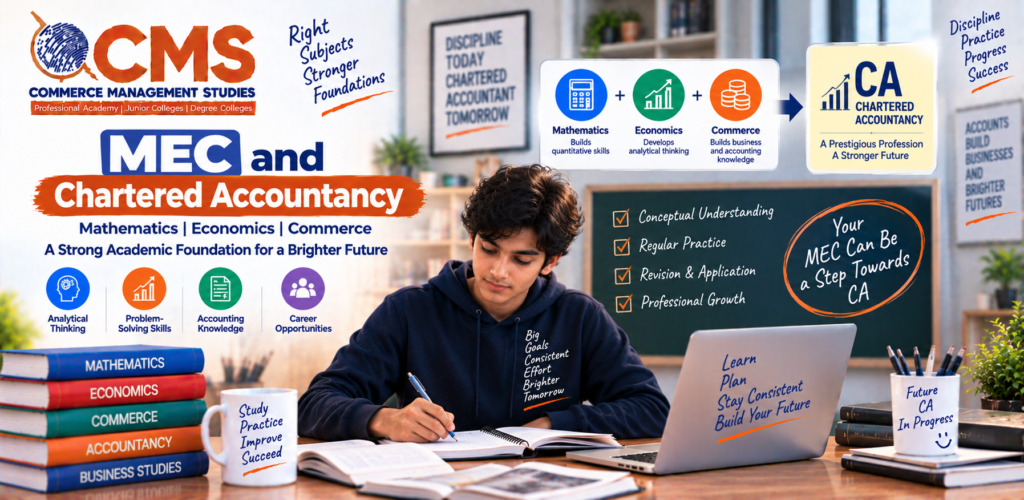
MEC and Chartered Accountancy
Students interested in Chartered Accountancy can consider both MEC and CEC because Commerce and Economics provide relevant academic exposure. MEC additionally provides Mathematics, which can help students develop quantitative and analytical skills that may be useful in their broader academic preparation.
CA preparation involves more than numerical ability. Students need conceptual understanding, application skills, regular practice, revision, and familiarity with professional-level subjects. Therefore, the choice between MEC and CEC should not be based solely on the assumption that one stream automatically leads to CA. Students should consider which subject combination suits their learning preferences while developing the skills required for professional preparation.
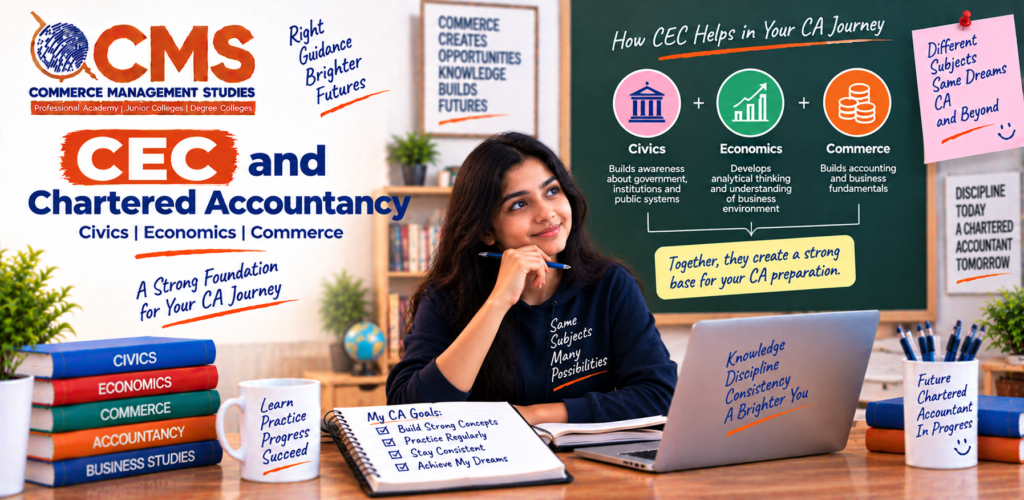
CEC and Chartered Accountancy
CEC can also provide a foundation for students who want to pursue CA. Commerce introduces students to accounting and business concepts, while Economics helps them understand broader economic conditions and business environments. Civics can contribute to general awareness and understanding of institutions and public systems.
Students from CEC who are interested in CA can build their professional foundation alongside their Intermediate studies. Their preparation can focus on strengthening Commerce-related concepts while developing numerical, analytical, and examination skills through appropriate practice. The absence of Mathematics as an Intermediate subject does not by itself determine whether a student can pursue CA; the relevant course and examination eligibility rules should always be checked.
MEC and CMA
Cost and Management Accountancy is closely connected with costing, financial analysis, budgeting, management accounting, and business decision-making. MEC can provide a useful academic combination for students interested in these areas because Mathematics develops quantitative skills while Economics and Commerce provide complementary business knowledge.
Students interested in CMA can gradually develop numerical accuracy, analytical thinking, accounting fundamentals, and business awareness during Intermediate. These skills can later support their understanding of professional subjects involving costing, finance, and management accounting.
CEC and CMA
CEC students can also consider CMA as a professional pathway. Commerce provides exposure to accounting and business fundamentals, while Economics helps students understand markets, resources, and economic decision-making. These areas can complement the financial and management-oriented concepts encountered in professional CMA studies.
Students interested in CMA should focus on building strong Commerce fundamentals and developing the ability to analyse numerical and business information. Professional success involves more than the subjects studied during Intermediate, so students should gradually develop problem-solving, communication, accuracy, and consistent study habits as well.
MEC and Management Entrance Examinations
Students who enjoy Mathematics and are interested in management education may explore management entrance pathways after or alongside Intermediate. Examinations such as IPMAT include aptitude-oriented components, and quantitative ability can form an important part of preparation depending on the examination and participating institution.
MEC students can use their Mathematics background as a starting point for developing quantitative aptitude, while also working on verbal ability, logical reasoning, and other examination requirements. Preparing for management entrance examinations requires dedicated practice because entrance-test questions can differ from regular Intermediate Mathematics questions in terms of application and time management.
CEC and Law-Related Pathways
CEC can be particularly interesting for students who want to explore law and related fields because Civics provides exposure to government, institutions, constitutional ideas, and public systems. Economics and Commerce add understanding of economic and business environments, which can also be relevant to areas of legal education.
Students interested in law can explore entrance examinations such as CLAT, subject to the eligibility requirements of the relevant examination. Preparation generally involves areas such as English language, current affairs, legal reasoning, logical reasoning, and quantitative techniques. CEC students can use their Intermediate subjects as a foundation while separately developing the skills required for the entrance examination.
CUET and Both Commerce Streams
CUET can provide students with access to undergraduate programmes across different universities, with eligibility and subject requirements varying according to the programme and institution. Both MEC and CEC students can explore CUET-related opportunities based on the courses they are interested in and the applicable admission criteria.
Students should research individual university requirements before preparing their subject combination. Understanding the admission process early can help students identify which subjects and areas they need to focus on. Preparation can then be integrated with Intermediate studies through regular revision, practice questions, and mock tests.
Economics as a Common Foundation
Economics is common to both MEC and CEC, making it an important connecting subject between the two streams. It introduces students to concepts such as demand, supply, markets, production, consumption, inflation, economic growth, and resource allocation.
These concepts can be useful across several higher-education fields. Students interested in commerce, finance, business, management, public policy, or economics can benefit from understanding how economic systems work. Studying Economics can also encourage students to connect classroom concepts with current business and economic developments.
Commerce as a Common Career Foundation
Commerce is another common component of MEC and CEC. It provides students with exposure to accounting, business activities, financial concepts, and the functioning of commercial organisations.
This foundation can be useful for students considering professional courses such as CA and CMA as well as undergraduate programmes in commerce, finance, management, and related disciplines. Students can strengthen this foundation by understanding concepts rather than relying solely on memorisation and by connecting classroom topics with real business examples.
How to Decide Between MEC and CEC
The decision should begin with the student’s interests and preferred style of learning. Students who enjoy Mathematics, numerical problem-solving, and quantitative reasoning may find MEC more aligned with their interests. Those who are more interested in Civics, government, society, law, and public affairs alongside Commerce and Economics may find CEC more suitable.
Students should also consider their possible future pathways, but they do not need to have their entire career decided at the age of 15 or 16. It is more useful to understand the subjects involved, examine potential pathways, and choose a combination that they can study with genuine interest and consistency.
Skills Students Can Develop in MEC and CEC
Both streams can help students develop skills that extend beyond their textbooks. MEC can provide greater exposure to quantitative reasoning through Mathematics, while CEC can provide greater exposure to Civics and related social and institutional concepts.
At the same time, both combinations involve Economics and Commerce, giving students opportunities to develop financial awareness, business understanding, analytical thinking, and subject knowledge. Students can further strengthen these abilities through reading, problem-solving, discussions, projects, entrance-test practice, and regular revision.
Integrated Preparation Alongside Intermediate
Students who have already identified a professional or entrance pathway can gradually begin building relevant skills during Intermediate. This does not mean that every student needs to start intensive preparation immediately. Instead, students can develop a balanced routine in which their Intermediate subjects remain the foundation while additional preparation is introduced according to their future goals.
At CMS MEC Intermediate Colleges in Hyderabad and CEC Junior Colleges in Hyderabad, students can pursue MEC and CEC with integrated preparation options for professional and entrance pathways such as CA, CMA, CLAT, CUET, and IPMAT. This type of approach can help students connect their Intermediate learning with the skills required for future examinations while continuing to build their academic foundation.
Conclusion
MEC and CEC both provide students with a commerce-oriented foundation, but they offer different subject combinations and learning experiences. MEC combines Mathematics, Economics, and Commerce, making it relevant for students interested in quantitative reasoning, finance, accounting, economics, business, and management. CEC combines Civics, Economics, and Commerce, providing additional exposure to government, institutions, society, law-related concepts, and public affairs.
After Intermediate, students from either stream can explore several professional courses, undergraduate programmes, and entrance examinations, depending on the eligibility requirements of the pathway they choose. The important consideration is not simply which stream appears to have more options, but which subjects match the student’s interests, abilities, and intended direction. Understanding these differences early can help students make a thoughtful choice and build a stronger foundation for the years ahead.