
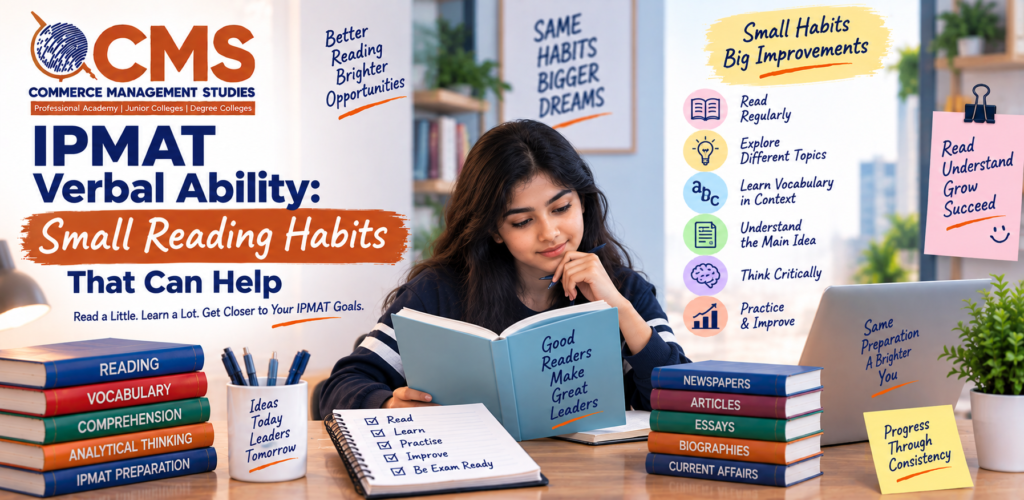
Verbal Ability is an important part of preparing for management entrance examinations such as IPMAT. Students are expected to work with passages, understand written information, identify relationships between ideas, and answer questions based on language and comprehension. While vocabulary and grammar are useful, strong verbal ability is generally developed through consistent exposure to different types of reading rather than through memorising words alone.
The good news is that students do not necessarily need to spend several hours reading every day to build these skills. Small, regular reading habits can gradually improve comprehension, vocabulary, sentence awareness, and the ability to understand unfamiliar ideas. When these habits are combined with focused practice, they can make reading-based questions more manageable and help students approach verbal preparation in a more structured way.
Why Reading Matters for IPMAT Verbal Ability
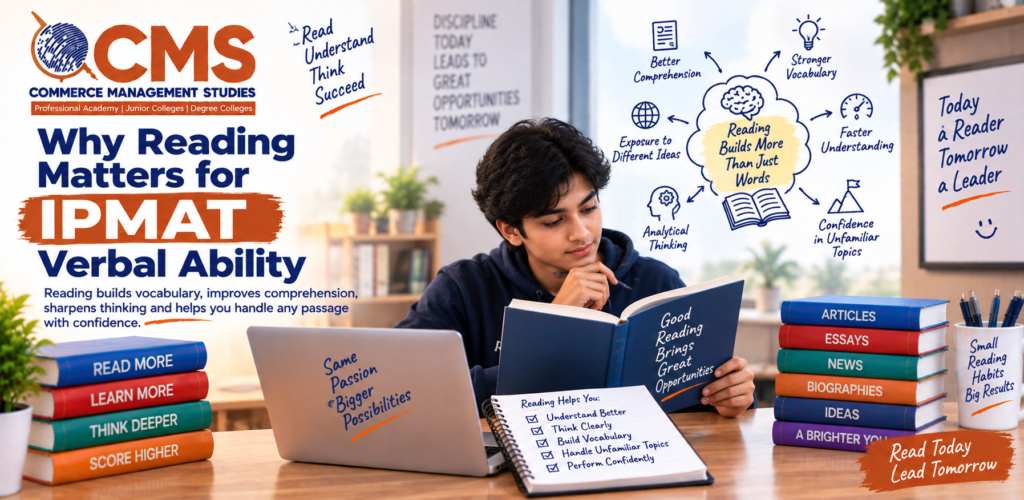
Reading regularly exposes students to different sentence structures, writing styles, vocabulary, and ways of presenting an argument. Over time, students become more comfortable with longer passages and unfamiliar topics. This can be useful because entrance-examination passages may require students to understand information quickly rather than reading every sentence repeatedly.
Reading also develops the ability to identify the main idea of a passage. Instead of focusing on every individual word, students gradually learn to recognise what the writer is trying to communicate, how different ideas are connected, and which details are supporting the central argument. These skills can be useful when dealing with comprehension-based questions.
Start With a Small Daily Reading Target
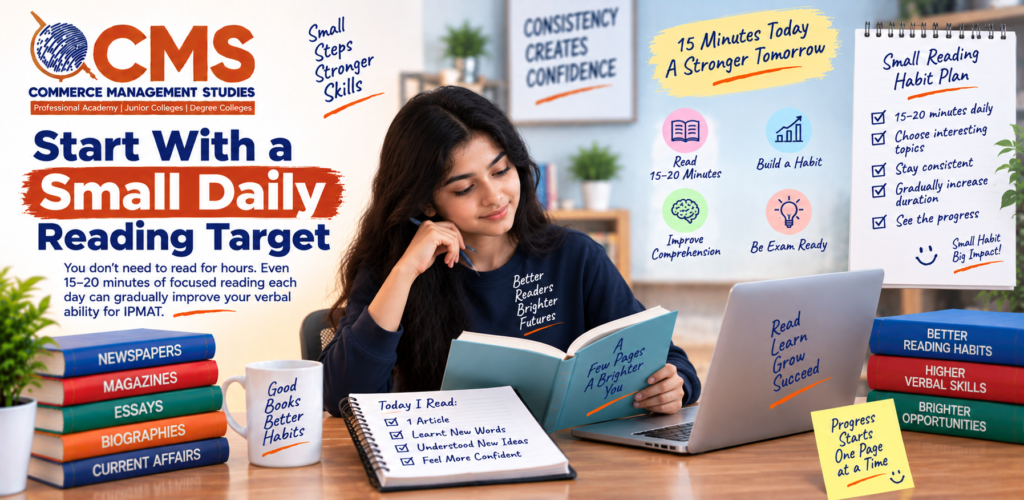
Students who are not regular readers often make the mistake of setting an unrealistic target at the beginning. Trying to read for an hour every day can become difficult alongside Intermediate studies and other entrance preparation. A smaller target, such as 15 to 20 minutes of focused reading, can be easier to maintain consistently.
The purpose of a daily reading habit is not to finish a particular number of pages. It is to make reading a regular activity. Once students become comfortable with a short daily routine, they can gradually increase the duration. Consistency is generally more useful than occasionally reading for a long period and then stopping for several days.

Read Beyond Your Textbooks
Academic textbooks are important, but they usually expose students to a limited range of writing styles. Reading newspapers, magazines, essays, opinion pieces, science articles, biographies, and well-written online publications can introduce students to different forms of language.
Exposure to different subjects is particularly useful because students cannot always predict what topic a passage may discuss. Reading about economics one day and science, history, culture, technology, or social issues on another day can make unfamiliar subjects feel less intimidating. The goal is to become comfortable understanding ideas even when the topic itself is unfamiliar.
Build Vocabulary Through Context
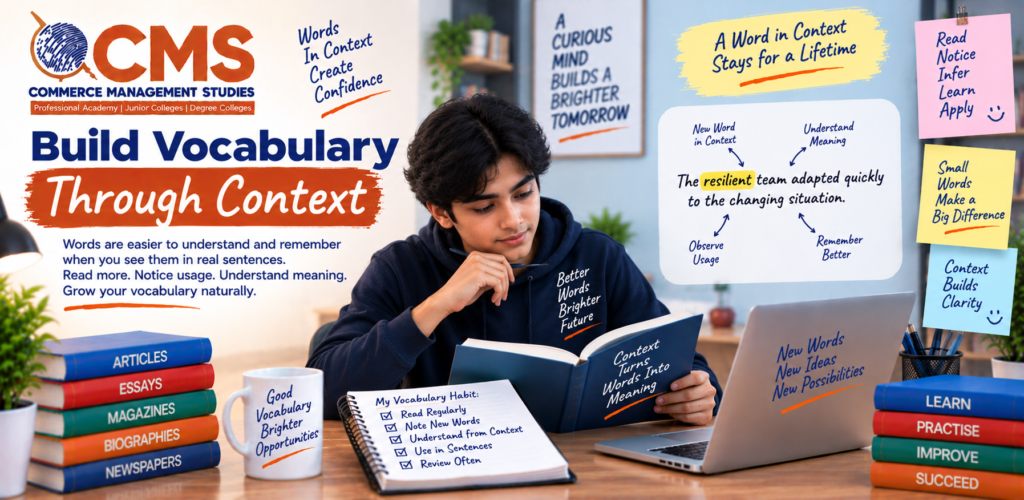
Memorising long lists of vocabulary words can help to a certain extent, but words are easier to understand and remember when encountered in meaningful contexts. When students come across an unfamiliar word while reading, they can first try to understand its meaning from the surrounding sentences.
After making an initial interpretation, students can check the dictionary meaning and note how the word is being used. They can also observe related forms of the word, such as its noun, verb, adjective, or adverb forms. This approach helps students develop contextual vocabulary rather than simply memorising isolated definitions.
Keep a Simple Vocabulary Notebook
A small vocabulary notebook can make reading more purposeful. Students do not need to write down every unfamiliar word they encounter. Instead, they can record words that are useful, repeatedly encountered, or difficult to understand.
A useful entry can include:
- The word
- Meaning in simple language
- The sentence or context in which it appeared
- One similar or opposite word
- An example sentence created by the student
Reviewing these words periodically can help move them from passive recognition to active understanding.
Read for the Main Idea
One common difficulty in reading comprehension is getting too focused on individual sentences. Students may understand every sentence separately but still struggle to identify what the entire passage is trying to communicate.
A simple reading habit is to pause after completing an article or short passage and explain its central idea in one or two sentences without looking back at the text. This forces the reader to distinguish the main argument from supporting examples and minor details. With regular practice, identifying the central idea can become faster and more natural.
Notice How Writers Build Their Arguments
Good reading involves more than understanding vocabulary. Students should also pay attention to how an author develops an idea. A passage may begin with a problem, provide evidence, present an opposing view, and then reach a conclusion. Recognising this structure can make comprehension easier.
While reading, students can occasionally ask themselves questions such as: What is the writer’s main point? Why has this example been included? Is the author explaining, comparing, criticising, describing, or arguing? These questions encourage active reading and help students understand the purpose behind different parts of a passage.
Read Without Looking Up Every Word
Stopping for every unfamiliar word can interrupt the flow of reading. While dictionaries are useful, students should also learn to continue reading when a word is not essential to understanding the overall idea.
Often, the surrounding sentences provide enough clues to understand the approximate meaning. If the word appears important or repeatedly, the student can look it up after finishing the paragraph or article. This habit improves reading continuity and teaches students to deal with unfamiliar vocabulary without immediately becoming dependent on a dictionary.
Try Different Reading Speeds
Not every text needs to be read at the same speed. A short news report, a detailed analytical article, and a literary essay may require different levels of attention. Students can gradually learn to adjust their reading speed depending on the complexity of the material.
For IPMAT preparation, it is useful to develop both careful reading and reasonably quick comprehension. Students should not aim to read as fast as possible. Instead, they should focus on maintaining understanding while gradually becoming more efficient. Speed without comprehension does not provide much benefit in a reading-based examination.
Summarise What You Read
One of the simplest ways to check whether you have actually understood something is to summarise it. After reading an article, students can write three or four sentences explaining its central argument, important supporting points, and conclusion.
This exercise can improve both comprehension and expression. It also encourages students to distinguish essential information from secondary details. Over time, students may find that they can understand the structure of an article more quickly because they are actively looking for its key ideas.
Read Aloud Occasionally
Reading aloud is not necessary for every study session, but doing it occasionally can improve awareness of sentence structure and punctuation. Hearing a sentence can sometimes make grammatical relationships or awkward constructions easier to notice.
It can also help students become more comfortable with unfamiliar words and their pronunciation. However, reading silently should remain an important part of preparation because examination passages are normally read silently under time constraints.
Develop a Habit of Questioning the Text
Active readers do not simply absorb information; they interact with it mentally. While reading an opinion article, for example, students can ask what evidence supports the author’s argument and whether an alternative explanation is possible.
This does not mean that students need to debate every article they read. The purpose is to develop critical reading. Being able to distinguish between facts, examples, opinions, assumptions, and conclusions can strengthen comprehension and analytical ability, which are useful skills for management entrance examinations.
Make Reading a Part of Your Routine
The most effective reading habit is one that fits naturally into a student’s daily schedule. Students can choose a fixed time, such as after breakfast, during an afternoon break, or before starting their evening study session. Keeping the routine consistent reduces the need to repeatedly decide when to read.
Students preparing for IPMAT alongside Intermediate studies can also connect reading with their broader academic routine. For example, they might spend 20 minutes reading in the morning, complete quantitative practice later in the day, and reserve another session for school or Intermediate subjects. A realistic routine is easier to maintain than an overly demanding schedule.
Combine Reading With Question Practice
Reading by itself is valuable, but IPMAT preparation also requires students to become familiar with question formats. After developing a regular reading habit, students can complement it with comprehension exercises and verbal ability questions.
When reviewing their answers, students should examine why an option is correct or incorrect rather than focusing only on their score. This helps connect general reading skills with examination-specific reasoning. Over time, students can identify whether their difficulty lies in comprehension, vocabulary, inference, sentence interpretation, or time management.
Avoid Turning Reading Into a Burden
Reading should support preparation rather than become another source of pressure. Students do not need to finish lengthy books simply because other aspirants are doing so. The choice of reading material should reflect their current ability and gradually introduce greater complexity.
A student who currently struggles with long articles can begin with shorter, well-written pieces and slowly increase the difficulty. The objective is to develop comfort with language and ideas over time. Progress may initially seem slow, but regular exposure can make unfamiliar vocabulary and complex sentences increasingly manageable.
How CMS Students Can Build the Habit
Students preparing for IPMAT alongside Intermediate studies need to balance academic learning with entrance-oriented preparation. At CMS IPMAT Coaching in Hyderabad, students pursuing Intermediate pathways can include small reading sessions within their broader preparation routine, using them to strengthen comprehension and language awareness without taking excessive time away from their academic subjects.
A useful approach is to begin with a manageable daily reading target and gradually combine it with vocabulary building, comprehension practice, and timed verbal exercises. Rather than treating reading as a separate activity with an immediate score, students can view it as a long-term skill that supports their overall verbal preparation.
Conclusion
Strong Verbal Ability is not developed overnight. It grows through repeated exposure to language, regular comprehension practice, and the gradual development of habits that make reading more active and purposeful. Small actions such as reading for 15 to 20 minutes, learning vocabulary from context, identifying the main idea, summarising articles, and observing how writers structure their arguments can collectively make a difference over time.
For IPMAT aspirants, the goal should not simply be to read more but to read with greater awareness. Understanding what a writer is saying, how the ideas are connected, and what information is important can make reading-based questions easier to approach. With consistent practice and a realistic daily routine, reading can become a natural part of IPMAT preparation rather than something students have to force themselves to do.