
Introduction
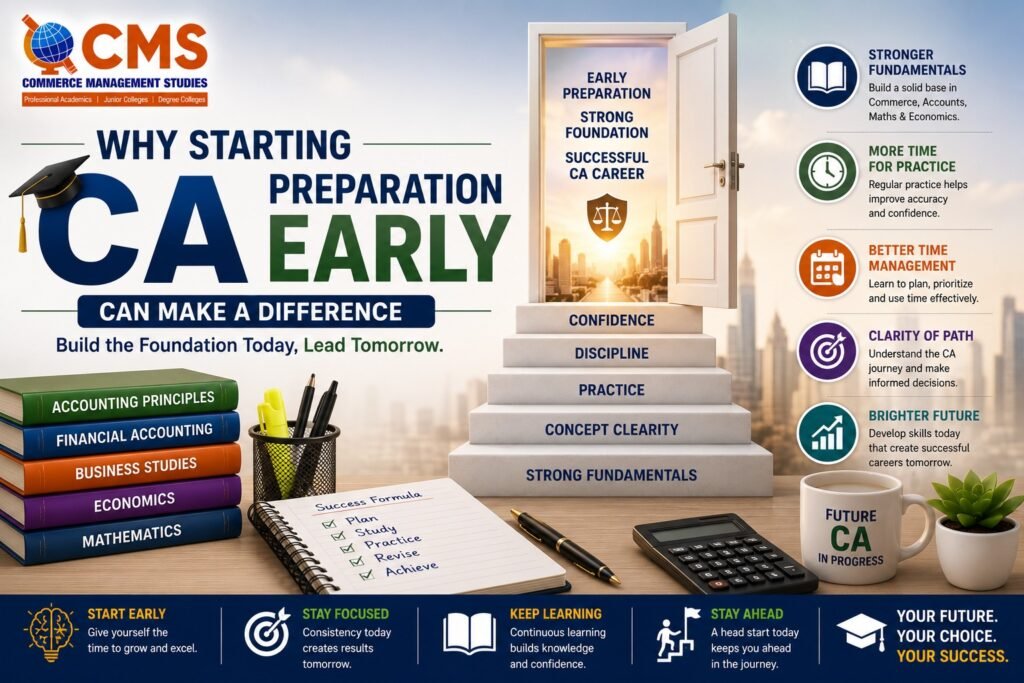
Chartered Accountancy is a professional qualification that requires strong conceptual understanding, regular practice, and long-term commitment. For students who are considering CA as a career after Intermediate, starting to understand the course and developing relevant skills early can provide a valuable advantage. Early preparation does not mean putting excessive pressure on students or studying professional-level material from the beginning. Instead, it means gradually building the academic foundation, study habits, and awareness needed for the CA journey.
Starting early also gives students more time to understand what the CA profession involves and whether it matches their interests and career goals. Students can strengthen subjects such as Commerce, Economics, and Mathematics while developing skills such as analytical thinking, numerical ability, problem-solving, and time management. With a structured approach, early preparation can make the transition from Intermediate education to professional studies more comfortable.
Understanding What Early CA Preparation Means
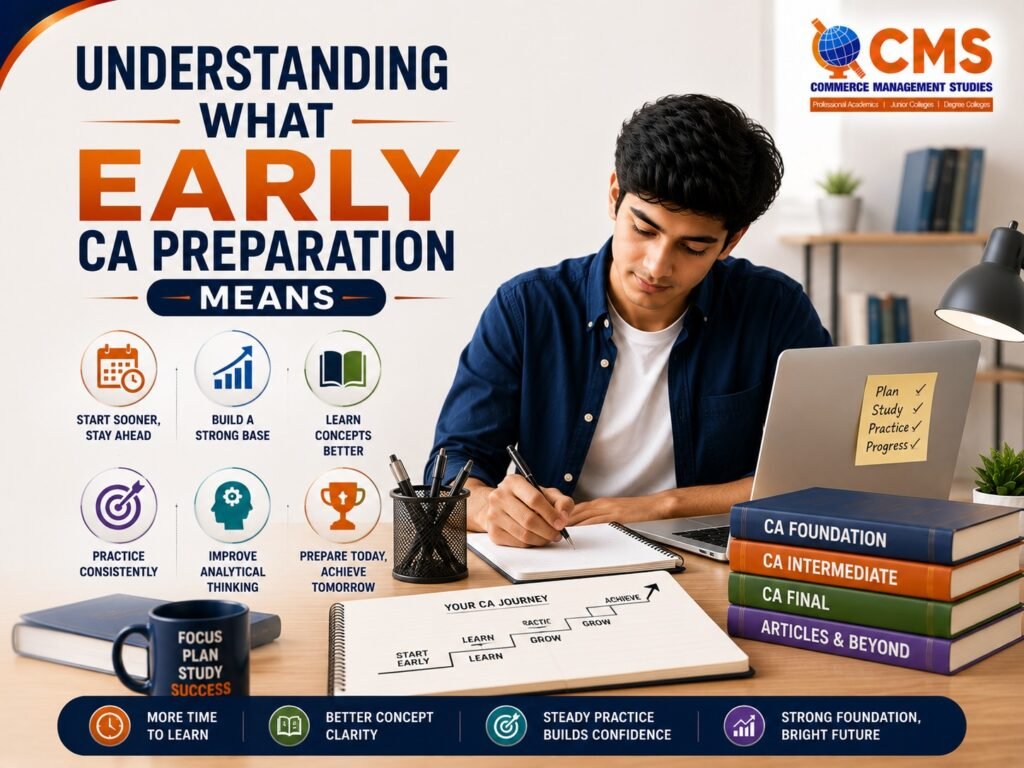
Early CA preparation is not simply about completing the CA syllabus years before the examination. It is about developing the right foundation before students enter the more demanding stages of professional education. During Intermediate, students can focus on understanding accounting concepts, strengthening their numerical skills, developing reading habits, and becoming familiar with business and financial terminology.
This approach allows students to build their knowledge gradually instead of trying to develop everything at once. When students eventually move toward professional-level studies, they may already have experience with disciplined study routines, regular revision, practice questions, and self-assessment. These habits can become valuable throughout the CA journey.
1. Stronger Academic Fundamentals
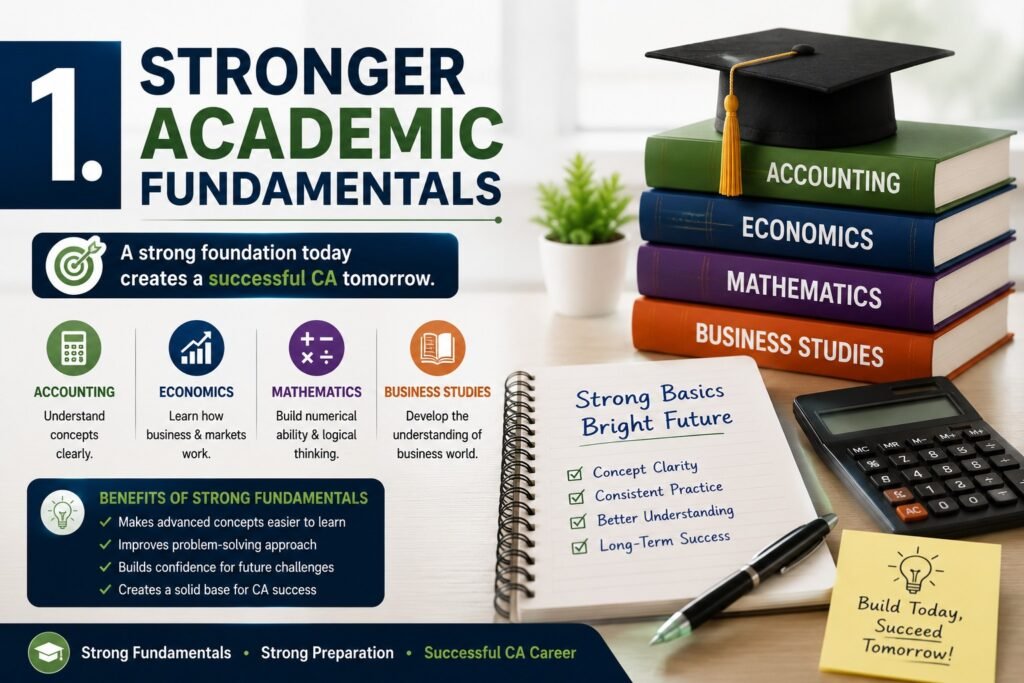
One of the biggest benefits of starting early is the opportunity to build strong fundamentals. Accounting, economics, mathematics, and business concepts introduced during Intermediate can form an important academic base for students interested in professional courses such as CA.
Students who take the time to understand the logic behind concepts are better positioned to approach more advanced topics later. Rather than memorizing formulas or accounting treatments, they can focus on understanding why a particular method is used and how it applies to different situations. Strong fundamentals can make future learning more organized and meaningful.
2. More Time for Regular Practice
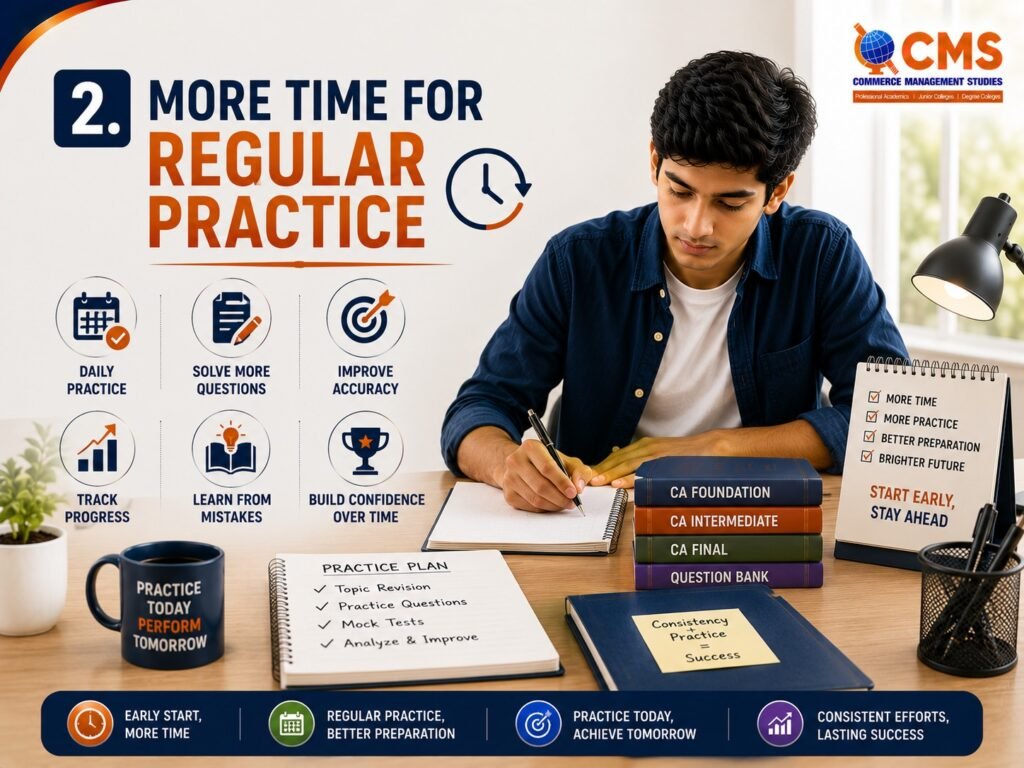
CA preparation involves extensive practice, particularly when students need to apply concepts to different types of questions. Starting early gives students more time to develop the habit of practicing regularly rather than relying on last-minute preparation.
Regular practice can help students identify areas where they need improvement. It also allows them to make mistakes, understand those mistakes, and try similar questions again. Over time, this process can improve accuracy and confidence while reducing the fear of unfamiliar questions.

3. Better Time Management Skills
Managing a demanding professional course requires effective time management. Students who begin developing this skill during Intermediate can gradually learn how to balance academics, preparation, revision, practice, and personal time.
A structured timetable can help students divide large goals into smaller tasks. Instead of attempting to complete an entire subject in a short period, students can study consistently and revise topics at regular intervals. This habit can become increasingly useful as the volume and complexity of professional studies increase.

4. Greater Familiarity with the CA Pathway
Students sometimes know CA as a popular professional qualification without fully understanding what the journey involves. Early preparation gives them an opportunity to learn about the stages, subjects, examination requirements, practical training, and career possibilities associated with the profession.
This awareness can help students make informed decisions. They can understand that CA is a long-term professional journey that requires patience and consistency. Knowing what to expect can help students prepare mentally and academically rather than being surprised by the demands of the course later.
Developing the Right Study Habits Early
Professional examinations require students to study independently and consistently. Developing these habits during Intermediate can make the transition to higher-level education easier. Students can practice maintaining notes, revising regularly, solving questions, reviewing mistakes, and setting realistic academic goals.
Useful habits include:
- Studying consistently rather than only before examinations
- Revising previously completed topics
- Practicing numerical and application-based questions
- Maintaining organized notes
- Reviewing mistakes
- Taking periodic assessments
- Setting achievable weekly goals
- Managing study time effectively
These habits can support students throughout their academic journey and are not limited to CA preparation alone.
Building Confidence Through Gradual Preparation
Starting early can also help students become more comfortable with challenging academic concepts. When students have sufficient time to learn, practice, revise, and ask questions, they can approach difficult topics without feeling that they need to master everything immediately.
Confidence should not be confused with assuming that the course will be easy. Instead, it comes from knowing that consistent preparation can improve performance. Students who understand their strengths and weaknesses can work on specific areas rather than becoming overwhelmed by the overall syllabus.
How Mathematics and Economics Can Help
For MEC students, Mathematics and Economics can contribute to the development of analytical and numerical abilities. Mathematics encourages structured problem-solving, while Economics helps students understand markets, resources, business decisions, and broader economic conditions.
These skills can complement Commerce-based learning. Students can gradually develop the ability to interpret information, analyze numerical data, and understand how financial and economic factors are connected. Such abilities can be useful not only for professional education but also for understanding real-world business situations.
The Role of Commerce in Early CA Preparation
Commerce provides students with an early introduction to accounting and business fundamentals. Learning concepts such as transactions, financial statements, business activities, and basic accounting principles can help students become familiar with the language of finance.
Students should focus on conceptual clarity rather than simply trying to remember accounting procedures. Understanding the reasoning behind accounting treatments can make future learning easier and encourage students to approach problems logically. A strong Commerce foundation can therefore be valuable for students planning to pursue CA.
Learning to Analyze Mistakes
Making mistakes is a natural part of preparation. What matters is whether students understand those mistakes and learn from them. Starting early gives students more opportunities to identify recurring errors and develop strategies to avoid them.
After completing a practice test or assignment, students can review incorrect answers and ask whether the mistake occurred because of a conceptual gap, calculation error, misunderstanding of the question, or lack of time. This simple habit can turn mistakes into useful learning opportunities and gradually improve accuracy.
Early Preparation Does Not Mean Excessive Pressure
Starting CA preparation early should not mean that students spend every available hour studying professional subjects. Students need time for Intermediate academics, extracurricular activities, physical activity, relaxation, and adequate sleep.
The purpose of early preparation is to create a sustainable academic routine. Students can gradually introduce CA-oriented learning while maintaining their regular education. A balanced approach is more likely to remain effective over a longer period than an overly demanding schedule that leads to fatigue or loss of motivation.
How Integrated CA Preparation Can Help
An integrated approach can make early preparation more structured by connecting Intermediate education with professional goals. Students can strengthen their academic subjects while gradually developing the skills and knowledge that can support their future CA preparation.
At CMS CA Coaching in Hyderabad, students can pursue MEC or CEC with integrated CA coaching, allowing them to continue their Intermediate education while developing a foundation for the CA pathway. Regular learning, practice, assessments, and revision can help students build confidence and become familiar with the discipline required for professional education.
Who Can Benefit from Starting Early?
Early CA preparation can be particularly useful for students who already have a strong interest in accounting, finance, taxation, auditing, and business. It can also benefit students who prefer having more time to understand concepts and develop their preparation gradually.
However, students do not need to decide their entire professional future immediately. Early exposure can simply help them explore the profession and understand whether it matches their interests. The decision should ultimately be based on informed career planning rather than pressure or trends.
Long-Term Benefits of Early Skill Development
The skills developed through early CA preparation can remain useful even if a student’s career direction changes later. Analytical thinking, numerical ability, communication, time management, attention to detail, and problem-solving are valuable across many academic and professional fields.
This is why early preparation should focus on building transferable skills rather than only completing examination-oriented material. Students who develop the ability to learn consistently and solve problems independently can carry those skills into higher education and their eventual careers.
Conclusion
Starting CA preparation early can make a meaningful difference by giving students more time to build strong fundamentals, develop effective study habits, practice regularly, and understand the professional pathway. It can reduce dependence on last-minute preparation and allow students to approach challenging concepts gradually. Early preparation can also help students understand whether Chartered Accountancy genuinely matches their interests and long-term career plans.
The most effective approach is not to rush into professional-level preparation but to build a strong foundation step by step. With consistent academics, conceptual learning, regular practice, effective time management, and the right guidance, students can enter their CA journey with greater confidence and preparedness. Early preparation is ultimately about creating a strong foundation today that can support professional learning tomorrow.