
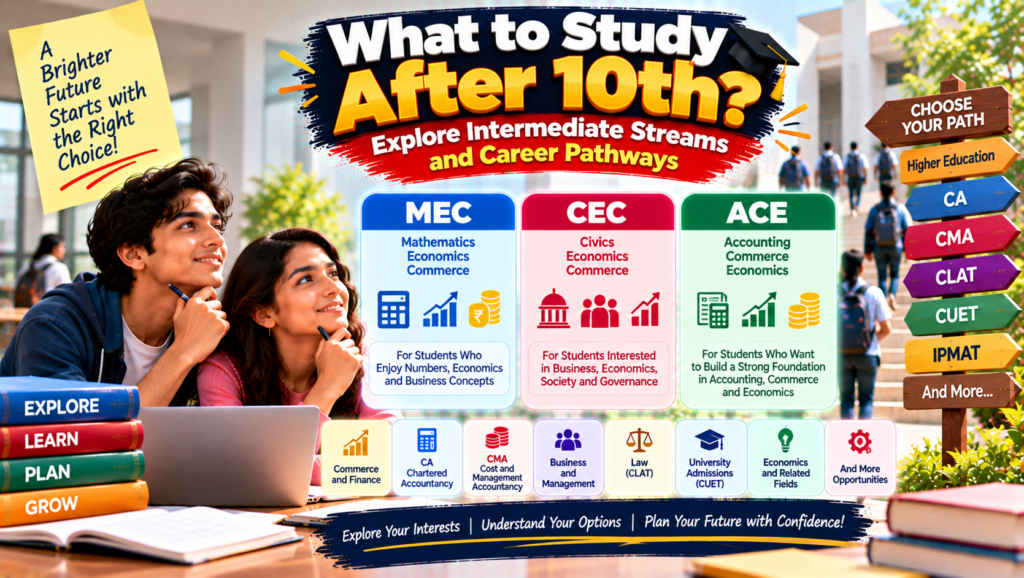
Completing Class 10 is an important milestone in every student’s academic journey. It is also the stage when students begin thinking about what to study next, which subjects suit their interests, and what career opportunities they may want to explore in the future. With several educational pathways available, choosing the right course after 10th can feel confusing for students and parents. Understanding the available options, their subject combinations, and the opportunities they may lead to can make this decision easier.
In Telangana and Andhra Pradesh, Intermediate education is a popular choice for students who want to continue their studies after Class 10. Among the available options, MEC, CEC and ACE are streams that students can explore based on their academic interests and future goals. Each stream offers a different learning experience and can help students prepare for various undergraduate courses, professional qualifications and competitive examinations. At CMS, students can explore these Intermediate streams alongside relevant coaching programmes, helping them plan their academic journey with greater clarity.

Understanding Your Options After 10th Class
After Class 10, students can consider different educational pathways depending on their interests, strengths and long-term plans. Some may prefer science-related subjects, while others may be interested in commerce, economics, business, accounting, mathematics or management. Students can also explore vocational and skill-oriented programmes, depending on their goals and the courses available to them.
Before selecting a course, it is useful to understand the subjects involved, the academic requirements and the opportunities available after completing the programme. Students should also consider whether they enjoy the subjects they will study over the next two years. Rather than choosing a stream based only on marks, friends’ decisions or popular opinions, they should identify the options that match their interests and the direction in which they want to develop their skills.
MEC, CEC and ACE: Which Intermediate Stream Should You Choose?
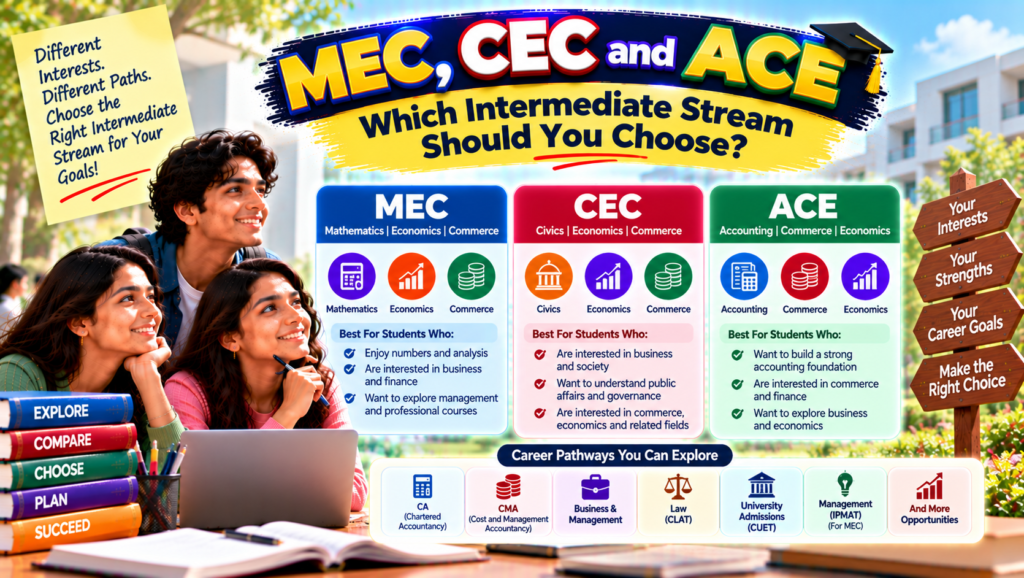
MEC, CEC and ACE are Intermediate stream options for students interested in commerce, economics, business and related areas. However, their subject combinations and learning focus differ, so students should understand these differences before making a decision.
MEC – Mathematics, Economics and Commerce
MEC combines Mathematics, Economics and Commerce. It can be a suitable option for students who enjoy working with numbers, understanding economic concepts and learning about business and financial systems. Mathematics also helps students develop analytical thinking, quantitative reasoning and problem-solving skills, which can be useful in several higher education and professional pathways.
Students pursuing MEC can explore undergraduate programmes in commerce, economics, business administration, finance and related fields, subject to the eligibility requirements of the institution and course. They may also consider professional qualifications such as Chartered Accountancy (CA) and Cost and Management Accountancy (CMA), as well as entrance examinations such as CUET and IPMAT. Students interested in law can also explore CLAT, depending on their goals and preparation plans.
CEC – Civics, Economics and Commerce
CEC combines Civics, Economics and Commerce. It can appeal to students who want to understand business fundamentals, economic developments, government, public affairs and the functioning of society. The stream helps students explore how economic activities, institutions and public policies influence individuals, businesses and communities.
After CEC, students can consider undergraduate programmes in commerce, economics, business, political science, public administration and other related areas, depending on admission criteria. They may also explore professional qualifications such as CA and CMA, along with entrance examinations such as CUET and CLAT. Students should review the eligibility criteria for their preferred courses and examinations before finalising their Intermediate stream.
ACE – Accounting, Commerce and Economics
ACE is another option for students interested in accounting, commerce and economics. Its subject combination can help learners build an understanding of financial concepts, business activities and economic principles. Students considering this stream should review the exact subjects and curriculum offered by their chosen institution to understand how the programme aligns with their academic interests.
Depending on the subjects studied and the eligibility requirements of their preferred institutions, ACE students may explore undergraduate courses related to commerce, accounting, finance, economics and business. Professional pathways such as CA and CMA, along with entrance examinations such as CUET and CLAT, may also be worth exploring where applicable. Students should check the relevant eligibility requirements before choosing a particular pathway.
How to Choose the Right Intermediate Stream After 10th
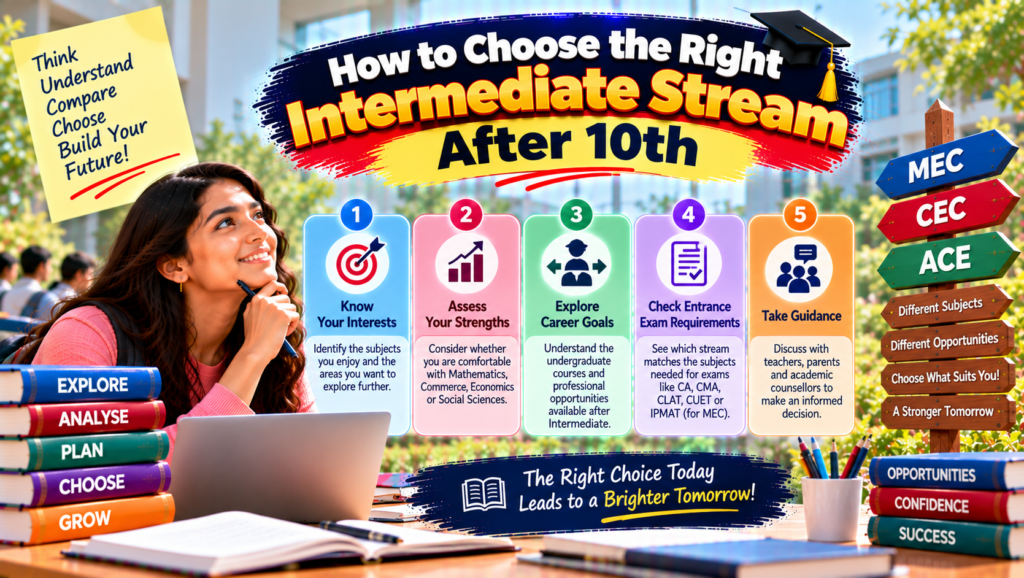
Selecting an Intermediate stream requires more than simply comparing course names. Students should think about the subjects they enjoy, the skills they want to develop and the types of courses or careers they may want to pursue later. A stream that matches a student’s interests can make learning more engaging and help them approach their studies with greater confidence.
The following factors can help students and parents make a more informed decision:
- Personal interests: Identify the subjects you enjoy learning and the topics you would like to understand in greater depth.
- Academic strengths: Consider whether you are comfortable with Mathematics, accounting concepts, economics, social sciences or analytical problem-solving.
- Future education plans: Explore the undergraduate courses and professional qualifications you may want to pursue after Intermediate.
- Entrance examination requirements: Check whether your preferred course requires a specific subject combination or entrance examination.
- Learning preferences: Think about whether you prefer numerical problem-solving, business concepts, economic analysis or subjects connected with society and governance.
- Guidance and support: Discuss your options with teachers, parents and academic counsellors who can help you compare the available streams.
Students do not need to have their entire career planned at the age of 15 or 16. However, understanding the connection between Intermediate subjects and future opportunities can help them make a thoughtful choice. It is equally important to verify course-specific eligibility requirements because not every stream automatically qualifies a student for every degree or entrance examination.
Career Pathways After MEC, CEC and ACE
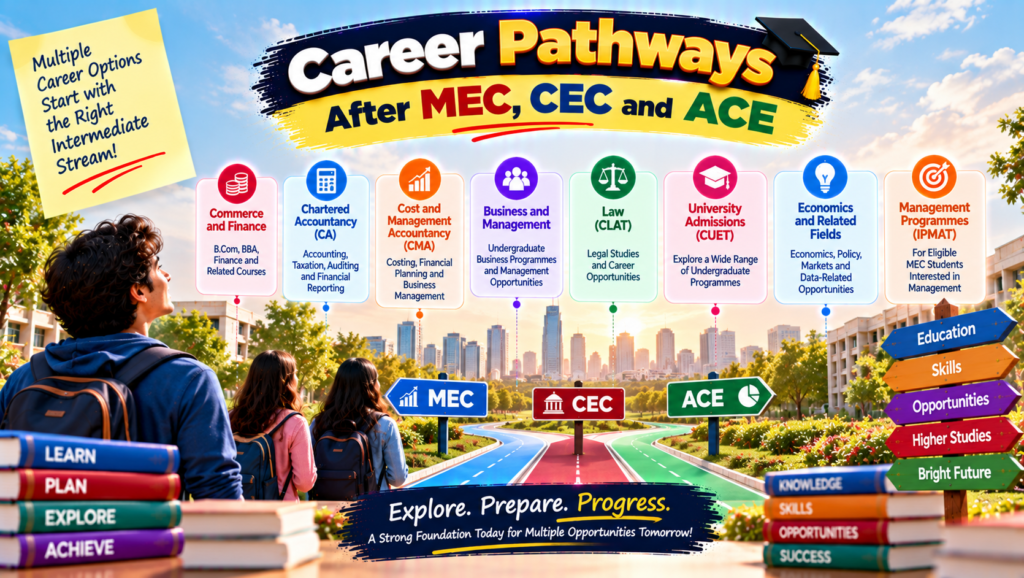
Intermediate is an important stage for building the academic foundation needed for higher education. Once students understand their stream and subject strengths, they can begin exploring suitable undergraduate programmes, professional courses and entrance examinations. Planning early can help them identify the subjects they need to focus on and the preparation required for their preferred goals.
Some possible pathways include:
- Commerce and finance: Students can explore degrees in commerce, accounting, finance and related disciplines.
- Chartered Accountancy (CA): Students interested in accounting, taxation, auditing and financial reporting can learn about the CA qualification and its stages.
- Cost and Management Accountancy (CMA): Students interested in costing, financial planning, performance management and business decision-making can explore the CMA pathway.
- Business and management: Students can consider undergraduate business programmes and relevant management entrance examinations.
- Law: Students interested in legal studies can explore law entrance examinations such as CLAT, subject to the relevant eligibility requirements.
- University admissions through CUET: Students can investigate eligible undergraduate programmes at participating universities and understand their admission criteria.
- Economics and related disciplines: Students interested in economic systems, markets, policy and data can explore suitable undergraduate programmes.
For students interested in management programmes after Class 12, IPMAT is another entrance examination to consider where eligible. Students should check the requirements of individual institutions and examinations, including accepted subjects, age criteria where applicable, and admission procedures, before deciding on their preparation plan.
Why Start Planning for Competitive Examinations During Intermediate?
Some students begin preparing for professional courses and entrance examinations only after completing Class 12. However, learning about these examinations during Intermediate can give them more time to understand the syllabus, strengthen fundamental concepts and develop effective study habits. Early planning does not mean that students must prepare for every examination at once. Instead, they can identify one or two suitable pathways and gradually build the knowledge and skills those pathways require.
For example, students considering CA or CMA can develop a stronger understanding of commerce and accounting concepts while studying their Intermediate subjects. Those interested in CUET can learn about the subject requirements of their target undergraduate programmes, while students considering CLAT can begin developing reading comprehension, reasoning and general awareness skills. MEC students interested in IPMAT can also explore quantitative aptitude and verbal ability preparation alongside their regular studies.
A balanced preparation plan should leave sufficient time for board examinations, revision, practice and rest. Students benefit from understanding the requirements of their chosen examination early, rather than relying on assumptions or trying to prepare for several unrelated goals without a clear plan.
How Integrated Coaching Can Support Students
Managing Intermediate academics alongside entrance examination preparation can be challenging when students do not have a clear schedule. An integrated coaching programme can help organise learning by aligning relevant academic subjects with preparation for selected professional courses or competitive examinations. Students should look for a programme that provides a clear syllabus, regular practice opportunities, assessments and feedback on areas that need improvement.
CMS offers Intermediate streams such as MEC, CEC and ACE, with integrated coaching options designed around relevant pathways. At CMS MEC Intermediate Colleges in Hyderabad, MEC students can explore preparation for CA, CMA, CLAT, CUET and IPMAT, while CEC and ACE students can explore integrated preparation for CA, CMA, CLAT and CUET. The appropriate option depends on the stream, the programme selected and the student’s goals.
Before joining any programme, students and parents should understand the subjects covered, the examination preparation offered, the assessment schedule and how academic progress is monitored. The aim should be to find a learning environment that supports board examination preparation while helping students work steadily towards their future goals.
Common Mistakes to Avoid When Choosing a Course After 10th
Choosing an Intermediate stream can influence the subjects students study and the pathways they explore later. Therefore, it is worth taking time to understand the options instead of making a quick decision based on incomplete information.
One common mistake is choosing a stream simply because friends are choosing it. Another is assuming that one stream is universally better than another. MEC, CEC and ACE have different subject combinations, and their suitability depends on the student’s interests, strengths and intended courses. Students should also avoid selecting a stream based only on a particular career’s popularity without understanding its educational requirements.
It is equally important not to overlook eligibility criteria for entrance examinations and undergraduate programmes. Students should check official admission requirements, discuss their plans with knowledgeable teachers and compare the subjects offered by different institutions. A well-informed decision can help them make better use of their Intermediate years and prepare for the next stage of education with a clearer sense of direction.
Conclusion
Deciding what to study after 10th is an important step, but students do not have to make the decision without guidance. By understanding the differences between MEC, CEC and ACE, exploring potential career pathways and considering their own interests and strengths, they can choose an Intermediate stream that suits their academic goals. It is also helpful to research future course requirements early so that they can plan their studies and entrance examination preparation effectively.
With the right stream, consistent learning and a realistic preparation plan, Intermediate can become a strong foundation for higher education and professional development. Students and parents can explore the available options at CMS, understand the relevant integrated coaching pathways and make a decision based on the student’s interests, eligibility and long-term aspirations.