

Introduction
Getting admission into a reputed National Law University (NLU) is an important goal for students interested in pursuing a career in law. The Common Law Admission Test (CLAT) provides an opportunity to secure admission to undergraduate law programs offered by participating NLUs across India. However, achieving a competitive CLAT rank requires more than simply understanding the examination pattern. Students need to develop strong reading habits, improve their reasoning abilities, stay informed about current affairs and practise regularly.
Intermediate is a valuable stage to begin this preparation. Students pursuing MEC, CEC or ACE can use Classes 11 and 12 to strengthen the skills required for CLAT while continuing their regular academic studies. With a planned approach, consistent effort and suitable guidance, students can work towards their goal of securing admission to a preferred NLU.
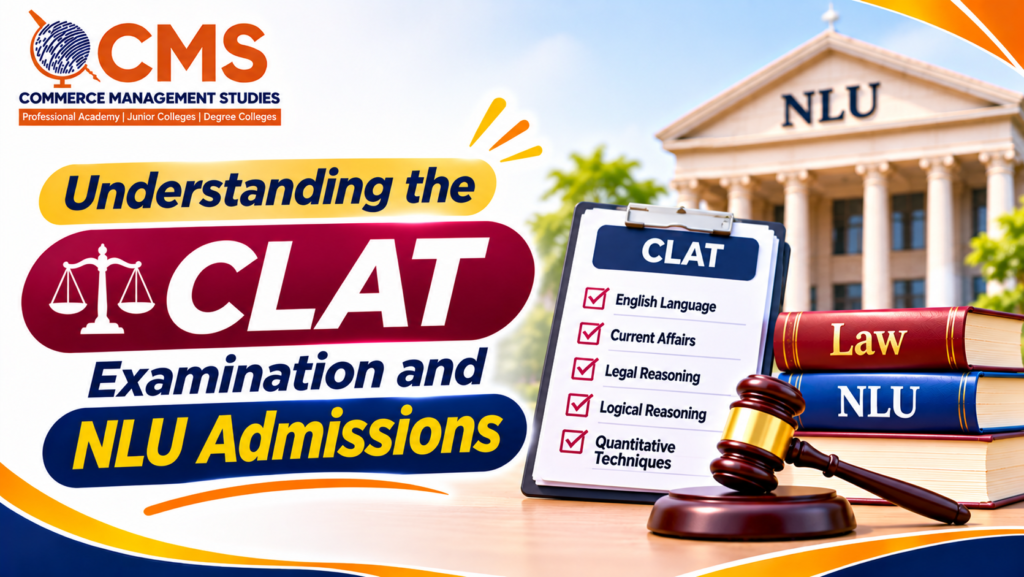
Understanding the CLAT Examination and NLU Admissions
CLAT is a national-level entrance examination conducted for admission to undergraduate law programs at participating National Law Universities. The undergraduate examination assesses a candidate’s ability to understand passages, interpret information, analyse arguments and apply logical reasoning.
The major sections of CLAT-UG include:
- English Language: Tests reading comprehension, vocabulary in context, interpretation and understanding of written passages.
- Current Affairs Including General Knowledge: Evaluates awareness of important national and international events and the ability to understand information related to them.
- Legal Reasoning: Assesses the ability to understand legal principles and apply them to given situations. Prior knowledge of law is not generally required to attempt the questions.
- Logical Reasoning: Focuses on identifying arguments, understanding relationships, drawing conclusions and evaluating statements.
- Quantitative Techniques: Tests the ability to interpret numerical information, understand data and solve questions using basic mathematical concepts.
A good CLAT rank can improve a student’s chances of receiving an admission offer from a preferred NLU. However, admission depends on several factors, including the candidate’s rank, category, seat availability, university preferences and counselling rules.

Why Intermediate Is the Right Time to Start CLAT Preparation
Students do not need to wait until Class 12 examinations are completed to begin preparing for CLAT. Starting during Intermediate gives them sufficient time to become familiar with the examination and gradually develop the skills required for each section.
Unlike examinations that primarily test textbook knowledge, CLAT requires students to read carefully, interpret information and apply reasoning. These abilities improve through regular practice rather than last-minute preparation.
Beginning early can help students:
- Develop a consistent newspaper and current affairs reading habit.
- Improve comprehension and vocabulary through regular reading.
- Understand the different CLAT sections without rushing through the syllabus.
- Practise logical and legal reasoning questions progressively.
- Identify weaker areas and work on them over time.
- Become familiar with mock tests and examination time management.
Students pursuing Intermediate in Hyderabad can also explore integrated CLAT coaching alongside their regular MEC, CEC or ACE education. This approach can help them manage academic subjects and entrance examination preparation within a planned schedule.

How MEC, CEC and ACE Students Can Approach CLAT Preparation
Students from different Intermediate streams can prepare for CLAT because the examination does not require candidates to have studied a particular stream in Class 11 or Class 12. What matters is their ability to understand passages, analyse information and apply reasoning.
MEC Students
MEC introduces students to Mathematics, Economics and Commerce. These subjects can support the development of numerical understanding, analytical thinking and the ability to interpret information. Mathematics can be particularly useful when practising the Quantitative Techniques section of CLAT.
MEC students should also devote time to English comprehension, current affairs, legal reasoning and logical reasoning. A balanced preparation plan will help them build skills across all five sections instead of concentrating only on numerical subjects.
CEC Students
CEC provides a foundation in Civics, Economics and Commerce. Studying Civics can encourage an interest in governance, institutions, public administration and the functioning of society. These areas can help students develop broader awareness of topics that may be useful when reading about legal and constitutional developments.
However, CLAT preparation requires dedicated practice beyond regular Intermediate subjects. CEC students should focus on reading comprehension, current affairs, legal reasoning, logical reasoning and quantitative techniques.
ACE Students
ACE students can also pursue CLAT preparation while completing their Intermediate education. Their preparation should focus on developing the reading, interpretation and reasoning abilities assessed in the entrance examination.
Students should gradually become comfortable with passage-based questions, numerical data and analytical exercises. Regular mock tests can help them understand their performance and identify the sections that need additional attention.
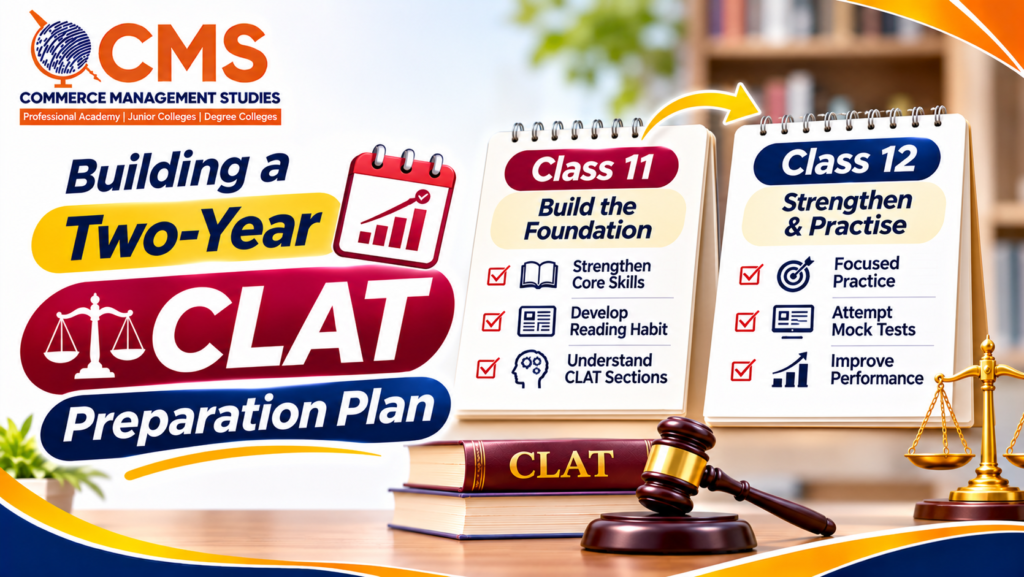
Building a Two-Year CLAT Preparation Plan
A two-year preparation strategy allows students to divide their work into manageable stages. Instead of attempting to master every section immediately, they can first build essential skills and then move towards examination-oriented practice.
Class 11: Build the Foundation
Class 11 should primarily focus on understanding the CLAT examination, improving reading habits and developing basic reasoning abilities. Students can begin by exploring the question types in each section and identifying their strengths and weaknesses.
Important activities during Class 11 include:
- Reading newspapers and reliable news sources regularly.
- Practising English comprehension passages.
- Learning to identify arguments, assumptions and conclusions.
- Understanding basic legal terminology and applying legal principles to situations.
- Revising fundamental mathematical concepts and practising data interpretation.
- Maintaining notes on important national and international developments.
Students should avoid focusing only on the number of questions they solve. At this stage, understanding why an answer is correct or incorrect is more important than completing large volumes of practice material.
Class 12: Strengthen Preparation and Practise Mock Tests
In Class 12, students should gradually move towards more examination-focused preparation. They should continue developing their reading and reasoning skills while increasing the frequency of section-wise practice and mock tests.
The main priorities during this stage include:
- Completing regular practice across all five CLAT sections.
- Attempting full-length mock tests under timed conditions.
- Reviewing incorrect answers and understanding the reasons behind mistakes.
- Improving reading speed without compromising comprehension.
- Revising current affairs through organised notes.
- Balancing CLAT preparation with board examination studies.
Students should also review the latest CLAT notification to understand the examination schedule, eligibility requirements and any changes to the pattern.
Developing the Skills Required for a Competitive CLAT Rank
A strong CLAT performance depends on several interconnected skills. Students who develop these abilities during Intermediate can approach the examination with greater confidence.
1. Reading Comprehension
Reading comprehension plays an important role in CLAT because several sections are passage-based. Students should practise reading editorials, opinion articles, essays and other informative material. While reading, they should focus on identifying the central idea, understanding the author’s viewpoint and recognising supporting arguments.
2. Current Affairs Awareness
Current affairs preparation should be consistent rather than limited to the final months before the examination. Students should follow important developments in India and abroad, including government initiatives, legal developments, international events, awards, appointments and significant reports.
Maintaining short notes can make revision easier. Students should also try to understand the background and importance of major events instead of memorising isolated facts.
3. Legal and Logical Reasoning
Legal Reasoning requires students to understand the information provided in a passage and apply the relevant principles to a situation. Logical Reasoning involves analysing arguments, identifying assumptions and evaluating conclusions.
Students can improve in these areas by solving passage-based exercises regularly. Reviewing the reasoning behind each answer will help them recognise patterns and avoid repeated mistakes.
4. Quantitative Ability
The Quantitative Techniques section requires students to interpret numerical information and solve questions involving basic mathematical concepts. Regular practice in percentages, ratios, averages, data interpretation and other relevant topics can improve accuracy.
Students should focus on understanding the methods used to solve questions rather than memorising shortcuts without understanding the underlying concepts.
The Importance of Mock Tests and Performance Analysis
Mock tests are an important part of CLAT preparation because they help students understand how to apply their knowledge within a limited time. They also provide an opportunity to practise answering different types of questions in an examination-like environment.
However, simply attempting mock tests is not enough. Students should analyse their performance after every test and identify the reasons behind incorrect answers, unanswered questions and time-management difficulties.
A useful mock-test review should consider:
- Which sections are consistently producing lower scores?
- Are mistakes caused by a lack of understanding, misinterpretation or hurried reading?
- Is too much time being spent on particular questions?
- Are students making avoidable errors despite knowing the concepts?
- Which topics require additional practice before the next mock test?
Tracking these observations over time helps students understand whether their preparation strategy is working. It also allows them to make specific improvements instead of following the same routine without evaluating their progress.
Balancing Intermediate Board Examinations and CLAT Preparation
One of the major challenges for students preparing for CLAT during Intermediate is managing entrance examination studies alongside board examinations. Both require consistent attention, and neglecting either can create unnecessary pressure.
A practical timetable should allocate time for Intermediate subjects, CLAT practice, current affairs reading and revision. Students can use shorter daily study sessions for newspaper reading and comprehension, while reserving longer sessions for mock tests and detailed practice.
Some useful approaches include:
- Preparing a weekly timetable with separate slots for board subjects and CLAT sections.
- Using daily reading time to improve comprehension and current affairs awareness.
- Setting realistic weekly targets instead of following an overloaded schedule.
- Increasing attention to board examinations when school assessments or public examinations approach.
- Using weekends for mock tests, revision and performance analysis.
The objective should be to maintain steady progress in both areas. A well-organised routine can help students avoid last-minute pressure and develop better study discipline.
How CMS Supports CLAT Preparation During Intermediate
At CMS CLAT Coaching Institutes in Hyderabad, students pursuing MEC, CEC and ACE can explore integrated CLAT coaching alongside their Intermediate education. This provides an opportunity to work on entrance examination preparation while continuing their regular academic subjects.
CLAT preparation involves developing skills that require continuous attention, including reading comprehension, current affairs awareness, legal reasoning, logical reasoning and quantitative techniques. A planned learning approach can help students understand these areas, practise different question formats and gradually improve their examination readiness.
With guidance, classroom learning, practice sessions and mock examinations, students can evaluate their progress and identify areas that require further improvement. Preparing during Intermediate also gives them time to become familiar with the examination well before the admission process begins.
For students in Hyderabad who are considering law as a career option, CMS offers an opportunity to pursue Intermediate education with integrated CLAT preparation. Students can use these two years to strengthen their academic foundation and work towards their preferred law college admission goals.
What Should Students Do After Completing Their CLAT Preparation?
After completing their preparation, students should focus on the examination requirements and admission process. They should carefully follow the official CLAT website for application announcements, eligibility conditions, examination dates, admit cards and result updates.
Once the results are announced, candidates can review their ranks and participate in the counselling process according to the applicable rules. They should research participating NLUs, compare available courses and consider factors such as location, academic environment, course structure and career opportunities before filling in their preferences.
Students should remember that CLAT is one route to law school admission. Some universities and law colleges conduct their own entrance examinations or follow different admission procedures. Exploring these alternatives can help students make informed decisions about their higher education.
Conclusion
Planning CLAT preparation during Intermediate gives students the time to develop essential reading, reasoning, analytical and numerical skills. By understanding the examination pattern, following a consistent study routine, practising mock tests and reviewing their performance, students can work towards achieving a competitive rank and securing admission to a preferred National Law University.
Whether pursuing MEC, CEC or ACE, students can begin building their CLAT preparation strategy from Class 11 and strengthen it throughout Class 12. With the right balance between board examinations and entrance preparation, Intermediate can become an important stepping stone towards a future in legal education. At CMS, integrated CLAT coaching alongside MEC, CEC and ACE helps students work towards their law admission goals while continuing their Intermediate studies.