

Choosing the right subjects for the Common University Entrance Test (CUET) is an important step for students planning to pursue undergraduate education after Intermediate. While preparing for the examination, students often focus on completing the syllabus and practising questions, but subject selection deserves equal attention. The subjects chosen for CUET can influence which undergraduate programmes students may be eligible to apply for at participating universities. Therefore, understanding the admission requirements of preferred courses before selecting CUET subjects can help students plan their preparation more effectively.
For students pursuing MEC, CEC or ACE, this decision becomes particularly important because each stream offers a different subject combination and academic foundation. Students should understand how their Intermediate studies connect with their preferred degree programs and identify the CUET test papers required by their target universities. At CMS, students from MEC, CEC and ACE can pursue Intermediate education alongside integrated CUET coaching, helping them prepare for university entrance examinations while continuing their regular academic studies.

1. Understand Your Desired Undergraduate Degree First
Before selecting CUET subjects, students should identify the undergraduate programmes they are interested in pursuing. For example, a student considering B.Com may need to check the university’s requirements for Accountancy, Business Studies, Economics or other accepted subjects. Someone interested in Economics may need to review the required subject combination, while students considering programmes in humanities or social sciences should understand the relevant domain subjects and language requirements.
The important point is that CUET subject selection should be based on the admission requirements of the desired program, not simply on the subjects a student finds easy or familiar. Different universities may prescribe different subject combinations for similar degree programs . Students should therefore shortlist their preferred courses and institutions before deciding which CUET papers to choose.
2. Understand the Different Types of CUET Subjects
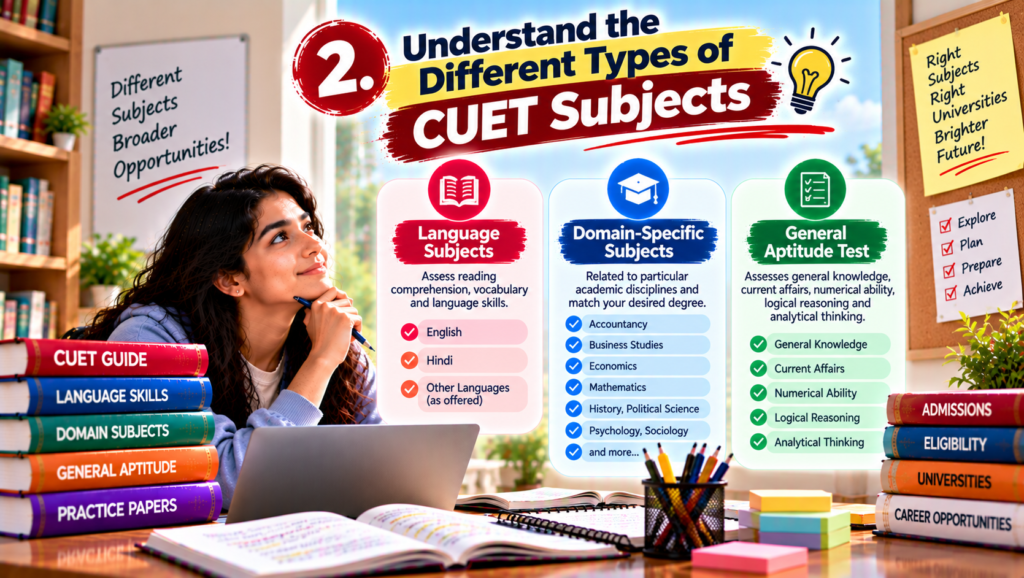
CUET-UG includes different categories of test papers. Understanding these categories helps students identify which subjects may be relevant to their intended undergraduate programmes.
Language Subjects
Language papers assess a student’s ability to understand and interpret written information. These papers generally involve reading comprehension, vocabulary and language-related skills. Students should check which language subjects are accepted by their preferred universities and whether a particular language is required for their intended degree.
Domain-Specific Subjects
Domain-specific subjects relate to particular academic disciplines. Depending on the examination year, these may include subjects such as Accountancy, Business Studies, Economics, Mathematics, History, Political Science, Geography, Psychology, Sociology and other disciplines. Students should select the domain subjects that match the eligibility requirements and subject mapping of their preferred undergraduate programmes.
General Aptitude Test
The General Aptitude Test assesses a range of abilities, including general knowledge, current affairs, numerical ability, logical reasoning and analytical thinking. Some universities and programs may require or accept this test as part of their admission criteria. Students should verify whether it is relevant to their selected courses before including it in their CUET subject choices.
3. How MEC Students Can Plan Their CUET Subject Selection
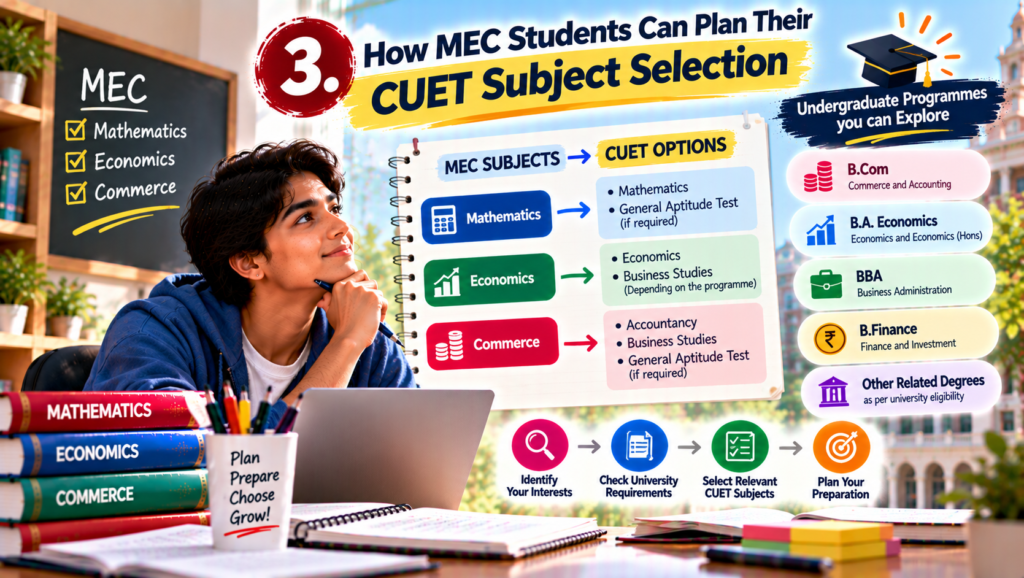
MEC combines Mathematics, Economics and Commerce, giving students an academic foundation in numerical concepts, economic principles and business-related subjects. Students pursuing MEC may explore undergraduate programmes in commerce, economics, finance, business administration and other related disciplines. However, the appropriate CUET subject combination depends on the specific programme and university.
For example, students interested in commerce-related degrees can investigate whether Accountancy, Business Studies, Economics or other papers are required or accepted. Those considering Economics programmes should check the university’s Mathematics requirements and accepted CUET subjects. Students interested in management-related undergraduate programmes should also research the individual institution’s admission process rather than assuming that the same CUET combination applies everywhere.
MEC students should make a list of their preferred universities and courses, compare the subject requirements and then select the relevant CUET papers. This approach helps them connect their Intermediate learning with their future degree plans.
4. How CEC Students Can Plan Their CUET Subject Selection
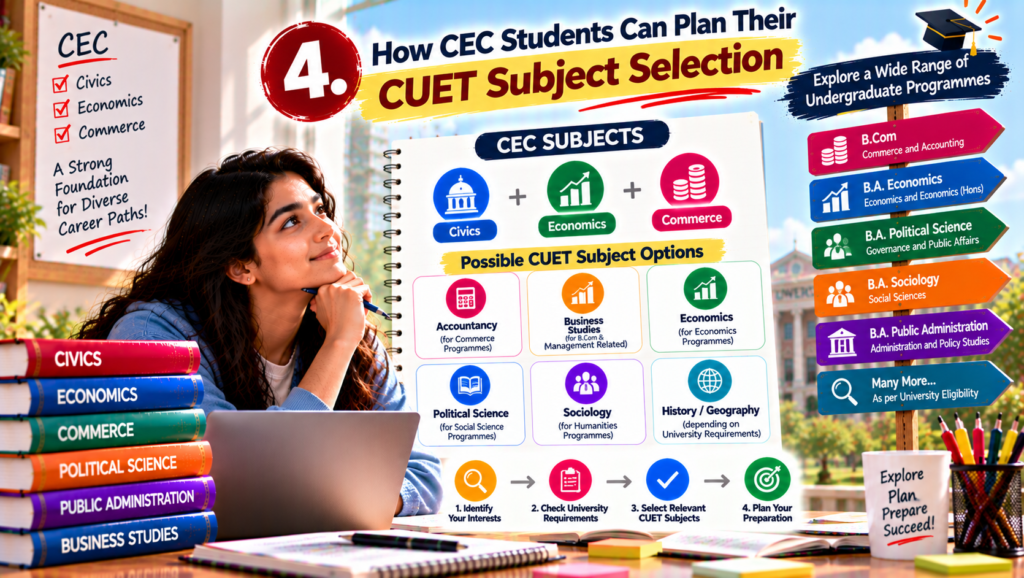
CEC combines Civics, Economics and Commerce. It can be a suitable academic option for students interested in business, economics, governance, public affairs and social sciences. After Intermediate, CEC students may explore undergraduate programmes such as B.Com, Economics, Political Science, Public Administration and other related disciplines, depending on the eligibility criteria of the universities they choose.
Students interested in commerce programmes should check whether their preferred universities require or accept subjects such as Accountancy, Business Studies or Economics. Those considering humanities and social science degrees should investigate the relevant domain subjects, language requirements and General Aptitude Test criteria, wherever applicable. The requirements may differ between universities, even when the degree names are similar.
CEC students can benefit from researching several degree options before finalising their CUET subjects. This allows them to understand which test papers are relevant to their interests and avoid choosing subjects without considering the admission requirements of their preferred programmes.
5. How ACE Students Can Plan Their CUET Subject Selection
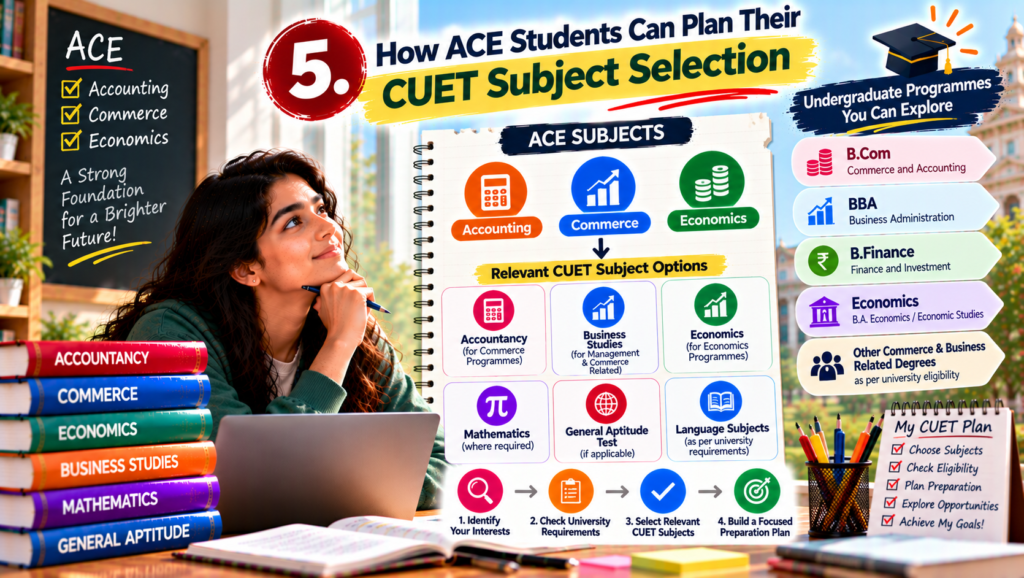
ACE focuses on Accounting, Commerce and Economics in programmes offering this subject combination. It can be an option for students interested in financial concepts, business activities, accounting principles and economic systems. Students pursuing ACE may consider undergraduate courses related to commerce, accounting, finance, economics and business, subject to the admission requirements of their chosen universities.
For commerce-oriented programmes, students should examine the CUET subject combinations accepted by their target institutions. They should also check whether a particular degree requires Mathematics, Accountancy, Business Studies, Economics or another subject. Students interested in economics and business-related degrees should compare the eligibility criteria of different universities instead of relying on general assumptions about which subjects are accepted.
Since university admission requirements can vary, ACE students should review the course-wise subject mapping before applying for CUET. This will help them select test papers that support their preferred undergraduate pathways.
6. Check University-Wise Eligibility Before Selecting CUET Subjects
One of the most important steps in CUET subject selection is checking the admission requirements of individual universities. A particular undergraduate degree may have different eligibility conditions at different institutions. Even when universities offer the same programme, they may specify different domain subjects, qualifying examination requirements or minimum marks.
Students can follow these steps before finalising their choices:
- Shortlist universities: Identify the institutions where you would like to pursue your undergraduate degree.
- Select preferred courses: List the programmes you are interested in applying for at each university.
- Check eligibility criteria: Visit the official admission website of each institution and review its course-wise requirements.
- Identify required CUET papers: Check the accepted language, domain-specific subjects and General Aptitude Test requirements, wherever applicable.
- Compare subject combinations: Look for combinations that meet the requirements of more than one preferred programme, if permitted.
- Review the latest notification: Confirm the current CUET examination rules and application instructions before submitting your choices.
Students should not assume that choosing a subject in the CUET application automatically makes them eligible for every degree related to that subject. The final admission decision depends on the university’s eligibility rules, qualifying examination requirements, CUET performance and other applicable admission conditions.
7. Common Mistakes to Avoid During CUET Subject Selection
Students sometimes select CUET subjects based only on their Intermediate stream or the subjects they feel most confident in. Although academic strengths are important, they should not be the only consideration. A subject that seems familiar may not meet the eligibility requirements of a particular undergraduate programme.
Another common mistake is focusing on only one university without exploring other suitable options. Students may discover later that their chosen CUET papers do not match the requirements of another institution they want to apply to. It is also important not to rely entirely on previous years’ subject combinations because admission rules and examination instructions can change.
To avoid these problems, students should research their preferred programmes early, maintain a record of university-wise requirements and review official notifications before completing the application. Taking time to verify the details can prevent unnecessary confusion during the admission process.
8. Why Start CUET Preparation During Intermediate?
CUET preparation involves more than learning the examination syllabus. Students need to develop subject knowledge, practise objective questions, improve accuracy and become familiar with the examination format. Starting preparation during Intermediate gives them time to strengthen these skills while continuing their regular board examination studies.
Students can begin by understanding their preferred degree programmes and identifying the relevant CUET subjects. They can then divide their preparation into manageable study sessions, revise important concepts and practise questions regularly. Mock tests and assessments can help them understand their performance, recognise weaker areas and improve their approach to answering questions. A planned routine also helps students avoid leaving the entire entrance examination preparation until the final months of Intermediate.
9. How Integrated CUET Coaching at CMS Supports MEC, CEC and ACE Students
Preparing for Intermediate board examinations and CUET together requires an organised approach. Students need to manage their academic subjects while developing the knowledge and examination skills required for university admissions. Integrated coaching can help bring these preparation activities into a structured learning routine, making it easier to plan regular practice and revision.
CMS offers integrated CUET Coaching in Hyderabad alongside all three Intermediate streams: MEC, CEC and ACE. This allows students from different academic backgrounds to explore CUET preparation while continuing their Intermediate education. With a structured learning approach, subject-focused preparation, mock tests and regular assessments, students can work towards improving their understanding and examination performance.
The choice of CUET subjects should still be based on the student’s preferred degree programmes and the eligibility criteria of the target universities. Students and parents should understand the course structure, subjects covered and preparation support available when selecting an integrated programme. Planning these decisions during Intermediate can help students approach university admissions with greater clarity.
Conclusion
Choosing the right CUET subjects is not simply about selecting papers based on personal preference or Intermediate stream. It requires students to understand their desired undergraduate degree, research university-wise eligibility criteria and identify the test papers required for admission. Whether a student is pursuing MEC, CEC or ACE, careful planning can help connect Intermediate education with future academic opportunities.
Students should begin exploring their degree options early, compare the admission requirements of their preferred universities and prepare for the relevant CUET subjects alongside their board examinations. With integrated CUET coaching available for MEC, CEC and ACE at CMS, students can work towards their Intermediate academic goals while preparing for university entrance examinations. A well-informed subject selection and consistent preparation can help them take a more confident step towards higher education.