
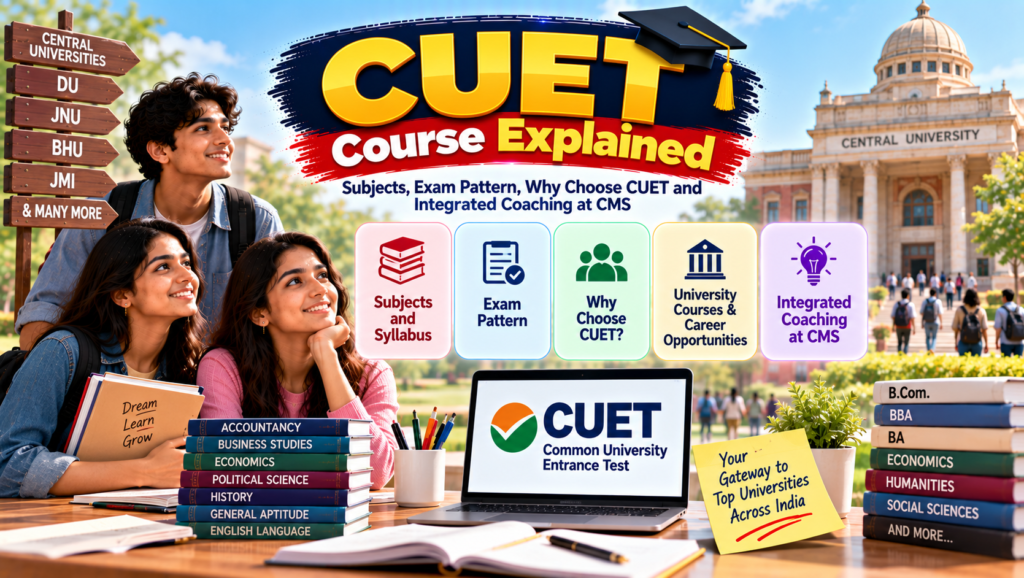
The Common University Entrance Test (CUET) is a national-level entrance examination conducted by the National Testing Agency (NTA) for admission to undergraduate programmes at participating universities across India. It gives students an opportunity to apply for a range of university courses through a common entrance examination. Students interested in commerce, economics, business administration, humanities, social sciences and other undergraduate programmes can explore CUET as part of their plans after Class 12. Understanding the examination structure, available subjects and university admission requirements helps students make informed decisions about their higher education.
Preparing for CUET involves more than studying for a single examination. Students must select the appropriate test subjects according to the eligibility requirements of their preferred universities and programmes, understand the relevant syllabus and practise the question formats. Starting preparation during Intermediate can help students balance board examinations with entrance test preparation and explore suitable undergraduate courses early. At CMS, students can explore integrated CUET coaching with MEC, CEC and ACE, allowing them to plan their Intermediate education alongside preparation for university entrance examinations.

1. What Is CUET and Why Is It Important?
CUET stands for Common University Entrance Test. CUET UG is designed to support admissions to undergraduate programmes at participating central universities and other participating institutions. Instead of each participating university relying exclusively on a separate entrance examination, CUET provides a common testing platform. Universities use CUET scores according to their own admission policies, programme requirements and selection procedures. The examination can therefore be an important part of the admission process for students who want to explore undergraduate opportunities across different institutions.
CUET is important because it can give eligible students access to a broad range of university programmes through a common entrance test. However, appearing for CUET does not automatically guarantee admission to a particular university or course. Students must satisfy the relevant Class 12 eligibility criteria, choose the required test subjects and follow the admission procedures of each institution. Understanding these requirements before applying can help students avoid selecting unsuitable subjects or overlooking important admission conditions.

2. Why Should Students Choose CUET After Class 12?
Students who want to pursue undergraduate education at participating universities can consider CUET as one of their admission pathways. It allows them to explore eligible programmes in areas such as commerce, economics, management, humanities, social sciences and several other disciplines. Depending on the university and course, students may consider degrees such as B.Com., B.Com. (Hons.), BBA, BA, economics-related programmes and other undergraduate qualifications. The courses available and the eligibility conditions vary between institutions, so students should research their options before finalising their test choices.
Another advantage of preparing for CUET is that it encourages students to strengthen subject knowledge, practise objective questions and develop examination discipline. Preparing alongside Intermediate can also help students become more familiar with the subjects required for their intended degree programmes. However, students should not choose CUET subjects simply because they seem popular or easy. They should first identify the courses they want to pursue, check the universities offering those programmes and select the test subjects that match the published admission requirements.

3. CUET Eligibility: Who Can Apply?
Students who have completed Class 12 or are appearing for their Class 12 qualifying examination can generally apply for CUET UG, subject to the applicable examination and admission requirements. The examination is open to students from different recognised educational streams. MEC, CEC and ACE students can all consider CUET if they meet the relevant eligibility conditions. The important point is to identify the undergraduate programmes they wish to pursue and check whether their academic background and selected CUET subjects meet the requirements of the relevant institutions.
CUET eligibility and university admission eligibility are not always identical. A student may be permitted to take the entrance examination but still need to satisfy a particular university’s subject requirements, minimum qualifying marks or other admission conditions. Some programmes may require specific Class 12 subjects, while others may have additional criteria. Students should therefore review the latest NTA information bulletin and the admission requirements published by their preferred universities before registering. Planning early helps them make appropriate subject choices and avoid unnecessary confusion during the application process.
4. CUET Exam Pattern: Duration, Questions, Marks and Mode
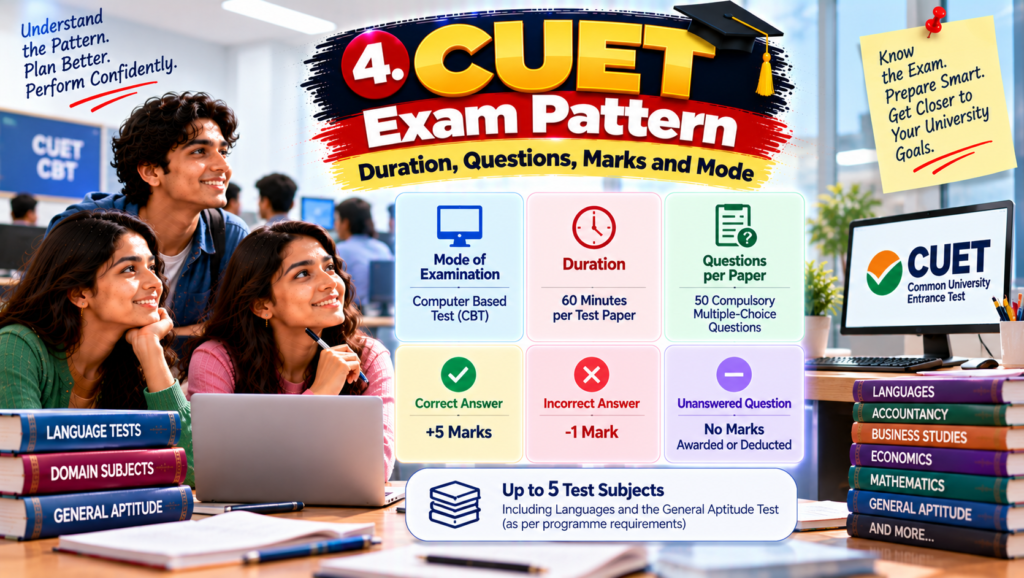
Understanding the CUET examination pattern helps students organise their preparation and become familiar with the way questions are presented. Under the CUET UG 2026 pattern, the examination was conducted in Computer Based Test (CBT) mode. Candidates could choose up to five test subjects, including languages and the General Aptitude Test, depending on the requirements of the programmes and universities they intended to apply to. The examination offered 37 test options, comprising 13 languages, 23 domain-specific subjects and one General Aptitude Test.
The main features of the CUET UG 2026 examination pattern were:
- Mode of examination: Computer Based Test (CBT).
- Maximum subject choices: Up to five test subjects, including languages and the General Aptitude Test.
- Questions per test paper: 50 compulsory multiple-choice questions.
- Duration: 60 minutes per test paper.
- Correct answer: Five marks.
- Incorrect answer: One mark deducted.
- Unanswered question: No marks awarded or deducted.
- Examination schedule: Multiple shifts, depending on the subject combinations and number of candidates.
Candidates may need to take different test papers depending on their chosen degree programmes. Students should not assume that every CUET candidate has to take the same subjects or that all universities use identical subject combinations. Before beginning preparation, they should check the required test papers and the current admission criteria for their preferred courses. Since examination rules can change from year to year, students planning for a future CUET session should verify the latest pattern when the relevant information bulletin is released.
5. CUET Subjects and Syllabus: What Can Students Choose?
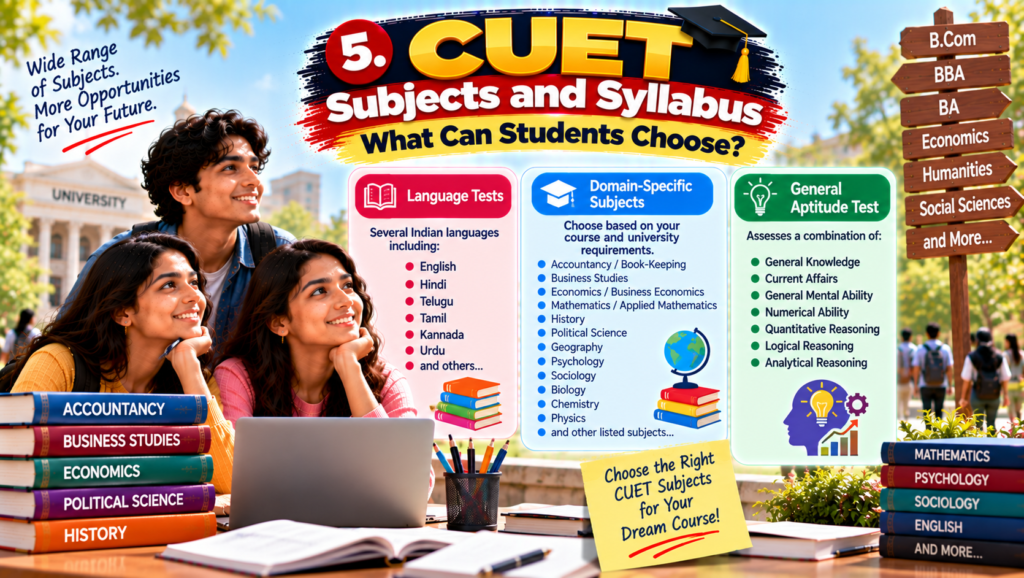
CUET UG offers different test options so that students can demonstrate their proficiency in languages, domain-specific subjects and general aptitude. The syllabus and question format depend on the test selected. There is no single subject combination that suits every candidate because university programmes may require different tests. Students should therefore choose subjects based on their academic background, intended degree and the admission criteria of the institutions they want to apply to.
The major subject categories include the following.
Language Tests
Language tests assess skills such as reading comprehension, vocabulary and the understanding of different types of passages. CUET UG offers several Indian language options, including English, Hindi, Telugu, Tamil, Kannada, Urdu and others. The languages available are specified in the relevant examination information bulletin.
Students should practise reading factual, literary and narrative passages, identifying the central idea, understanding words in context and answering comprehension questions accurately. Regular reading can help improve vocabulary and comprehension speed. Students should also become familiar with the question format of the particular language test they plan to take rather than relying only on general language practice.
Domain-Specific Subjects
Domain-specific tests cover subjects such as Accountancy or Book-Keeping, Business Studies, Economics or Business Economics, Mathematics or Applied Mathematics, History, Political Science, Geography, Psychology, Sociology, Biology, Chemistry, Physics and other listed subjects. The available options allow students to select tests relevant to their preferred undergraduate programmes, subject to the applicable admission criteria.
For students from MEC, CEC and ACE, subjects such as Accountancy, Business Studies and Economics may be particularly relevant when considering commerce, business or economics-related degrees. However, the correct combination depends on the programme and university. Students should review the published syllabus for each selected subject and prepare using the appropriate textbooks, topic-wise exercises, revision notes and practice questions.
General Aptitude Test
The General Aptitude Test assesses a combination of general knowledge, current affairs, general mental ability, numerical ability, quantitative reasoning, logical reasoning and analytical reasoning. It may be relevant to certain undergraduate programmes, depending on the university’s admission requirements. Students should check whether the test is required or accepted for their intended course before choosing it.
Preparation can include following important current affairs, practising basic arithmetic, revising numerical concepts and solving logical and analytical reasoning questions. Students should also practise working within a time limit because the examination requires them to answer questions efficiently. The aim should be to build a sound understanding of the tested skills and improve accuracy through consistent practice.
How Should Students Select Their CUET Subjects?
Subject selection should begin with the undergraduate course a student wants to pursue. Students can shortlist universities, identify the relevant degree programmes and check which CUET tests each programme requires or accepts. They should then compare those requirements with the subjects they have studied in Intermediate and the eligibility rules specified by the universities.
This process is particularly important for students applying to several universities because the required test combinations may differ. Keeping a simple list of preferred courses, universities, required tests and eligibility conditions can help students organise their applications. At CMS, students preparing for CUET alongside MEC, CEC or ACE can use early planning to connect their Intermediate studies with their intended university admission pathway.
6. How to Prepare for CUET Alongside Intermediate Studies
Preparing for CUET while studying Intermediate requires a balanced timetable that accounts for board examinations and entrance test practice. Students should first identify their target degree programmes and the corresponding CUET subjects. Once they understand the required syllabus, they can divide their preparation into manageable study sessions. This approach helps them focus on relevant subjects instead of spending time on tests that may not be required for their intended courses.
A practical preparation plan should include subject revision, objective-question practice, timed tests and regular review of mistakes. Students can allocate time each week to the selected domain subjects, language preparation and the General Aptitude Test if required. Mock examinations can help them become familiar with the computer-based format, improve time management and identify topics that need additional attention. Reviewing errors after each test is equally important because it helps students understand why an answer was incorrect and how to avoid repeating the same mistake.
7. When Should Students Start CUET Coaching? Why Intermediate Is the Right Time
Starting CUET preparation during Intermediate gives students more time to understand their university options and build familiarity with the relevant subjects. Students can begin by identifying possible degree programmes, reviewing their admission criteria and strengthening the subjects they may need for the entrance examination. Early planning can also help them recognise the difference between studying a topic for board examinations and answering objective questions under timed conditions.
Starting early does not mean students should compromise on their Intermediate studies. Instead, they can create a balanced routine that gives priority to classroom learning while gradually introducing CUET-specific practice. For example, students can revise their domain subjects, practise reading comprehension and work through objective questions alongside their regular studies. As the examination approaches, they can increase their use of mock tests and timed revision. Integrated CUET coaching can support this process by helping students organise their Intermediate and entrance preparation within a planned academic schedule.
8. MEC, CEC and ACE with Integrated CUET Coaching at CMS
MEC, CEC and ACE students can all explore CUET as a route to eligible undergraduate programmes, subject to the admission requirements of their chosen universities. MEC includes Mathematics, Economics and Commerce, while CEC includes Civics, Economics and Commerce. ACE is also offered as an Intermediate stream at CMS. These streams provide different subject combinations, so students should consider their interests, strengths and future course preferences when deciding which stream to pursue.
CMS Best CUET Coaching in Hyderabad offers integrated CUET coaching with MEC, CEC and ACE, helping students plan their Intermediate education alongside university entrance preparation. An integrated approach can help students coordinate their board syllabus with relevant CUET subject practice and work towards both academic goals in a planned manner. Students can begin by identifying suitable undergraduate courses, understanding the required CUET tests and creating a preparation schedule that fits their academic responsibilities. This gives them a clearer pathway from Intermediate studies towards the next stage of higher education.
9. What Should Students Look for in a CUET Coaching Course?
Choosing a CUET coaching course involves more than checking the number of classes or practice questions provided. Students should consider whether the programme covers the relevant test subjects, explains concepts clearly and offers sufficient opportunities for question practice. A structured timetable, suitable study materials, faculty guidance and support for resolving doubts can help students understand the syllabus and prepare systematically. It is also important to consider how the course fits alongside Intermediate classes and board examination preparation.
Mock tests, regular assessments and performance feedback can help students identify their strengths and weaknesses. They can use these results to revise difficult topics, improve accuracy and adjust their study schedule. At CMS, students considering integrated CUET coaching with MEC, CEC or ACE can explore how the course connects their Intermediate education with entrance preparation. A well-planned learning approach should help students work consistently towards their university goals without losing focus on their school examinations.
10. Courses and Career Opportunities After CUET
CUET can be used for admission to a range of undergraduate programmes at participating universities. Depending on the institution, available courses may include B.Com., B.Com. (Hons.), BBA, BA, economics-related degrees and programmes in humanities, social sciences and other disciplines. The exact options depend on the university, the academic year, the candidate’s eligibility and the CUET subject combination required for each programme.
The degree a student chooses can influence their future career options. Commerce graduates may explore accounting, finance, banking, business operations and further professional qualifications. Students pursuing economics may consider research, policy-related work, financial analysis or postgraduate study, depending on their qualifications and interests. Business administration can provide a foundation for careers in management, marketing, operations and entrepreneurship. Students interested in humanities and social sciences may explore teaching, research, public administration, communication or related fields after meeting the relevant requirements. CUET is an admission pathway rather than a qualification that directly guarantees a particular career, so students should select an undergraduate programme that matches their interests and long-term plans.
11. Starting Your CUET Preparation Journey with CMS
CUET provides students with an opportunity to apply for eligible undergraduate programmes at participating universities through a common entrance examination. Effective preparation begins with understanding the examination pattern, selecting the appropriate test subjects and reviewing the admission requirements of preferred universities. Students who plan early can balance board examinations with subject revision, objective-question practice and mock tests. Understanding the available undergraduate courses also helps them make more informed decisions about their academic future.
CMS offers integrated CUET coaching with MEC, CEC and ACE, allowing students to plan their Intermediate education alongside preparation for university entrance examinations. Through a structured study plan, relevant subject practice, mock tests and performance feedback, students can work towards improving their preparation while managing their academic responsibilities. Students and parents exploring Intermediate options can consider the integrated programmes at CMS and select an approach that aligns with their chosen subjects, university goals and future ambitions.