
Introduction
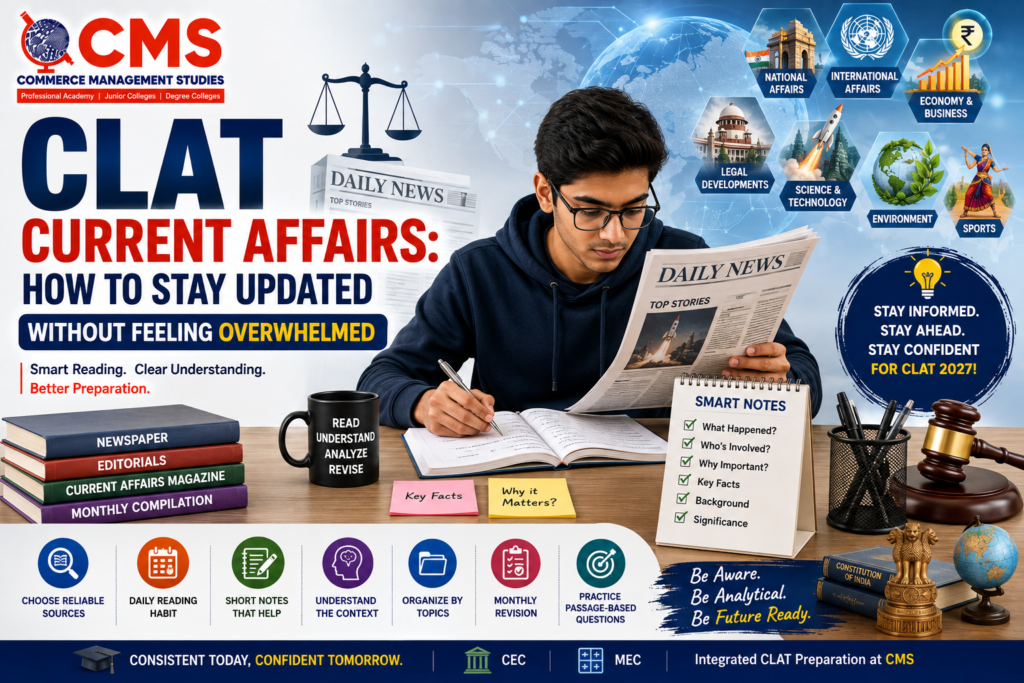
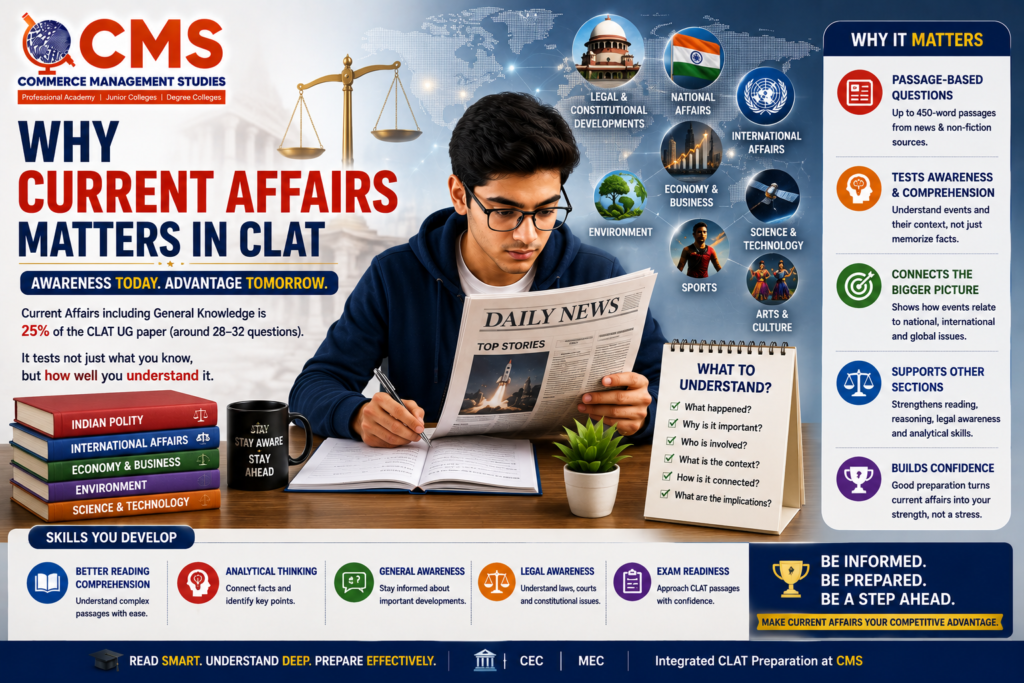
Current affairs is an important part of CLAT preparation because the examination expects students to have an awareness of significant developments in India and around the world. For CLAT 2027, the Current Affairs including General Knowledge section is one of the five sections of the UG examination and is expected to account for approximately 28–32 questions, or around 25% of the paper. The official syllabus indicates that questions can cover contemporary events of significance, arts and culture, international affairs, and historical events of continuing significance.
For many students, however, current affairs can initially feel overwhelming. News is published every day, and there can be a temptation to read everything, make lengthy notes, and memorize large amounts of information. A better approach is to develop a focused reading habit and learn how to identify information that is relevant to CLAT. The goal is not to know every event that happens but to understand significant developments and their broader context.
Why Current Affairs Matters in CLAT
The Current Affairs including General Knowledge section is designed differently from a traditional general-knowledge quiz. According to the official CLAT 2027 syllabus, students will encounter passages of up to around 450 words based on news, journalistic sources, and other non-fiction writing. Questions can test awareness of current events as well as the ability to understand information presented in the passage.
This means students should develop two abilities together: awareness and comprehension. Simply memorizing lists of names, dates, and headlines may not be enough. Students should understand what happened, why it matters, who or what was involved, and how the event connects to a larger national or international issue.

Don’t Try to Read Every News Story
One of the biggest mistakes students make is believing that successful current-affairs preparation requires reading every newspaper page or following every breaking-news update. This can quickly become tiring and can take time away from other sections of CLAT preparation.
Instead, students can focus on significant developments that have broader relevance. National policies, important legal and constitutional developments, major international events, economic developments, science and technology, environmental issues, important awards, sports events of major significance, and arts and culture can all be relevant areas to follow. The official syllabus specifically mentions contemporary events, arts and culture, international affairs, and historical events of continuing significance.
Choose a Limited Number of Reliable Sources
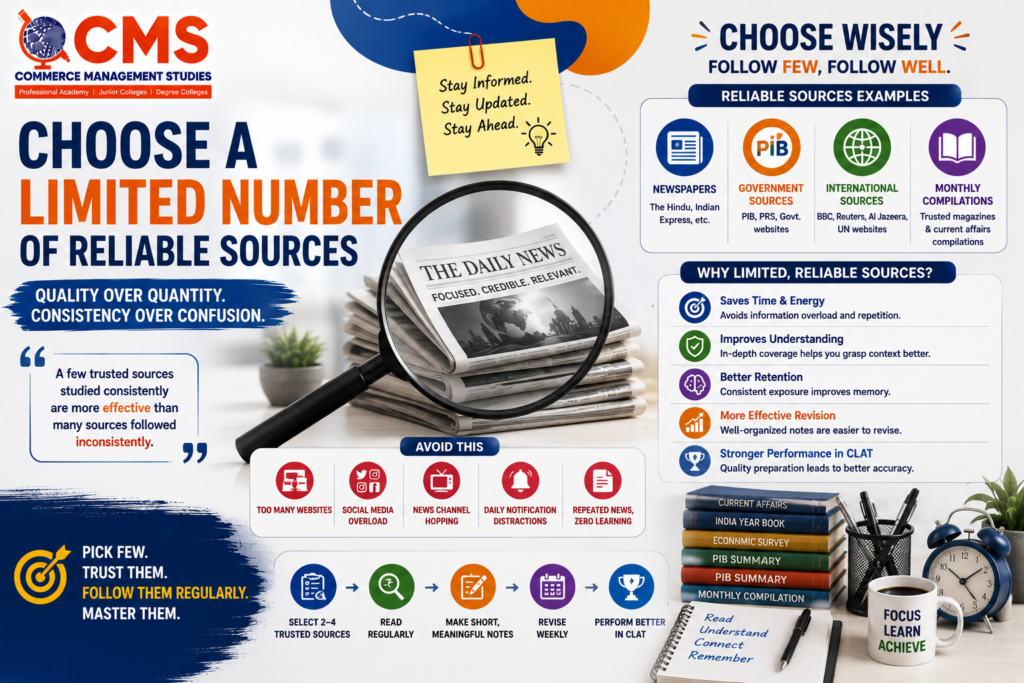
Having too many sources can actually make preparation more difficult. Students may find themselves reading the same story several times from different platforms without gaining much additional understanding.
A better approach is to select a small number of reliable sources and follow them consistently. Students can use a quality newspaper or news source for regular reading and supplement it with a monthly current-affairs compilation or revision resource if required.
The objective should be depth and consistency rather than quantity. Reading one reliable source regularly is generally more manageable than trying to follow numerous websites, social-media accounts, channels, and daily updates simultaneously.
Create a Daily Current-Affairs Routine
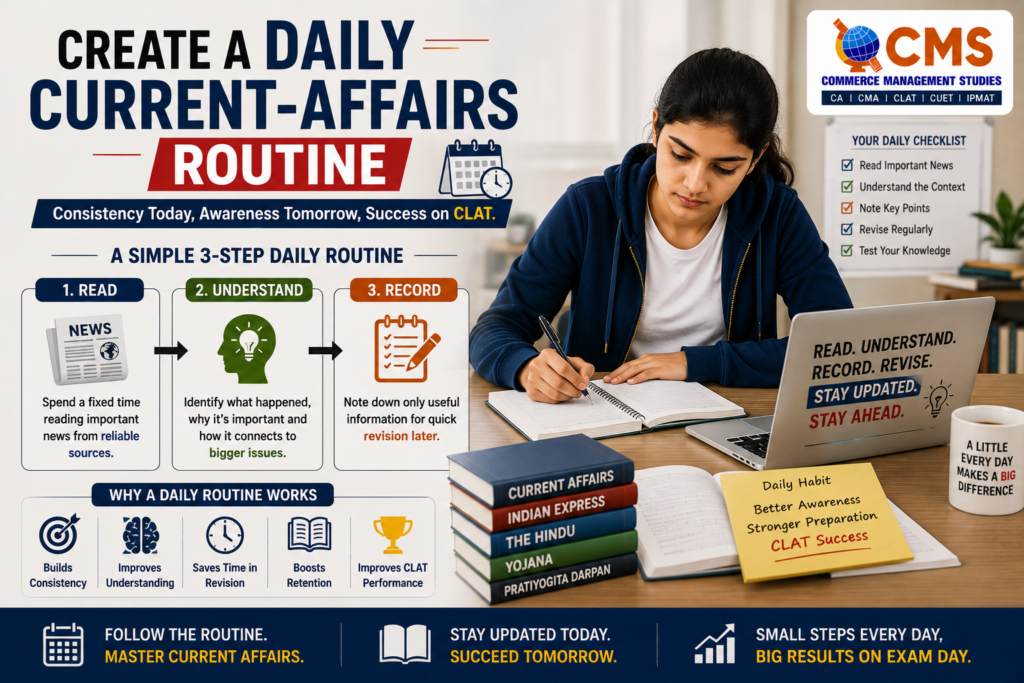
Current-affairs preparation becomes easier when it is treated as a regular habit rather than a separate task that students postpone until examinations are approaching. A short, focused daily session can be sufficient to build awareness over time.
Students can divide their routine into three simple stages:
- Read: Spend a fixed amount of time reading important news.
- Understand: Identify what happened and why it is significant.
- Record: Note only the information that is useful for later revision.
The exact duration can vary according to the student’s schedule. What matters most is consistency. A manageable routine followed throughout the preparation period is more useful than studying large amounts of current affairs occasionally.
Focus on Understanding the Story
When reading a news report, students should go beyond the headline. They can ask a few simple questions to understand the story properly:
What happened?
Where did it happen?
Who or what is involved?
Why is it important?
What is the larger issue connected to it?
Are there any important terms, institutions, agreements, laws, or organizations associated with it?
These questions encourage students to read actively. They also make it easier to remember information because the student understands the context rather than trying to memorize isolated facts.
Organize Current Affairs by Topic
Instead of maintaining one extremely long list of daily events, students can organize information according to broad categories. This makes revision easier and helps them recognize connections between different events.
Useful categories can include:
- National affairs
- International affairs
- Legal and constitutional developments
- Economy and business
- Science and technology
- Environment
- Government policies and initiatives
- Awards and important appointments
- Arts and culture
- Sports
- Important historical developments
This structure can make monthly revision significantly more manageable.
Pay Attention to Legal and Constitutional Developments
Students preparing for CLAT should pay particular attention to significant developments involving courts, laws, constitutional issues, government institutions, and public policy. The official syllabus notes that questions in the Current Affairs section may include legal information or knowledge discussed in or related to the passage.
Students do not need to become law experts while preparing for this section. The focus should be on understanding the issue presented in the news and recognizing important institutions, events, and concepts associated with it. This can also complement preparation for the Legal Reasoning section, where general awareness of contemporary legal and moral issues can be beneficial.
Understand the Context Behind International News
International affairs can sometimes appear difficult because students may encounter unfamiliar countries, organizations, agreements, conflicts, or diplomatic developments. Instead of trying to memorize every detail, students can first understand the basic context.
For example, when reading about an international organization or agreement, students can identify what the organization does, which countries are involved, and why the development matters. Building this background knowledge makes future news stories easier to understand because students begin recognizing recurring institutions and issues.
Don’t Ignore Economics and Business News
Economic developments can also form an important part of general awareness. Students can gradually become familiar with concepts such as inflation, interest rates, monetary policy, economic growth, taxation, trade, employment, and major government economic decisions.
The objective is not to become an economics specialist. Students should simply understand the basic meaning and significance of important economic developments. This can be particularly useful for commerce students because it connects naturally with concepts they may encounter in their Intermediate studies.
Make Short and Useful Notes
Current-affairs notes should help with revision rather than become another textbook that students have to read from beginning to end. Long notes containing every detail from an article can make revision unnecessarily difficult.
A simple note could contain:
- Event: What happened?
- Date/Period: When did it happen?
- People/Organizations: Who was involved?
- Key Facts: What are the important details?
- Significance: Why does it matter?
- Related Background: What should you know to understand the issue?
Students should write information in their own words wherever possible. This encourages understanding and can make the information easier to recall later.
Use Monthly Revision
Daily reading creates awareness, but revision helps convert that awareness into long-term memory. At the end of each month, students can review the important events they have collected and remove information that is no longer useful.
Monthly revision can include:
- Reviewing important events
- Revisiting difficult topics
- Solving current-affairs questions
- Connecting related events
- Updating notes
- Testing memory without looking at the answers
This process prevents several months of current affairs from accumulating into an enormous revision burden.
Practice With Passage-Based Questions
Because the CLAT Current Affairs section is passage-based, students should not restrict their preparation to one-line factual questions. The official CLAT 2027 syllabus states that passages in this section can be drawn from news, journalistic sources, and other non-fiction writing.
Students should therefore practice reading a news-based passage and identifying its main idea, important facts, context, and implications. This can help them become comfortable with the type of reading required during the examination.
Connect Current Affairs With Other CLAT Sections
Current affairs preparation does not have to remain isolated from the rest of CLAT preparation. Reading news regularly can simultaneously strengthen reading comprehension, vocabulary, analytical thinking, and awareness of legal and social issues.
For example, reading an article about a constitutional issue can introduce students to legal concepts while also requiring them to understand a lengthy passage. Similarly, following an international issue can improve general awareness while developing the ability to identify arguments and important information.
This makes current-affairs reading a broader skill-building activity rather than simply a memorization exercise.
Avoid Information Overload From Social Media
Social media can expose students to a large number of news updates, but it can also make preparation confusing. Different platforms may present information in highly condensed formats, and students may encounter unverified claims or incomplete context.
Students should use social media carefully and verify important information through reliable sources. A structured preparation routine based on dependable news sources can provide greater clarity than continuously scrolling through updates.
Don’t Panic About Missing a Few Stories
Current affairs preparation can sometimes create unnecessary anxiety. Students may feel that missing one day’s news means they have permanently lost an important piece of preparation.
This mindset is not helpful. The purpose of a long-term current-affairs strategy is to build broad and meaningful awareness over time. If a student misses a day or two, they can simply return to their regular routine and use a reliable weekly or monthly compilation to catch up on significant developments.
Consistency over several months is much more important than trying to achieve perfect coverage every single day.
Use Mock Tests to Identify Gaps
Mock tests can show students whether their current-affairs preparation is translating into actual performance. A student may feel familiar with a topic but discover during a test that they cannot recall the relevant information or understand it in a passage-based context.
After a mock test, students can categorize their mistakes. They may have forgotten a fact, misunderstood the context, missed information in the passage, or simply rushed through the question. Understanding the reason for the mistake can help them adjust their preparation.
A Practical Weekly Current-Affairs Plan
Students who feel overwhelmed can simplify their preparation by following a basic weekly structure.
Monday to Friday: Read important news and make short notes.
Saturday: Revise the week’s major events and organize notes by topic.
Sunday: Solve current-affairs questions or take a short quiz and review mistakes.
This structure can be adjusted according to school, Intermediate, and other preparation commitments. The important idea is to combine reading, understanding, revision, and testing rather than relying on reading alone.
Current Affairs Preparation for Students From CEC
CEC students already study Economics, Commerce, and Civics, which can provide useful background for understanding many current events. Topics involving government, public institutions, economic developments, business, and society can often be connected to concepts students encounter during their academic studies.
For students preparing for CLAT, this connection can make current-affairs learning more meaningful. Instead of viewing every news story as a completely new topic, students can relate it to concepts they have already studied and gradually build a broader understanding of current events.
Current Affairs Preparation for Students From MEC
MEC students can also prepare effectively for CLAT by combining their academic strengths with focused current-affairs practice. Mathematics can develop quantitative and analytical skills, while Economics and Commerce provide useful exposure to economic and business concepts.
For CLAT aspirants from MEC, current-affairs preparation can be supplemented with dedicated reading, legal awareness, reasoning practice, and passage-based exercises. The key is to develop the specific skills required by the examination while continuing to make the most of their Intermediate subjects.
How CMS Can Support CLAT Preparation
Students preparing for CLAT alongside Intermediate need to manage academic studies and entrance preparation in a structured manner. At CMS CLAT Coaching in Hyderabad, students can pursue CEC or MEC with integrated CLAT preparation, allowing them to work on their Intermediate subjects while developing skills relevant to the law entrance examination.
An integrated approach can give students the opportunity to build reading habits, practice reasoning, stay updated with current affairs, and work on examination-specific skills alongside their regular academic studies. The objective should be to develop these abilities gradually rather than trying to cover everything at the last moment.
Conclusion
Current affairs preparation for CLAT does not have to mean reading every piece of news or memorizing hundreds of facts. A focused approach based on reliable sources, regular reading, meaningful note-making, monthly revision, and passage-based practice can make the process much more manageable.
The most important principle is to understand rather than simply memorize. Students should learn to identify significant developments, understand their context, connect related issues, and practice applying that knowledge to questions. With a consistent routine and a balanced approach, current affairs can become an interesting part of CLAT preparation rather than an overwhelming one.