
Introduction
Choosing the right professional course after Class 10 or Intermediate is an important decision that can shape a student’s entire career. Among the most sought-after commerce professions in India are Chartered Accountancy (CA) and Cost and Management Accountancy (CMA). Both qualifications offer excellent career opportunities, professional recognition, and long-term growth. However, many students and parents find it difficult to understand the differences between these two professions because both involve accounting, finance, taxation, and business management. While they share certain similarities, their areas of expertise, work responsibilities, and career paths are quite different.
Understanding these differences before choosing a professional course helps students make informed career decisions based on their interests and strengths. Some students enjoy auditing and taxation, while others are interested in cost control, budgeting, business strategy, and financial planning. Knowing what each profession involves, the subjects covered, career opportunities available, and the skills required can make the decision much easier. This guide provides a detailed comparison between Chartered Accountancy and Cost and Management Accountancy to help aspiring commerce students select the career path that best aligns with their future goals.
What is Chartered Accountancy (CA)?
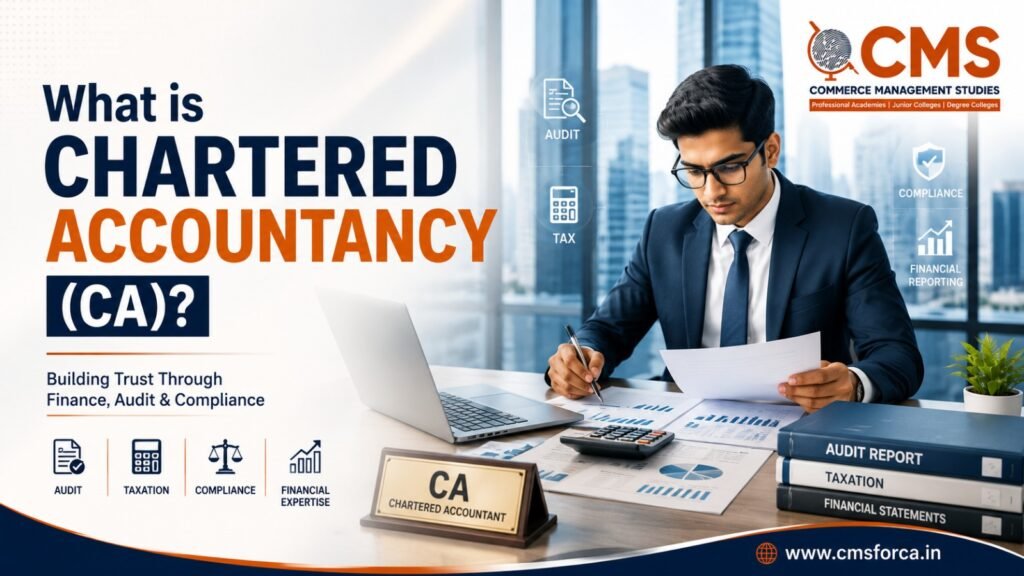
Chartered Accountancy is one of India’s most respected professional qualifications in the field of finance and accounting. A Chartered Accountant is responsible for maintaining financial records, conducting audits, managing taxation, ensuring legal compliance, preparing financial statements, and providing financial advice to businesses and individuals. The qualification is awarded by the Institute of Chartered Accountants of India (ICAI), and professionals are highly valued across industries for their expertise in financial reporting, auditing, corporate laws, and taxation.
The CA profession requires strong analytical abilities, attention to detail, and a deep understanding of accounting standards and financial regulations. Chartered Accountants often work with corporations, banks, government organizations, consulting firms, multinational companies, and even establish independent practice. Since businesses require financial transparency and regulatory compliance, the demand for qualified Chartered Accountants continues to remain strong across various sectors of the economy.
What is Cost and Management Accountancy (CMA)?
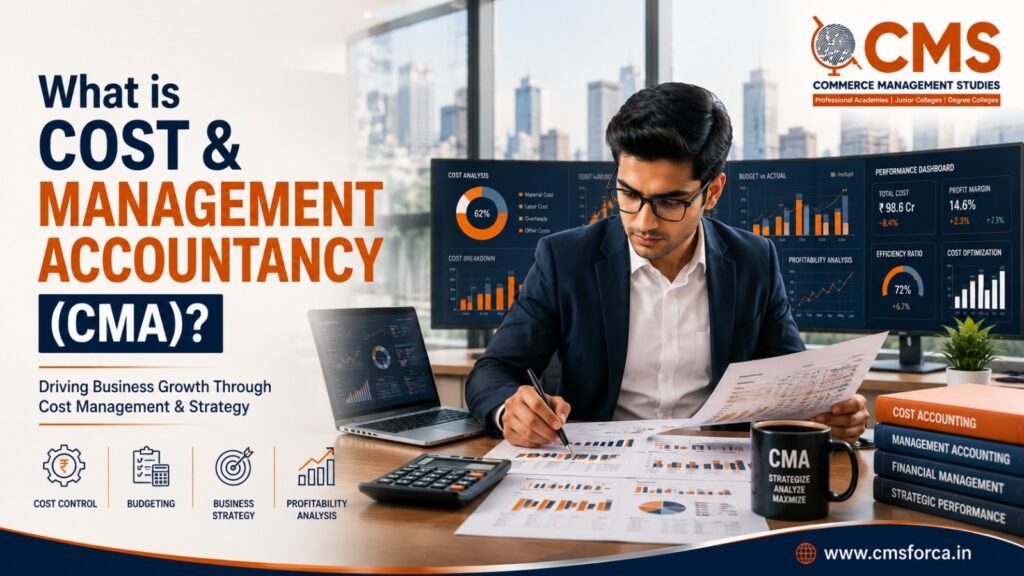
Cost and Management Accountancy focuses primarily on cost management, budgeting, financial planning, business strategy, and improving organizational efficiency. A Cost and Management Accountant helps businesses control production costs, maximize profitability, prepare budgets, evaluate investments, and support strategic decision-making. The qualification is awarded by the Institute of Cost Accountants of India (ICMAI) and is recognized across manufacturing, service, healthcare, infrastructure, and corporate sectors.
Unlike Chartered Accountants, who primarily focus on auditing, taxation, and statutory compliance, CMAs specialize in helping organizations make better financial decisions through cost analysis and performance evaluation. They play an important role in improving operational efficiency by analyzing expenses, reducing wastage, planning budgets, and supporting management in achieving long-term financial objectives. As businesses increasingly emphasize cost optimization and profitability, the role of Cost and Management Accountants has become more significant than ever before.
Understanding the Primary Difference Between CA and CMA
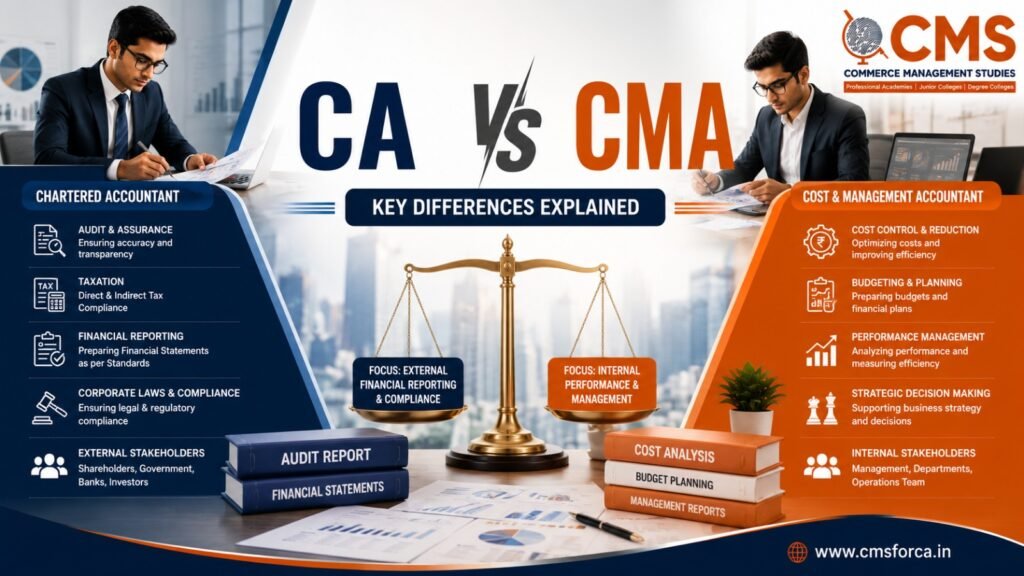
Although both CA and CMA belong to the commerce and finance domain, their primary focus areas differ considerably. Chartered Accountants mainly deal with financial accounting, auditing, taxation, statutory compliance, financial reporting, and corporate laws. Their work ensures that organizations maintain accurate financial records while complying with various legal and regulatory requirements. They also advise businesses on taxation, accounting standards, and financial reporting practices.
Cost and Management Accountants, on the other hand, focus on internal business performance. Their responsibilities include cost control, pricing strategies, budgeting, financial planning, profitability analysis, inventory management, and management decision-making. Instead of concentrating only on external financial reporting, CMAs help organizations improve efficiency, reduce operational costs, and increase profitability through effective financial planning and strategic analysis.
Eligibility and Course Structure
Students aspiring to become either a Chartered Accountant or a Cost and Management Accountant can begin their journey after completing Class 12. Both professional courses consist of multiple examination levels along with practical training that gradually develops technical knowledge and professional competence. Since both qualifications require dedication and consistent preparation, students benefit from understanding the complete course structure before beginning their professional journey.
The broad progression for both courses includes:
- Foundation Level
- Intermediate Level
- Practical Training
- Final Level
- Professional Membership
Although the structure appears similar, the syllabus, examination pattern, practical exposure, and specialization areas differ according to the objectives of each profession. Choosing the right course depends more on personal interests than on perceived difficulty.
Subjects Covered in CA and CMA
Both CA and CMA include accounting, economics, taxation, corporate laws, and financial management as part of their curriculum. However, the depth and focus of these subjects differ significantly. Chartered Accountancy places greater emphasis on auditing, financial reporting, direct taxation, indirect taxation, accounting standards, and corporate regulations. Students develop expertise in maintaining financial transparency and ensuring compliance with legal frameworks.
The CMA curriculum emphasizes areas that directly influence business performance and strategic decision-making. Students study cost accounting, management accounting, budgeting, performance management, financial planning, operational strategy, business valuation, and cost control techniques. This specialized knowledge enables CMAs to help organizations improve efficiency while supporting informed managerial decisions that contribute to long-term profitability.

Career Opportunities for Chartered Accountants
A Chartered Accountant enjoys diverse career opportunities across almost every industry because organizations require experts who can manage financial reporting, taxation, auditing, and regulatory compliance. Whether working in private companies, multinational corporations, financial institutions, or government departments, Chartered Accountants play a critical role in maintaining financial integrity and supporting business growth. Many professionals also choose independent practice, offering accounting and taxation services to businesses and individuals.
Some popular career opportunities for Chartered Accountants include:
- Statutory Auditor
- Internal Auditor
- Tax Consultant
- Financial Analyst
- Corporate Finance Manager
- Investment Banking Professional
- Risk Consultant
- Compliance Officer
- Chief Financial Officer (CFO)
- Independent Chartered Accountant
The flexibility of the profession allows CAs to work across industries such as banking, healthcare, manufacturing, information technology, infrastructure, consulting, and financial services.
Career Opportunities for Cost and Management Accountants
Cost and Management Accountants are highly valued by organizations that focus on improving efficiency, reducing operational expenses, and maximizing profitability. Their expertise supports management in making strategic financial decisions based on cost analysis and performance evaluation. As companies increasingly rely on data-driven decision-making, the demand for skilled CMAs continues to grow across multiple industries.
Some of the major career opportunities available for CMAs include:
- Cost Accountant
- Management Accountant
- Budget Analyst
- Financial Controller
- Cost Auditor
- Business Analyst
- Corporate Planner
- Inventory Controller
- Finance Manager
- Management Consultant
CMAs frequently find opportunities in manufacturing companies, service organizations, public sector enterprises, logistics firms, healthcare institutions, infrastructure projects, and multinational corporations where cost optimization plays a significant role.
Salary and Career Growth
Both Chartered Accountants and Cost and Management Accountants enjoy attractive salary prospects, although compensation depends on several factors such as skills, experience, employer, industry, and job location. Fresh graduates entering reputed organizations often receive competitive salary packages, while experienced professionals who develop specialized expertise can earn significantly higher compensation over time. Professional qualifications also provide opportunities for career advancement into senior leadership positions.
Rather than comparing salaries alone, students should focus on choosing a profession that matches their interests and career aspirations. A motivated professional who continuously updates their knowledge, develops practical skills, and gains relevant experience can achieve substantial career growth in either field. Long-term success depends far more on dedication and continuous learning than on the choice between CA and CMA alone.
Which Course Should You Choose?
Choosing between Chartered Accountancy and Cost and Management Accountancy depends largely on your interests, aptitude, and long-term career goals. Students who enjoy taxation, auditing, financial reporting, accounting standards, and legal compliance may find Chartered Accountancy more suitable. Those who are interested in business strategy, cost optimization, budgeting, financial planning, and organizational decision-making may find Cost and Management Accountancy more aligned with their strengths.
Many students begin exploring professional coaching options during their Intermediate education, and while researching structured preparation they often look for the Best CMA Coaching in Hyderabad to receive expert guidance, regular assessments, and integrated academic support. Regardless of the profession chosen, early preparation, disciplined study habits, and conceptual clarity remain the key ingredients for long-term success.
Common Myths About CA and CMA
Several misconceptions surround both professional courses, often confusing students who are trying to decide between them. Some believe one qualification is superior to the other, while others assume that only academically exceptional students can succeed. In reality, both professions are highly respected and offer rewarding career opportunities for students who are willing to work consistently toward their goals.
Some common myths include:
- CA and CMA are exactly the same profession.
- Only students with exceptional mathematical ability can pursue these courses.
- CMA professionals have fewer career opportunities.
- Chartered Accountants only prepare income tax returns.
- Only top-ranking students can qualify as CA or CMA.
- One qualification completely replaces the other.
Understanding the actual scope and responsibilities of each profession helps students make career decisions based on facts rather than misconceptions.

Conclusion
Chartered Accountancy and Cost and Management Accountancy are two prestigious professional qualifications that contribute significantly to the financial success of organizations. While Chartered Accountants specialize in auditing, taxation, financial reporting, and regulatory compliance, Cost and Management Accountants focus on cost optimization, budgeting, strategic planning, and improving business performance. Both professions require dedication, continuous learning, and strong analytical abilities, but they offer distinct career paths suited to different interests and professional aspirations.
Students should avoid choosing a profession solely based on popularity or perceived salary potential. Instead, they should evaluate their strengths, interests, and long-term career objectives before making a decision. Whether you choose to become a Chartered Accountant or a Cost and Management Accountant, early planning, quality education, and consistent preparation will help you build a successful and rewarding career in the world of finance, accounting, and business management.