
Introduction
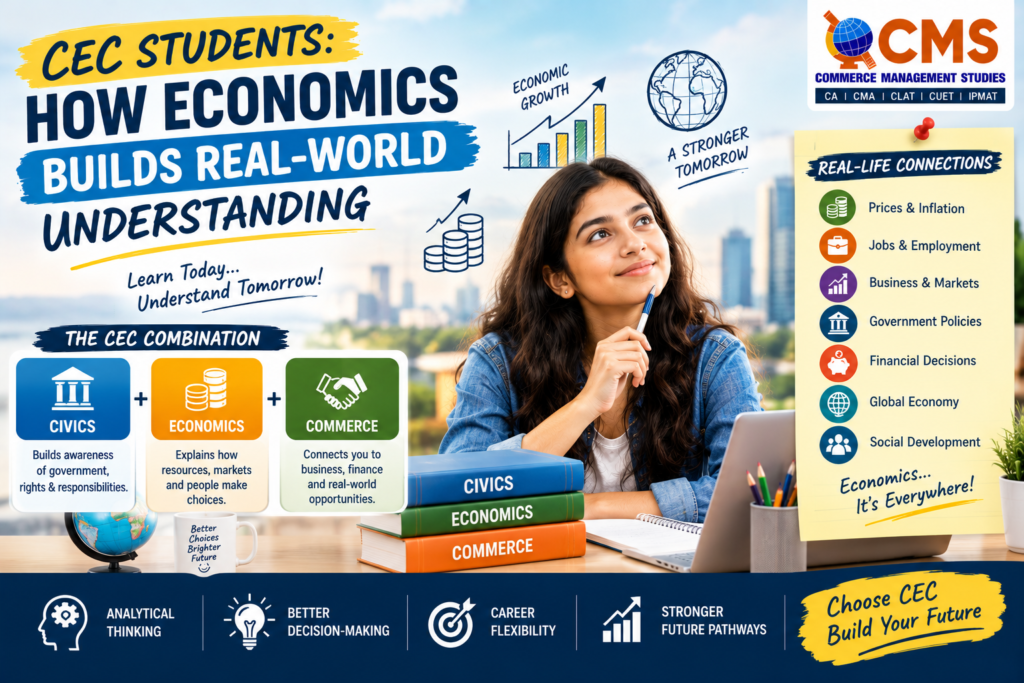
Economics is one of the subjects that connects classroom learning with the way people, businesses, governments, and societies function in the real world. For CEC students, studying Economics alongside Civics and Commerce provides an opportunity to understand how economic decisions influence everyday life. Topics such as demand, supply, inflation, employment, taxation, markets, and government policies are not limited to textbooks; they can be observed in the world around us.
The value of Economics goes beyond examination preparation. It encourages students to understand why prices change, how businesses make decisions, why governments introduce particular policies, and how economic conditions can affect individuals and communities. By developing this understanding during Intermediate, CEC students can build analytical thinking and awareness that can support their higher education and future professional journeys.
Understanding What Economics Really Studies
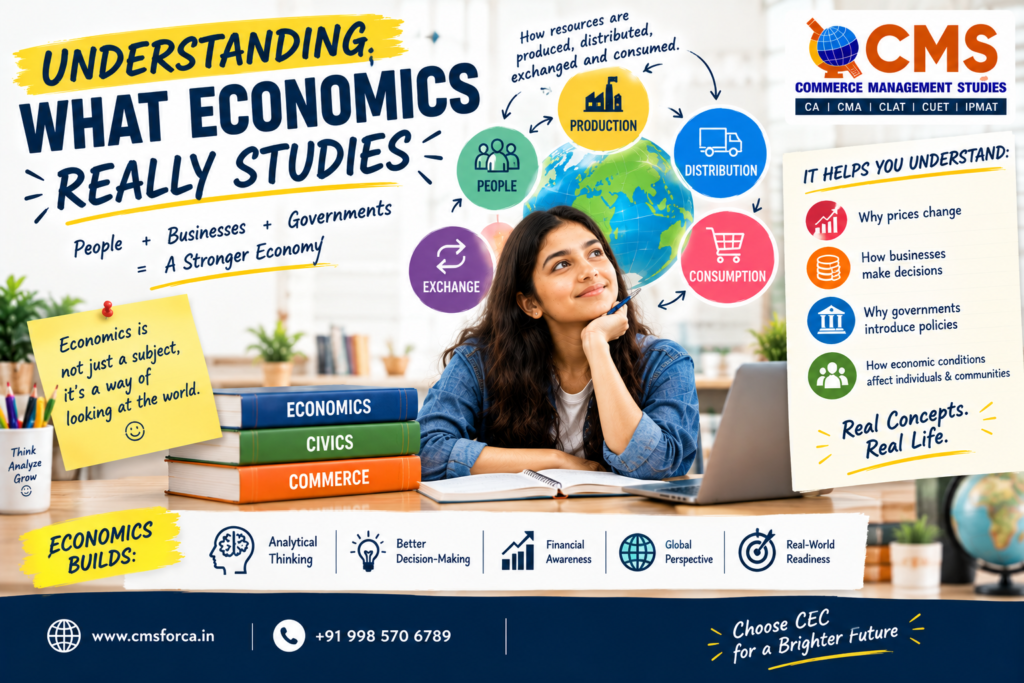
Economics is fundamentally concerned with how individuals, businesses, and governments make choices when resources are limited and needs are numerous. It examines how resources are produced, distributed, exchanged, and consumed.
This makes Economics closely connected to everyday decisions. Choosing how to spend money, understanding why a product becomes expensive, observing changes in employment, or considering the impact of a government policy can all involve economic thinking. Students who understand these principles can begin looking at ordinary events from a more analytical perspective.
1. Understanding Prices and Inflation
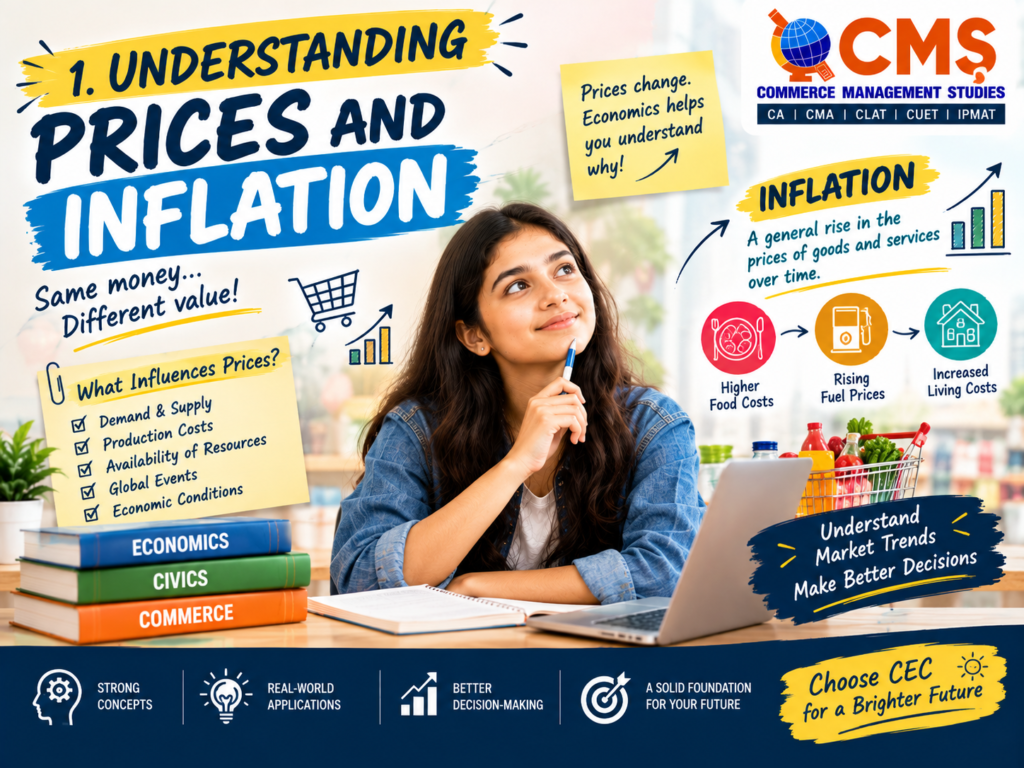
One of the most visible economic concepts in everyday life is the movement of prices. Students may notice that the cost of food, transportation, education, technology, or other goods and services can change over time.
Economics helps students understand that prices can be influenced by several factors, including demand, supply, production costs, availability of resources, and broader economic conditions. Inflation provides another important example because it describes a general increase in the prices of goods and services over time. Understanding these concepts can help students interpret economic news and everyday financial decisions more effectively.
2. Understanding Demand and Supply
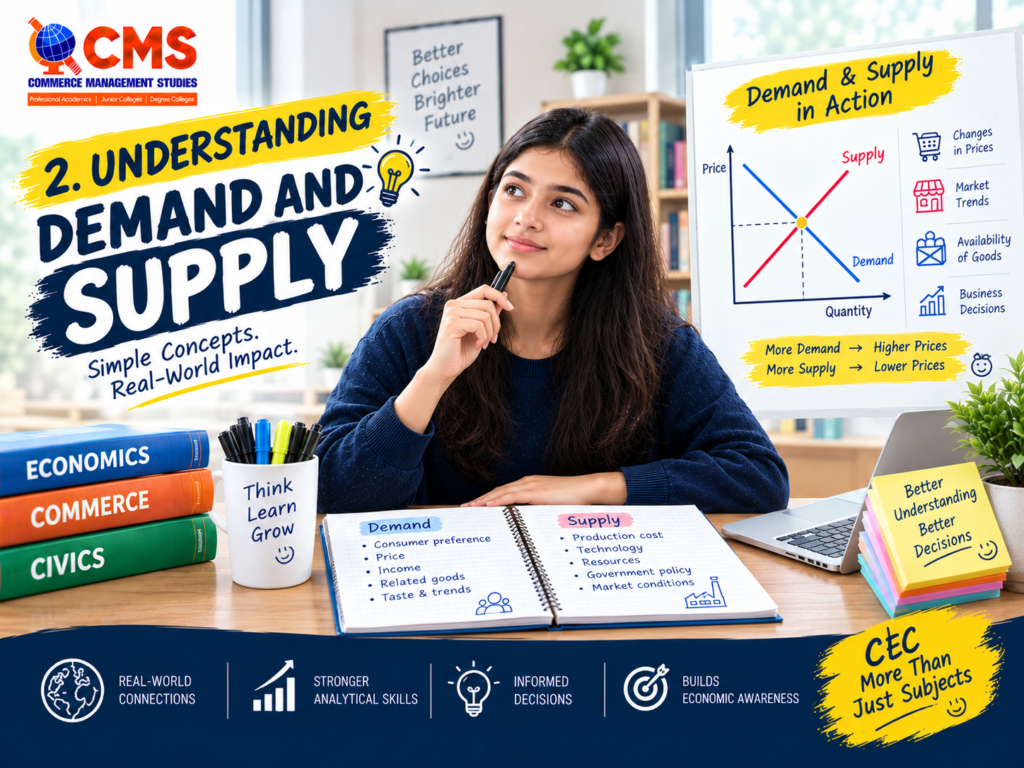
Demand and supply are fundamental economic concepts that can be observed in many markets. When consumers want more of a product while its availability remains limited, businesses may respond by adjusting prices or increasing production.
Similarly, when supply increases significantly while demand remains unchanged, businesses may need to adjust their pricing or production strategies. Students can observe these principles in areas ranging from agricultural products to electronics, transportation, and seasonal goods.
Learning demand and supply therefore gives students a framework for understanding why markets behave differently under changing conditions.
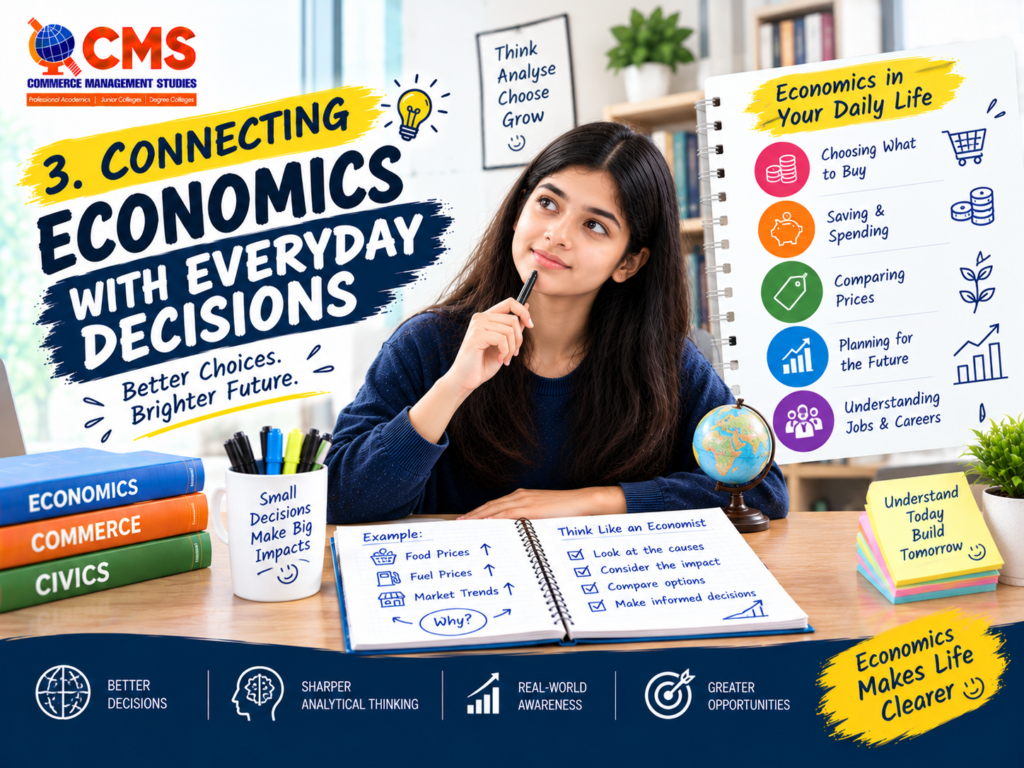
3. Connecting Economics With Everyday Decisions
People make economic decisions every day, often without consciously identifying them as economic choices. Deciding whether to save or spend money, comparing prices before making a purchase, choosing between different services, or planning educational expenses involves the allocation of limited resources.
Economics provides students with a structured way of thinking about these decisions. It encourages them to consider alternatives, opportunity costs, benefits, and possible consequences rather than making choices without evaluating the available options.
4. Understanding How Businesses Make Decisions
Businesses operate in environments where they must consider costs, customers, competition, resources, and market conditions. Economics helps students understand the factors that influence these decisions.
For example, a business may need to decide whether to increase production, introduce a new product, change its pricing, enter a new market, or invest in technology. Each decision can involve costs and potential benefits. Understanding economic principles can help students recognize why businesses make different choices under different market conditions.
5. Understanding Government Policies
Governments make decisions that can influence economic activity. Policies related to taxation, public spending, employment, trade, infrastructure, and various economic programmes can have effects on individuals and businesses.
Economics helps students understand the reasoning behind such decisions and consider their possible effects. Instead of simply reading that a particular policy has been introduced, students can begin asking what problem the policy addresses, what resources are involved, and how different groups may be affected.
This develops a more informed approach to understanding public affairs.
6. Building Financial Awareness
Although Economics is not the same as personal finance, it can provide students with concepts that contribute to better financial awareness. Understanding inflation, interest rates, saving, investment, and purchasing power can help students appreciate how economic conditions can influence personal financial decisions.
For example, changes in interest rates can influence borrowing and saving decisions. Similarly, inflation can affect the purchasing power of money over time. Learning these concepts early can encourage students to think more carefully about financial information they encounter later in life.
7. Understanding Employment and Career Trends
Employment is another area where Economics provides useful real-world context. Changes in technology, consumer demand, business investment, education, and economic conditions can influence the types of jobs available in an economy.
Students can use economic concepts to understand why certain industries grow rapidly while others may experience slower growth. They can also explore how technological developments and changing consumer preferences influence demand for different skills.
This can encourage students to think more carefully about their own education and career choices.
8. Developing Awareness of Business News
Students who understand basic Economics may find it easier to follow business and economic news. Terms such as inflation, interest rates, GDP, fiscal policy, monetary policy, trade, exports, imports, and market demand can become easier to understand when students have studied the underlying concepts.
Regularly reading reliable economic and business news can further strengthen this understanding. Students do not need to memorize every economic statistic they encounter. Instead, they can focus on understanding what the development means and why it matters.
9. Understanding the Global Economy
Modern economies are closely connected. Countries trade goods and services, businesses operate across borders, and economic developments in one part of the world can sometimes affect other economies.
CEC students can use Economics to understand concepts such as international trade, exchange rates, imports, exports, and global markets. These concepts help explain why international developments can influence domestic businesses, consumers, and industries.
Developing this perspective can make students more aware of the economic relationships that shape the modern world.
10. Learning About Opportunity Cost
Opportunity cost is one of the most useful economic concepts for understanding decision-making. When a person chooses one option, they generally give up the opportunity to pursue another.
For example, a student who spends an evening preparing for an examination may give up the opportunity to use that time for another activity. Similarly, a business investing money in one project may have fewer resources available for another project.
Understanding opportunity cost encourages students to consider what they are giving up when making a decision. This way of thinking can be useful in both personal and professional situations.
11. Developing Analytical Thinking
Economics encourages students to examine relationships between different factors. A change in one variable can influence another, and students learn to consider possible causes and consequences.
For example, an increase in production costs may influence prices, business profitability, or consumer demand. Students can learn to examine these relationships rather than viewing individual events in isolation.
This analytical approach can be useful beyond Economics. It can support reasoning, decision-making, research, and problem-solving in higher education and professional environments.
12. Understanding the Role of Markets
Markets bring together buyers and sellers and facilitate the exchange of goods and services. Economics helps students understand how markets operate and how different factors influence them.
Students can observe markets in their daily lives through supermarkets, online shopping platforms, financial markets, service providers, and local businesses. Studying market structures and competition can help them understand why businesses compete, how consumers make choices, and why different markets can operate differently.
This creates a practical connection between classroom concepts and the commercial world.
13. Understanding Economic Inequality
Economics also helps students explore broader social and economic issues. Income distribution, employment opportunities, access to education, poverty, and economic development are connected to the way resources and opportunities are distributed within societies.
Studying these issues encourages students to look beyond individual financial decisions and consider larger questions about economic development and social well-being. It also helps them understand why governments and institutions may introduce policies aimed at addressing economic challenges.
14. Connecting Economics With Civics
CEC combines Civics, Economics, and Commerce, and these subjects can complement one another. Civics introduces students to government, institutions, rights, responsibilities, and the functioning of public systems, while Economics examines how resources and economic decisions operate.
Government decisions often have economic consequences, while economic conditions can influence public policy. Studying both subjects can therefore help students develop a broader understanding of how governments, economies, businesses, and citizens interact.
This interdisciplinary perspective can make CEC particularly relevant for students interested in areas involving public policy, law, commerce, economics, or administration.
15. Connecting Economics With Commerce
Economics and Commerce also have a natural connection. Economics helps students understand markets, demand, supply, and broader economic conditions, while Commerce introduces them to business activities, accounting, trade, and financial concepts.
Together, these subjects can help students understand both the environment in which businesses operate and the activities carried out within businesses. This can provide a useful foundation for students considering professional courses and higher education in business-related fields.
How CEC Students Can Make Economics More Practical
Students can make their Economics learning more meaningful by connecting textbook concepts with current events and everyday observations. When studying a topic, they can look for examples of that concept in the real world.
For example, while learning about inflation, students can observe changes in prices. While studying demand and supply, they can examine how seasonal demand affects products. When learning about government policies, they can follow reliable reports explaining the objectives and possible effects of those policies.
This approach turns Economics from a subject that is simply studied for examinations into a way of understanding the world.
Developing a Habit of Reading Economic News
Regular reading can strengthen a student’s understanding of Economics over time. Students can follow reliable newspapers, economic publications, government announcements, and educational resources to understand important developments.
They should focus on understanding the context rather than attempting to memorize every number or headline. A useful reading habit involves asking:
- What happened?
- Why did it happen?
- Who is affected?
- What economic concept is connected to it?
- What could be the possible consequences?
These questions encourage active learning and can improve both economic awareness and analytical thinking.
Economics and Future Career Pathways
A strong understanding of Economics can be useful across several higher-education and professional pathways. Students may later explore fields such as economics, commerce, finance, management, law, public policy, banking, business, or professional courses.
For students interested in CA or CMA, Economics can provide useful background for understanding business environments and financial decision-making. For students interested in CLAT or civil-services-oriented pathways, economic awareness can help them understand public policy and contemporary issues.
The subject therefore has relevance across multiple career directions rather than being limited to one profession.
CEC With Integrated Professional Preparation
CEC students who already have an idea about their future pathway can gradually connect their Intermediate education with entrance or professional preparation. The combination of Civics, Economics, and Commerce provides a foundation that can be complemented with preparation for courses and examinations related to law, finance, management, and commerce.
At CMS CEC Coaching in Hyderabad, CEC is offered with integrated preparation for pathways such as CA, CMA, CLAT, and other relevant entrance goals. This approach allows students to continue developing their Intermediate subject knowledge while gradually building skills required for their future academic choices.
Conclusion
Economics gives CEC students a practical framework for understanding many of the events and decisions they encounter every day. From changing prices and business strategies to government policies, employment, international trade, and financial decisions, economic concepts can help students understand the reasons behind developments rather than simply observing them.
The real value of Economics lies in developing curiosity and analytical thinking. When students connect classroom concepts with current events, business activities, government decisions, and everyday experiences, the subject becomes more meaningful and easier to relate to. For CEC students, this real-world understanding can become a valuable foundation for higher education, professional courses, and informed decision-making in the future.