
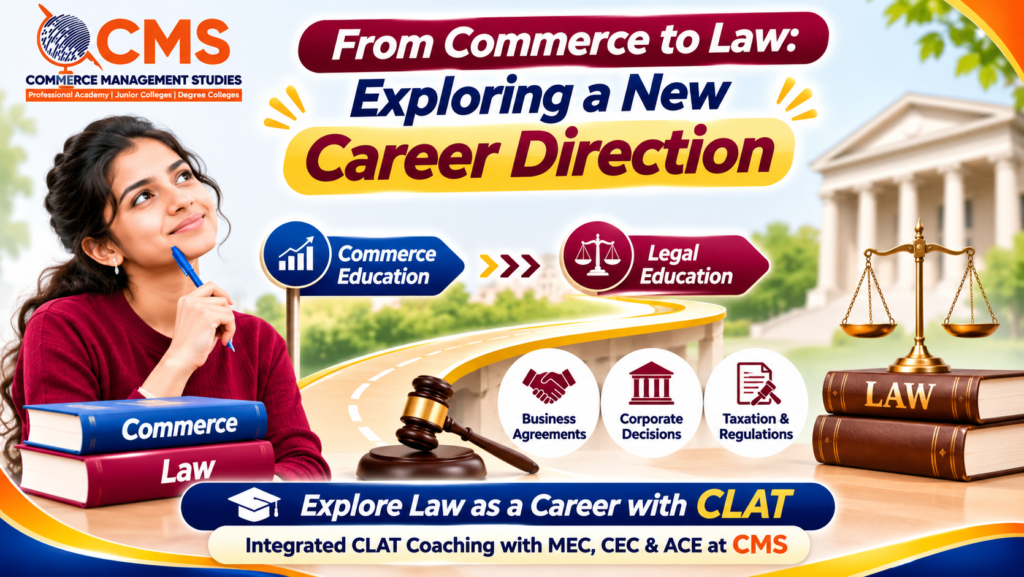
From Commerce to Law: Exploring a New Career Direction
Commerce education introduces students to the way businesses operate, how financial decisions are made and how economic activities influence society. For students studying MEC, CEC or ACE, these subjects can also create an interesting starting point for exploring legal education. Law is not limited to courtroom arguments or criminal cases; it also involves business agreements, corporate decisions, consumer rights, taxation, public policy and the rules that guide organisations.
Students who are interested in both commerce and law can consider the Common Law Admission Test (CLAT) as one route towards undergraduate legal education. CLAT is conducted for admission to participating National Law Universities and other institutions that use its scores. With the right preparation, commerce students can explore law as a career while continuing to build their academic knowledge through their chosen subjects.
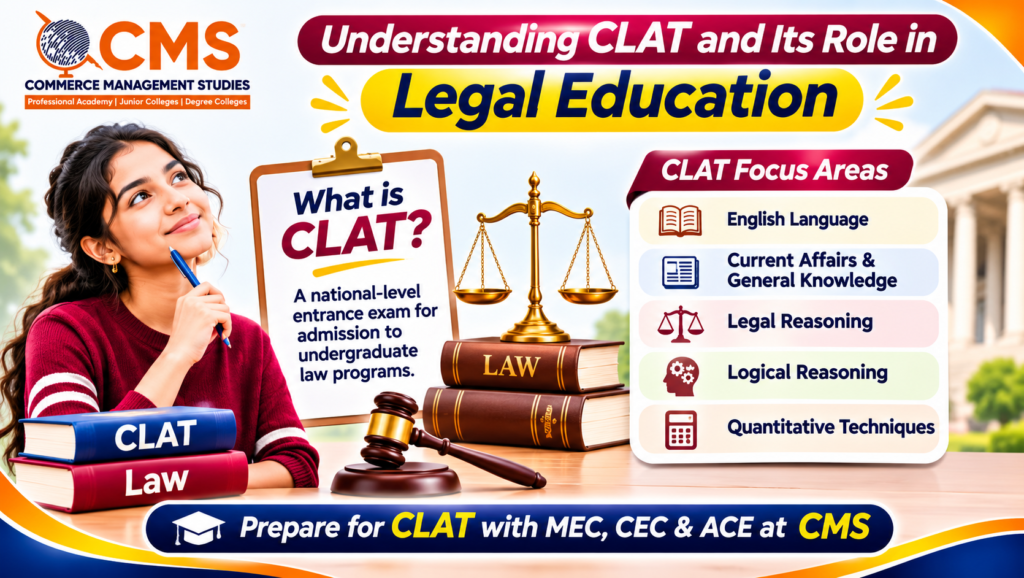
Understanding CLAT and Its Role in Legal Education
CLAT is a national-level entrance examination used by participating institutions for admission to undergraduate law programs. It is designed to assess skills that are important for legal education, including reading comprehension, reasoning, interpretation and the ability to apply information presented in passages. Students do not need to begin with advanced legal knowledge to prepare for the examination; the focus is on understanding information and using it logically.
The undergraduate CLAT syllabus includes areas such as English Language, Current Affairs including General Knowledge, Legal Reasoning, Logical Reasoning and Quantitative Techniques. These sections encourage students to read carefully, identify arguments, understand principles and make reasoned decisions. Such abilities are useful not only for the entrance examination but also for the academic demands of studying law.
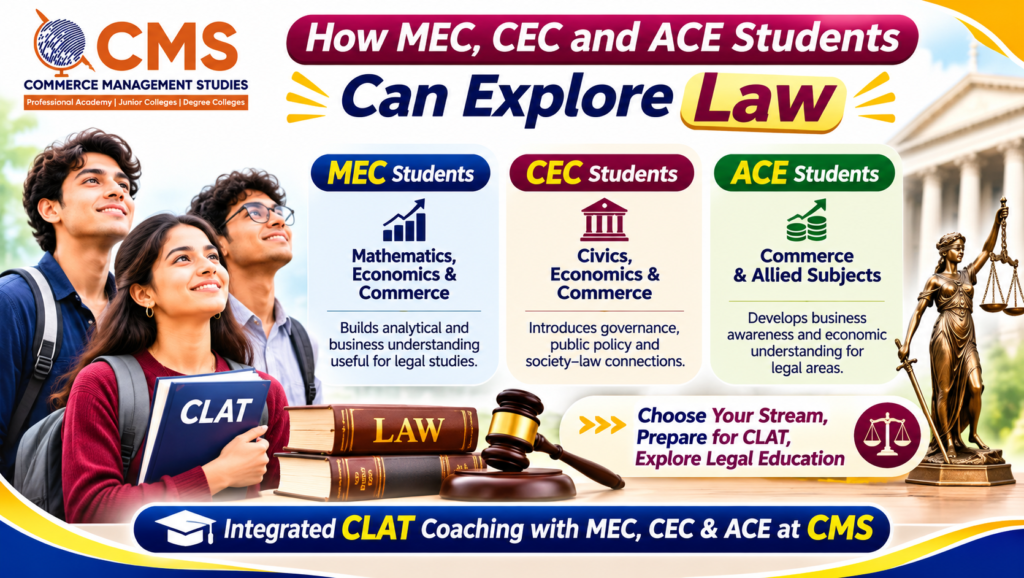
How MEC, CEC and ACE Students Can Explore Law
Students choosing MEC, CEC or ACE can consider law alongside their commerce education. Each stream offers a different combination of subjects, but all three can provide a broader understanding of business, society and economic activity. Students should choose their stream based on their academic interests and learning strengths while separately planning for the requirements of their intended law program.
MEC students study Mathematics, Economics and Commerce. Mathematics can support numerical interpretation, while Economics and Commerce introduce concepts related to markets, business activity and financial decisions. These areas may help students connect classroom learning with topics such as corporate regulation, commercial agreements and economic policy.
CEC students study Civics, Economics and Commerce. Civics introduces ideas related to government, public institutions and citizenship, while Economics and Commerce help students understand business and economic systems. These subjects can be interesting for students who want to explore constitutional principles, public policy and the relationship between law and society.
ACE students also have the opportunity to explore law while developing their commerce-related knowledge. Their subject combination can support an understanding of business activity and economic concepts, which may be useful when learning about commercial organisations and legal responsibilities.
The choice of MEC, CEC or ACE does not by itself determine a student’s success in CLAT. Consistent reading, reasoning practice, awareness of current affairs and familiarity with the examination format remain important parts of preparation.
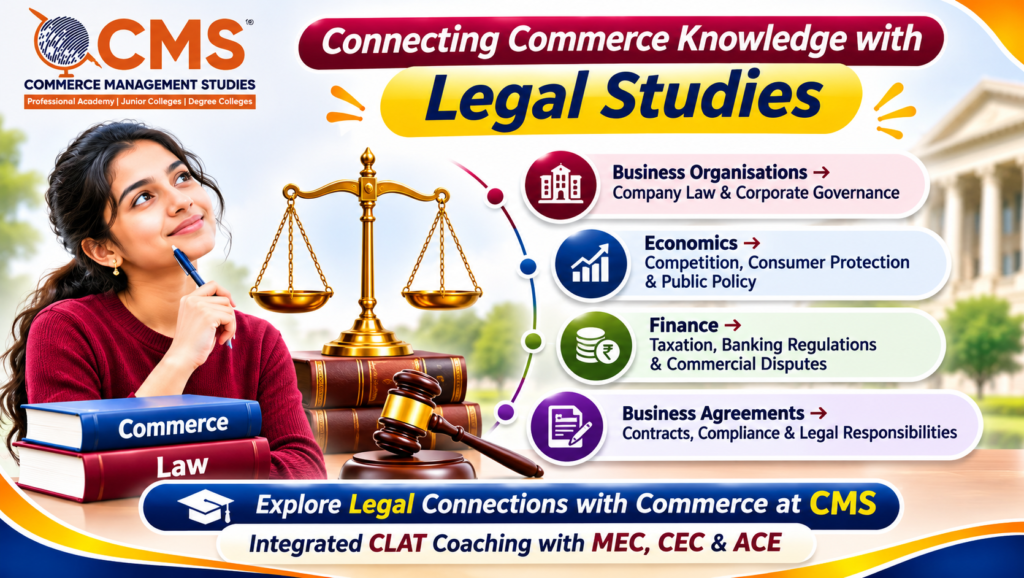
Connecting Commerce Knowledge with Legal Studies
Commerce and law often intersect in the real world. Businesses operate within legal frameworks, enter into agreements, follow regulations and make decisions that affect employees, customers and other organisations. Understanding these connections can help commerce students appreciate how legal education relates to their existing academic interests.
For example, students who learn about business organisations may later explore company law and corporate governance. Those interested in economics may find it useful to understand competition, consumer protection and public policy. Students who enjoy financial subjects may also explore taxation, banking regulations and commercial disputes as possible areas of legal study.
These connections do not mean that commerce subjects replace CLAT preparation. Instead, they can give students a wider perspective and help them identify areas of law that they may want to learn more about during their future studies.
Skills Commerce Students Can Develop for CLAT
CLAT preparation requires more than memorising facts. Students need to develop the ability to understand passages, evaluate arguments and apply information accurately. These skills can be strengthened gradually alongside regular academic learning.
- Reading comprehension: Read editorials, articles and informative passages to understand the central idea, supporting arguments and conclusions.
- Logical reasoning: Practise identifying assumptions, analysing statements and recognising relationships between ideas.
- Legal reasoning: Learn to identify principles provided in a passage and apply them to the situations described in questions.
- Current affairs awareness: Follow important national and international developments and understand their broader significance.
- Quantitative interpretation: Practise interpreting numerical information, percentages, ratios, tables and basic mathematical concepts.
- Time management: Complete practice exercises within a set time to improve accuracy and develop a balanced examination approach.
Developing these skills during Classes 11 and 12 can help students become more familiar with the style of questions they may encounter in CLAT. A consistent routine is generally more useful than attempting to complete large amounts of preparation at the last moment.
Exploring Law Courses After Class 12
Students who complete Class 12 and meet the eligibility requirements can explore undergraduate law programs. Common five-year integrated law degrees include BA LL.B., BBA LL.B. and B.Com. LL.B., where offered by the respective institutions. These programs combine legal education with subjects from the arts, business or commerce.
A BA LL.B. program may include subjects related to political science, sociology, economics and legal studies. A BBA LL.B. program may combine business administration with law, while a B.Com. LL.B. program may connect commerce-related subjects with legal education. The availability of these courses and their admission requirements vary across institutions.
Students should research the programs offered by their preferred universities, check the latest eligibility criteria and understand the admission process before making a final decision. CLAT scores are accepted by participating institutions, while some universities may conduct their own entrance examinations or follow different admission procedures.
Career Opportunities After Studying Law
A law degree can lead to several professional directions. The career a student chooses may depend on their interests, further qualifications, practical experience and the requirements of the relevant profession.
- Corporate law: Working with businesses on contracts, compliance, transactions and legal responsibilities.
- Litigation: Representing clients and assisting with legal disputes through the court system.
- Legal consultancy: Providing legal guidance to individuals, companies or organisations within the permitted professional framework.
- Judicial services: Preparing for the relevant judicial service examinations after meeting the applicable eligibility requirements.
- Public policy and legal research: Studying laws, regulations and public issues to support research or policy-related work.
- Further legal specialisation: Pursuing advanced study in areas such as commercial law, intellectual property, international law or other specialised fields.
Students should remember that a law degree is the beginning of professional development. Practical training, internships, additional examinations and registration requirements may apply depending on the career path they choose.
Preparing for CLAT Alongside Commerce Education
Students can create a balanced preparation plan by dividing their time between school or academic subjects and CLAT practice. A useful routine may include daily reading, regular reasoning exercises, current affairs revision and periodic mock tests. Reviewing mistakes after each practice session can help students identify whether they need to improve comprehension, accuracy, speed or question interpretation.
CMS offers integrated CLAT Coaching in Hyderabad alongside MEC, CEC and ACE education, allowing students to plan their commerce studies and law entrance preparation within an academic pathway. Through guided preparation, practice and examination-focused learning, students can work towards strengthening the skills required for CLAT while continuing their regular studies.
The most effective preparation plan is one that students can follow consistently. Rather than focusing only on the number of hours spent studying, they should pay attention to the quality of practice, progress in mock tests and their ability to understand unfamiliar passages.
From Commerce to Law: Making an Informed Choice
Choosing commerce with CLAT coaching can open an additional direction for students who are interested in legal education. MEC, CEC and ACE students can explore how their subjects connect with business law, public policy, corporate regulation and other areas of legal study while preparing for the entrance examination.
For students considering this pathway, the first step is to understand the nature of legal education, explore undergraduate law programs and begin developing reading and reasoning skills. With careful planning and consistent preparation, commerce students can make an informed decision about pursuing law after Class 12 and work towards their future academic and professional goals.