
Introduction
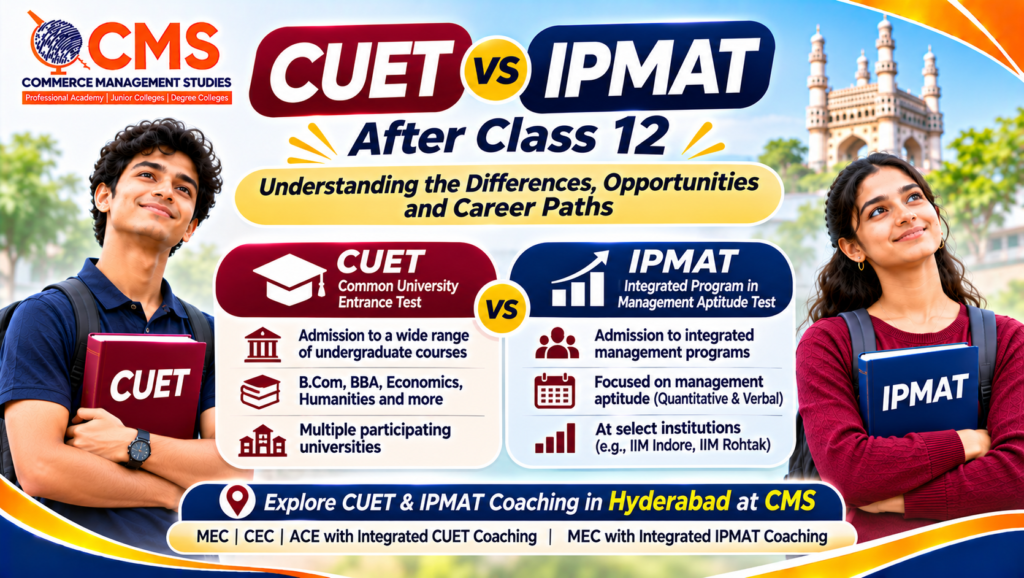
Choosing the right entrance examination after Class 12 is an important step for students planning their higher education. Among the popular options, the Common University Entrance Test (CUET) and the Integrated Program in Management Aptitude Test (IPMAT) offer different pathways into undergraduate education. While CUET allows students to apply for a wide range of undergraduate courses at participating universities, IPMAT provides an opportunity to seek admission to selected integrated management programs.
Although both examinations are taken after school education, their purpose, examination requirements and academic opportunities are different. Students interested in commerce, management, economics, finance and other disciplines should understand these differences before deciding where to focus their preparation. At CMS, commerce students can choose MEC, CEC or ACE with integrated CUET coaching, while MEC students can also explore integrated IPMAT coaching alongside their academic education.
What Is CUET?
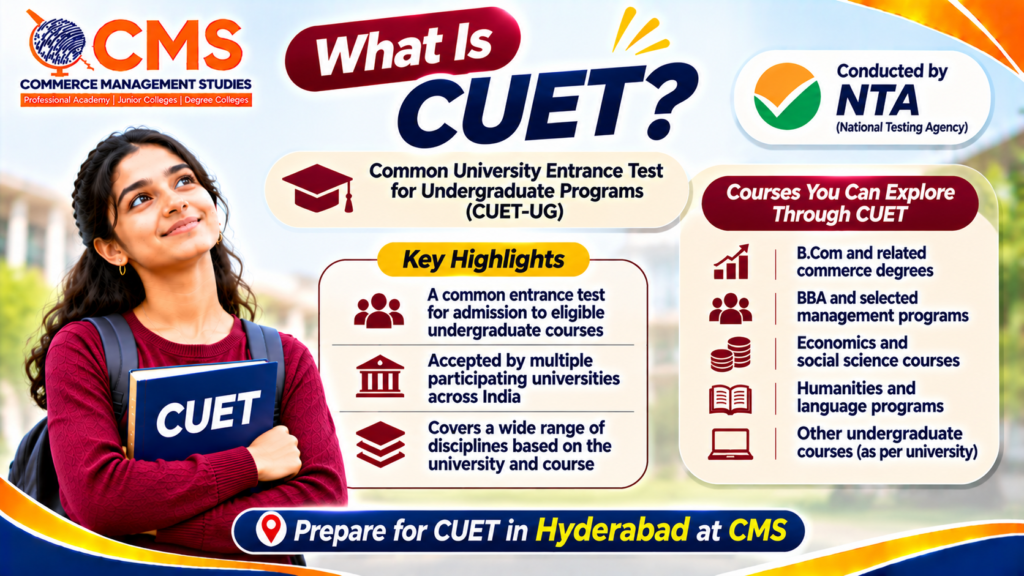
The Common University Entrance Test for Undergraduate programs, known as CUET-UG, is conducted by the National Testing Agency (NTA). It provides a common entrance examination pathway for admission to eligible undergraduate courses at participating central, state, deemed and private universities.
CUET gives students an opportunity to apply to multiple participating universities through a common examination. Depending on the university and course, students may explore undergraduate degrees in commerce, management, economics, humanities, languages, science and other disciplines.
Some courses students may consider through CUET include:
- Bachelor of Commerce (B.Com) and related commerce degrees.
- Bachelor of Business Administration (BBA) and selected management programs.
- Economics and other social science courses.
- Humanities and language-based undergraduate programs.
- Selected integrated and interdisciplinary courses.
However, not every university or course uses CUET for admission. Each participating institution specifies its own eligibility requirements, subject combinations and admission procedures. Students should check the latest university prospectus before selecting their CUET subjects.
What Is IPMAT?
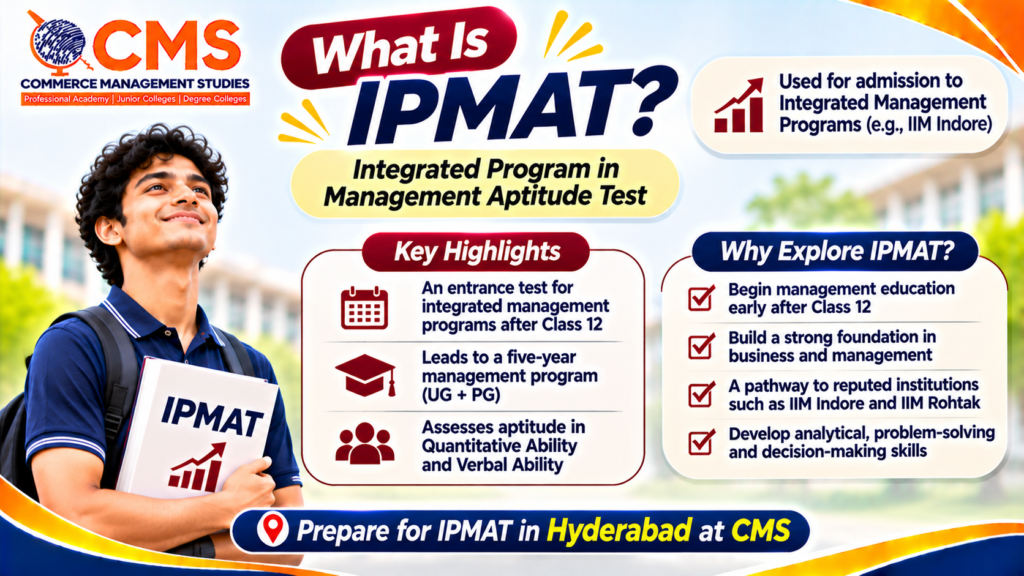
The Integrated Program in Management Aptitude Test (IPMAT) is an entrance examination used by selected institutions for admission to their integrated management programs. One prominent example is the five-year Integrated Program in Management offered by IIM Indore.
Unlike CUET, which covers admission opportunities across several academic disciplines, IPMAT is specifically designed to assess the aptitude of students interested in management education. The examination generally evaluates quantitative ability and verbal ability, although the exact pattern depends on the institution conducting the test.
An integrated management program combines undergraduate-level and postgraduate-level management education within a structured academic pathway. It allows students to begin studying business and management after Class 12 rather than completing a separate undergraduate degree before pursuing postgraduate management education.
Students should remember that IPMAT is not a single common examination for every integrated management course. Different institutions may use IPMAT Indore, IPMAT Rohtak or their own entrance examinations and selection procedures. Candidates should check the latest admission notifications of their preferred institutions.
CUET vs IPMAT: Understanding the Key Differences
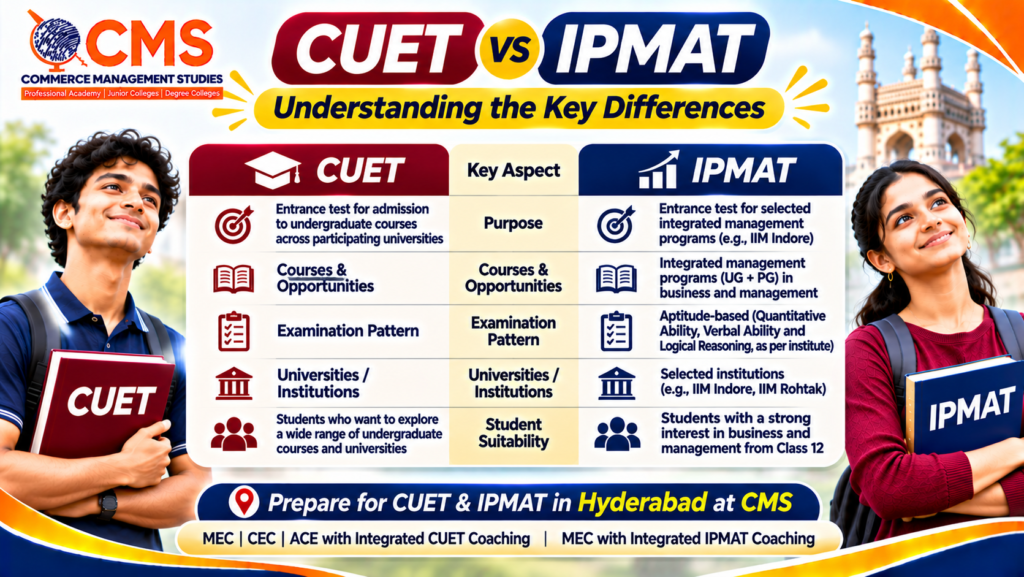
CUET and IPMAT serve different admission purposes. Understanding how they differ can help students identify the examination that matches their academic interests and future plans.
1. Purpose of the Examination
CUET
CUET is designed to facilitate undergraduate admissions across participating universities. It allows students to apply for different courses depending on their subjects, eligibility and university preferences.
IPMAT
IPMAT is intended for admission to selected integrated management programs. It is relevant to students who want to pursue management education through a structured five-year academic pathway after Class 12.
2. Courses and Academic Opportunities
Through CUET, students may explore:
- B.Com and B.Com (Hons).
- BBA and selected management-related degrees.
- Economics and social science courses.
- Humanities and language programs.
- Other undergraduate courses offered by participating universities.
Through IPMAT, students can seek admission to:
- Five-year Integrated Program in Management courses at participating institutions.
- Management-focused academic pathways combining undergraduate and postgraduate-level education.
The available courses depend on the institutions participating in the respective admission processes. Students should verify the current course offerings before applying.
3. Examination Pattern
CUET and IPMAT assess different areas of academic ability because they serve different admission purposes.
CUET Examination
CUET-UG generally includes language tests, domain-specific subjects and a general aptitude test, depending on the student’s chosen subjects and the requirements of the university and course.
The examination may assess:
- Language comprehension and communication.
- Knowledge of selected academic subjects.
- General knowledge and current affairs, where applicable.
- Logical reasoning and numerical ability, where applicable.
Students should select subjects based on the eligibility requirements of their preferred university courses.
IPMAT Examination
IPMAT examinations generally focus on aptitude rather than a broad set of school subjects. Depending on the institution, the test may assess:
- Quantitative ability.
- Verbal ability.
- Logical reasoning, where included in the particular examination.
For example, the IPMAT conducted by IIM Indore has traditionally included quantitative ability multiple-choice questions, quantitative ability short-answer questions and verbal ability. Other institutions may follow different patterns.
4. Universities and Institutions
CUET
CUET scores are accepted by participating universities for their eligible undergraduate courses. Students can research institutions such as the University of Delhi, Banaras Hindu University, the University of Hyderabad, Jamia Millia Islamia and other participating universities, subject to the relevant course and admission rules.
IPMAT
IPMAT is associated with selected institutions offering integrated management programs. IIM Indore and IIM Rohtak are prominent examples, but their examinations and admission procedures are different. Other institutions may have separate entrance tests or selection processes.
Students should not assume that every IIM or integrated management program accepts the same IPMAT score.
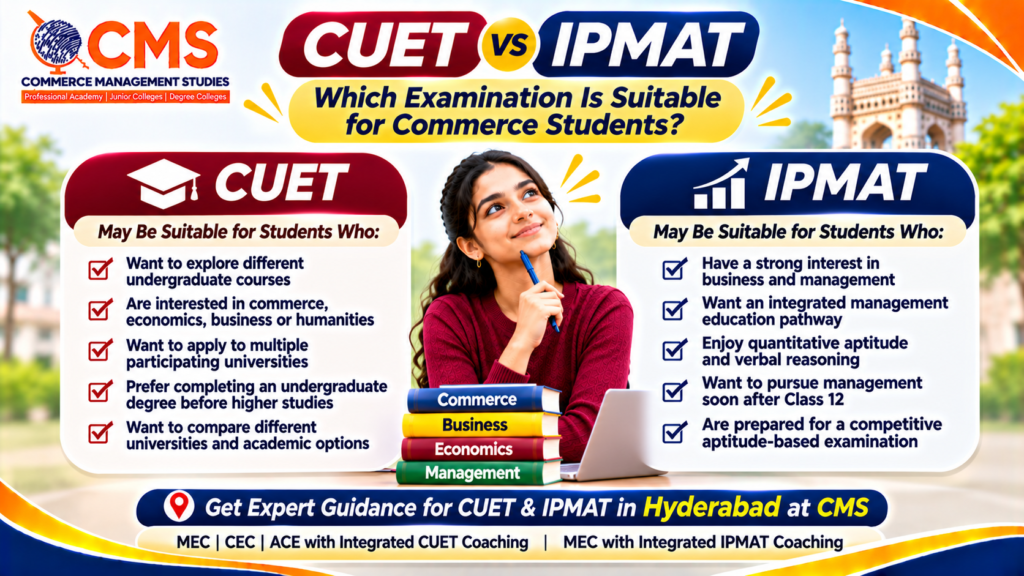
CUET vs IPMAT: Which Examination Is Suitable for Commerce Students?
The choice between CUET and IPMAT depends on the type of higher education a student wants to pursue. Both examinations can lead to valuable academic opportunities, but their pathways are different.
CUET May Be Suitable for Students Who:
- Want to explore different undergraduate courses after Class 12.
- Are interested in commerce, economics, business or humanities.
- Want to apply to multiple participating universities.
- Prefer completing an undergraduate degree before deciding on postgraduate education.
- Want to compare different universities and academic disciplines.
For example, a student interested in accounting and finance may explore B.Com courses, while someone interested in business administration may consider eligible BBA programs through CUET.
IPMAT May Be Suitable for Students Who:
- Have a strong interest in business and management.
- Want to explore an integrated management education pathway.
- Enjoy quantitative aptitude and verbal reasoning.
- Are interested in studying management soon after Class 12.
- Are prepared for a competitive entrance examination focused on aptitude.
Students who are confident about pursuing management education from an early stage may consider IPMAT and research the institutions offering integrated management programs.
What Career Opportunities Can Follow CUET-Based Courses?
CUET does not lead to one specific profession. It provides access to different undergraduate courses, and the career opportunities depend on the degree students choose, their further education and their professional interests.
Some possible academic and career pathways include:
1. Commerce and Accounting
Students pursuing B.Com and related degrees can develop knowledge of accounting, taxation, finance and business operations. Depending on their qualifications and further professional training, they may explore careers in accounting, financial services, taxation and corporate administration.
2. Business and Management
Students pursuing eligible BBA and related courses can study marketing, finance, human resources, business operations and organisational management. These degrees can provide a foundation for corporate roles or further management education.
3. Economics and Financial Analysis
Students choosing economics-related degrees can explore areas such as economic research, banking, financial analysis, policy research and data-related work, depending on their skills and additional qualifications.
4. Humanities and Social Sciences
Students interested in humanities and social sciences can pursue academic and professional pathways in areas such as public administration, communication, research, education and related fields. The career direction ultimately depends on the undergraduate course selected and the skills and qualifications developed during higher education.
What Career Opportunities Can Follow an Integrated Management Program?
An integrated management program provides a foundation in business and organisational management. Students are introduced to different areas of management and can develop specialised interests as they progress through their studies.
Depending on the curriculum, specialisation, experience and further qualifications, graduates may explore opportunities in:
- Finance: Financial analysis, corporate finance and financial planning.
- Marketing: Brand management, market research and sales strategy.
- Human Resources: Recruitment, employee development and organisational management.
- Business Analytics: Data interpretation, business research and decision-making.
- Consulting: Business research, problem-solving and strategic advisory work.
- Entrepreneurship: Business development, startup management and new venture planning.
An integrated management qualification does not guarantee a particular job or salary. Career opportunities depend on the institution, academic performance, practical exposure, specialisation and employer requirements.
Can Students Prepare for Both CUET and IPMAT?
Students may consider preparing for both examinations if they meet the relevant eligibility requirements and want to keep different higher education pathways open. However, they should understand that the examinations have different preparation requirements.
There can be some overlap in areas such as quantitative ability, English comprehension and general reasoning. However, CUET preparation also requires attention to the specific domain subjects and university requirements selected by the student, while IPMAT requires focused aptitude preparation.
A combined preparation plan should therefore include:
- Strengthening relevant academic subjects for CUET.
- Developing quantitative aptitude for IPMAT.
- Improving reading comprehension and verbal ability.
- Practising examination-specific questions.
- Taking separate mock tests for each examination.
- Reviewing the admission requirements and application timelines of preferred institutions.
Students should plan their preparation according to their academic workload and avoid treating the two examinations as if they follow the same syllabus or pattern.
How MEC, CEC and ACE Students Can Explore CUET Preparation
Commerce students can choose MEC, CEC or ACE based on their academic interests and future goals. Each stream offers a different combination of subjects, and students should consider their preferred undergraduate courses when planning CUET preparation.
MEC – Mathematics, Economics and Commerce
MEC combines Mathematics, Economics and Commerce. Mathematics helps students develop numerical and analytical skills, while Economics and Commerce introduce them to business activities, financial concepts and economic systems.
Students can explore eligible CUET courses in commerce, economics, business and management, depending on university requirements.
CEC – Civics, Economics and Commerce
CEC combines Civics, Economics and Commerce. It provides exposure to economic concepts, business fundamentals, governance and social institutions.
Students can explore eligible undergraduate courses in commerce, management, economics, humanities and social sciences, subject to the requirements of their preferred universities.
ACE – Accounting, Commerce and Economics
ACE includes Accounting, Commerce and Economics. These subjects introduce students to financial records, business operations and economic concepts.
Students can explore suitable CUET-based undergraduate courses in commerce, business and related disciplines, depending on the course-specific eligibility criteria.
At CMS, MEC, CEC and ACE students can pursue integrated CUET coaching alongside their academic education. This provides an opportunity to strengthen relevant subject knowledge and prepare for university entrance requirements during the same academic period.
How MEC Students Can Explore IPMAT Preparation
MEC can provide a useful academic foundation for students interested in management education. Mathematics supports numerical ability and problem-solving, Economics introduces students to markets and economic decision-making, and Commerce helps them understand business and financial concepts.
However, school-level subject knowledge alone is not enough to prepare for IPMAT. Students also need dedicated practice in quantitative aptitude, verbal ability, time management and examination strategy.
At CMS, MEC students can pursue integrated IPMAT Coaching in Hyderabad alongside their academic education. This gives them an opportunity to strengthen their subject fundamentals while developing the aptitude skills required for management entrance examinations.
Students interested in IPMAT should also research the institutions they wish to apply to and understand their individual eligibility, examination and selection requirements.
How CMS Supports CUET and IPMAT Preparation
At CMS, commerce students can choose MEC, CEC or ACE with integrated CUET Coaching in Hyderabad. Students pursuing MEC can also explore integrated IPMAT coaching alongside their academic education.
The preparation approach focuses on developing subject knowledge, strengthening aptitude skills and familiarising students with entrance examination requirements. Regular practice, assessments and mock examinations help students evaluate their progress and identify areas that need improvement.
For CUET, students can work towards understanding relevant domain subjects and preparing for the requirements of their preferred university courses. For IPMAT, MEC students can focus on quantitative and verbal aptitude while becoming familiar with the examination format.
For students looking for CUET or IPMAT coaching in Hyderabad, CMS provides an opportunity to begin entrance examination preparation alongside their commerce education. The choice of examination should ultimately depend on the student’s preferred course, academic interests and future plans.
Conclusion
CUET and IPMAT offer different opportunities for students planning their education after Class 12. CUET provides access to a wide range of undergraduate courses at participating universities, while IPMAT offers an entrance route to selected integrated management programs. Neither examination is universally better; the right option depends on the academic pathway a student wants to pursue.
Commerce students should first identify their interests, research suitable courses and understand the admission requirements of their preferred institutions. At CMS, students can choose MEC, CEC or ACE with integrated CUET coaching, while MEC students can also pursue integrated IPMAT coaching. With early planning and focused preparation, students can make more informed decisions about their higher education and future career paths.