
Introduction
For students interested in accounting, cost management, finance, taxation and business strategy, Cost and Management Accountancy (CMA) is a professional career path worth exploring after Intermediate. Cost and Management Accountants help organisations understand their costs, manage financial resources, evaluate business performance and make informed decisions. Their knowledge is useful across manufacturing companies, financial institutions, consulting firms and several other industries.
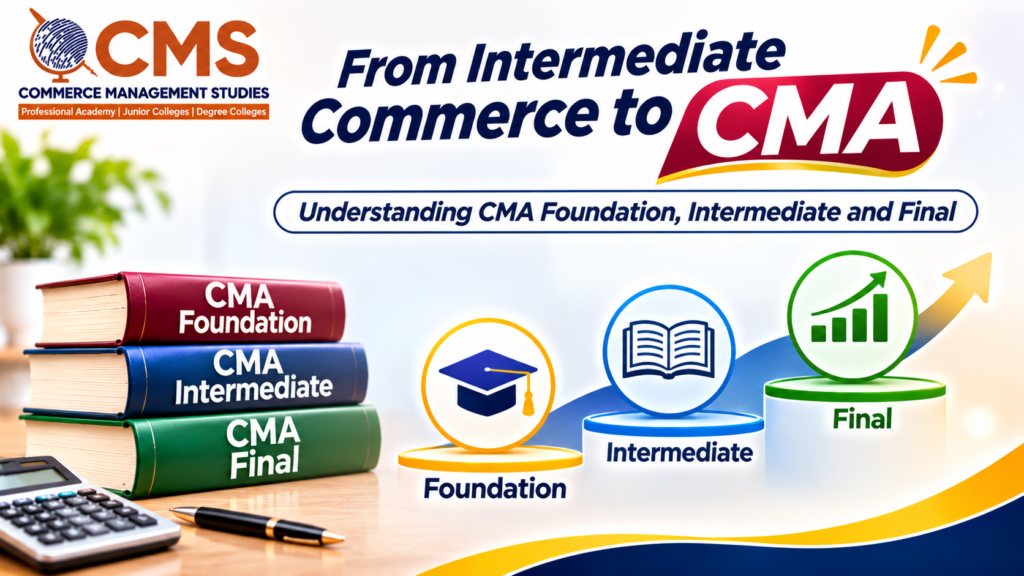
In India, the CMA qualification is regulated by the Institute of Cost Accountants of India (ICMAI). The course follows a structured pathway consisting of three examination levels: CMA Foundation, CMA Intermediate and CMA Final. Along with academic learning, students must also complete the prescribed training requirements. For students pursuing MEC, CEC or ACE, understanding these stages during Intermediate can help them plan their preparation and explore a future in cost and management accounting.
What Is the Cost and Management Accountancy Course?
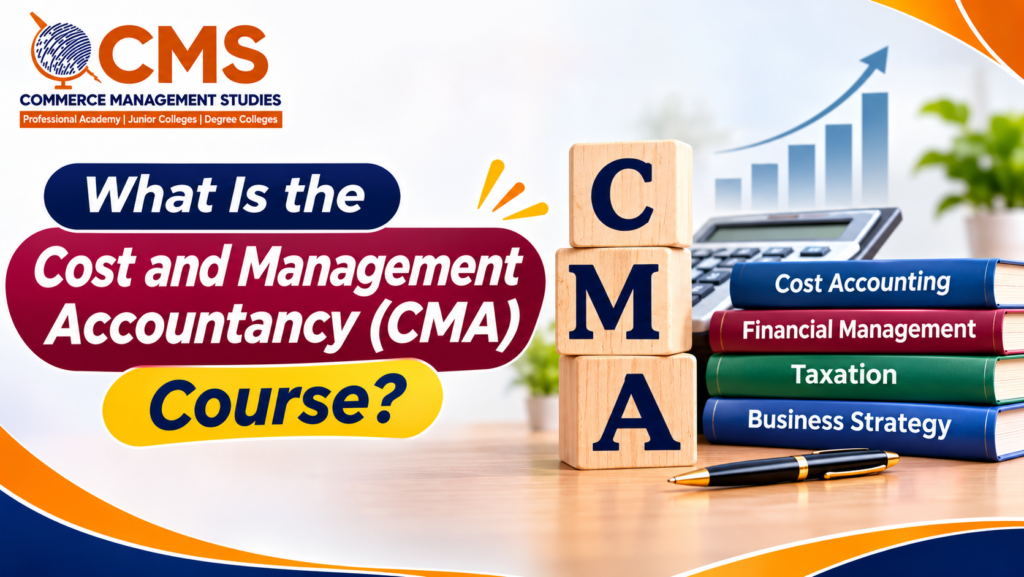
Cost and Management Accountancy is a professional qualification that focuses on cost accounting, financial management, taxation, auditing, business strategy and organisational performance. Unlike a course focused only on recording financial transactions, CMA education also develops the ability to analyse costs, evaluate operational efficiency and support management decisions.
The Institute of Cost Accountants of India (ICMAI), a statutory professional body established under an Act of Parliament, regulates the CMA course in India. Students generally enter through the Foundation route after completing Class 12, while eligible graduates and candidates with specified qualifications may be eligible for direct admission to Intermediate.
The CMA course consists of three main examination levels:
- CMA Foundation: Introduces students to business laws, financial and cost accounting, mathematics, statistics, economics and management.
- CMA Intermediate: Develops detailed knowledge of financial accounting, cost accounting, taxation, business laws, auditing and management accounting.
- CMA Final: Focuses on advanced subjects such as strategic financial management, corporate reporting, cost and management audit, taxation and strategic cost management.
Students must also fulfil the applicable practical training, skills training and industry-oriented training requirements prescribed by ICMAI. Understanding the purpose of each level helps students see how the course progresses from fundamental business concepts to advanced professional responsibilities.
CMA Foundation: The First Step Towards Cost and Management Accountancy
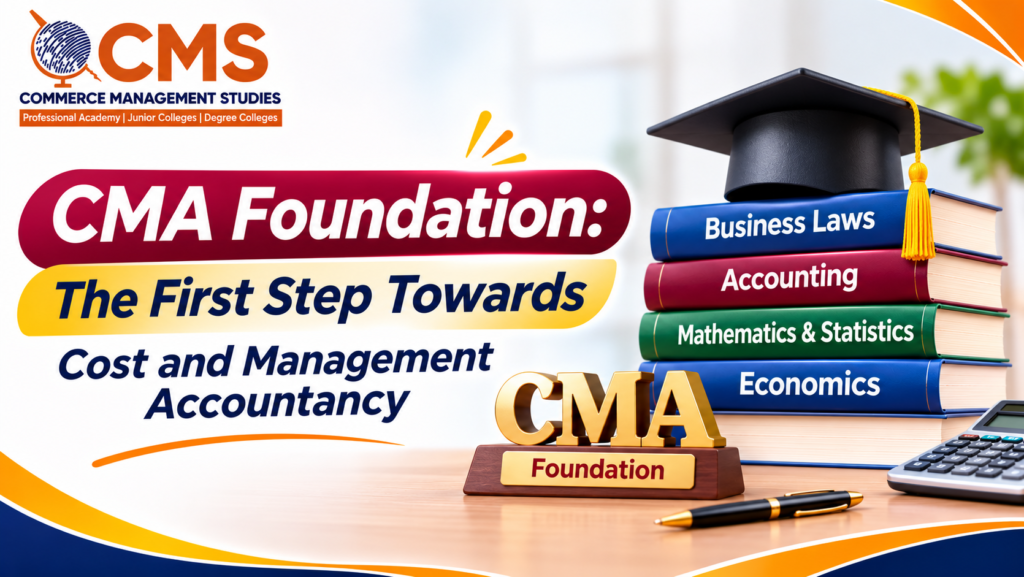
CMA Foundation is the entry-level examination for students following the Foundation route. It introduces the basic concepts that form the foundation of cost and management accounting. Students who have passed Class 10 can register for the Foundation Course, but they must pass Class 12 or an equivalent qualifying examination before appearing for the Foundation examination.
Under the ICMAI Syllabus 2022, CMA Foundation consists of four papers.
1. Fundamentals of Business Laws and Business Communication
This paper introduces students to the basic legal principles relevant to business activities and develops their understanding of professional communication. It helps students become familiar with business responsibilities, legal concepts and the importance of clear communication in professional environments.
2. Fundamentals of Financial and Cost Accounting
This subject introduces the principles of financial accounting and cost accounting. Students learn about recording transactions, preparing financial statements and understanding the basic methods used to identify and analyse costs. These concepts provide a foundation for more advanced accounting subjects.
3. Fundamentals of Business Mathematics and Statistics
This paper develops numerical and analytical abilities through mathematical and statistical concepts. Students learn to work with numbers, interpret data and apply quantitative methods to business-related problems.
4. Fundamentals of Business Economics and Management
This subject introduces economic principles and basic management concepts. Students explore topics related to markets, business decisions, organisational functions and the economic environment in which businesses operate.
CMA Foundation helps students develop an understanding of the relationship between accounting, economics, mathematics and business operations. Consistent practice and conceptual clarity are important for building confidence at this stage.
CMA Intermediate: Developing Professional Knowledge
After qualifying CMA Foundation and meeting the prescribed educational requirements, students can register for CMA Intermediate. Eligible graduates and candidates with other qualifications specified by ICMAI may also enter through the Direct Entry route.
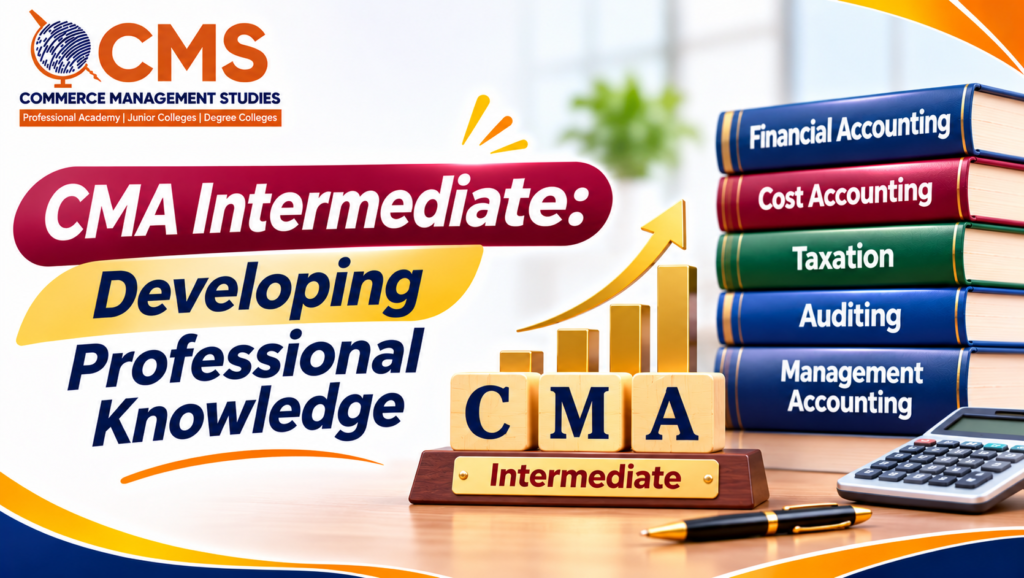
CMA Intermediate develops a deeper understanding of the subjects used in cost accounting, financial management and business operations. Under Syllabus 2022, the level consists of eight papers divided into two groups.
Group I
- Business Laws and Ethics: Introduces the legal framework relevant to business organisations and develops an understanding of ethical responsibilities in professional activities.
- Financial Accounting: Covers accounting principles, financial statements and the preparation and interpretation of financial information.
- Direct and Indirect Taxation: Develops knowledge of direct taxation and indirect taxation, including the relevant provisions of income tax and GST.
- Cost Accounting: Focuses on cost classification, cost determination, cost control and methods used to analyse production and business expenses.
Group II
- Operations Management and Strategic Management: Explores operational efficiency, production planning, process management and business strategy.
- Corporate Accounting and Auditing: Covers corporate financial accounting concepts, audit principles and the examination of financial records.
- Financial Management and Business Data Analytics: Introduces financial decision-making, investment concepts and the use of data analytics in business.
- Management Accounting: Focuses on the use of financial and cost information for planning, performance evaluation and managerial decisions.
At this level, students move beyond basic accounting concepts and learn how financial information can support business planning and organisational performance. Regular practice, subject-wise revision and an understanding of practical applications become increasingly important.
CMA Final: Preparing for Advanced Professional Responsibilities
CMA Final is the advanced examination level of the course. Students who successfully complete both groups of CMA Intermediate can progress to this stage, subject to the applicable registration and course requirements.
The Final level focuses on advanced financial, legal, taxation and management concepts. Under ICMAI Syllabus 2022, it includes seven core papers and one elective paper.
Group III
- Corporate and Economic Laws: Covers the legal and regulatory framework governing companies and economic activities.
- Strategic Financial Management: Develops advanced knowledge of financial planning, investment decisions, risk management and financial strategies.
- Direct Tax Laws and International Taxation: Focuses on advanced direct taxation principles and taxation aspects of international transactions.
- Strategic Cost Management: Explores advanced cost management techniques and their application in improving organisational performance and business decisions.
Group IV
- Cost and Management Audit: Develops knowledge of cost audits, management audits, performance evaluation and professional audit responsibilities.
- Corporate Financial Reporting: Focuses on advanced financial reporting, accounting standards and the presentation of corporate financial information.
- Indirect Tax Laws and Practice: Covers the legal and practical aspects of indirect taxation, including GST.
Elective Paper
Students must select one of the following elective papers:
- Strategic Performance Management and Business Valuation: Focuses on evaluating organisational performance and understanding business valuation methods.
- Risk Management in Banking and Insurance: Explores risk identification, assessment and management in banking and insurance environments.
- Entrepreneurship and Startup: Introduces business creation, startup development and the financial and strategic considerations involved in entrepreneurship.
The Final level encourages students to connect knowledge from different areas and apply it to complex business situations. It prepares them to understand how financial decisions, cost management, taxation and organisational strategy influence overall business performance.
Practical Training: Applying CMA Knowledge in Professional Settings
Practical training is an important component of the CMA qualification. It gives students an opportunity to understand how the concepts learned during their course are applied in professional environments. Through training, students gain exposure to financial activities, cost management, auditing, taxation and business operations.
Under the ICMAI training scheme, students are required to complete the prescribed practical training of 15 months. Practical training can be commenced at the Intermediate level, subject to the Institute’s applicable requirements. Students must also complete the relevant skills training and Industry Oriented Training Programme (IOTP) requirements.
During practical training, students may gain experience in activities such as:
- Analysing production costs and business expenses.
- Preparing financial reports and management information.
- Assisting with cost accounting and budgeting activities.
- Understanding taxation and regulatory compliance.
- Supporting internal audit and cost audit procedures.
- Evaluating operational efficiency and resource utilisation.
- Working with financial data and accounting systems.
This experience helps students understand how organisations manage their resources and make financial decisions. It also allows them to develop professional skills that are valuable when moving from academic learning into the workplace.
How Can Intermediate Commerce Students Begin CMA Preparation?
Intermediate is a useful stage for students to explore Cost and Management Accountancy and become familiar with the subjects they may encounter in CMA Foundation. Students from MEC, CEC and ACE can pursue the CMA pathway, subject to meeting ICMAI’s eligibility requirements.
Each stream provides a different academic foundation that can support students as they begin exploring professional commerce education.
MEC Students
MEC includes Mathematics, Economics and Commerce. Mathematics helps students develop numerical ability and problem-solving skills, while Economics introduces them to markets, business decisions and economic systems. Commerce provides exposure to financial and business concepts that can be useful when studying accounting and management-related subjects.
CEC Students
CEC combines Civics, Economics and Commerce. Commerce introduces students to business activities and financial concepts, while Economics develops their understanding of markets and resource allocation. These subjects can help students build familiarity with the business environment and prepare for areas covered in CMA Foundation.
ACE Students
ACE students can also explore Cost and Management Accountancy after Intermediate. Developing an interest in accounting, business operations, economics and numerical reasoning can help them prepare for the transition into the professional course. Consistent practice and additional attention to relevant concepts can support their learning.
The choice between MEC, CEC and ACE does not by itself determine a student’s ability to pursue CMA. Students should focus on meeting the prescribed eligibility requirements and developing the academic skills needed for the course.
From CMA Foundation to Final: Understanding the Overall Journey
The CMA qualification involves several stages, and understanding the sequence can help students plan their academic and professional preparation.
The general Foundation route includes:
- Register for CMA Foundation: Students can seek admission to the Foundation Course after passing Class 10 or an equivalent examination.
- Complete Class 12: Candidates must pass the Senior Secondary examination or an accepted equivalent qualification before appearing for CMA Foundation.
- Clear CMA Foundation: Students must qualify in the Foundation examination according to ICMAI’s prescribed passing requirements.
- Register for CMA Intermediate: After qualifying Foundation and satisfying the educational requirements, students can register for Intermediate.
- Complete CMA Intermediate: Students must clear the required Intermediate groups and fulfil the applicable training and skills requirements.
- Register for CMA Final: After passing both Intermediate groups, students can enrol for the Final Course.
- Complete the prescribed training: Students must fulfil the practical training, skills training and Industry Oriented Training Programme requirements applicable to their course stage.
- Clear CMA Final: After completing the required examinations and training, students can proceed towards fulfilling the remaining requirements for ICMAI membership.
ICMAI also provides a Direct Entry route for candidates with specified qualifications, including eligible graduates. Students should check the latest admission guidelines to understand whether they qualify for Foundation or direct registration at Intermediate.
Career Opportunities After Becoming a Cost and Management Accountant
A qualified Cost and Management Accountant can explore career opportunities across different industries and professional areas. Organisations use cost and financial information to plan operations, manage resources, evaluate performance and make strategic decisions. This creates opportunities for professionals with specialised knowledge of cost accounting and management finance.
Some career areas include:
- Cost Accounting: Analyse production costs, identify cost variations and help organisations improve cost efficiency.
- Management Accounting: Prepare financial information and performance reports to support business planning and management decisions.
- Financial Management: Assist with budgeting, financial planning, investment decisions and resource allocation.
- Cost and Management Audit: Examine cost records, evaluate operational efficiency and support audit-related activities within the applicable professional framework.
- Taxation: Work on tax calculations, compliance, reporting and advisory services.
- Corporate Finance: Support financial analysis, business planning and strategic financial decisions.
- Business Consulting: Help organisations evaluate costs, improve processes and identify opportunities for better financial performance.
The career direction a CMA chooses may depend on professional interests, experience and areas of specialisation. Some professionals work in manufacturing and corporate organisations, while others explore consulting, financial services, auditing and independent professional practice.
How CMS Supports Students Preparing for CMA Alongside Intermediate
For students interested in pursuing Cost and Management Accountancy, beginning preparation during Intermediate can provide an opportunity to become familiar with professional subjects while continuing regular academic studies. CMS offers integrated Best CMA Coaching in Hyderabad with MEC, CEC and ACE Intermediate education, helping students work towards their board examinations and professional course goals together.
The integrated learning approach introduces students to CMA-related concepts alongside their Intermediate subjects. Classroom instruction, subject-wise practice, regular assessments and examination preparation help students understand important concepts and identify areas that require additional attention. This planned approach also encourages students to develop consistency and manage their academic responsibilities effectively.
At CMS, students can begin building the academic foundation required for CMA Foundation while pursuing their Intermediate education. This gives them an opportunity to understand the professional course at an early stage and prepare for the next steps towards a career in cost and management accounting.
For students looking for CMA coaching in Hyderabad, exploring integrated preparation alongside Intermediate can help make the transition from school-level commerce education to professional studies more organised.
Conclusion
Cost and Management Accountancy offers a professional pathway for students interested in accounting, cost control, financial management, taxation and business strategy. From CMA Foundation to Intermediate and Final, each stage develops a deeper understanding of how organisations manage financial resources and make business decisions. Students from MEC, CEC and ACE can explore this pathway after Intermediate by understanding the eligibility requirements and preparing for the subjects involved in the course.
Starting early, building conceptual clarity and maintaining a consistent study routine can help students approach the CMA journey with greater confidence. With integrated CMA coaching alongside Intermediate education at CMS, students can begin working towards their professional goals while continuing their regular academic studies.