
Introduction
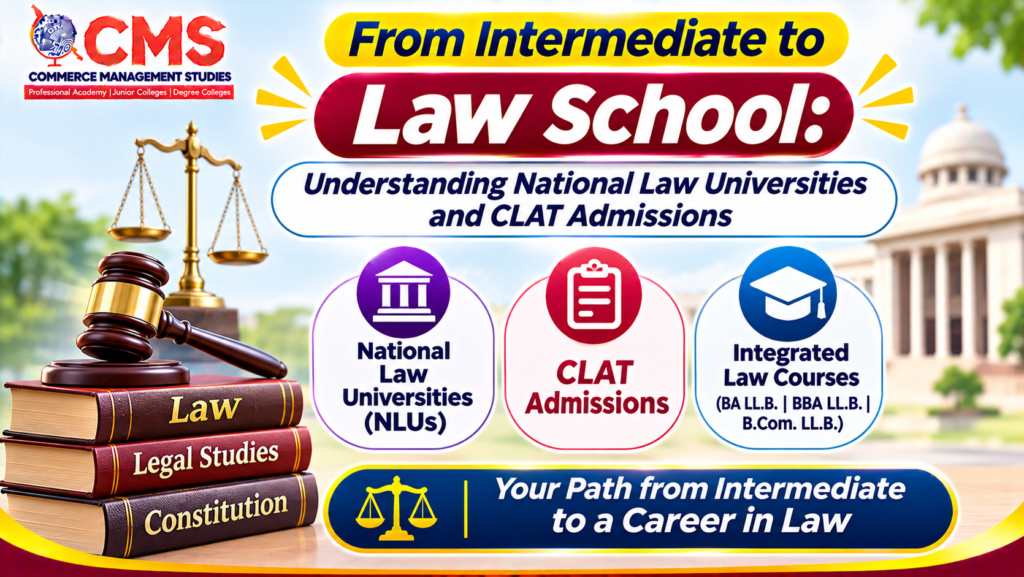
Choosing a career after Intermediate is an important decision, particularly for students who are interested in law, public policy, business regulations, social justice and the legal system. Law offers opportunities across several fields, including litigation, corporate law, civil services, legal consultancy, research and public administration. For students who wish to enter the legal profession after Class 12, National Law Universities (NLUs) are among the prominent institutions to explore.
The Common Law Admission Test (CLAT) provides an important admission pathway to undergraduate law programs offered by participating National Law Universities. Students from different Intermediate streams, including MEC, CEC and ACE, can begin developing the skills required for this entrance examination while continuing their regular education. With an understanding of the admission process and early preparation, students can plan their transition from Intermediate to law school more confidently.
What Are National Law Universities?
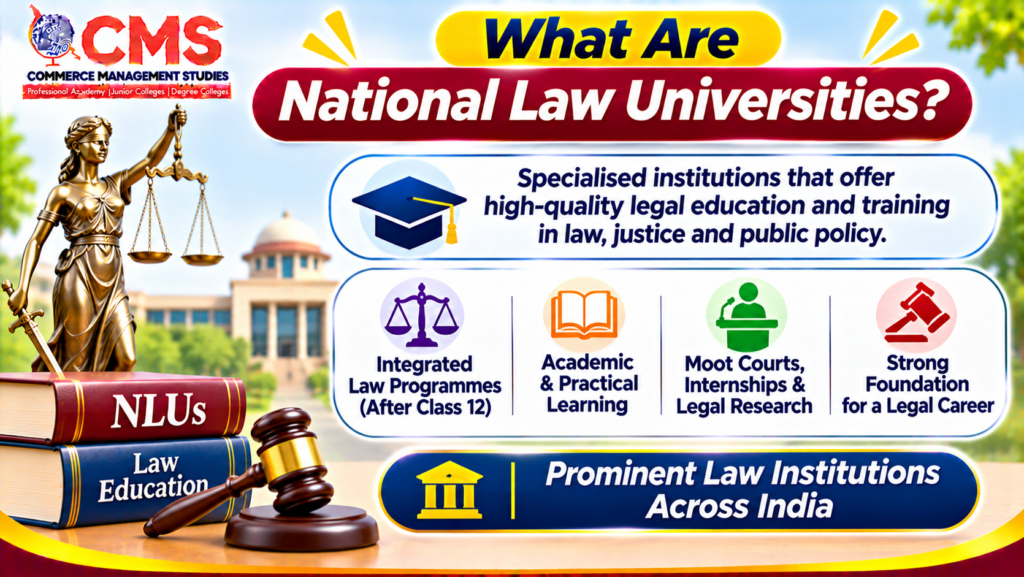
National Law Universities are specialised institutions established to provide higher education and professional training in law. They focus on developing students’ understanding of legal principles, constitutional values, justice systems and the relationship between law and society. Many NLUs offer integrated undergraduate law degrees that allow students to begin their legal education immediately after completing Class 12.
These universities provide an academic environment that combines classroom learning with practical exposure. Students may participate in moot court competitions, legal research projects, internships, debates, seminars and other activities that help them understand how legal concepts are applied in real situations.
Some well-known National Law Universities include:
- National Law School of India University (NLSIU), Bengaluru
- NALSAR University of Law, Hyderabad
- National Law Institute University (NLIU), Bhopal
- The West Bengal National University of Juridical Sciences (WBNUJS), Kolkata
- National Law University, Jodhpur
- Hidayatullah National Law University (HNLU), Raipur
The participating universities, available courses, seat intake and admission requirements may vary. Students should review the latest information published by the Consortium of National Law Universities and individual institutions before making their choices.
Which Law Courses Can Students Pursue After Intermediate?
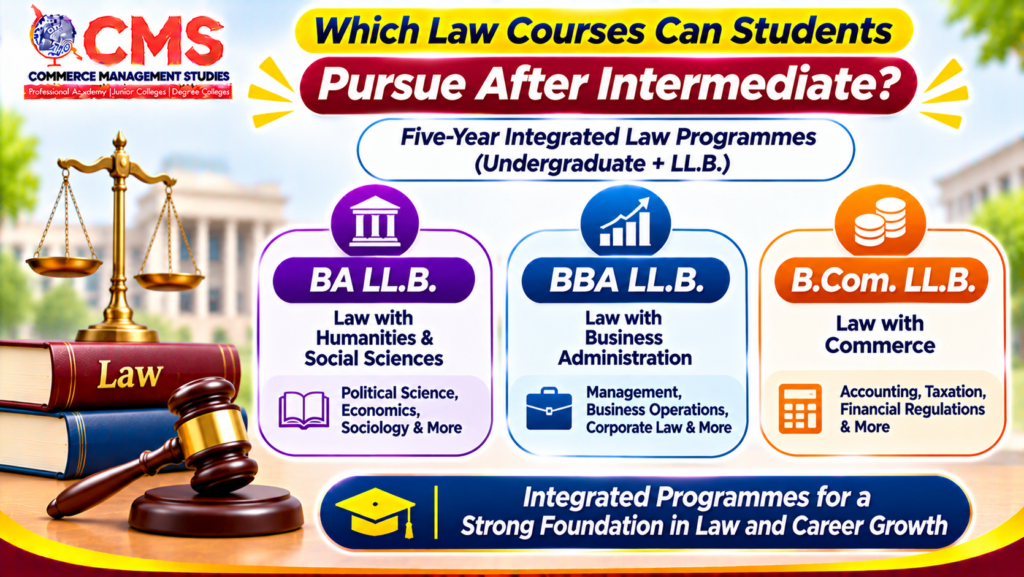
Students who complete Class 12 can explore five-year integrated undergraduate law programs. These courses combine a bachelor’s degree in a particular academic discipline with a Bachelor of Laws (LL.B.), allowing students to study both areas as part of a single program.
Some commonly offered integrated law courses include:
1. BA LL.B.
The Bachelor of Arts and Bachelor of Laws program combines legal education with subjects from the humanities and social sciences. Students may study areas such as political science, economics, sociology, history and legal studies. This course can interest students who want to understand the relationship between law, government, society and public institutions.
2. BBA LL.B.
The Bachelor of Business Administration and Bachelor of Laws program combines business administration with legal education. It introduces students to areas such as management, business operations, corporate regulations, commercial law and legal principles relevant to organisations.
3. B.Com. LL.B.
The Bachelor of Commerce and Bachelor of Laws program brings commerce-related subjects together with legal studies. It can be relevant to students interested in corporate law, taxation, financial regulations, business agreements and commercial disputes.
The availability of these courses differs across universities. Not every NLU offers all three options, so students should check the individual university’s course brochure before selecting their preferences.
Understanding CLAT and Its Role in NLU Admissions
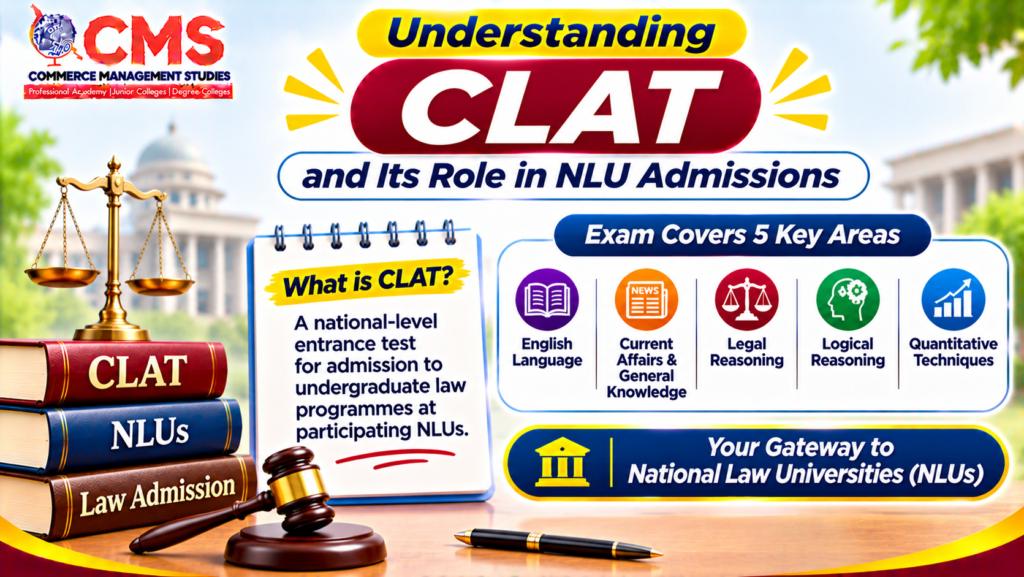
The Common Law Admission Test, commonly known as CLAT, is a national-level entrance examination conducted by the Consortium of National Law Universities. It is used for admission to undergraduate and postgraduate law programs at participating NLUs.
For students completing Intermediate, CLAT-UG is the relevant examination to explore. It assesses skills that are important for legal education, including reading comprehension, logical thinking, interpretation, awareness of current affairs and the ability to analyse information.
The examination generally covers five areas:
- English Language
- Current Affairs, including General Knowledge
- Legal Reasoning
- Logical Reasoning
- Quantitative Techniques
Rather than relying only on memorisation, preparation involves understanding passages, identifying arguments, interpreting information and applying reasoning to different situations. These abilities are useful not only for the entrance examination but also for the academic demands of law school.
Students should refer to the latest CLAT notification for the applicable examination format, syllabus, marking scheme and other instructions, as these details may be revised.
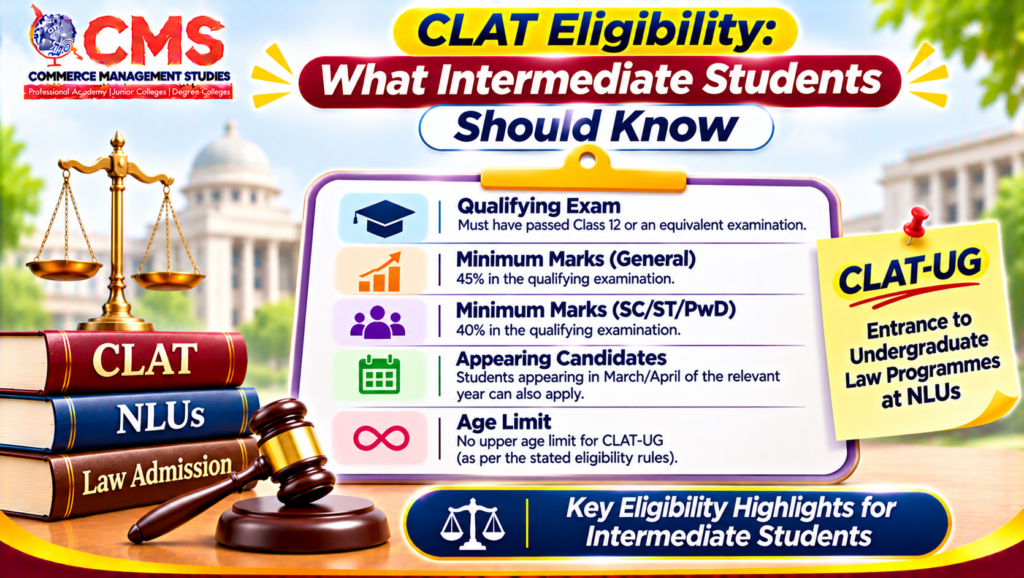
CLAT Eligibility: What Intermediate Students Should Know
Students from different academic backgrounds can explore CLAT-UG, provided they satisfy the eligibility requirements specified by the Consortium of NLUs for the relevant admission year. The examination is not restricted to students who have studied a particular Intermediate stream.
For example, the CLAT 2027 eligibility notification specifies the following requirements:
- Candidates must have passed Class 12 or an equivalent qualifying examination.
- The general minimum qualifying percentage is 45%.
- Candidates belonging to SC, ST and PwD categories require a minimum of 40%.
- Students appearing for their qualifying examination in March or April of the relevant year may also apply, subject to producing proof of passing at the time of admission.
- There is no upper age limit for the undergraduate examination under the stated eligibility rules.
These requirements are specific to the CLAT 2027 admission cycle. Students preparing for subsequent examinations should check the latest eligibility notification, including any category-specific conditions and university-level requirements.
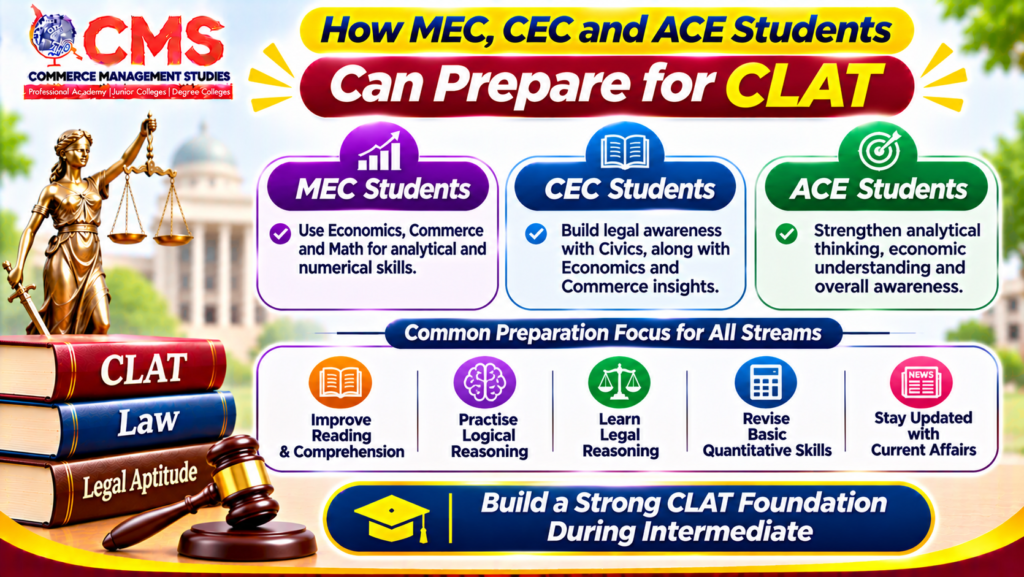
How MEC, CEC and ACE Students Can Prepare for CLAT
Students from MEC, CEC and ACE backgrounds can explore law as a higher-education pathway after Intermediate. Although their academic subjects differ, each stream can help develop knowledge and abilities that are useful when studying legal concepts and preparing for an entrance examination.
MEC Students
MEC introduces students to Mathematics, Economics and Commerce. Economics helps students understand markets, public policies, financial systems and economic decisions. Commerce introduces business activities and financial concepts, while Mathematics supports numerical reasoning and problem-solving. These areas can provide useful background for students interested in commercial law, corporate regulations and economic policy.
CEC Students
CEC combines Civics, Economics and Commerce. Civics introduces students to government institutions, constitutional ideas, citizenship and political systems. These topics can help students develop an initial understanding of the relationship between law, governance and society. Economics and Commerce further introduce them to business and financial concepts that may be relevant to different areas of legal study.
ACE Students
ACE students can also explore CLAT preparation alongside their Intermediate education. Their academic subjects provide opportunities to strengthen analytical abilities, understand economic and commercial concepts, and develop a broader awareness of the world around them. Consistent reading, reasoning practice and familiarity with current affairs can help them build the skills needed for the examination.
Regardless of their stream, students should focus on reading regularly, understanding arguments, practising comprehension questions and developing awareness of important national and international developments.
How to Plan CLAT Preparation During Intermediate
Beginning preparation during Intermediate gives students time to develop the required skills gradually instead of trying to cover everything close to the examination. A balanced preparation plan should consider both board examinations and entrance-test requirements.
Students can organise their preparation around the following activities:
- Develop a reading habit: Read newspapers, editorials and reliable current-affairs resources to improve comprehension and awareness of important developments.
- Practise legal reasoning: Work with passage-based questions and learn to identify principles, facts and conclusions.
- Strengthen logical reasoning: Practise questions involving arguments, assumptions, conclusions and analytical relationships.
- Improve quantitative skills: Revise basic mathematical concepts and practise interpreting numerical information.
- Take regular mock tests: Use practice examinations to understand question formats, improve time management and identify areas that need attention.
- Review performance: Analyse mistakes after each test and spend additional time on topics that require improvement.
Students in Class 11 can focus on building their foundation, while Class 12 students can gradually increase examination-oriented practice. A planned timetable helps maintain consistency without neglecting Intermediate subjects.
Understanding the CLAT Admission Process
Qualifying for CLAT is an important step, but students must also complete the admission and counselling process to secure a seat at a participating university. The process is conducted according to the instructions issued by the Consortium and the admission policies of individual NLUs.
The general process involves the following stages:
- Online registration: Candidates register through the official CLAT website during the application period and submit the required details and documents.
- Entrance examination: Registered candidates appear for CLAT-UG on the announced examination date.
- Result and rank list: The Consortium publishes the results and ranks based on the examination process.
- Counselling registration: Eligible candidates receive instructions to participate in the centralised admissions counselling process.
- University preferences and seat allotment: Candidates provide their preferences and participate in seat allotment according to their rank, available seats, reservation policies and university-specific rules.
- Admission confirmation: Candidates complete the required fee payments, document verification and other formalities within the prescribed deadlines.
Students should monitor official announcements carefully because counselling schedules, registration requirements, seat allotment rules and admission procedures can vary between admission cycles.
Career Opportunities After Studying Law
A five-year integrated law degree can open pathways into several professional areas. While some graduates pursue legal practice, others explore opportunities in organisations, government-related fields, research and business.
Some career options include:
- Advocate: Represent clients, prepare legal arguments and appear before courts after fulfilling the applicable professional requirements.
- Corporate Lawyer: Work with companies on contracts, business transactions, compliance and corporate regulations.
- Legal Consultant: Provide legal guidance to businesses, institutions and individuals in areas of specialisation.
- Legal Researcher: Study legislation, judicial decisions and legal developments for academic institutions, research organisations or legal teams.
- Government and Public Services: Explore relevant competitive examinations and roles connected with administration, public policy and legal institutions.
- Judicial Services: Pursue the applicable judicial service examinations after meeting the prescribed qualifications and eligibility conditions.
Career opportunities depend on the student’s interests, academic performance, professional qualifications and applicable regulatory requirements. A law degree can provide a foundation for different career directions, but some roles require additional examinations, training or professional experience.
How CMS Supports Students Preparing for CLAT
For Intermediate students who are interested in pursuing law, preparing for CLAT alongside regular academics requires a planned approach. CMS offers integrated CLAT Coaching in Hyderabad with MEC, CEC and ACE Intermediate education, helping students work towards their board examinations while developing the skills required for the law entrance examination.
The preparation approach can include concept-based learning, regular practice, mock examinations and performance assessments. These activities help students become familiar with different question types, understand their progress and identify areas that need further attention. Guidance and structured study planning also help students manage their academic responsibilities while preparing for a competitive entrance examination.
With CLAT coaching available alongside MEC, CEC and ACE, students at CMS can begin exploring the pathway from Intermediate education to undergraduate law programs. This allows them to work towards their academic goals while gradually developing the reading, reasoning and analytical abilities required for legal education.
Conclusion
The transition from Intermediate to law school can be an exciting opportunity for students interested in understanding legal systems, business regulations, governance and social issues. National Law Universities offer specialised legal education through five-year integrated courses, while CLAT provides an important admission route to participating institutions. Students from MEC, CEC and ACE can explore this pathway by understanding the examination requirements and developing their reading, reasoning and analytical skills during Intermediate.
Starting preparation early, maintaining a balance between board examinations and entrance-test practice, and staying informed about admission notifications can help students approach the process with greater confidence. With integrated CLAT coaching alongside Intermediate education at CMS, students in Hyderabad can begin planning their journey towards National Law Universities and a future in the field of law.