
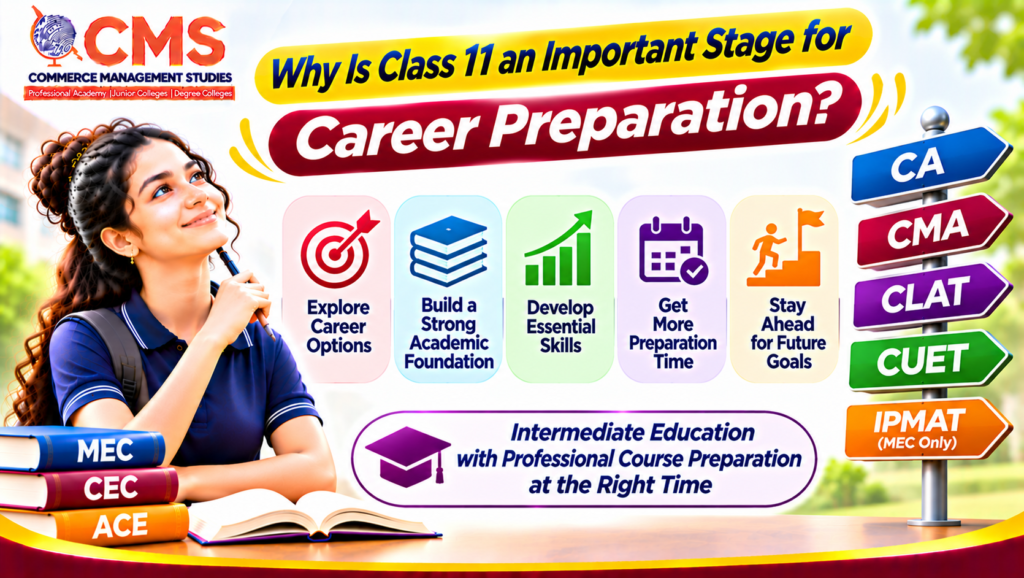
Why Is Class 11 an Important Stage for Career Preparation?
Choosing an Intermediate stream after Class 10 is one of the first major academic decisions students make. Along with selecting subjects, students often begin exploring professional courses and competitive examinations that can shape their future careers. Class 11 provides an opportunity to understand these options and gradually prepare for them while continuing regular academic studies. Rather than waiting until the final year of Intermediate, students can use this time to develop subject knowledge, improve essential skills and understand the requirements of their chosen career paths.
At CMS, students pursuing MEC, CEC and ACE can combine their Intermediate education with integrated coaching for professional courses and entrance examinations. Depending on their interests, students can begin preparing for CA, CMA, CLAT and CUET alongside these streams. MEC students can also pursue integrated IPMAT coaching. Starting early gives students more time to understand examination patterns, practise relevant topics and build a consistent study routine.
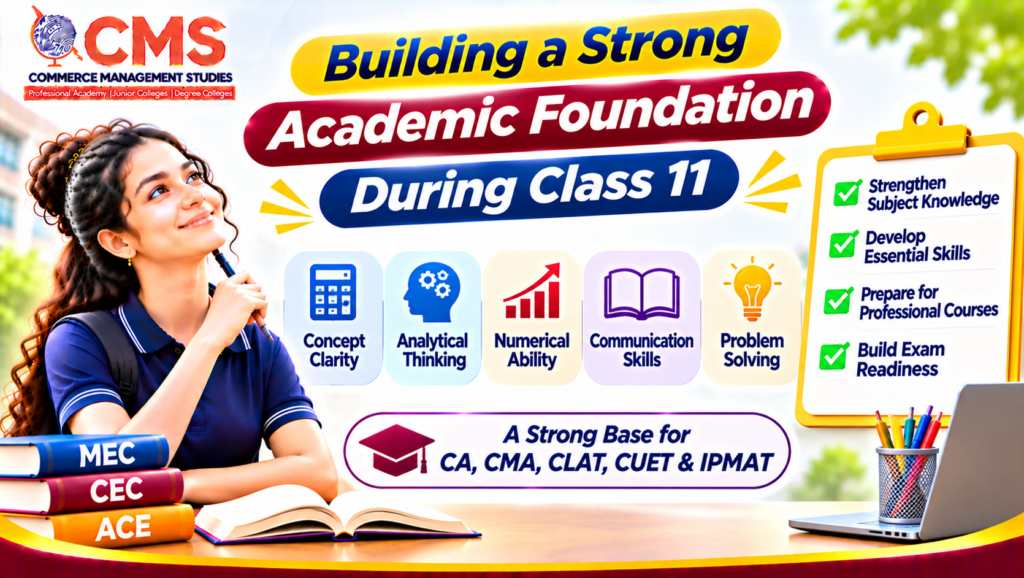
Building a Strong Academic Foundation During Class 11
Professional courses often require students to develop skills that go beyond memorising textbook content. Analytical thinking, numerical ability, communication, logical reasoning and conceptual understanding play an important role in different entrance and professional examinations. Class 11 provides sufficient time to begin developing these abilities without the immediate pressure of completing the final year of Intermediate.
For example, students interested in accounting-related careers can start strengthening their understanding of commerce, economics and basic mathematical concepts. Those considering law can gradually develop reading comprehension, logical reasoning and awareness of current affairs. Students interested in management entrance examinations can work on quantitative aptitude, verbal ability and analytical thinking.
Building these skills gradually can help students approach future examinations with greater confidence. It also allows them to identify subjects that require additional attention and improve their understanding through consistent practice.
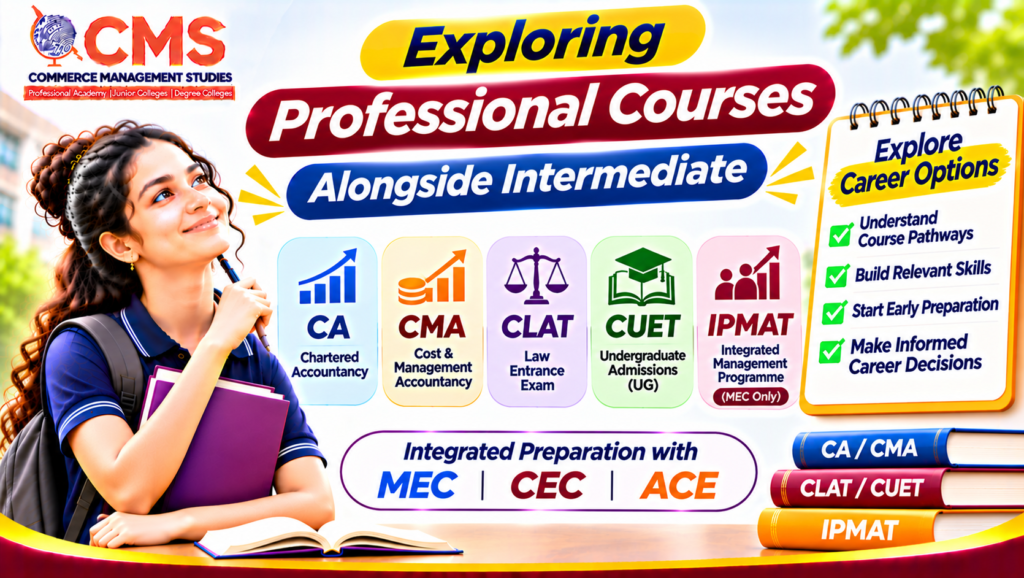
Exploring Professional Courses Alongside Intermediate
Students do not need to wait until they complete Class 12 to learn about professional courses. Understanding different career pathways during Class 11 helps them make informed decisions and choose preparation methods that suit their interests.
Chartered Accountancy (CA)
Chartered Accountancy is a professional qualification focused on accounting, taxation, auditing, financial reporting and related areas. Students interested in finance and accounting can begin developing a foundation in commerce, business concepts and numerical skills during Intermediate.
Starting preparation in Class 11 can help students become familiar with the subjects and expectations associated with the CA Foundation level. It also provides time to understand the qualification pathway and plan for the relevant examinations after meeting the applicable eligibility requirements.
Cost and Management Accountancy (CMA)
Cost and Management Accountancy focuses on cost management, financial planning, performance analysis and business decision-making. Students interested in understanding how organisations manage costs and resources can explore this career during Intermediate.
Class 11 is a suitable time to strengthen basic accounting, economics, mathematics and analytical skills. Early preparation can also help students understand the CMA qualification structure and the subjects covered at the Foundation level.
Common Law Admission Test (CLAT)
CLAT is an entrance examination used for admission to participating National Law Universities and other institutions that accept its scores. Students interested in legal education can begin developing the skills required for the examination during Class 11.
Reading comprehension, legal reasoning, logical reasoning, current affairs and quantitative techniques are important preparation areas. Regular reading and reasoning practice can help students improve their ability to understand passages, interpret information and analyse questions.
Common University Entrance Test (CUET)
CUET-UG provides an entrance examination route for undergraduate admissions at participating universities. Students planning to pursue degrees in commerce, economics and other disciplines can explore the examination requirements during Intermediate.
Beginning preparation in Class 11 allows students to understand the available test components, identify relevant domain subjects and improve their language and aptitude skills. Since subject requirements vary across universities and programmes, students should research their preferred courses before deciding on a CUET subject combination.
Integrated Programme in Management Aptitude Test (IPMAT)
IPMAT is associated with admission to integrated management programmes offered by participating institutions. Students interested in management education can begin developing quantitative aptitude, verbal ability and analytical reasoning skills during Intermediate.
For MEC students, Mathematics can provide a useful foundation for quantitative preparation, while regular reading and practice can strengthen verbal and analytical skills. Students should also understand that IPMAT examination patterns and admission requirements differ between institutions.
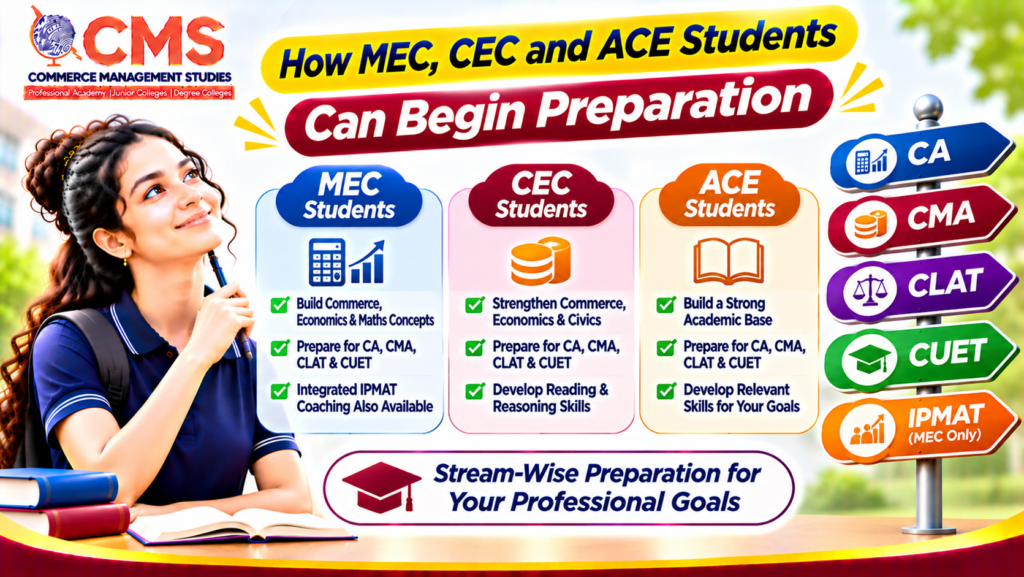
How MEC, CEC and ACE Students Can Begin Preparation
Each Intermediate stream offers a different academic foundation. Students can connect what they learn in Class 11 with the professional courses and entrance examinations they wish to pursue.
MEC Students
MEC students study Mathematics, Economics and Commerce, making the stream relevant to several commerce, finance and management-related career pathways. They can explore CA and CMA preparation through accounting and commerce concepts, while Economics and Mathematics help develop analytical and numerical skills.
Students interested in law and university admissions can also prepare for CLAT and CUET. Additionally, MEC students can pursue integrated IPMAT coaching to begin developing the quantitative and verbal skills required for management entrance examinations. CMS is regarded as one of the most trusted choices among parents seeking quality MEC Colleges in Hyderabad, backed by a strong academic track record, benchmark results, and a commitment to helping students achieve excellence.
CEC Students
CEC students study Civics, Economics and Commerce. These subjects provide an understanding of economic systems, business concepts, governance and social institutions. Students can explore CA and CMA preparation while strengthening their commerce-related knowledge.
CEC students interested in legal education can develop reading comprehension and reasoning skills for CLAT. They can also prepare for CUET by identifying the domain subjects and other requirements relevant to their preferred undergraduate programmes. With a proven record of academic excellence and outstanding student achievements, CMS stands out among CEC Junior Colleges in Hyderabad, providing students with the right guidance and learning environment to build a strong foundation for their future careers.
ACE Students
ACE students can use their Intermediate education as a foundation for exploring professional courses and higher education opportunities. Depending on their academic interests and intended career paths, they can begin preparing for CA, CMA, CLAT and CUET alongside their regular studies.
Identifying suitable examinations early helps ACE students understand the required subjects, develop relevant skills and plan their preparation more effectively. CMS offers a focused academic environment through its Best ACE Junior Colleges in Hyderabad, combining quality education, expert faculty guidance, and career-oriented preparation to help students excel academically and pursue their professional ambitions.
The Benefits of Starting Professional Course Preparation in Class 11
Beginning preparation during Class 11 offers several academic advantages. Students get additional time to understand concepts, practise examination questions and become familiar with the expectations of professional courses and entrance tests.
Some important benefits include:
- More preparation time: Students can distribute their preparation across Classes 11 and 12 instead of trying to cover everything in the final months.
- Better conceptual understanding: Learning foundational concepts gradually helps students develop stronger subject knowledge.
- Consistent practice: Regular exercises and assessments allow students to improve their accuracy, speed and problem-solving abilities.
- Early career awareness: Exploring different professional courses helps students understand qualification pathways and future opportunities.
- Identification of strengths: Students can recognise the subjects and skills in which they perform well and identify areas that need improvement.
- Improved examination readiness: Familiarity with question formats and mock tests can make entrance examinations less unfamiliar.
These advantages are most effective when preparation is planned according to the student’s academic schedule and individual career interests.
How to Balance Intermediate Studies and Professional Course Preparation
Starting early does not mean students should neglect their Intermediate syllabus or spend every available hour preparing for entrance examinations. Both academic learning and professional course preparation require consistent attention. A balanced timetable can help students manage their responsibilities without unnecessary pressure.
Students can follow a few practical strategies:
- Prepare a weekly timetable that includes Intermediate subjects and professional course preparation.
- Set realistic daily study targets rather than attempting to cover too many topics at once.
- Revise classroom lessons regularly to strengthen academic understanding.
- Practise examination-related questions according to the course selected.
- Take periodic assessments to evaluate progress and identify learning gaps.
- Reserve time for revision, reading and improving problem-solving skills.
- Review preparation plans periodically and adjust them according to academic performance.
Students should also remember that not every professional course needs to be prepared for simultaneously. Choosing a suitable pathway based on interests and eligibility requirements makes preparation more focused and manageable.
Why Integrated Coaching Can Help Intermediate Students
Preparing for Intermediate examinations and professional entrance tests separately can sometimes make it difficult for students to manage different schedules, study materials and practice sessions. An integrated coaching approach brings academic learning and relevant entrance preparation into a coordinated plan.
CMS offers integrated coaching alongside MEC, CEC and ACE Intermediate education for CA, CMA, CLAT and CUET. MEC students can also pursue integrated IPMAT coaching. This allows students to work towards their Intermediate academic goals while developing the subject knowledge and examination skills needed for their chosen professional pathways.
Subject-focused teaching, regular assessments, practice sessions and mock examinations help students monitor their progress. Performance feedback can also help them understand where they need additional practice. With a planned approach, students can make productive use of their Class 11 and Class 12 academic years.
Choosing the Right Professional Course Based on Your Interests
Starting preparation early is useful, but choosing a course that matches a student’s interests and abilities is equally important. Students should understand the nature of each qualification, the subjects involved, the examination process and the career opportunities associated with it.
Those interested in accounting, auditing and taxation may explore CA, while students drawn towards cost management and financial planning may consider CMA. Students interested in legal studies can explore CLAT, whereas those planning undergraduate education at participating universities can consider CUET. Students interested in management education can explore IPMAT and the integrated management programmes offered by participating institutions.
Students should discuss their interests with parents, teachers and academic mentors before finalising their preparation pathway. They should also verify the latest eligibility requirements and admission procedures of the relevant professional bodies, universities and institutions.
Conclusion
Class 11 is an important opportunity for students to connect their Intermediate education with their future career goals. Beginning professional course preparation at this stage provides time to develop essential skills, understand examination requirements, strengthen academic concepts and practise consistently. Whether students choose MEC, CEC or ACE, early career planning can help them make informed decisions and approach their next academic steps with greater clarity.
At CMS, students can pursue integrated CA, CMA, CLAT and CUET coaching alongside MEC, CEC and ACE Intermediate education, while MEC students also have the option of integrated IPMAT coaching. With a balanced study routine, regular assessments and focused preparation, students can use their Intermediate years to build a strong foundation for professional education and future opportunities.