
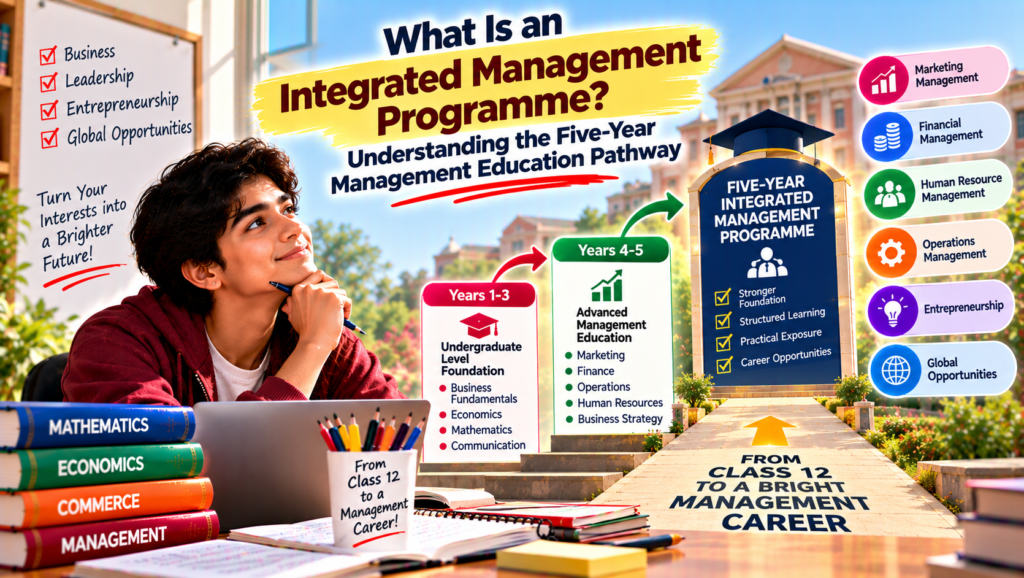
Students interested in business, entrepreneurship and corporate careers often consider management education after completing their Intermediate studies. Traditionally, many students pursue an undergraduate degree such as BBA or B.Com before applying for an MBA. However, an Integrated Program in Management (IPM) offers another pathway by combining undergraduate and postgraduate management education into a structured five-year program. It allows students to begin their management education after Class 12 instead of completing a separate undergraduate degree before pursuing an MBA.
For MEC students exploring career opportunities after Intermediate, understanding this pathway can help them make informed decisions about their future. Admission to several integrated management programs is offered through entrance examinations such as the Integrated Program in Management Aptitude Test (IPMAT), depending on the institution. At CMS, MEC is integrated with IPMAT coaching, giving students an opportunity to prepare for management entrance examinations alongside their Intermediate studies.
What Is an Integrated Program in Management?
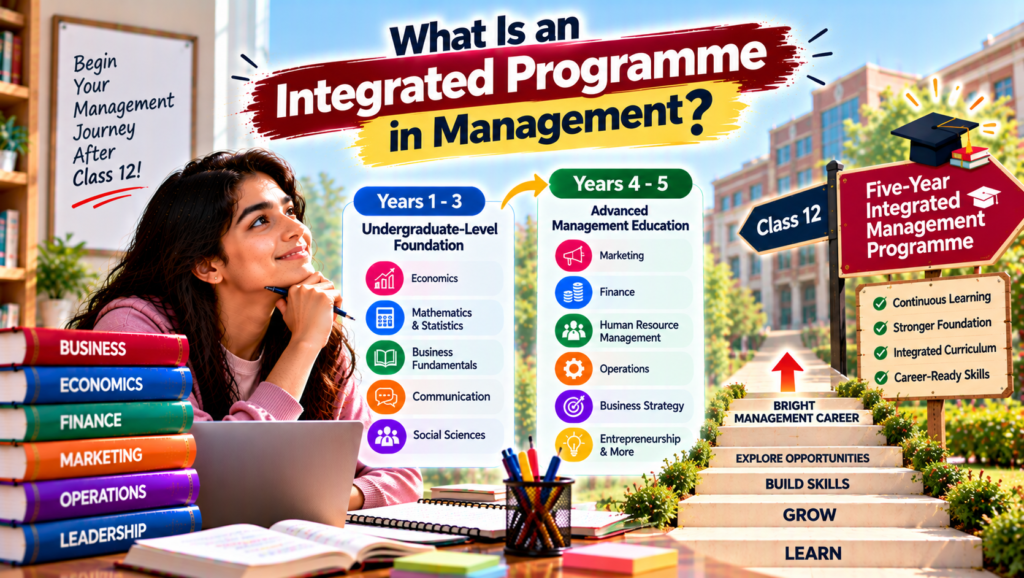
An Integrated Program in Management is a five-year academic program that combines undergraduate-level education with postgraduate management studies. It is designed for students who want to explore management education immediately after Class 12. Instead of completing a separate undergraduate degree and then applying for an MBA, students enter a structured programme that covers foundational subjects first and progresses towards advanced management learning.
The program generally introduces students to areas such as economics, mathematics, statistics, business fundamentals, communication and social sciences during the initial years. As students progress, they study more specialised management subjects, including marketing, finance, human resource management, operations and organisational strategy. The exact curriculum, degree structure and award of qualifications differ across institutions, so students should review the program details before applying.
Understanding the Five-Year Management Education Pathway
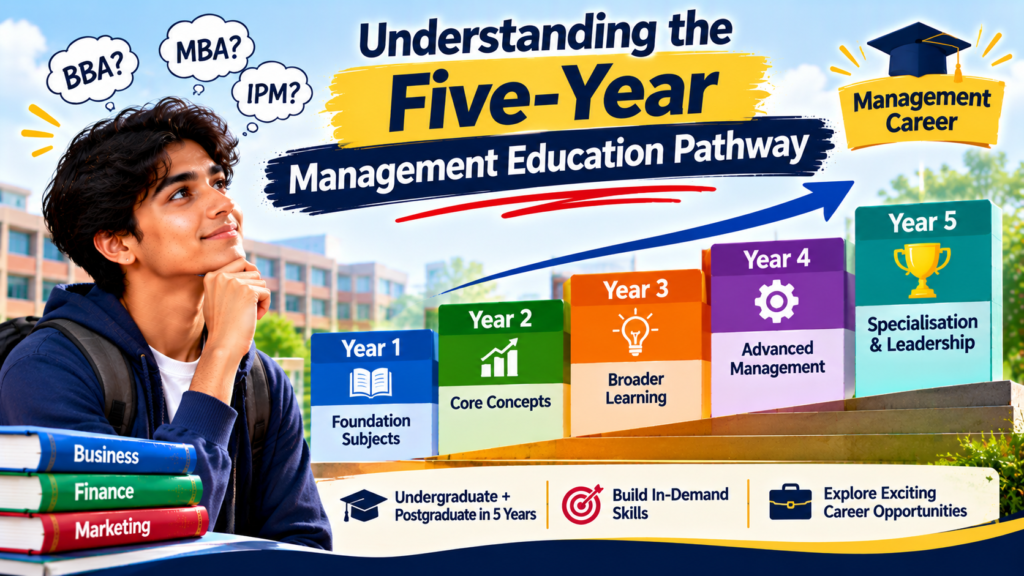
The five-year structure of an Integrated Program in Management is designed to gradually develop a student’s understanding of business and management. The initial years focus on building academic foundations, while the later years introduce advanced management concepts and practical applications.
Years 1 to 3: Undergraduate-Level Foundation
The first three years generally focus on developing a broad understanding of subjects that support management education. Students may study mathematics, economics, statistics, humanities, communication, business fundamentals and other foundational disciplines. This multidisciplinary approach helps them understand how businesses operate within wider economic and social environments.
During this stage, students also develop analytical thinking, problem-solving, teamwork and communication skills. These abilities are important because management involves more than understanding business concepts. Students must learn to evaluate information, work with different people, understand challenges and make reasoned decisions.
Years 4 and 5: Advanced Management Education
The later years generally focus on advanced management subjects and their practical applications. Students may explore areas such as financial management, marketing, operations, human resources, business strategy, entrepreneurship and organisational behaviour. Depending on the institution, the program may also include projects, internships, case studies and industry-oriented learning opportunities.
This stage helps students connect theoretical knowledge with business situations. They learn how organisations plan their activities, manage resources, understand customers and respond to changing market conditions. The combination of foundational and advanced learning is intended to provide a broader understanding of management and organisational decision-making.
What Is IPMAT and How Does It Connect to Integrated Management Program?
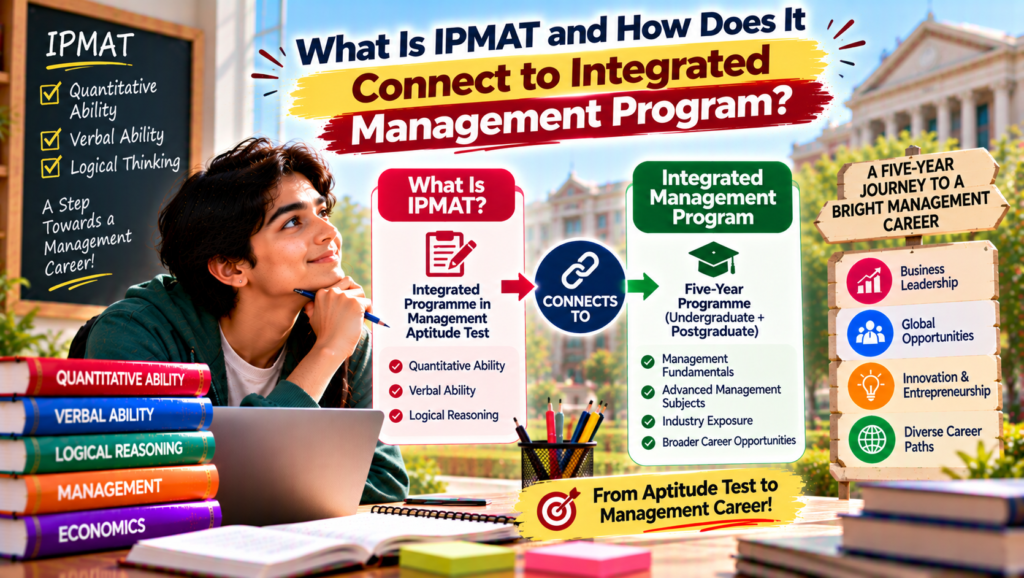
IPMAT stands for Integrated Program in Management Aptitude Test. It is an entrance examination associated with admission to certain five-year integrated management programs offered by institutions such as the Indian Institutes of Management. Students who have completed or are appearing for Class 12 or an equivalent qualifying examination may be eligible to apply, subject to the requirements of the institution and examination.
The examination generally assesses areas such as quantitative ability and verbal ability. Quantitative ability tests mathematical understanding, numerical reasoning and problem-solving skills, while verbal ability evaluates reading comprehension and language-related skills. However, the examination pattern, selection process and eligibility criteria can differ between institutions. Students should understand that IPMAT is not a single admission test accepted by every institution offering an integrated management program. They should check the official admission information of each institution they wish to apply to.
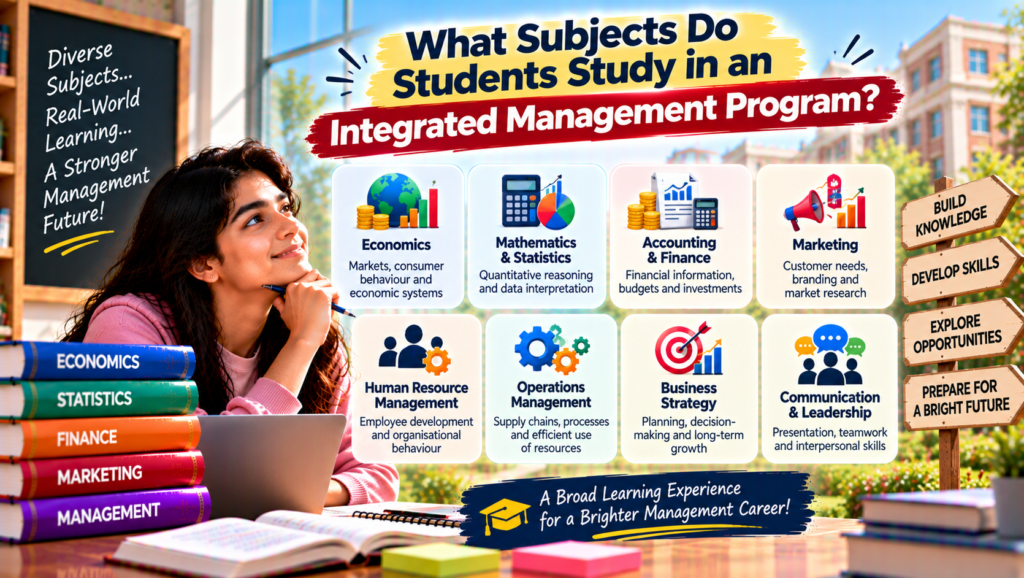
What Subjects Do Students Study in an Integrated Management Program?
Integrated management programs combine different academic disciplines to help students understand business from multiple perspectives. The curriculum may vary depending on the institution, but students generally encounter subjects from the following areas:
- Economics: Understanding markets, consumer behaviour, resource allocation and economic systems.
- Mathematics and Statistics: Developing quantitative reasoning, data interpretation and analytical problem-solving abilities.
- Accounting and Finance: Learning how organisations manage financial information, budgets, investments and resources.
- Marketing: Understanding customer needs, branding, market research and business promotion.
- Human Resource Management: Exploring employee development, organisational behaviour, recruitment and workplace management.
- Operations Management: Understanding production, supply chains, process improvement and efficient use of resources.
- Business Strategy: Learning how organisations plan, compete, make decisions and work towards long-term objectives.
- Communication and Leadership: Developing presentation, teamwork, decision-making and interpersonal skills.
Students should remember that the subjects and the order in which they are taught depend on the program’s curriculum. Reviewing the academic structure of the institution is a useful step before choosing an integrated management course.
How Is an Integrated Management Program Different from BBA Followed by MBA?
Students considering management education after Intermediate often compare an integrated program with the traditional route of completing a BBA or another undergraduate degree followed by an MBA. Both pathways can lead to management education, but their structures and admission processes are different.
In the traditional route, students first complete a three-year undergraduate degree, such as BBA or B.Com, and then apply for an MBA program through the relevant admission process. This gives students an opportunity to explore undergraduate subjects and decide on postgraduate management education later. The integrated route allows students to enter a structured five-year management program after Class 12, subject to admission requirements and program rules.
Neither option is automatically better for every student. An integrated program may appeal to students who are already interested in management education and want a continuous academic pathway. A separate undergraduate degree followed by an MBA may suit students who prefer to explore a different discipline before deciding on management. Students should compare the curriculum, institution, admission criteria, program flexibility and available exit options before making a decision.
Why Is MEC Relevant for Students Interested in IPMAT?
MEC combines Mathematics, Economics and Commerce, making it an option for students interested in numbers, business concepts, financial systems and economic activities. These subjects can provide useful academic exposure for students exploring management education. Mathematics, in particular, helps develop quantitative reasoning and problem-solving skills, which are relevant to the quantitative ability section of IPMAT.
Economics and Commerce also introduce students to concepts related to markets, businesses, financial activities and resource management. This knowledge can help students develop an understanding of the business environment while exploring future management studies. However, students should remember that an Intermediate stream alone does not determine admission eligibility or guarantee success in IPMAT. Entrance examination preparation, performance and the institution’s eligibility requirements remain important.
What Career Opportunities Can Follow Management Education?
An integrated management program can provide a foundation for exploring different professional areas within business and management. The opportunities available to graduates depend on their qualifications, specialisations, skills, experience and the requirements of employers or further study programs.
Some career areas students may explore after completing management education include:
- Marketing Management: Working in brand development, advertising, market research, customer engagement and sales strategy.
- Financial Management: Exploring financial analysis, corporate finance, budgeting and investment-related roles.
- Human Resource Management: Working in recruitment, employee development, training and organisational planning.
- Business Analytics: Using data and analytical tools to understand business performance and support decision-making.
- Operations Management: Managing business processes, supply chains, production activities and operational efficiency.
- Entrepreneurship: Developing business ideas, launching ventures and managing entrepreneurial activities.
- Consulting: Helping organisations analyse challenges, improve processes and make strategic decisions.
Management education can also provide a foundation for further learning and professional development. Students may explore specialised postgraduate studies or other qualifications depending on their interests and career goals.
Skills Students Can Start Developing During Intermediate
Students do not have to wait until they enter a management program to begin developing relevant skills. Their Intermediate years can be a useful time to strengthen the abilities required for management entrance examinations and future business studies.
Some important skills students can work on include:
- Quantitative aptitude: Practise mathematical concepts, numerical reasoning and problem-solving questions.
- Reading comprehension: Develop the habit of reading articles, editorials and informative material to improve understanding and interpretation.
- Communication: Improve vocabulary, written expression, speaking confidence and the ability to explain ideas clearly.
- Logical reasoning: Practise identifying patterns, evaluating information and reaching conclusions through logical thinking.
- Analytical thinking: Learn to compare information, interpret data and approach problems systematically.
- Time management: Develop a realistic study schedule that balances Intermediate subjects with entrance examination preparation.
Developing these skills gradually can help students become more comfortable with aptitude-based examinations and prepare for the academic demands of management education.
Why Start IPMAT Preparation During MEC Intermediate?
Students who are interested in integrated management programs can benefit from understanding IPMAT requirements during Intermediate rather than waiting until the end of Class 12. Early preparation gives them more time to strengthen mathematical fundamentals, improve verbal ability and become familiar with the examination format. It also allows them to identify areas that need additional practice and work on them gradually.
Preparing during MEC Intermediate can help students connect their Mathematics learning with quantitative aptitude practice while continuing to develop their understanding of Economics and Commerce. A structured preparation plan can include concept revision, aptitude exercises, reading practice, mock tests and performance analysis. Students should also research the eligibility criteria and selection procedures of their preferred institutions so that their preparation aligns with their intended admission pathway.
How CMS Supports MEC Students with Integrated IPMAT Coaching
Preparing for Intermediate examinations and IPMAT at the same time requires a balanced approach. Students need to understand their academic subjects while developing the aptitude and language skills required for management entrance examinations. An integrated coaching program can help organise these learning goals within a planned academic routine.
CMS offers MEC integrated with IPMAT Coaching in Hyderabad, giving students an opportunity to prepare for management entrance examinations alongside their Intermediate education. The approach connects MEC learning with relevant preparation areas such as quantitative aptitude and verbal ability. Students can benefit from structured preparation, regular practice, mock tests and performance feedback to understand their progress and identify areas that require improvement.
For students considering management education after Class 12, exploring IPMAT during Intermediate can help them understand the admission pathway and prepare more systematically. Parents and students should also review the program structure, coaching support and examination requirements when choosing an integrated course.
Conclusion
An Integrated Program in Management offers students an opportunity to pursue undergraduate and postgraduate management education through a structured five-year pathway after Class 12. It introduces students to a broad range of subjects, from economics and mathematics to finance, marketing and business strategy. Understanding the program structure, admission process and potential career opportunities can help students decide whether this route matches their interests and future goals.
For MEC students interested in management education, Intermediate is a useful time to explore IPMAT requirements and begin developing quantitative, verbal and analytical skills. With MEC integrated with IPMAT coaching at CMS, students can work towards their Intermediate academic goals while preparing for management entrance examinations. Researching institutions, checking eligibility requirements and following a consistent preparation plan can help students take informed steps towards their future in management.