
Introduction
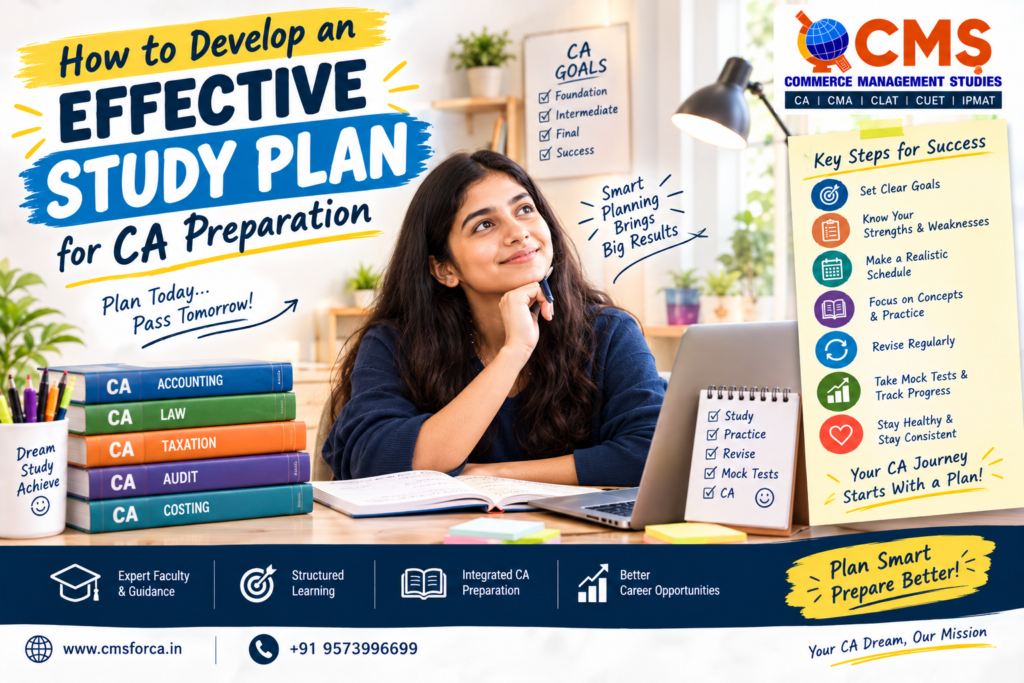
Preparing for Chartered Accountancy requires more than studying for long hours. The CA journey involves multiple subjects, extensive concepts, regular practice, revision, and examinations that require students to apply what they have learned. Because of this, having a structured study plan can help students organize their preparation, distribute their time effectively, and avoid leaving important topics until the final stage.
An effective study plan should be realistic, flexible, and based on the student’s individual strengths and weaknesses. Students should gradually develop a routine that combines concept learning, question-solving, revision, mock tests, and self-assessment. When preparation is planned systematically, students can make consistent progress while also balancing their Intermediate education and other academic responsibilities.
Understand Your CA Preparation Requirements
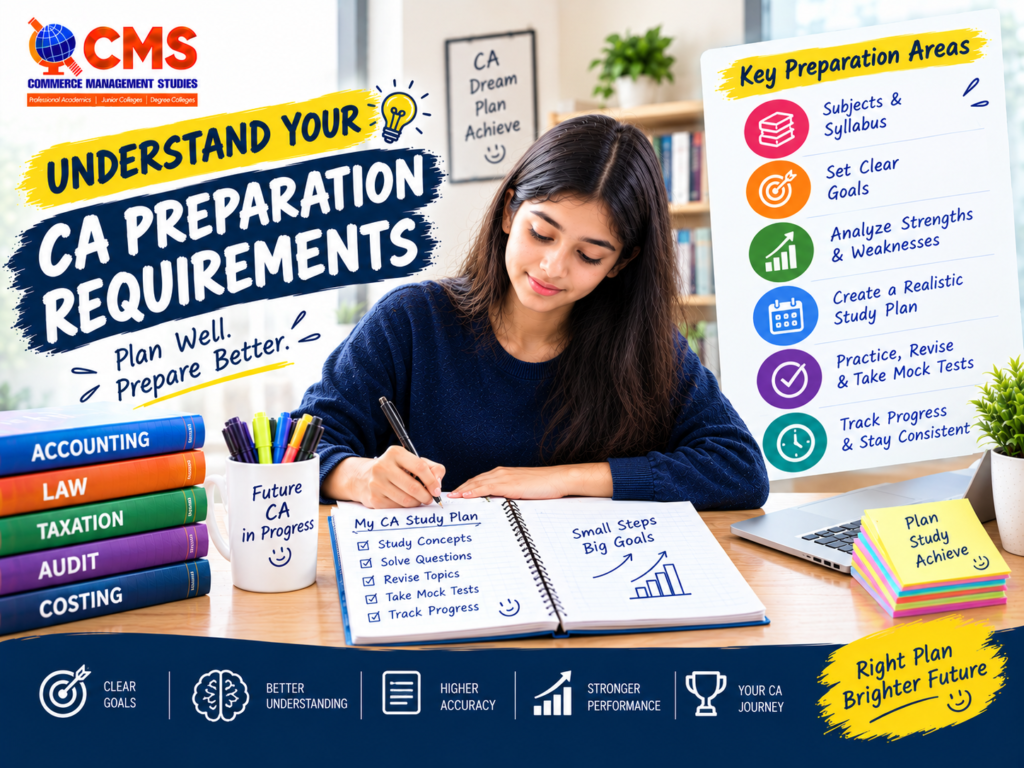
Before creating a timetable, students should first understand the stage of the CA course they are preparing for and the subjects involved. Each subject may require a different preparation strategy, so giving every subject exactly the same amount of time may not always be effective.
Students should identify the topics within each subject, understand the examination requirements, and determine which areas are relatively strong or require additional attention. This initial assessment provides a starting point for creating a study plan that is based on actual needs rather than simply dividing the available time equally.
Set Clear Study Goals
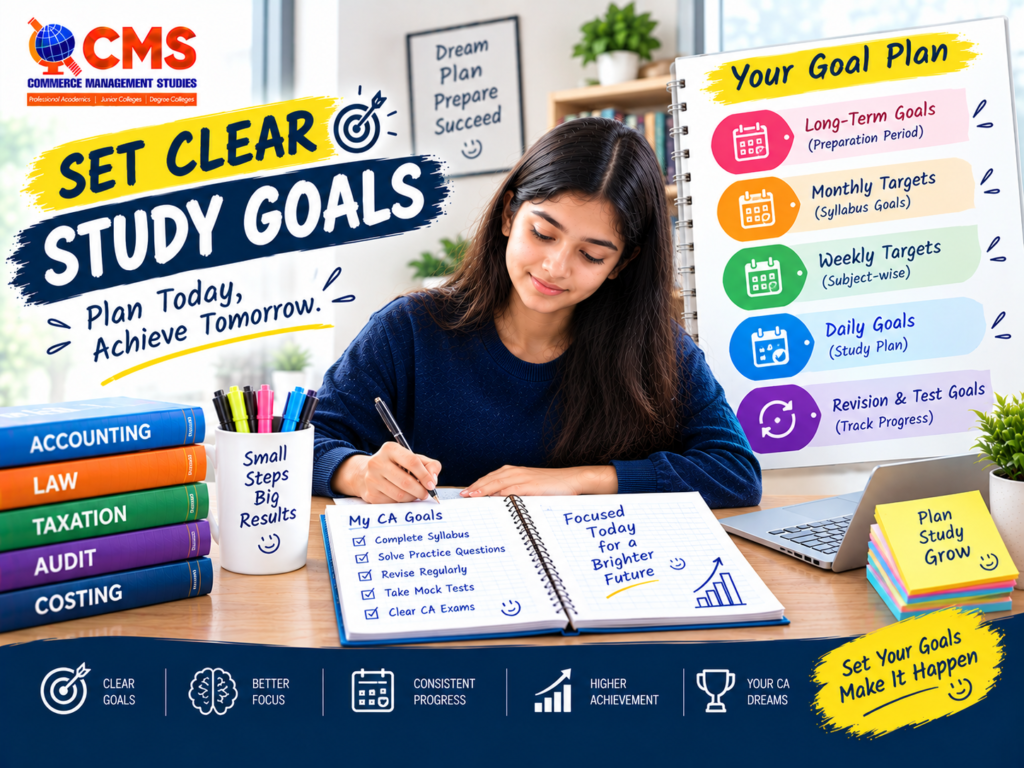
A useful study plan begins with clear goals. Instead of writing a timetable that simply says “study Accounting,” students can set specific objectives such as completing a particular concept, solving a set of problems, or revising a specific chapter.
Goals can be divided into different time periods:
- Long-term goals for the preparation period
- Monthly syllabus targets
- Weekly learning targets
- Daily study objectives
- Revision and test targets
Breaking a large syllabus into smaller goals can make preparation feel more manageable and allows students to monitor their progress regularly.
Assess Your Strengths and Weaknesses
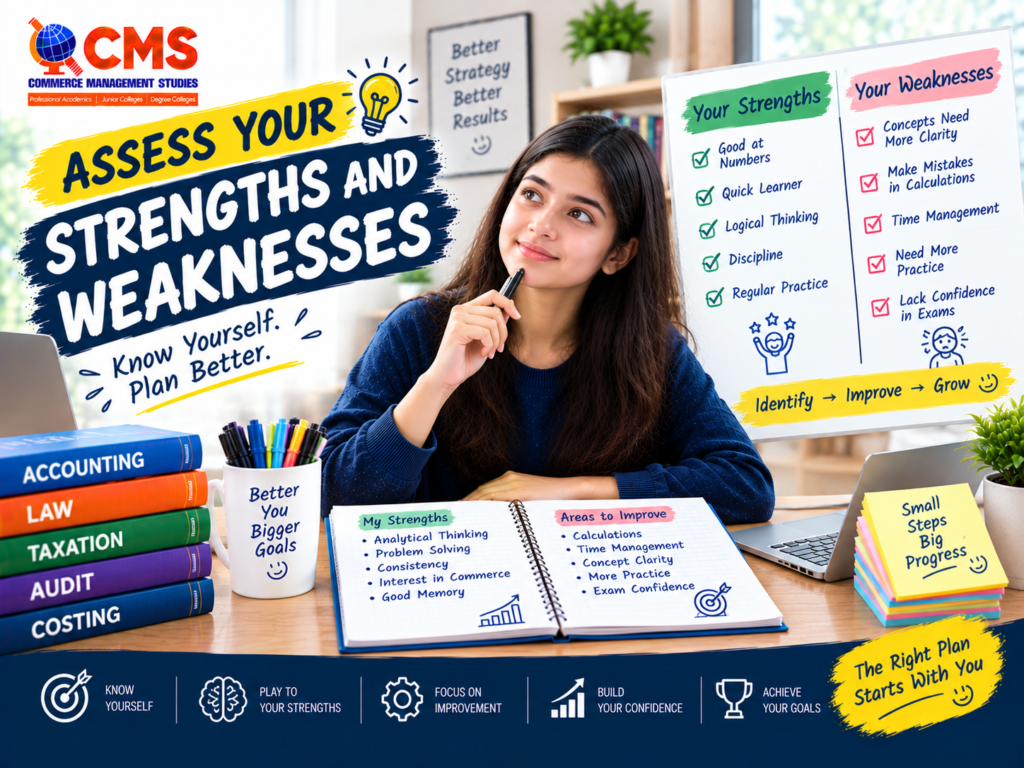
Every student has subjects and topics that they find easier or more difficult. An effective study plan should recognize these differences instead of treating every topic in exactly the same way.
Students can begin by taking a basic assessment or attempting questions from different subjects. Based on their performance, they can classify topics as strong, moderate, or requiring improvement. More time can then be allocated to areas where conceptual understanding or question-solving ability is weaker.
This does not mean ignoring strong subjects. Strong areas still require revision and practice, but weaker areas may need additional attention to bring overall preparation into balance.
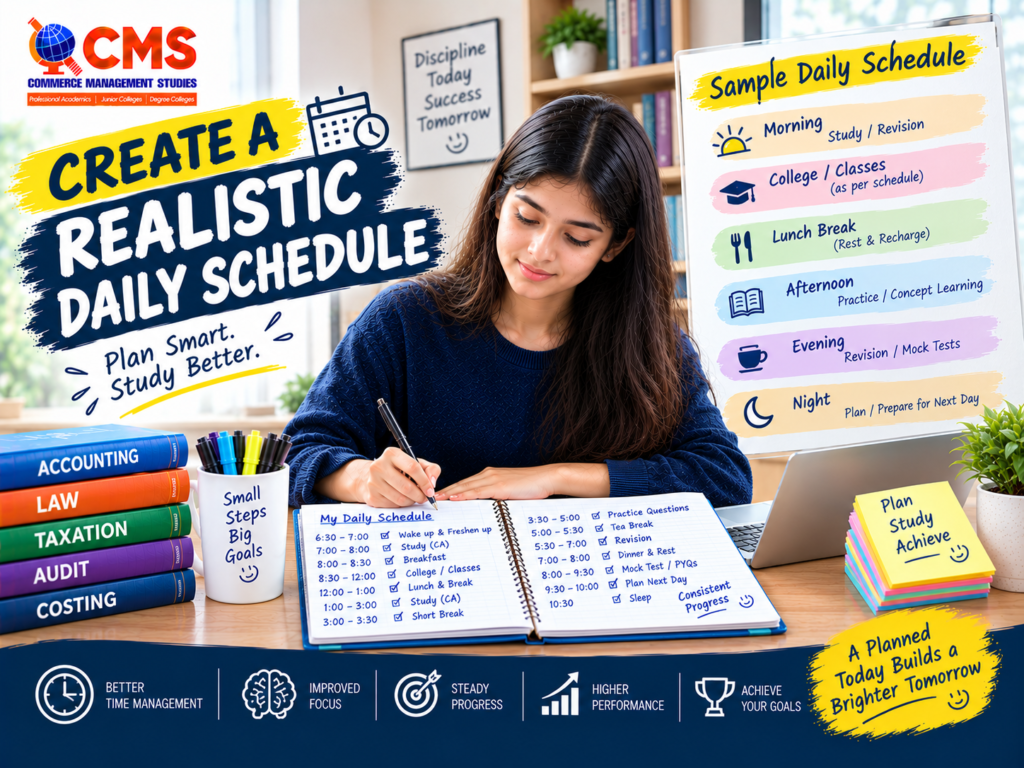
Create a Realistic Daily Schedule
A study timetable should fit the student’s actual routine. Students preparing alongside Intermediate classes should consider school or college hours, travel, assignments, examinations, meals, sleep, and personal responsibilities before deciding how much time they can realistically dedicate to CA preparation.
A practical daily routine might include separate periods for learning new concepts, solving questions, and revising previously studied material. Students can also divide longer study sessions into smaller blocks with short breaks to maintain concentration.
The goal should be to create a routine that can be followed consistently. A timetable that looks perfect but is impossible to maintain is less useful than a simple schedule that students can follow every day.
Follow a Subject-Wise Approach
Different CA subjects require different types of preparation. Numerical subjects generally require regular problem-solving, while theory-oriented subjects may require reading, understanding, recall, and repeated revision.
Students can therefore vary their study methods according to the subject. For example, they can dedicate focused practice sessions to accounting or quantitative areas while using active reading and recall techniques for theory-based topics.
A balanced weekly plan can ensure that no subject is ignored for long periods.
Give Priority to Conceptual Understanding
CA preparation should not depend entirely on memorizing information. Students need to understand concepts well enough to apply them to different types of questions.
While studying a topic, students should ask themselves why a particular rule, formula, accounting treatment, or principle works. Understanding the reasoning behind a concept can make it easier to remember and apply later.
Once the concept is clear, students should reinforce it through examples and practice questions. This creates a stronger connection between learning and application.
Combine Learning With Question Practice
Reading a chapter and feeling that it is understood does not necessarily mean a student can solve examination questions successfully. Question practice helps students determine whether they can actually apply what they have learned.
After completing a topic, students can attempt relevant questions without immediately referring to the solution. If they make a mistake, they should identify the reason and return to the underlying concept where necessary.
A useful preparation cycle is:
Learn → Practice → Check → Correct → Revise
Repeating this cycle can gradually improve both understanding and accuracy.
Use Time Blocks Effectively
Instead of studying one subject continuously for several hours, students can divide their preparation into focused time blocks. Each block can have a specific purpose.
For example:
- Block 1: Learn a new concept
- Block 2: Solve practice questions
- Block 3: Revise an earlier topic
- Block 4: Attempt a short test
This approach gives each study session a clear objective and can reduce the tendency to spend too much time passively reading.
Make Revision Part of the Plan From the Beginning
Revision should not be something students start only after completing the entire syllabus. If previously studied topics are not revisited, students may forget important concepts by the time examinations approach.
Students can include short revision sessions throughout their preparation. A topic studied earlier in the week can be reviewed later, followed by another revision after a longer interval.
Regular revision helps students retain information and can make final examination preparation less stressful.
Use Active Recall
Active recall involves trying to remember information without continuously looking at the textbook or notes. It can be particularly useful for theory-based portions of CA preparation.
After studying a topic, students can close their books and attempt to explain the concept in their own words. They can also write down important points from memory, answer self-created questions, or attempt practice questions without referring to the material.
This allows students to identify what they genuinely remember and which areas require further revision.
Practice Numerical Problems Regularly
For numerical subjects, occasional practice is usually not enough. Students should solve problems consistently so that calculations, methods, and problem-solving approaches become familiar.
Practice should gradually move from basic questions to more complex application-based problems. Students should also avoid immediately checking the solution whenever they become stuck. Giving themselves time to think about the problem can help develop independent problem-solving ability.
Over time, regular practice can improve both confidence and accuracy.
Keep a Record of Mistakes
A mistake notebook can be extremely useful during CA preparation. Students can record important errors made during practice questions, tests, and mock examinations.
The record can include:
- Conceptual mistakes
- Calculation errors
- Incorrect application of a rule
- Questions misunderstood
- Repeated mistakes
- Topics requiring additional revision
Before taking another test, students can review these mistakes. This makes revision more targeted and helps prevent the same errors from appearing repeatedly.
Include Weekly Tests
Weekly tests can help students evaluate whether their preparation is progressing as planned. These tests do not always need to cover an entire subject. They can focus on the topics studied during that particular week.
Testing helps students move beyond passive learning and identify gaps in their understanding. It can also provide an early indication of whether they are able to recall and apply concepts under time constraints.
Students should spend time analyzing their test after completion rather than focusing only on the score.
Gradually Introduce Mock Examinations
As the preparation progresses, students can begin attempting longer and more comprehensive mock tests. These tests can help them become comfortable with examination conditions and develop time-management strategies.
A mock test should be followed by detailed analysis. Students can identify questions they answered incorrectly, questions that took too long, and topics where they lacked confidence.
The purpose of a mock test is not simply to produce a score. It is to provide information that can be used to improve the next stage of preparation.
Learn to Manage Difficult Topics
Students may sometimes spend excessive amounts of time trying to complete a difficult topic in one sitting. This can lead to frustration and reduce the time available for other subjects.
Instead, difficult topics can be divided into smaller sections. Students can understand one concept at a time, practice a few related questions, revise them, and then move to the next part.
If a particular topic remains difficult despite repeated practice, students can seek guidance from teachers or use additional learning resources rather than repeatedly studying the same material without identifying the underlying problem.
Balance CA Preparation With Intermediate Studies
Students pursuing CA alongside Intermediate need to manage both academic responsibilities carefully. Intermediate studies provide an important foundation, particularly when subjects overlap with areas relevant to professional preparation.
A practical approach is to identify connections between Intermediate topics and CA preparation. Students can use their regular academic learning to strengthen concepts while dedicating additional time to CA-specific question patterns and examination requirements.
This approach can make preparation more efficient and reduce unnecessary duplication of effort.
Avoid Creating an Overloaded Timetable
An overloaded timetable can look productive but may be difficult to maintain. Students sometimes create schedules that leave little room for breaks, revision, unexpected academic work, or rest.
A sustainable plan should include realistic study periods and sufficient recovery time. If a student cannot follow a timetable consistently, the schedule should be adjusted rather than treating the inability to follow it as a personal failure.
Consistency over several months is more valuable than following an extreme routine for a few days.
Review Your Plan Every Week
A study plan should not be treated as a fixed document. Students can review their progress at the end of every week and make necessary adjustments.
They can ask:
- Which topics did I complete?
- Which topics remain unfinished?
- Which subjects require more time?
- What mistakes did I make?
- Did I meet my weekly targets?
- How well did I perform in tests?
- What should I change next week?
This weekly review helps students keep the plan aligned with their actual progress.
Increase Revision as Exams Approach
The focus of preparation should gradually change as the examination gets closer. During the early stage, students may spend more time understanding concepts and completing the syllabus.
Once most of the syllabus has been covered, the emphasis can shift toward revision, question-solving, mock tests, and correcting weak areas. In the final stage, students can focus more heavily on recalling important concepts and practicing under examination conditions.
This gradual transition prevents students from trying to complete learning, revision, and mock tests simultaneously at the last minute.
Use Technology as a Study Tool
Digital resources can support CA preparation through online classes, practice tests, educational videos, digital notes, and other learning materials. However, students should use these resources selectively.
Collecting too many resources can create confusion. Students should identify reliable sources and use them consistently rather than constantly switching between different materials.
Technology should make preparation more organized, not add another layer of distraction.
Take Care of Sleep and Breaks
A successful study plan must include adequate sleep and breaks. Studying for extremely long hours without rest can make it harder to concentrate and retain information.
Students can use short breaks between study sessions and maintain a consistent sleep schedule. Physical activity, proper meals, hydration, and personal time can also help students maintain their energy throughout a long preparation period.
CA preparation is a long-term process, so maintaining physical and mental well-being is part of effective preparation.
Building a CA Foundation During Intermediate
Students who are interested in CA can begin developing relevant academic skills during Intermediate rather than waiting until they formally enter the professional course. Strong fundamentals in Commerce, Economics, and Mathematics can provide useful preparation for different aspects of professional learning.
For students pursuing MEC, Mathematics can strengthen numerical and analytical ability, while Economics and Commerce provide complementary exposure to economic and business concepts. CEC students can similarly develop their Commerce and Economics foundation while building the additional skills required for their chosen professional pathway.
Integrated CA Preparation With Intermediate
An integrated approach can help students connect their Intermediate education with their long-term professional goals. Instead of treating Intermediate and CA preparation as completely separate activities, students can gradually develop relevant concepts, study habits, problem-solving skills, and examination techniques alongside their regular academic curriculum.
At CMS, students can pursue MEC or CEC with integrated CA Coaching in Hyderabad, allowing them to work on their Intermediate subjects while progressively building a foundation for the CA pathway. Regular practice, assessments, revision, and structured learning can help students develop the consistency required for professional education.
Conclusion
An effective CA study plan is not simply a timetable containing a large number of study hours. It is a structured system that combines conceptual learning, question practice, revision, testing, mistake analysis, and regular progress reviews. Students should create realistic targets, prioritize weaker areas, adapt their study methods according to different subjects, and gradually increase examination-oriented practice.
The most important part of any study plan is consistency. Students who develop disciplined study habits early, review their progress regularly, and adjust their approach when necessary can make their preparation more organized and sustainable. With a balanced routine and strong academic foundation, CA preparation can become a structured journey rather than a last-minute effort.