
Introduction
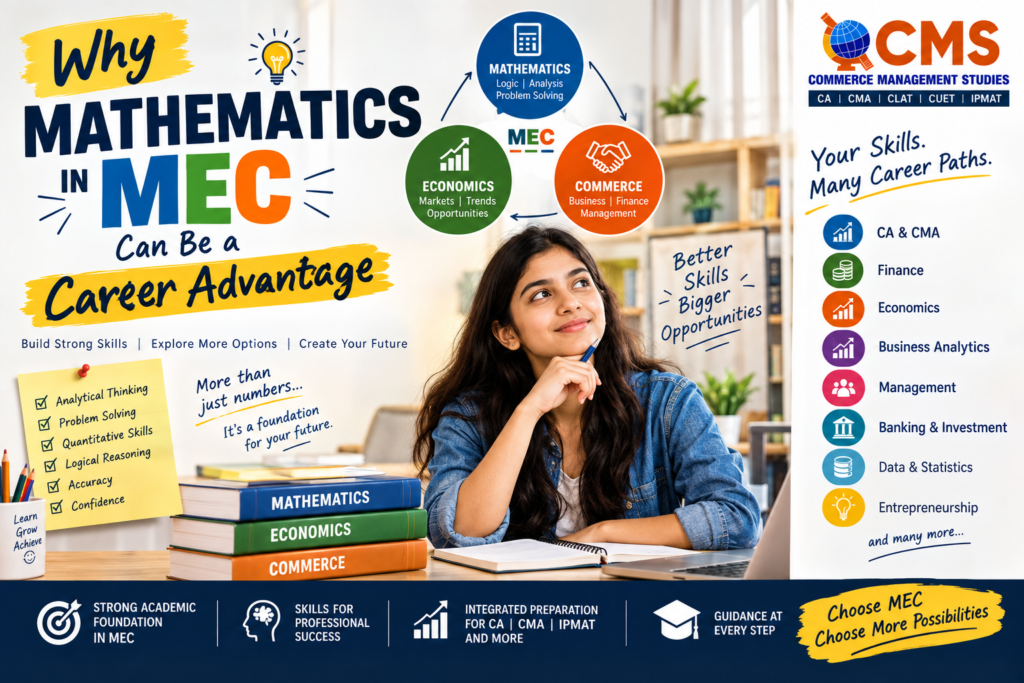
Choosing the right Intermediate stream after Class 10 can influence the subjects students study and the skills they develop during an important stage of their education. MEC, which combines Mathematics, Economics, and Commerce, brings together numerical ability, economic understanding, and business concepts. This combination can be useful for students who want to keep multiple academic and professional pathways open after Intermediate.
Mathematics is particularly valuable within MEC because it develops more than the ability to solve equations. Regular mathematical practice can strengthen logical thinking, analytical ability, accuracy, and structured problem-solving. These skills can be useful across areas such as Chartered Accountancy, Cost and Management Accountancy, management education, entrance examinations, finance, economics, business analysis, and several other career paths.
Understanding the MEC Combination
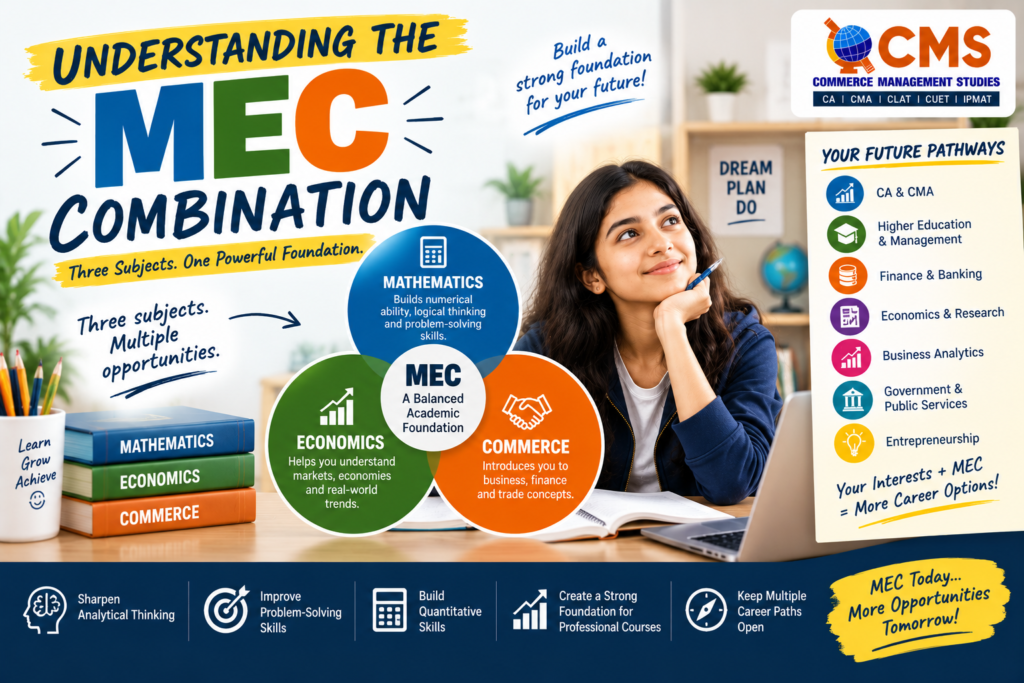
MEC combines three subjects that approach business and economic concepts from different perspectives. Mathematics develops quantitative and logical skills, Economics helps students understand how markets and economies function, while Commerce introduces students to fundamental business and financial concepts.
The combination can therefore provide a balanced academic foundation for students who enjoy working with numbers and are interested in business, finance, economics, or management. Instead of focusing on only one type of learning, students get opportunities to develop numerical, analytical, and commercial understanding together.
Why Mathematics Matters in MEC
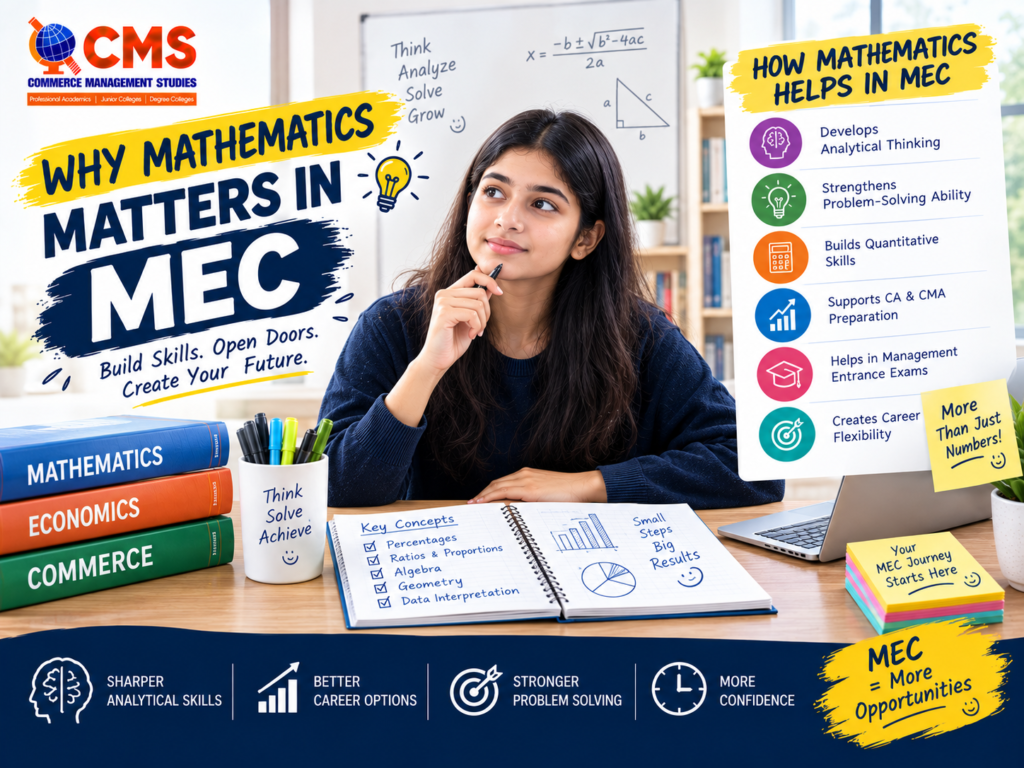
Mathematics encourages students to approach problems systematically. A mathematical problem usually requires students to understand the information provided, identify the appropriate method, perform calculations, and arrive at a logical answer.
These habits can extend beyond the classroom. Business and financial decisions frequently involve numbers, comparisons, percentages, trends, forecasts, and quantitative information. Students who become comfortable working with numbers early can find it easier to approach such information in future academic and professional settings.
1. Develops Analytical Thinking
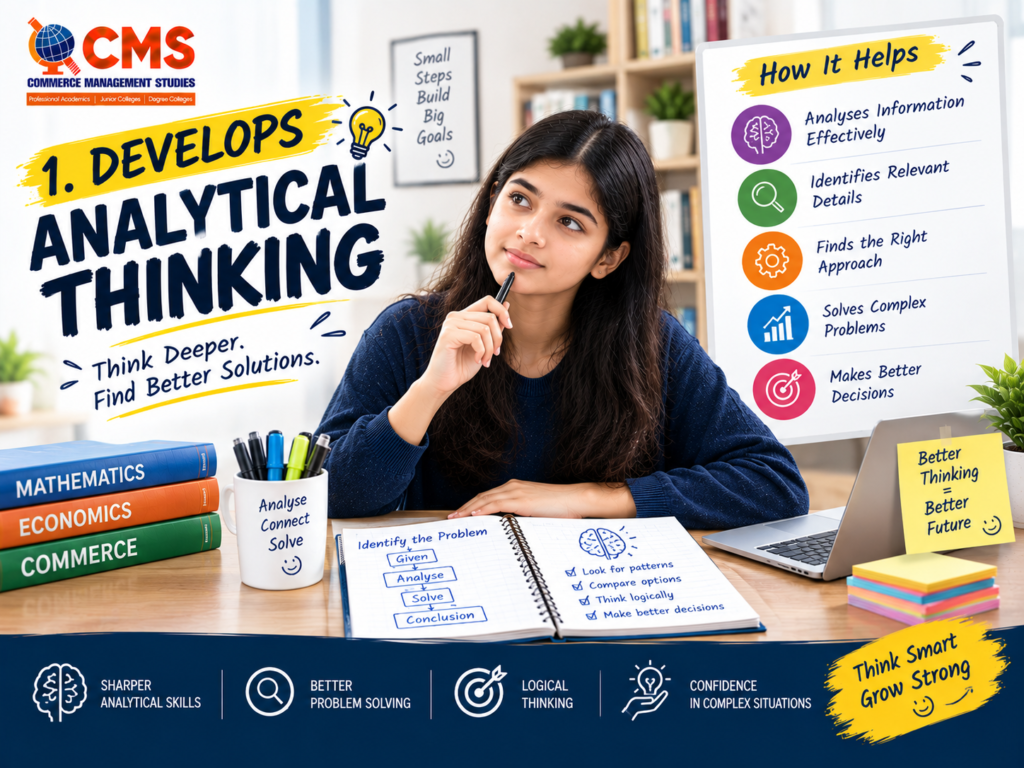
Mathematics requires students to examine information and determine how different elements are connected. This process naturally develops analytical thinking, which is useful in many areas of higher education.
For example, when students solve a complex problem, they learn to separate relevant information from unnecessary information and identify the steps required to reach a solution. This way of thinking can also be applied when analyzing business situations, economic trends, financial information, or entrance-examination questions.
Analytical thinking is therefore one of the broader skills students can develop through Mathematics, rather than simply learning formulas and calculations.
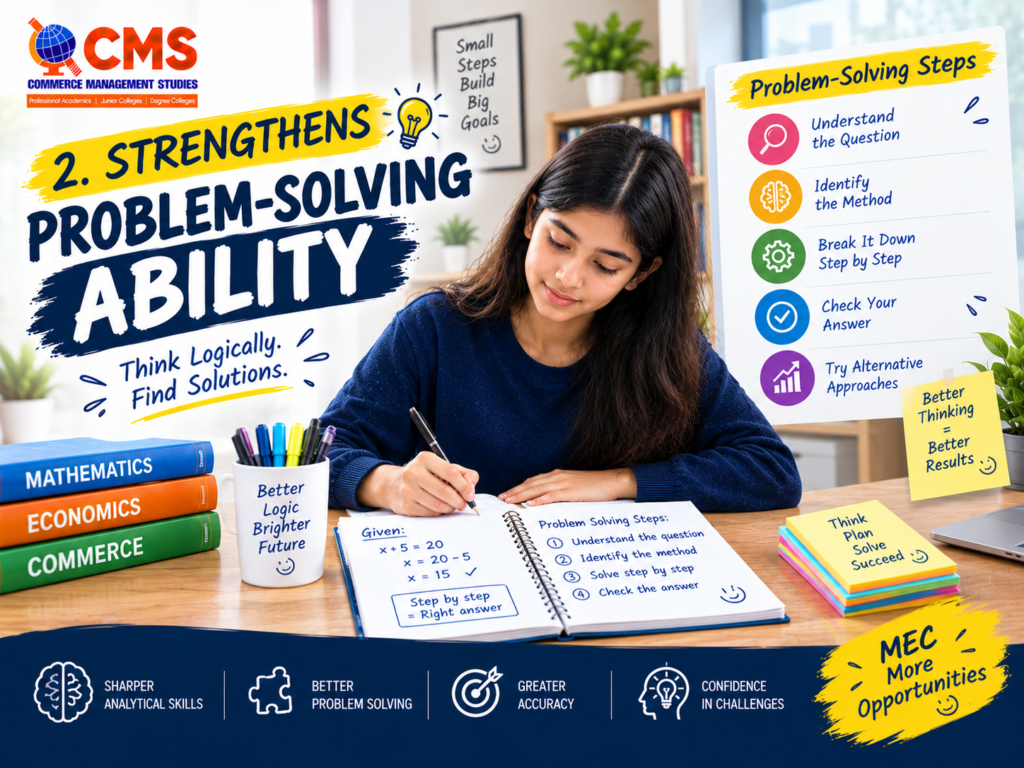
2. Strengthens Problem-Solving Ability
Problem-solving is an important skill across professional fields. Mathematics provides students with regular opportunities to practice solving problems through logical and structured methods.
Students gradually learn that a difficult problem can often be broken into smaller steps. They also learn to test approaches, identify errors, and try alternative methods when the first approach does not work.
This ability to approach challenges systematically can be useful in professional courses such as CA and CMA as well as management-oriented education and competitive examinations.
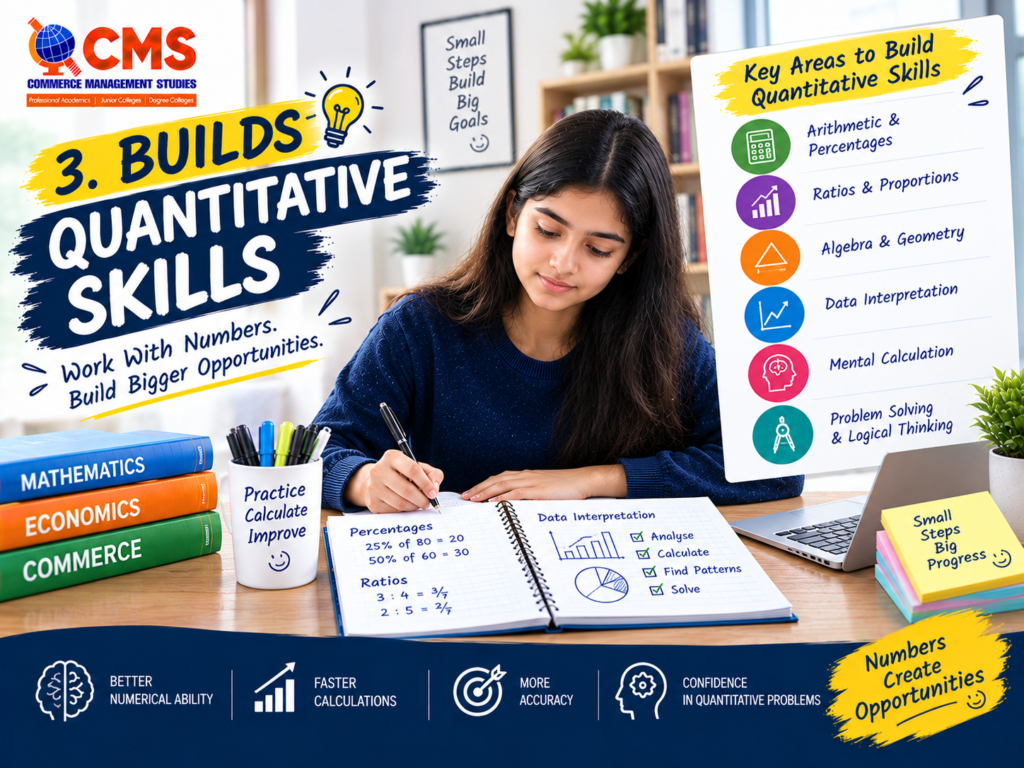
3. Builds Quantitative Skills
Modern businesses use numbers extensively. Financial statements, sales figures, budgets, market data, growth rates, costs, revenues, and forecasts all involve quantitative information.
Studying Mathematics in MEC can help students become more comfortable interpreting and working with numbers. This foundation can be useful when they later encounter more specialized subjects involving accounting, finance, economics, statistics, or business analytics.
Quantitative ability can also be valuable in entrance examinations where students are expected to solve numerical problems accurately within a limited amount of time.
4. Supports CA Preparation
Students interested in Chartered Accountancy can benefit from the combination of Mathematics, Economics, and Commerce. Commerce provides exposure to accounting and business fundamentals, while Economics introduces students to economic concepts and Mathematics strengthens quantitative and analytical ability.
Mathematics is not a replacement for accounting knowledge, but the numerical discipline developed through Mathematics can support students when they work with calculations and analytical problems. Students can therefore use their Intermediate years to develop complementary skills while preparing for the CA pathway.
5. Provides a Foundation for CMA
Cost and Management Accountancy involves understanding costs, financial information, budgeting, analysis, and business decision-making. Many of these areas require comfort with numbers and logical analysis.
MEC can provide students with exposure to Mathematics alongside Commerce and Economics, giving them an opportunity to develop quantitative and commercial understanding together. This can be a useful foundation for students who later choose to pursue CMA and related finance or management fields.
6. Helps With Management Entrance Examinations
Several management entrance examinations include quantitative or analytical components. Students preparing for examinations such as IPMAT may need to work with arithmetic, algebra, data interpretation, and other mathematical concepts.
MEC students already have regular exposure to Mathematics during Intermediate, which can provide a useful starting point for developing aptitude skills. However, students should remember that entrance-examination Mathematics often emphasizes application, logical thinking, and time management, so academic learning should be supplemented with dedicated aptitude practice.
7. Supports Economics and Business Understanding
Mathematics and Economics can complement each other in several ways. Economics frequently involves numerical relationships, graphs, percentages, statistics, and the interpretation of data.
A student who is comfortable with quantitative concepts may find it easier to understand certain economic relationships and analyze numerical information. This does not mean that Economics is purely mathematical, but mathematical confidence can provide an additional advantage when dealing with quantitative aspects of the subject.
Commerce can then add another dimension by introducing students to accounting, business activities, and financial concepts.
8. Develops Accuracy and Attention to Detail
Mathematical problems often require careful calculations and attention to small details. A minor error in a calculation or interpretation can change the final answer.
Regular practice can therefore encourage students to check their work, follow steps carefully, and identify errors. Attention to detail can be particularly useful in areas such as accounting, finance, auditing, taxation, and data analysis, where accuracy is important.
Developing this habit during Intermediate can have value well beyond Mathematics examinations.
9. Encourages Logical Decision-Making
Mathematics trains students to base solutions on information and logical relationships. While real-world decisions are more complex than mathematical problems, the habit of evaluating available information before reaching a conclusion can be useful.
Business professionals frequently need to compare alternatives, assess numerical information, and consider possible outcomes. Students who develop structured thinking early can gradually learn to approach such situations with greater clarity.
10. Builds Confidence With Numbers
Some students feel uncomfortable when they encounter numerical information, particularly when problems appear unfamiliar. Regular Mathematics practice can gradually reduce this hesitation.
Confidence develops when students understand concepts, practice different types of questions, make mistakes, correct them, and eventually solve similar problems independently. This process can make numerical problem-solving feel less intimidating over time.
The objective is not to become perfect at every type of mathematical problem but to develop the confidence to understand a problem and work toward a solution.
Career Areas Where Quantitative Skills Can Help
Mathematical and analytical skills can be relevant across a broad range of careers. Depending on their higher education and specialization, students with a strong quantitative foundation may explore areas such as:
- Chartered Accountancy
- Cost and Management Accountancy
- Finance
- Economics
- Business Analytics
- Investment and Financial Services
- Management
- Banking
- Statistics
- Data-related fields
- Actuarial studies
- Entrepreneurship
The career outcome depends on the student’s subsequent education, professional qualifications, interests, and specialization. MEC provides a foundation rather than determining a single career.
Mathematics and Competitive Examinations
Mathematical ability can also support students preparing for competitive examinations. Many entrance tests require candidates to work with numbers, percentages, ratios, equations, data, or logical relationships.
Students can use their Intermediate Mathematics preparation as a starting point and gradually adapt to aptitude-style questions. The key difference is that competitive examinations often require students to identify efficient approaches and solve questions within strict time limits.
Therefore, students should combine conceptual learning with regular practice, timed exercises, and mock tests.
Building Skills Beyond the Textbook
The career advantage of Mathematics does not come only from completing chapters and scoring marks. Students can maximize its value by focusing on the skills developed through the subject.
They can practice:
- Solving unfamiliar problems
- Explaining their reasoning
- Checking calculations
- Comparing different approaches
- Working with graphs and data
- Identifying patterns
- Managing time while solving questions
- Learning from incorrect answers
These habits can gradually strengthen the analytical mindset required in many professional and academic environments.
MEC and the Flexibility It Provides
One of the advantages of MEC is that it does not force students to decide on a single professional career immediately after Class 10. Students can explore different interests while building a combination of numerical, economic, and commercial knowledge.
A student may later choose CA, CMA, management education, economics, finance, business analytics, or another related field. The appropriate pathway will depend on the student’s interests, strengths, and future academic choices.
This flexibility can be particularly useful for students who know they are interested in commerce or business but are still exploring which professional direction suits them best.
Making the Most of Mathematics in MEC
Students can make their Mathematics preparation more valuable by focusing on conceptual clarity rather than relying entirely on memorization. Understanding why a method works can help them apply it to questions that are presented differently.
Regular practice is equally important. Students should solve questions consistently, review mistakes, and gradually move from basic exercises to application-based and time-bound problems. This approach can strengthen both academic performance and practical quantitative ability.
MEC With Integrated Professional Preparation
Students who have already identified professional courses such as CA, CMA, or management entrance examinations can gradually connect their Intermediate studies with their future goals. Mathematics can strengthen quantitative skills while Economics and Commerce provide complementary knowledge in business and finance.
At CMS MEC Coaching in Hyderabad, MEC can be pursued with integrated preparation for professional and entrance pathways such as CA, CMA, and IPMAT. This allows students to continue building their Intermediate academic foundation while developing skills relevant to their chosen future direction.
Is MEC Right for Every Student?
MEC can be a strong option for students who are comfortable with Mathematics or are willing to develop their mathematical skills and who have an interest in commerce, economics, finance, business, or management. However, choosing a stream should always depend on the student’s interests, aptitude, and long-term goals rather than simply following what others choose.
Students should understand the subjects involved and consider the type of learning they enjoy. If a student is interested in business and finance but also enjoys working with numbers and analytical problems, MEC can offer a particularly relevant combination.
Conclusion
Mathematics in MEC can provide more than an additional academic subject. It can help students develop analytical thinking, quantitative ability, logical reasoning, accuracy, and structured problem-solving skills. When combined with Economics and Commerce, these abilities can create a broad foundation for students interested in professional courses and careers related to accounting, finance, economics, business, and management.
The real advantage comes from how students use the subject. By developing conceptual clarity, practicing consistently, learning from mistakes, and connecting mathematical skills with real-world applications, students can build abilities that remain useful beyond Intermediate. For students interested in keeping multiple commerce-related career pathways open, MEC can therefore provide a strong and versatile academic foundation.