
Introduction
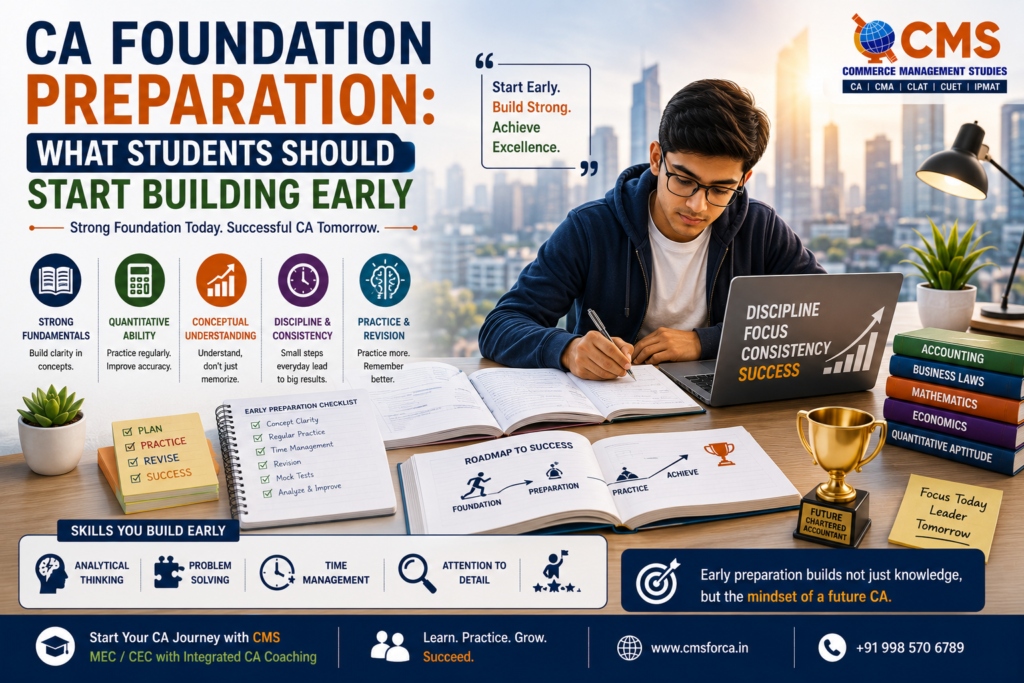
The CA Foundation stage is an important starting point for students who want to pursue Chartered Accountancy as a professional career. Unlike regular academic examinations, professional-course preparation requires students to develop a combination of conceptual understanding, problem-solving ability, accuracy, and disciplined study habits. Building these qualities early can make the transition into CA Foundation preparation more structured and manageable.
Students do not need to begin by trying to master the entire professional syllabus at once. A more effective approach is to strengthen the academic foundation they are already developing during Intermediate and gradually build the skills required for professional studies. Strong fundamentals in subjects such as accounting, mathematics, economics, and business-related concepts can provide a useful base for approaching CA Foundation studies with greater confidence.
Understanding the CA Foundation Stage
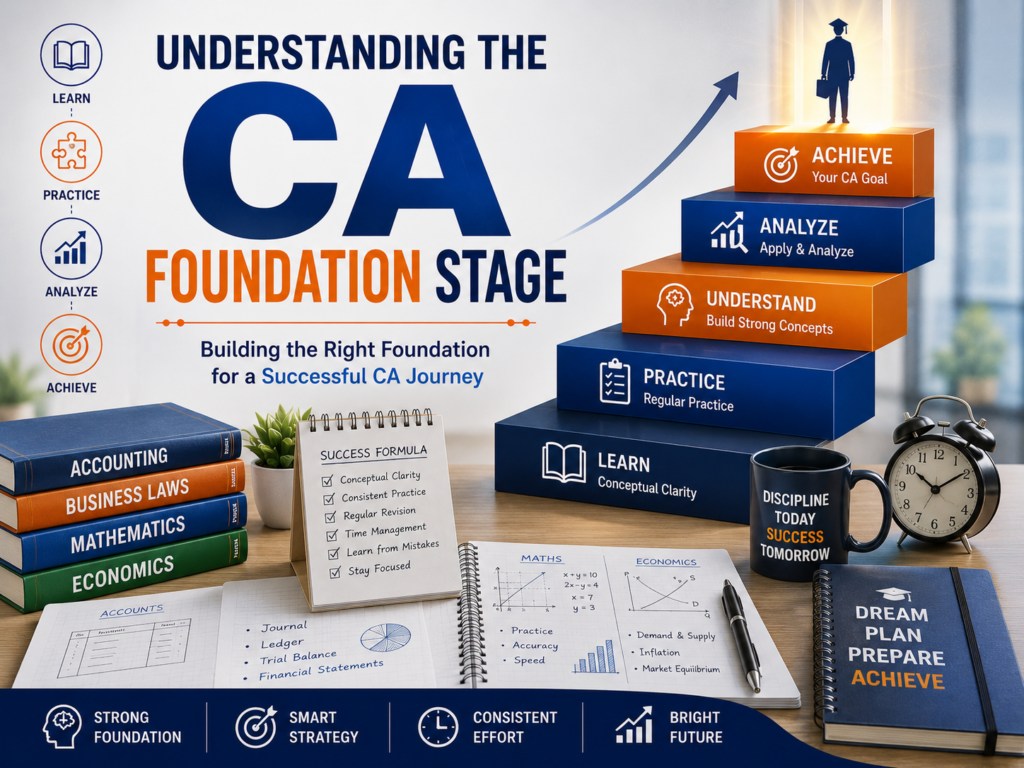
CA Foundation is the entry-level examination in the Chartered Accountancy course conducted by the Institute of Chartered Accountants of India (ICAI). It introduces students to fundamental areas of accounting, business laws, quantitative aptitude, and economics, helping them develop the knowledge required for the next stages of the CA journey.
The Foundation stage requires students to understand concepts and apply them to questions rather than relying entirely on memorization. This makes early skill development particularly valuable. Students who become comfortable with numerical problem-solving, reading, analysis, and regular revision during Intermediate can gradually adapt to the demands of professional examination preparation.
1. Build Strong Accounting Fundamentals
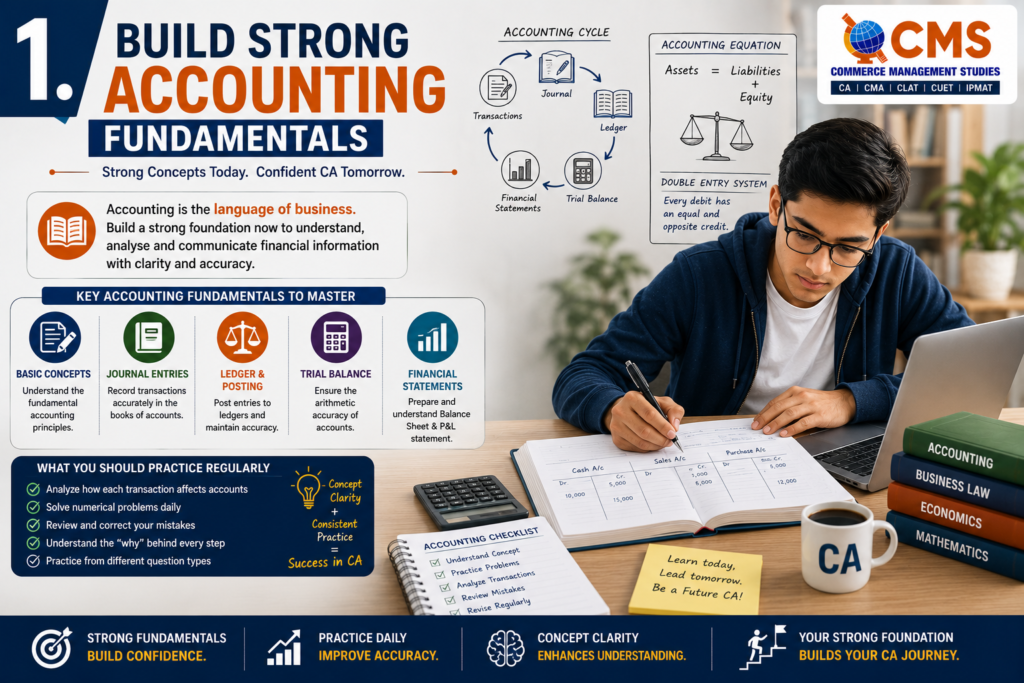
Accounting is an important area for students pursuing CA, making conceptual clarity particularly valuable from the beginning. Students should understand basic accounting principles, transactions, journal entries, ledgers, trial balances, and financial statements rather than simply memorizing procedures.
A strong foundation allows students to understand why a particular accounting treatment is used. When students encounter more complex problems later, this conceptual understanding can help them identify the appropriate method and apply it correctly. Regular practice is equally important because accounting requires students to translate their understanding into accurate solutions.
Students can focus on:
- Understanding basic accounting concepts
- Practicing journal entries
- Learning how transactions affect accounts
- Understanding financial statements
- Solving numerical problems regularly
- Reviewing mistakes and correcting them
The goal should be to develop accuracy and conceptual clarity together.
2. Strengthen Quantitative Ability
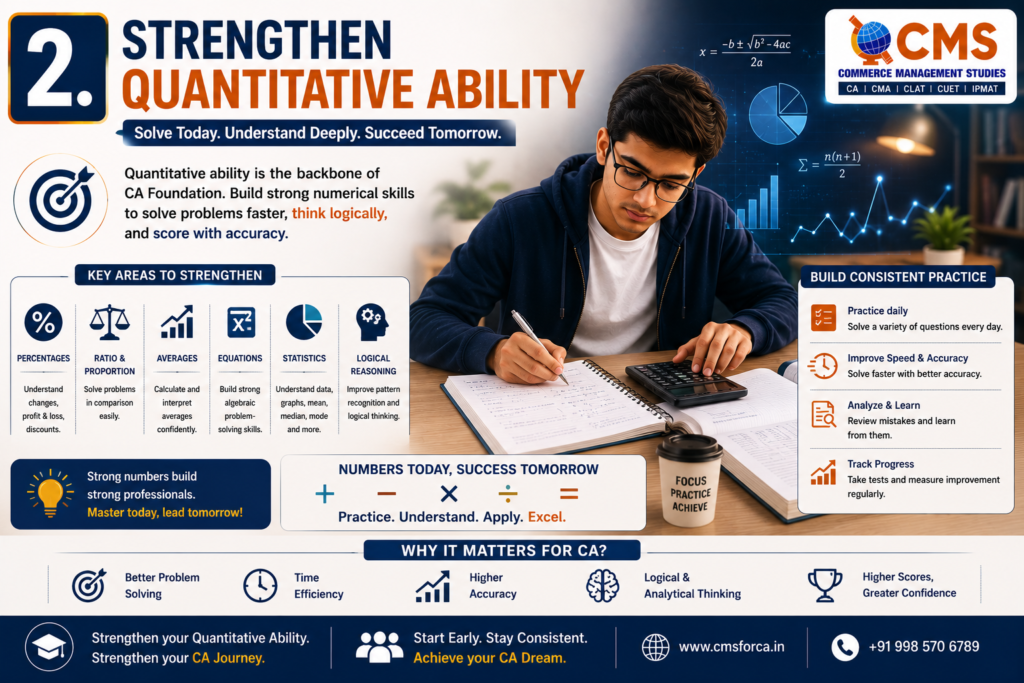
Quantitative ability is another skill students can begin developing well before their professional preparation becomes intensive. Working with percentages, ratios, averages, equations, statistics, and other mathematical concepts can help students become more comfortable with numerical problems.
Students should focus on understanding the logic behind mathematical methods rather than relying only on memorized formulas. Regular practice can improve both speed and accuracy, while solving different types of problems can help students become more confident when they encounter unfamiliar questions.
Developing quantitative ability early can also support other academic and professional pathways that involve analytical and numerical thinking. The skill is therefore useful beyond CA preparation alone.
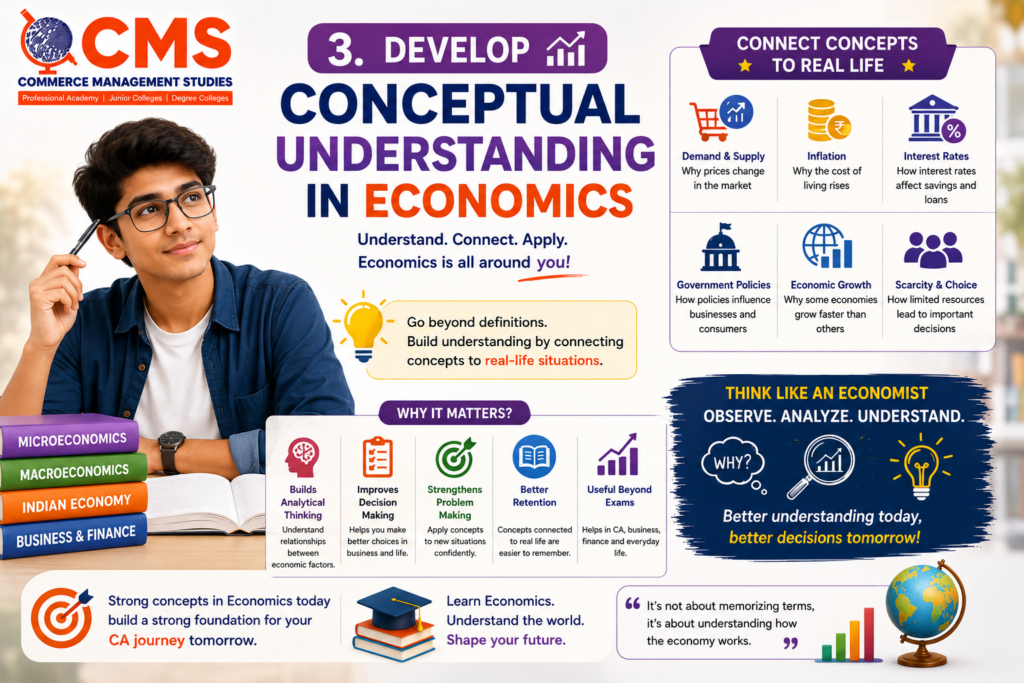
3. Develop Conceptual Understanding in Economics
Economics helps students understand how markets, businesses, consumers, resources, and economic systems function. Instead of studying definitions in isolation, students can try to connect economic concepts with real-world situations.
For example, students can observe how changes in prices, demand, inflation, interest rates, or government policies can influence businesses and consumers. Connecting classroom concepts with practical situations can make the subject easier to understand and remember.
A strong foundation in Economics can also encourage students to think analytically. Rather than simply recalling information, they learn to understand relationships between different economic factors.

4. Improve Business and Commercial Awareness
Students preparing for CA can benefit from understanding how businesses actually operate. Learning about different types of businesses, financial decisions, markets, contracts, and organizational activities can provide useful context for professional subjects.
Students can gradually develop business awareness by following reliable business news, reading informative articles, and observing how companies respond to changes in markets and regulations. This does not mean memorizing every business event. The objective is to develop curiosity about how financial and commercial decisions affect organizations.
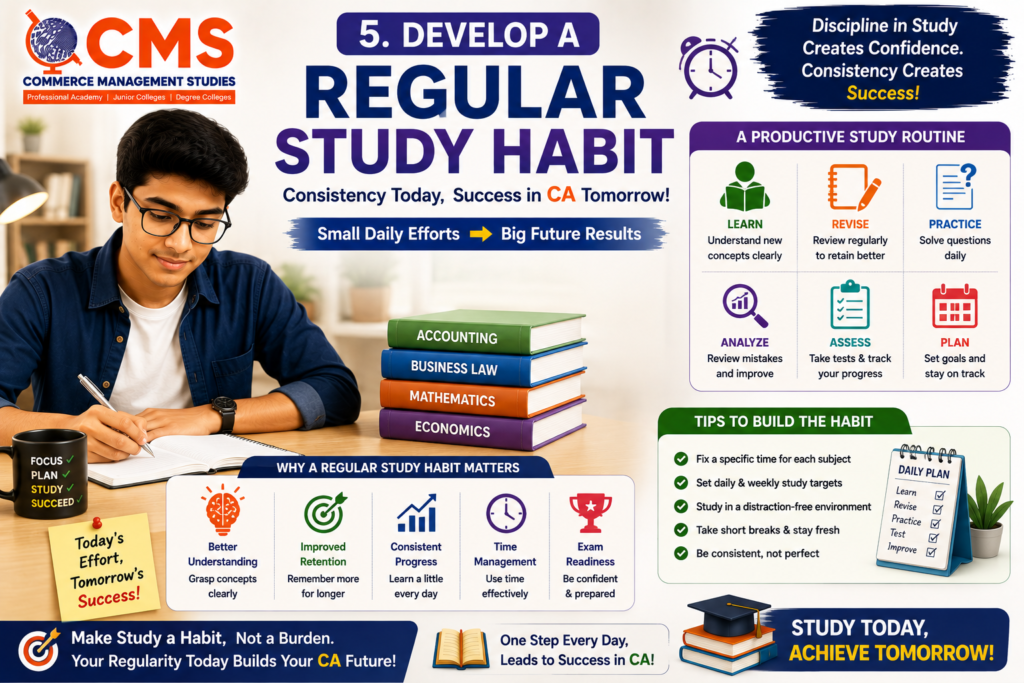
5. Develop a Regular Study Habit
One of the most valuable habits students can build before entering intensive CA preparation is consistency. Studying regularly helps students become comfortable with maintaining an academic routine over a long period.
A regular study habit does not necessarily mean spending extremely long hours with textbooks. Students can begin with manageable daily targets and gradually increase their study time when required. The important part is maintaining consistency and avoiding dependence on last-minute preparation.
A productive routine can include:
- Learning new concepts
- Revising previous topics
- Solving practice questions
- Reviewing mistakes
- Completing assignments
- Taking periodic assessments
Over time, these habits can make professional-course preparation more structured.
6. Learn to Manage Time Effectively
CA preparation involves managing multiple subjects and different types of questions. Students therefore need to learn how to distribute their available time effectively.
Time management can begin during Intermediate itself. Students can create realistic schedules, divide large chapters into smaller sections, set weekly targets, and allocate specific time for revision. This approach can help prevent students from spending too much time on one topic while neglecting others.
Effective time management is not about studying continuously. It is about using available time productively while maintaining sufficient rest and personal time.
7. Develop the Habit of Revision
Learning a concept once is not enough to guarantee that it will be remembered later. Regular revision helps students reinforce what they have learned and identify areas that need additional attention.
Students can use short revision sessions throughout the week instead of postponing all revision until examinations. They can revisit important concepts, formulas, definitions, accounting treatments, and previously solved problems at regular intervals.
Revision can also become more effective when students actively recall information instead of simply reading the same material repeatedly. Attempting questions without looking at the solution can help students determine whether they genuinely understand the topic.
8. Practice Question-Solving
CA Foundation preparation requires students to apply their knowledge to questions. Therefore, students should develop the habit of solving questions regularly rather than limiting their preparation to reading and note-making.
Practice helps students identify whether they can actually use a concept in a problem. It also exposes them to different question formats and gradually improves their ability to approach unfamiliar situations.
Students should pay attention to the process as well as the final answer. When an answer is incorrect, they should understand where their reasoning went wrong and attempt a similar problem again.
9. Learn From Mistakes
Mistakes are an important part of the learning process. Students who identify and understand their mistakes can use them to improve future performance.
After completing practice questions or tests, students can classify their errors. Some may result from a lack of conceptual understanding, while others may occur because of calculation errors, misreading, poor time management, or simple carelessness.
Keeping track of recurring mistakes can be useful because it allows students to recognize patterns. If the same type of error appears repeatedly, students can return to the underlying concept and practice it again.
10. Develop Reading and Comprehension Skills
Professional education involves reading and understanding a considerable amount of information. Students can therefore benefit from developing strong reading and comprehension skills early.
Regular reading can improve vocabulary, concentration, comprehension, and the ability to identify important information. Students can read newspapers, informative articles, business content, and other quality material to gradually improve their understanding.
The objective should not simply be to read quickly. Students should practice identifying the central idea, important facts, arguments, and conclusions. These skills can support both academic learning and professional examination preparation.
Building Exam-Oriented Thinking
Regular academic study and professional examination preparation require slightly different approaches. Students eventually need to learn how to apply concepts under time constraints and deal with different types of questions.
They can begin developing this mindset by occasionally practicing questions within a fixed time. This helps them understand how long different problems take and encourages them to focus on both accuracy and efficiency.
As students progress toward CA Foundation preparation, they can gradually introduce topic-wise tests, sectional assessments, and full-length mock examinations. Each stage provides an opportunity to measure improvement and identify areas requiring further work.
The Importance of Conceptual Clarity
Professional examinations can involve questions that test whether students can apply a concept rather than simply reproduce a definition. This makes conceptual clarity more valuable than rote learning.
Students should therefore ask themselves questions such as:
- Why does this concept work?
- How is this formula derived or applied?
- What happens when the conditions change?
- Why is one answer correct while another is incorrect?
- How can this concept be applied to a different problem?
This approach encourages deeper learning and can make it easier to handle questions that are presented in unfamiliar ways.
Balancing CA Preparation With Intermediate Studies
Students should not neglect their Intermediate education while preparing for their future CA journey. The academic concepts they learn during Intermediate can contribute to the foundation required for professional studies.
A balanced approach can involve strengthening Intermediate subjects while gradually introducing CA-oriented concepts and practice. Students can use related topics from their academic curriculum as opportunities to develop deeper understanding and numerical or analytical skills.
This approach can also prevent preparation from becoming unnecessarily stressful. Students can progress steadily instead of trying to complete large amounts of professional material too early.
The Role of Integrated CA Preparation
Starting professional preparation alongside Intermediate can provide students with a structured environment in which academic learning and future career goals are connected. Concepts can be introduced progressively, while students continue to focus on their regular curriculum.
At CMS, students can pursue MEC or CEC with integrated CA Coaching in Hyderabad, allowing them to strengthen their Intermediate foundation while gradually preparing for the CA pathway. Regular classes, practice, assessments, and revision can help students develop the discipline and conceptual clarity required for professional education.
Skills That Can Support the CA Journey
CA preparation involves more than subject knowledge. Students can use their Intermediate years to develop a range of transferable skills that can remain valuable throughout their academic and professional careers.
These include:
- Analytical thinking
- Numerical ability
- Problem-solving
- Attention to detail
- Communication
- Time management
- Logical reasoning
- Consistency
- Independent learning
- Decision-making
Building these skills gradually can make students better prepared to handle both professional examinations and future workplace responsibilities.
Starting Early Without Creating Pressure
Starting early should be viewed as an opportunity to build a foundation, not as a reason to create excessive academic pressure. Students need sufficient time for their regular studies, family, friends, extracurricular activities, relaxation, and sleep.
The most effective preparation is usually sustainable preparation. A student who studies consistently at a manageable pace can often make more meaningful progress than someone who follows an extremely demanding schedule for a short period and then struggles to maintain it.
Early preparation should therefore focus on developing good habits, strengthening fundamentals, and creating familiarity with professional learning rather than rushing through the entire CA syllabus.
Conclusion
CA Foundation preparation becomes more manageable when students begin building the right academic and personal skills early. Strong accounting fundamentals, quantitative ability, economic understanding, reading skills, conceptual clarity, regular practice, revision, and effective time management can provide a valuable foundation for the professional journey.
Starting early does not mean studying under constant pressure or attempting to complete advanced material immediately. It means using the Intermediate years to develop strong fundamentals and disciplined learning habits. With consistent effort and a balanced approach, students can enter CA Foundation preparation better prepared to understand concepts, solve problems, manage their time, and work toward their long-term goal of becoming a Chartered Accountant.