
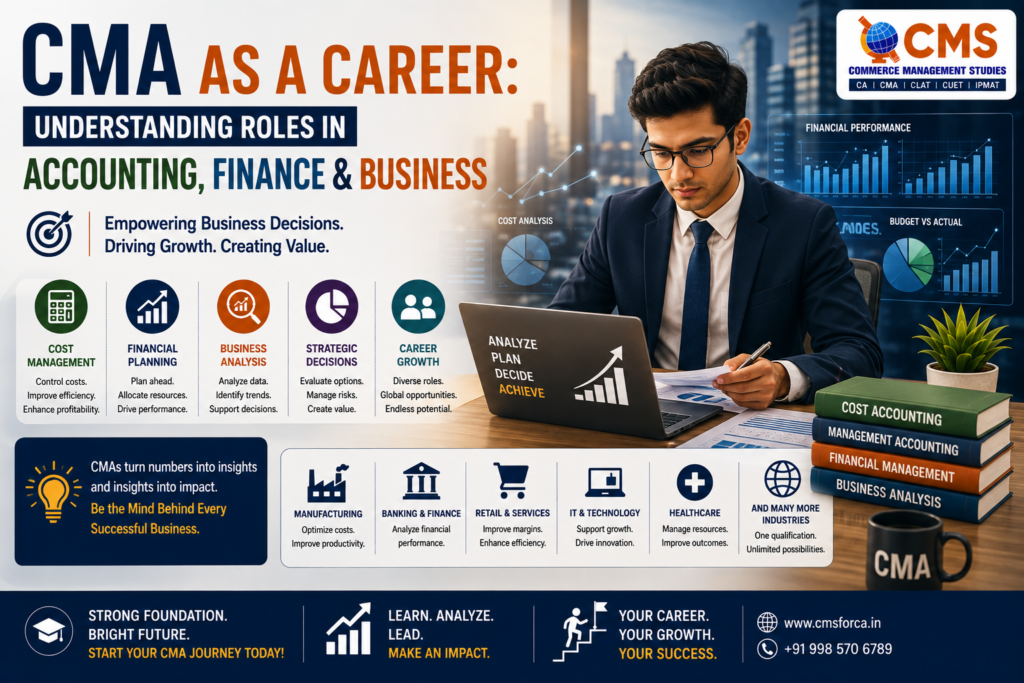
Introduction
The role of a Cost and Management Accountant has evolved considerably as businesses have become more complex, competitive, and data-driven. Traditionally, accounting professionals were closely associated with recording financial information, preparing statements, and monitoring costs. While these responsibilities remain important, modern businesses increasingly need financial professionals who can also interpret information, analyze performance, support planning, and contribute to important management decisions.
A Cost and Management Accountant, commonly known as a CMA, works at the intersection of accounting, finance, cost management, and business strategy. By examining financial and operational information, CMAs can help organizations understand where resources are being used, how costs can be managed, and how financial decisions may affect future performance. This makes the profession relevant across manufacturing, services, technology, banking, healthcare, retail, and many other industries.
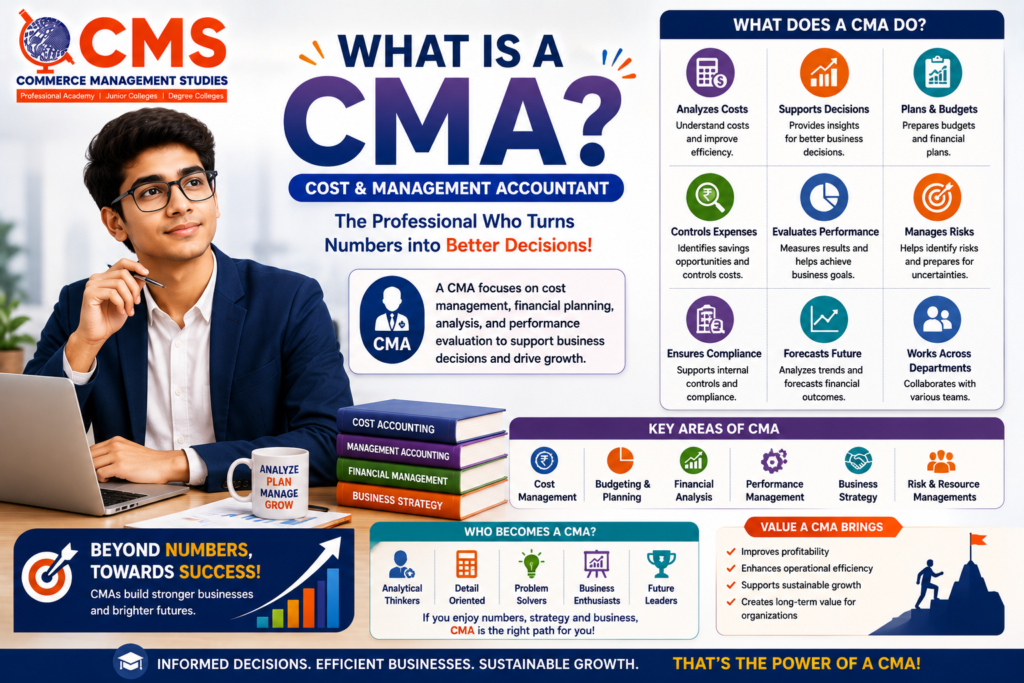
What Is a CMA?
A Cost and Management Accountant specializes in areas such as cost accounting, management accounting, financial planning, budgeting, performance evaluation, and business analysis. The profession focuses not only on recording what has already happened financially but also on using financial information to understand business performance and support future decisions.
A CMA may work with different departments within an organization to analyze costs, prepare budgets, evaluate financial performance, and provide management with useful information. This broader perspective allows the professional to understand how financial figures connect with operational activities and business objectives.
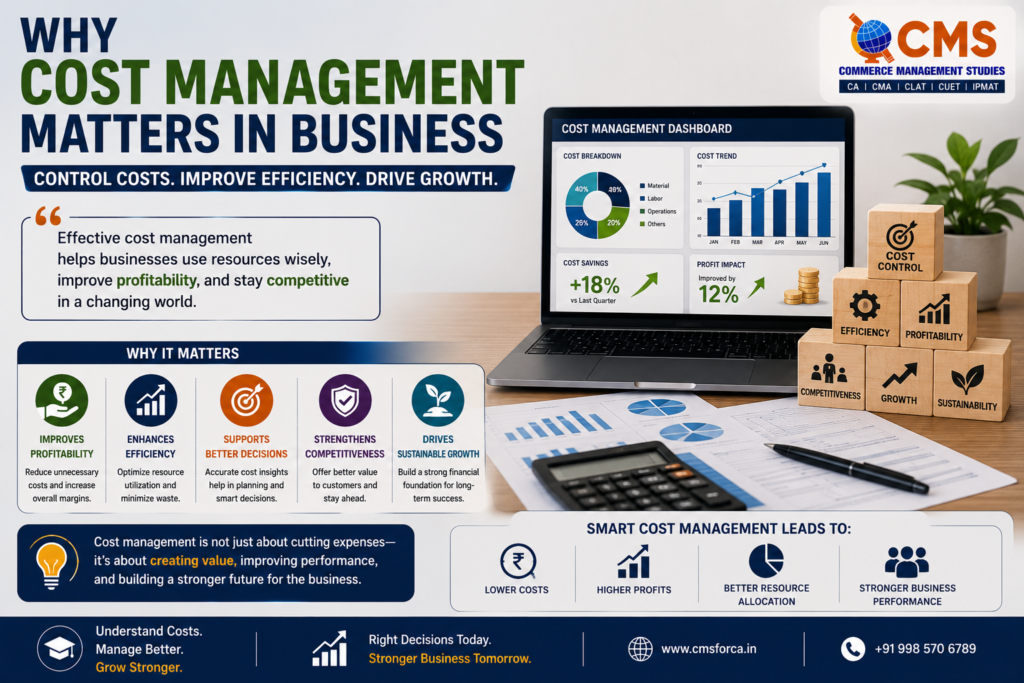
Why Cost Management Matters in Business
Every business needs to manage its resources carefully. Whether an organization manufactures products, provides services, develops technology, or operates through an online platform, controlling unnecessary costs can influence profitability and long-term sustainability.
CMAs help businesses examine different components of cost and understand where resources are being consumed. By analyzing expenses and comparing actual performance with planned targets, they can help management identify areas where efficiency can be improved. Cost management is therefore not simply about reducing spending; it is about ensuring that resources are being used effectively while maintaining the required level of quality and performance.
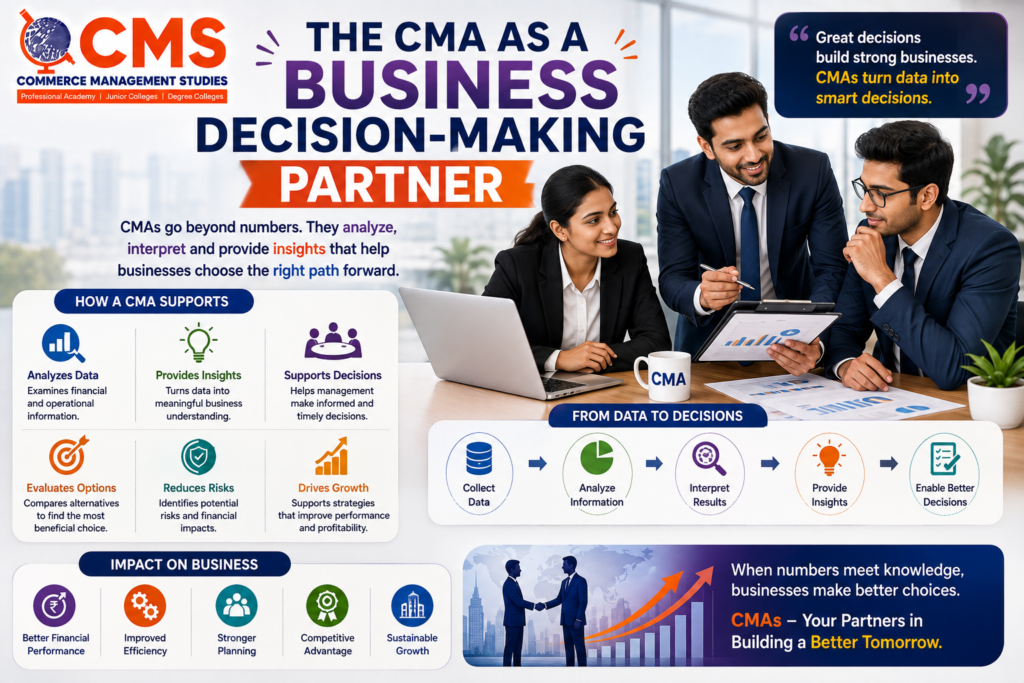
The CMA as a Business Decision-Making Partner
Modern management decisions often involve financial consequences. Before launching a new product, expanding operations, entering a new market, changing pricing, or investing in technology, businesses need to understand the potential costs and benefits.
A CMA can contribute to this process by analyzing relevant financial information and presenting it in a way that supports decision-making. Rather than simply providing numbers, the professional can help management understand what those numbers mean and how different choices may affect profitability, costs, cash flow, and overall performance.
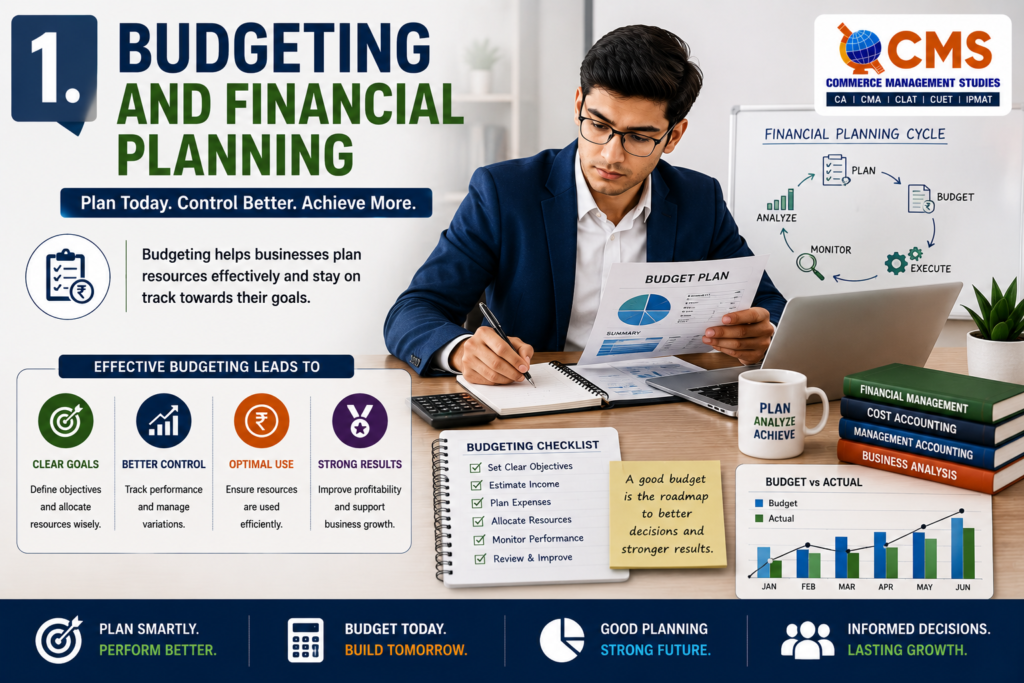
1. Budgeting and Financial Planning
Budgeting is an important function within organizations because it helps businesses plan how financial resources will be allocated. A budget can provide a framework for expected revenue, expenses, investments, and operational requirements.
CMAs can participate in preparing budgets, analyzing differences between planned and actual results, and identifying reasons for significant variations. This information can help management make adjustments when business conditions change. Effective budgeting can therefore support both short-term financial control and long-term planning.
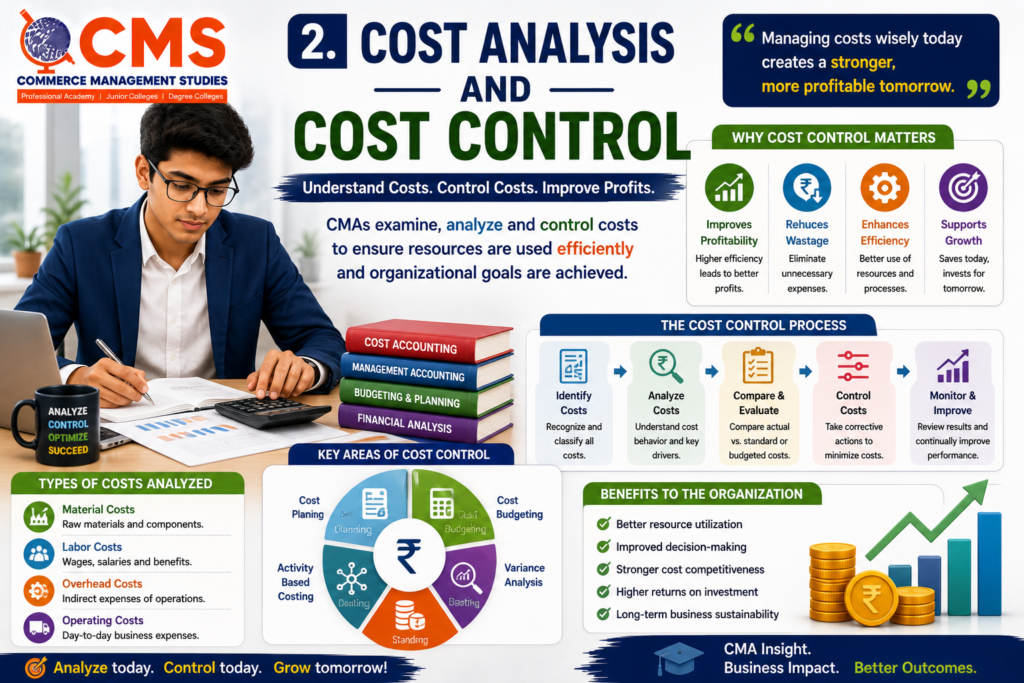
2. Cost Analysis and Cost Control
Understanding costs is one of the central responsibilities associated with management accounting. Businesses need to know not only how much they are spending but also what is driving those costs.
CMAs can analyze direct and indirect costs, production expenses, operating costs, and other financial components. They can help management identify inefficiencies and evaluate whether resources are being used effectively. The objective is not necessarily to minimize every expense but to understand which costs contribute to business value and where improvements may be possible.
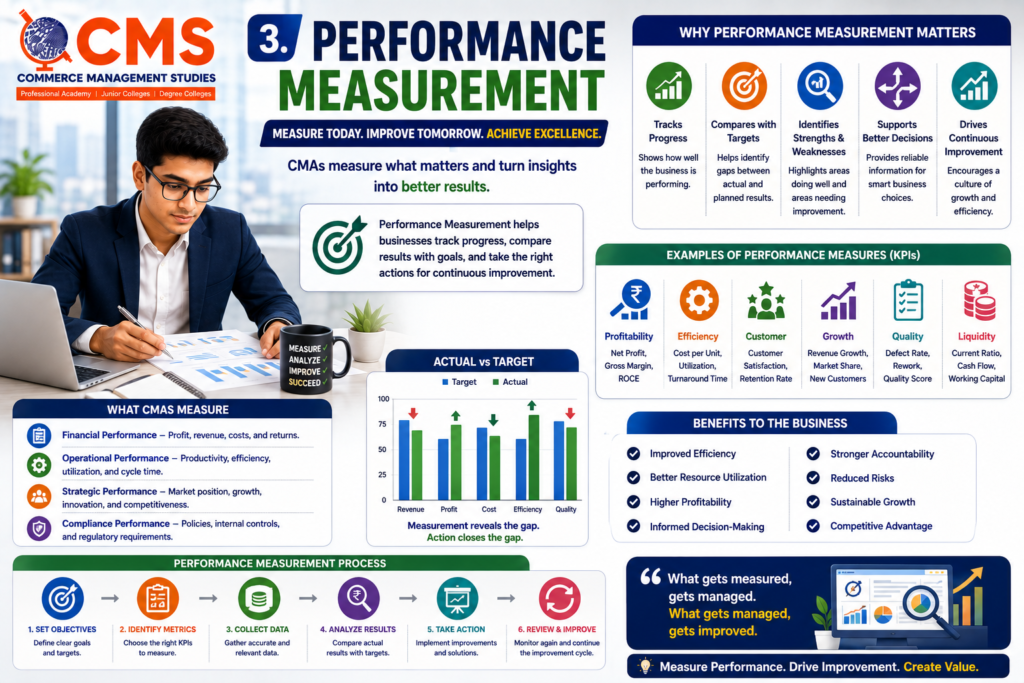
3. Performance Measurement
Businesses need reliable ways to evaluate whether they are meeting their objectives. Financial performance indicators can provide valuable information, but management often needs a broader view that connects financial results with operational performance.
CMAs can help develop and analyze performance measures that allow organizations to compare actual results with planned targets. They may examine profitability, costs, productivity, efficiency, and other relevant indicators. This analysis can help management identify areas performing well and areas that require attention.
4. Financial Forecasting
Business conditions can change quickly. Customer demand, input costs, competition, interest rates, technology, and economic conditions can all influence future performance.
Financial forecasting involves using available information to estimate possible future outcomes. CMAs can contribute to forecasting by analyzing historical financial information, current business conditions, and expected changes. While forecasts cannot guarantee what will happen, they can help organizations prepare for different possibilities and make more informed plans.
5. Supporting Pricing Decisions
Determining the appropriate price for a product or service requires more than simply looking at competitors. Businesses need to understand production costs, operating expenses, customer demand, market conditions, and desired margins.
CMAs can provide financial analysis that helps management evaluate different pricing scenarios. They can examine how changes in price or volume could affect revenue and profitability. This information can support management when considering pricing strategies and business objectives.
6. Investment and Business Expansion Decisions
Organizations regularly make decisions about investments, new projects, expansion, equipment, technology, and other major expenditures. Such decisions can involve significant financial commitments and long-term consequences.
CMAs can contribute by analyzing projected costs, expected returns, cash flows, and potential financial risks. Their analysis can help management compare different alternatives and understand the financial implications of a proposed investment.
7. Risk Management
Every business faces financial and operational risks. These can arise from changing market conditions, increasing costs, fluctuations in demand, regulatory changes, technology, or other factors.
CMAs can support risk management by identifying financial trends, examining potential impacts, and providing information that helps management prepare for different scenarios. Their understanding of financial data can complement the broader risk-management processes of an organization.
8. Supporting Strategic Planning
Strategic planning involves deciding where a business wants to go and how it intends to reach its objectives. Financial considerations are an important part of this process because business strategies require resources and investment.
CMAs can provide financial insights that help management evaluate whether a particular strategy is financially practical. They can analyze potential costs, expected returns, resource requirements, and financial risks. This allows financial information to become part of broader business planning rather than remaining limited to the accounting department.
CMA in the Digital Business Environment
Technology has changed the way businesses collect, process, and analyze financial information. Cloud accounting, enterprise systems, automation, artificial intelligence, and data analytics are increasingly becoming part of modern finance functions.
This development is also changing the role of CMAs. Professionals can use technology to process larger amounts of information, identify trends more efficiently, and generate reports that support management decisions. As routine processes become increasingly automated, the ability to interpret information and provide meaningful business insights can become even more important.
The Importance of Data Analytics for CMAs
Businesses today generate large amounts of financial and operational data. However, simply having data does not automatically lead to better decisions. Organizations need professionals who can interpret that information and identify what is relevant.
CMAs with data-analysis skills can examine trends, compare performance, identify unusual patterns, and evaluate different business scenarios. Combining management accounting knowledge with analytical abilities can allow professionals to move beyond traditional reporting and contribute more actively to business decision-making.
CMA Across Different Industries
The skills associated with management accounting can be applied across a wide range of industries. A manufacturing organization may need detailed production-cost analysis, while a technology company may focus more on project costs, profitability, and financial planning.
Similarly, healthcare organizations, banks, retail companies, logistics businesses, consulting firms, and service organizations require financial planning and performance analysis. This cross-industry relevance gives CMAs the opportunity to explore different types of organizations and business environments.
Career Areas for CMAs
A CMA can explore multiple professional roles depending on their interests, qualifications, experience, and specialization. The career does not have to remain limited to traditional accounting functions.
Possible areas include:
- Cost accounting
- Management accounting
- Financial planning and analysis
- Budgeting and forecasting
- Business analysis
- Cost control
- Financial reporting
- Internal controls
- Performance management
- Corporate finance
- Strategic planning
- Management consulting
The exact responsibilities can vary significantly depending on the organization and the position.
Skills That Modern CMAs Need
Professional knowledge forms the foundation of a CMA career, but modern business environments also require a broader set of skills. A CMA may need to communicate financial information to people who do not have an accounting background and explain complex information in a simple and practical manner.
Important skills include:
- Analytical thinking
- Financial analysis
- Data interpretation
- Problem-solving
- Communication
- Business awareness
- Decision-making
- Technology skills
- Attention to detail
- Time management
- Adaptability
Developing these skills can help professionals contribute more effectively to business discussions and management decisions.
CMA and Business Communication
Financial information is useful only when decision-makers can understand it. A CMA may need to explain budgets, financial performance, cost variations, forecasts, and business scenarios to managers from different departments.
Good communication therefore becomes an important professional skill. CMAs should be able to present information clearly, highlight important findings, and explain the possible implications of financial data. Strong communication can help transform technical accounting analysis into useful business recommendations.
How Students Can Start Building a Foundation for CMA
Students interested in CMA can begin developing relevant skills during Intermediate. Commerce can introduce them to accounting and business fundamentals, while Economics can help them understand markets, resources, and business conditions. Mathematics, when included through MEC, can further strengthen numerical and analytical ability.
Students do not need to master professional-level concepts immediately. They can begin by developing conceptual clarity, solving numerical problems regularly, improving analytical thinking, and understanding how businesses operate. These habits can provide a useful foundation for future professional studies.
CEC and MEC as Foundations for CMA
Both MEC and CEC can be considered by students interested in exploring CMA, although they offer somewhat different academic experiences. MEC combines Mathematics, Economics, and Commerce, giving students additional exposure to quantitative and analytical concepts alongside business subjects.
CEC combines Civics, Economics, and Commerce, providing greater exposure to government, institutions, economics, and commerce. Students choosing either stream should focus on building strong Commerce fundamentals and developing the numerical and analytical skills relevant to their future professional preparation.
Integrated CMA Preparation During Intermediate
Students who already have an interest in CMA may choose to begin familiarizing themselves with professional concepts while continuing their Intermediate education. An integrated approach can help connect academic subjects with future professional goals.
At CMS, students can pursue MEC or CEC with integrated CMA Coaching in Hyderabad, allowing them to strengthen their Intermediate foundation while gradually preparing for the professional pathway. Regular practice, conceptual learning, assessments, and revision can help students develop the academic discipline and skills required for professional education.
Why the CMA Role Is Becoming More Relevant
Modern businesses increasingly need to understand not only what happened financially but also why it happened and what could happen next. This creates a greater need for professionals who can analyze financial and operational information and translate it into useful business insights.
The CMA’s combination of accounting knowledge, cost management, financial analysis, and business understanding makes the profession relevant to this changing environment. As organizations continue to adopt technology and data-driven decision-making, professionals who can combine financial expertise with analytical and technological skills can contribute across a wide range of business functions.
Conclusion
The role of a CMA in modern business extends far beyond traditional cost accounting. CMAs can contribute to budgeting, cost management, financial forecasting, performance evaluation, risk management, investment analysis, pricing decisions, and strategic planning. Their ability to connect financial information with business objectives can make them valuable contributors to organizational decision-making.
As businesses become increasingly digital and data-driven, the CMA profession continues to evolve. Students interested in accounting, finance, business analysis, and strategic decision-making can begin building relevant skills during Intermediate by developing strong fundamentals, analytical thinking, numerical ability, and communication skills. With the right combination of professional knowledge and modern business skills, a CMA can play an important role in helping organizations understand their finances, manage resources effectively, and make informed decisions.