
Introduction
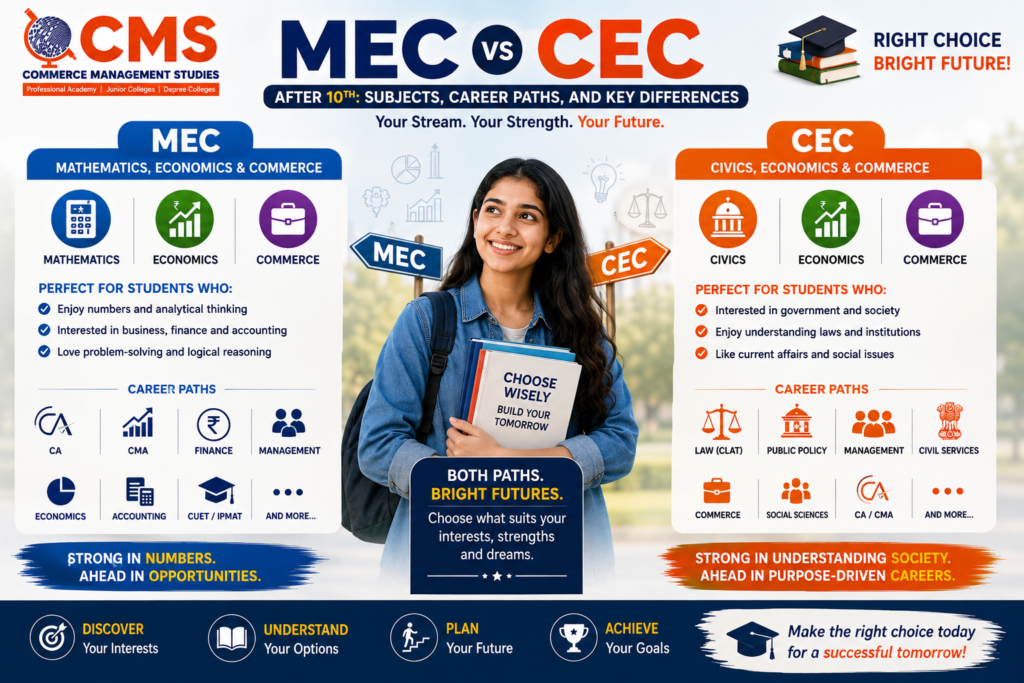
Choosing an Intermediate stream after Class 10 is an important academic decision because the subjects students study during these two years can influence the courses and career options they explore later. Among the commerce-oriented choices, MEC and CEC are two popular combinations. While both streams include Economics and Commerce, they differ mainly in the third subject: MEC includes Mathematics, whereas CEC includes Civics. Understanding this difference can help students make a decision based on their interests, strengths, and future academic goals.
There is no single stream that is automatically better for every student. MEC can be a suitable choice for students who enjoy Mathematics and are interested in finance, economics, accounting, management, or professional courses that benefit from quantitative skills. CEC can appeal to students who are more interested in Commerce, Economics, government, society, law, and related areas. The right choice depends on what a student enjoys learning and the kind of academic and career pathways they may want to explore after Intermediate.
What is MEC?
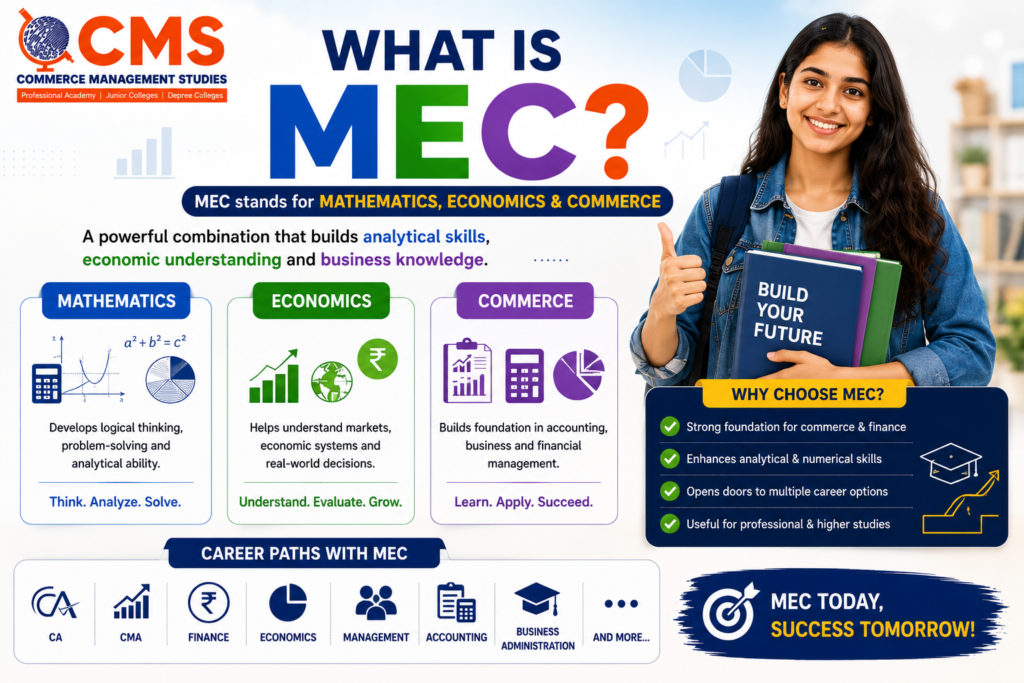
MEC stands for Mathematics, Economics, and Commerce. The combination brings together quantitative skills, economic understanding, and business-related knowledge. Mathematics develops logical thinking and problem-solving abilities, Economics introduces students to markets and economic systems, while Commerce provides a foundation in accounting and business concepts.
MEC can be considered by students who are comfortable with numbers and enjoy understanding how businesses and financial systems work. The combination can provide a useful foundation for students exploring areas such as Chartered Accountancy, Cost and Management Accountancy, finance, economics, management, commerce, and several undergraduate programmes.
What is CEC?
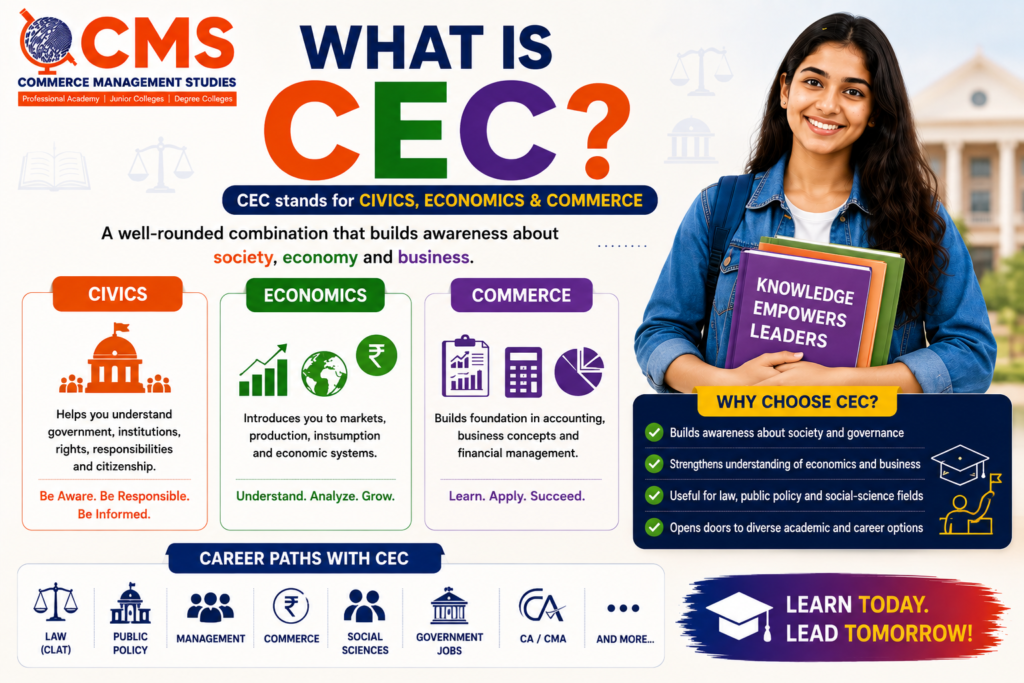
CEC stands for Civics, Economics, and Commerce. Like MEC, it gives students exposure to Economics and Commerce, but replaces Mathematics with Civics. Economics helps students understand markets, production, consumption, and economic systems, while Commerce introduces business and accounting concepts. Civics focuses on government, institutions, governance, citizenship, and related social and political concepts.
CEC can be attractive to students who enjoy understanding society, government, public institutions, business, and economic issues. It can also provide a relevant foundation for students considering areas such as law, public policy, commerce, management, civil services, and other fields where an understanding of society and institutions can be useful.
MEC vs CEC: The Main Difference
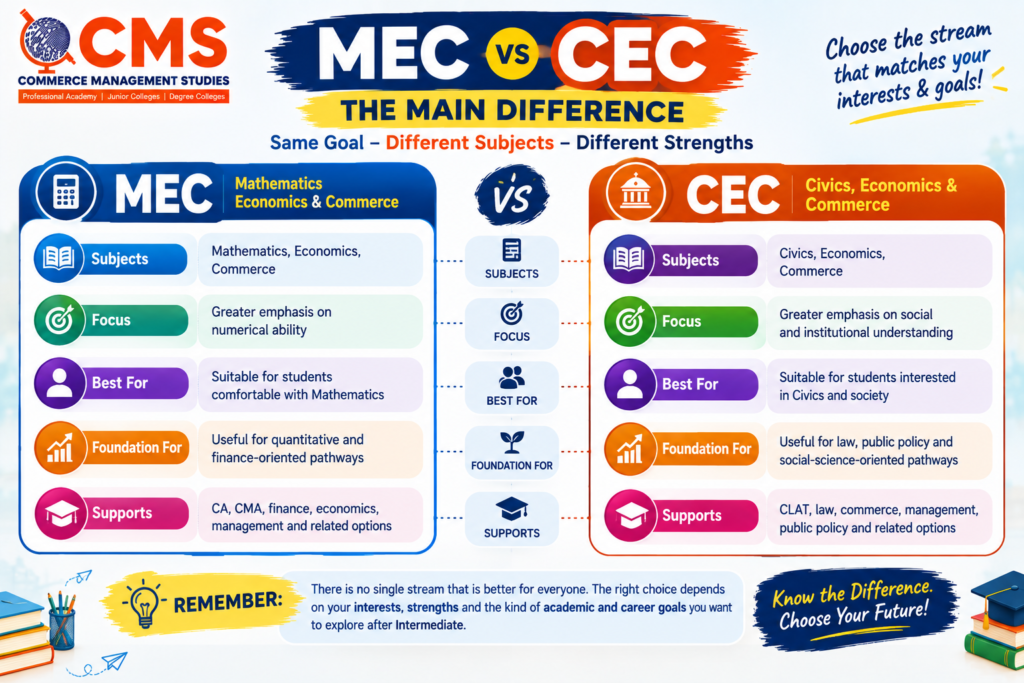
The most significant difference between the two combinations is Mathematics versus Civics. This distinction can influence the type of academic skills students develop during Intermediate and the subjects they may feel more comfortable studying.
MEC places greater emphasis on numerical and analytical thinking, while CEC provides greater exposure to government, society, and political institutions. Both streams retain Economics and Commerce, meaning students in either combination can develop an understanding of business and economic concepts.
| MEC | CEC |
|---|---|
| Mathematics, Economics, Commerce | Civics, Economics, Commerce |
| Greater emphasis on numerical ability | Greater emphasis on social and institutional understanding |
| Suitable for students comfortable with Mathematics | Suitable for students interested in Civics and society |
| Useful foundation for quantitative and finance-oriented pathways | Useful foundation for law, public policy, and social-science-oriented pathways |
| Can support CA, CMA, finance, economics, management and related options | Can support CLAT, law, commerce, management, public policy and related options |
The table provides a broad comparison; specific undergraduate and professional-course eligibility should always be checked according to the latest official requirements.
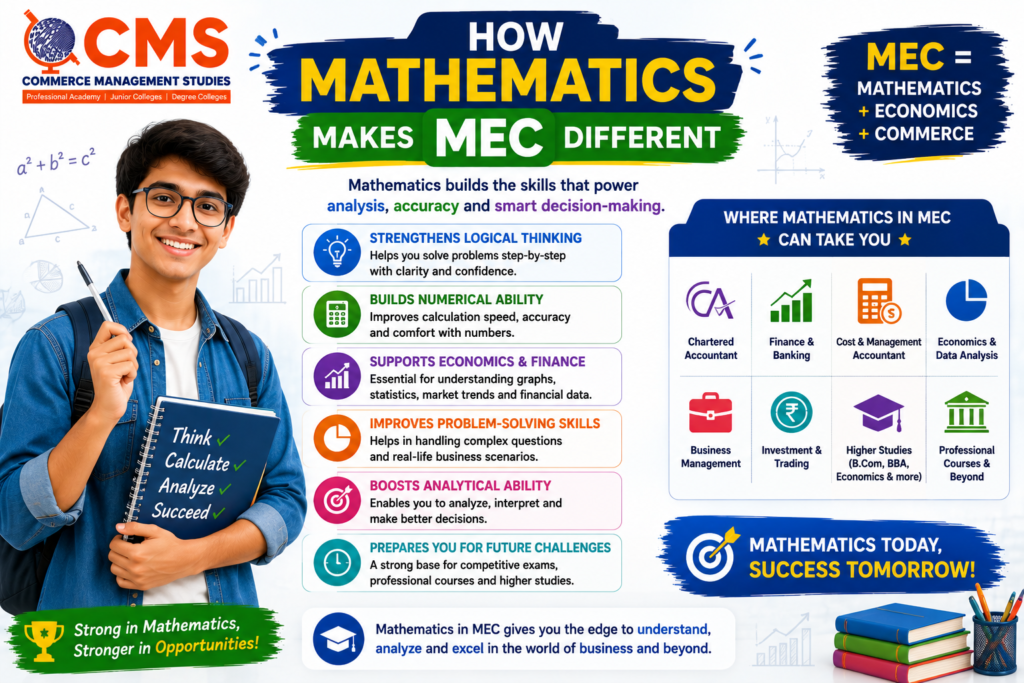
How Mathematics Makes MEC Different
Mathematics can strengthen a student’s ability to work with numbers, identify patterns, apply formulas, and solve structured problems. These skills can be useful in areas involving financial analysis, statistics, economics, accounting, and quantitative decision-making.
Students considering professional and undergraduate pathways that involve significant numerical or analytical components may appreciate having Mathematics as part of their Intermediate education. However, choosing MEC simply because it offers “more options” is not enough. Students should consider whether they are genuinely comfortable with Mathematics and willing to practice it consistently.
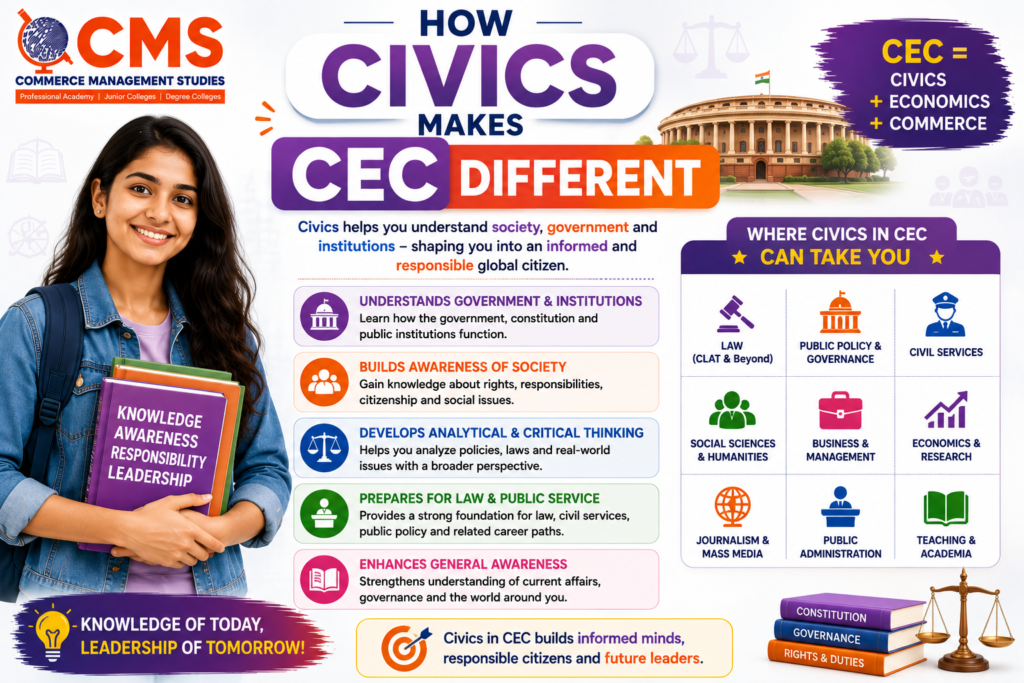
How Civics Makes CEC Different
Civics introduces students to concepts related to government, constitutional systems, public institutions, governance, and society. It can help students understand how institutions function and how laws, policies, and government decisions affect citizens and organizations.
This background can be particularly interesting for students who enjoy discussions around law, government, social issues, public administration, and current affairs. Students considering legal education may find that the concepts introduced through Civics provide useful background knowledge, although dedicated entrance preparation may still be required for examinations such as CLAT.
MEC for CA and CMA Aspirants
Students considering professional courses such as CA and CMA may find MEC useful because Mathematics, Economics, and Commerce together develop numerical, economic, and business-oriented knowledge. Commerce introduces accounting fundamentals, while Mathematics can strengthen quantitative and analytical ability.
For CA aspirants, a strong Commerce foundation can be particularly valuable because accounting and related business concepts form an important part of professional education. Students considering CMA can also benefit from understanding accounting, economics, costs, and numerical relationships. However, students should choose MEC because it suits their interests and abilities rather than assuming that Mathematics is compulsory for every professional pathway.
CEC for CLAT and Law Aspirants
CEC can be an interesting option for students who are considering law because Civics, Economics, and Commerce provide exposure to government, society, economics, and business. These subjects can help students develop broader awareness of the environment in which laws and institutions operate.
Students interested in CLAT should remember that their Intermediate stream alone does not prepare them for the entire entrance examination. CLAT preparation requires dedicated work on areas such as English Language, Current Affairs including General Knowledge, Legal Reasoning, Logical Reasoning, and Quantitative Techniques, according to the applicable examination pattern.
Can MEC Students Prepare for CLAT?
Yes, students from MEC can also explore law and CLAT preparation. Mathematics, Economics, and Commerce do not prevent students from pursuing legal education. In fact, Mathematics can help develop analytical and quantitative skills, while Economics and Commerce provide knowledge related to business and economic systems.
A student’s Intermediate stream should therefore not be viewed as a permanent limitation on their career options. If an MEC student develops an interest in law, they can undertake the necessary entrance preparation alongside their academic studies.
Can CEC Students Prepare for CA or CMA?
CEC students can also explore professional courses such as CA and CMA, subject to the applicable eligibility requirements. The presence of Civics instead of Mathematics does not automatically prevent students from pursuing these pathways.
However, students who choose CEC and later decide to pursue a course that requires substantial quantitative preparation may need to spend additional time strengthening their numerical skills. This is why students should consider their likely academic direction while selecting their Intermediate combination.
MEC and Undergraduate Options
MEC can provide a useful foundation for students considering undergraduate programmes in areas such as:
- Commerce
- Economics
- Finance
- Accounting
- Business administration
- Management
- Mathematics-related fields
- Professional courses such as CA and CMA
Students should check the eligibility requirements of individual universities and programmes because subject requirements can vary.
CEC and Undergraduate Options
CEC can provide a useful foundation for students interested in areas such as:
- Commerce
- Business and management
- Economics
- Law
- Public policy
- Social sciences
- Government-related studies
- Professional courses such as CA and CMA
Again, the exact eligibility criteria can differ between universities and programmes. Students should research their preferred courses before making their final Intermediate choice.
MEC and Competitive Examinations
MEC can complement preparation for several competitive pathways because Mathematics develops numerical and analytical abilities, while Economics and Commerce strengthen business and financial awareness. Students can also develop reading, reasoning, and general-awareness skills separately depending on the examination they plan to take.
For students preparing for CA, CMA, CUET, or IPMAT, MEC can provide an academic foundation that connects with several areas of professional and undergraduate education. The actual entrance or professional examination preparation will still require dedicated study according to the relevant syllabus.
CEC and Competitive Examinations
CEC can also support students preparing for competitive pathways. Economics and Commerce provide useful academic knowledge, while Civics can contribute to a broader understanding of government and institutions.
For students interested in CLAT, CUET, CA, CMA, or other pathways, CEC can be combined with focused preparation for the specific examination. Students should identify their target course and understand its entrance requirements rather than selecting a stream solely based on assumptions about a particular career.
How to Decide Between MEC and CEC
The decision should begin with the student’s interests and academic strengths rather than comparisons with friends or trends. Students should ask themselves which subject they genuinely enjoy studying and which type of learning they are more comfortable with.
Some useful questions to consider are:
- Do I enjoy Mathematics and numerical problem-solving?
- Am I interested in business, accounting, and finance?
- Do I enjoy learning about government and society?
- Am I considering CA or CMA?
- Am I interested in law or CLAT?
- Do I want to explore management or economics?
- Am I comfortable practicing Mathematics regularly?
- Which subjects am I naturally more curious about?
- What undergraduate courses am I currently considering?
Answering these questions can help students make a more informed decision.
Choosing Based on Interest Rather Than Pressure
Students sometimes choose a stream because their friends are choosing it or because they have heard that one combination is universally better. Such decisions can create difficulties if the student does not actually enjoy the subjects involved.
Both MEC and CEC can provide useful academic foundations. The better option is the one that aligns with the student’s interests, abilities, learning preferences, and possible future goals. Students should also remember that career decisions can evolve. Choosing a stream is important, but it does not mean that every future career decision has already been permanently determined.
How CMS Supports Different Career Pathways
Students today may want to prepare for professional courses and entrance examinations alongside their Intermediate education. At CMS, students can pursue MEC Coaching in Hyderabad or CEC Coaching in Hyderabad with integrated preparation for pathways such as CA, CMA, CLAT, CUET, and IPMAT, depending on the programme and preparation requirements.
An integrated approach can help students connect their Intermediate subjects with their future academic goals. Instead of waiting until after Intermediate to think about competitive examinations or professional courses, students can gradually develop relevant skills while continuing their regular academic education.
The Importance of Looking Beyond the Stream
The Intermediate stream is only one part of a student’s academic journey. Success in any professional or undergraduate pathway also depends on conceptual understanding, consistent preparation, communication, analytical thinking, discipline, and willingness to learn.
A student who chooses MEC should make the most of Mathematics, Economics, and Commerce by developing strong fundamentals. Similarly, a CEC student can use Civics, Economics, and Commerce to build a broad understanding of business, economics, government, and society. In both cases, additional preparation may be necessary for specific entrance examinations or professional courses.
Conclusion
MEC and CEC are both valuable commerce-oriented Intermediate combinations, but they offer different academic experiences. MEC combines Mathematics, Economics, and Commerce, making it particularly suitable for students who enjoy numbers, analytical thinking, business, finance, and economics. CEC combines Civics, Economics, and Commerce, making it an appealing option for students interested in commerce, government, society, law, and related areas.
The right choice ultimately depends on the individual student. Those who enjoy Mathematics and are considering finance, CA, CMA, economics, or management may find MEC a strong fit, while students interested in law, public policy, government, and social sciences may find CEC more aligned with their interests. Most importantly, students should research their preferred future courses, understand their requirements, and choose the stream in which they can learn confidently and consistently.