
Introduction
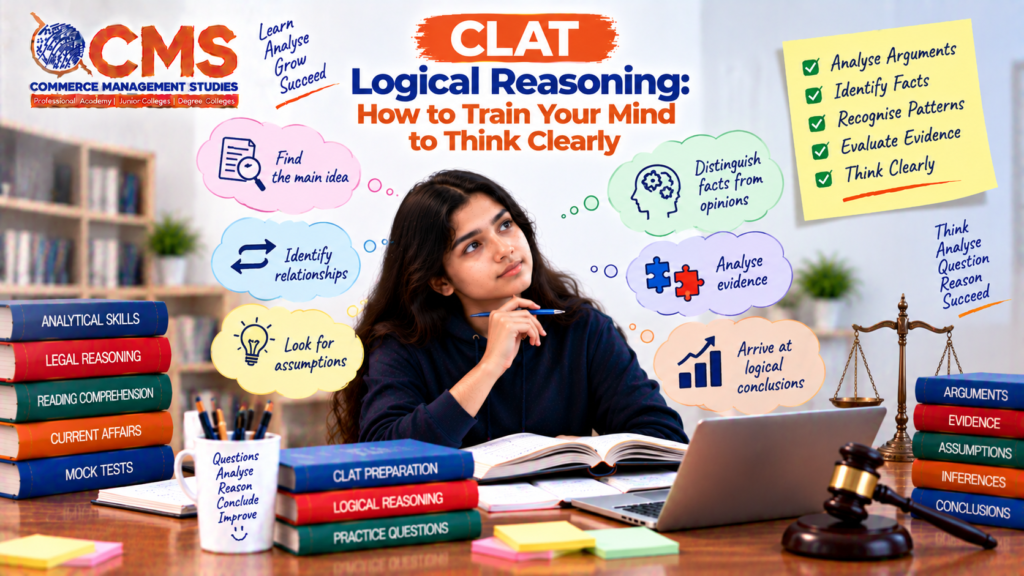
Logical Reasoning is an important area of CLAT preparation because it requires students to examine information, identify relationships between ideas, understand arguments, and arrive at conclusions based on the information provided. Unlike questions that depend mainly on memorising facts, logical reasoning often requires students to think carefully about how different statements connect with one another.
Developing this ability takes regular practice. Students do not need to solve difficult reasoning questions from the beginning to become better at logical thinking. They can gradually develop the skill by learning to identify the main idea of an argument, distinguish facts from assumptions, recognise patterns, evaluate evidence, and avoid conclusions that are not supported by the information given. These habits can make logical reasoning practice more structured and purposeful.
What Does Logical Reasoning Involve?
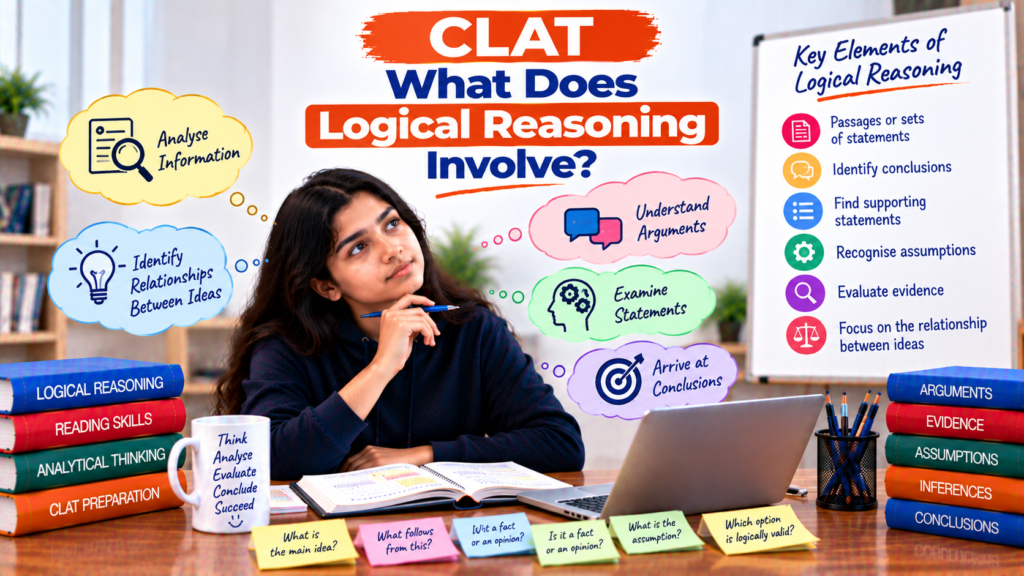
Logical reasoning is essentially about examining information in a systematic way. A question may present an argument, a set of statements, or a passage and ask students to identify what follows from the information. The challenge is to focus on the relationship between the ideas rather than relying on personal opinions or outside assumptions.
For CLAT preparation, students should become comfortable identifying conclusions, supporting statements, assumptions, and implications. Understanding these relationships can make it easier to determine why one answer is supported by the passage while another may appear reasonable but is not actually justified by the information provided.
Start by Identifying the Main Idea
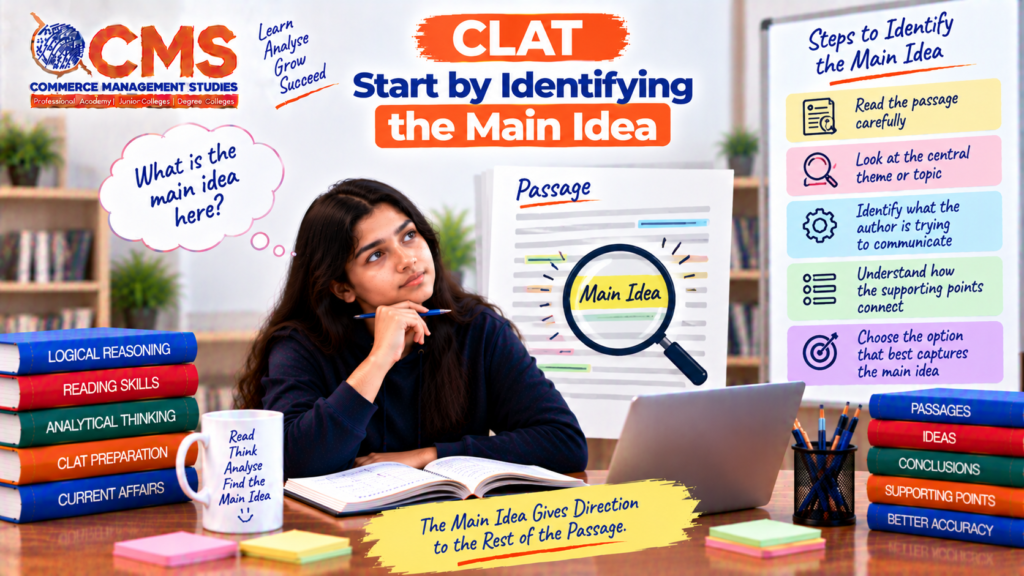
One of the simplest ways to improve logical reasoning is to develop the habit of identifying the central idea of a passage. Before examining individual details, students can ask themselves what the writer is mainly trying to communicate.
The main idea provides a framework for understanding the rest of the passage. Once students know what the argument is about, they can examine whether individual statements support, challenge, explain, or provide evidence for that central point. This approach can prevent students from becoming distracted by minor details.
Learn to Separate Facts From Opinions
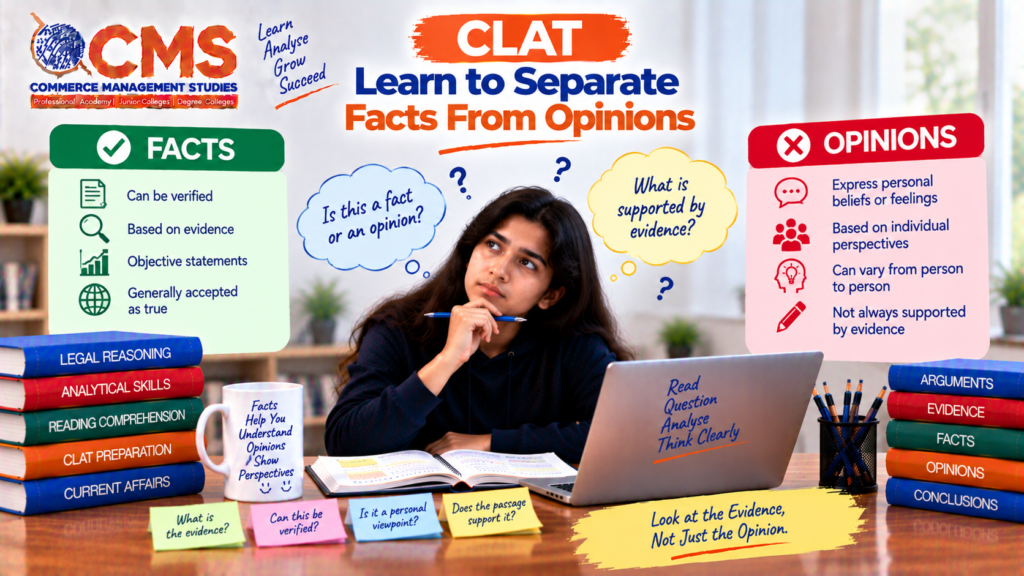
A statement presented in a passage may be a factual claim, an interpretation, an opinion, or an assumption. Understanding this distinction can be important when evaluating an argument.
Students can practise by reading short articles and identifying which statements are directly supported by evidence and which represent interpretations or viewpoints. This habit can gradually improve their ability to examine arguments objectively rather than accepting every statement simply because it appears confidently written.
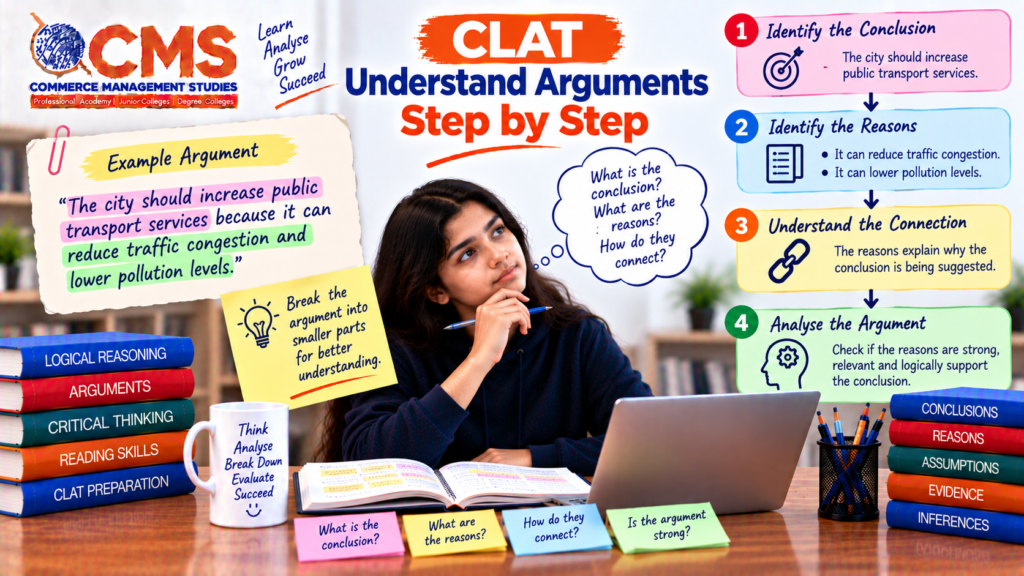
Understand Arguments Step by Step
Arguments usually contain a conclusion supported by one or more reasons. Students should learn to identify both parts rather than reading the argument as one continuous block of information.
For example, an argument might state that a particular policy should be introduced because it could reduce a certain problem. The proposed policy is the conclusion, while the expected reduction in the problem is part of the supporting reasoning. Breaking arguments into these components can make questions about assumptions, conclusions, and supporting evidence easier to analyse.
Pay Attention to Assumptions
An assumption is an idea that an argument depends on but does not necessarily state directly. Identifying assumptions can be challenging because they often appear to be naturally connected to the argument.
Students can practise by asking, “What must be true for this argument to make sense?” This question can help reveal the missing connection between the evidence and the conclusion. With practice, students become more comfortable looking beyond what is explicitly written while still remaining within the logical boundaries of the passage.
Avoid Bringing Personal Opinions Into the Question
One common mistake in reasoning questions is answering according to what the student personally believes rather than what the passage supports. A statement may be true in the real world but still not be the correct answer if the given information does not support it.
Students should therefore treat the passage as the primary source of information. Their task is to determine what can logically be concluded from the evidence provided. This distinction between personal knowledge and passage-based reasoning is an important habit to develop.
Learn to Recognise Cause and Effect
Many arguments involve relationships between causes and consequences. A passage may describe an event and then explain its possible effects, or it may present an outcome and discuss the factors that contributed to it.
Students should be careful not to assume that two events are automatically connected simply because one happened before another. They should examine whether the passage provides enough information to establish the relationship. This can help avoid incorrect conclusions based on assumptions.
Practise With Everyday Situations
Logical reasoning does not have to be limited to examination questions. Everyday situations can provide opportunities to practise analytical thinking.
When reading a news report, for example, students can ask what evidence is being presented, what conclusion is being suggested, and whether the evidence actually supports that conclusion. When comparing two products or services, they can consider which claims are supported by evidence and which are mainly promotional statements. These small exercises can make logical thinking a regular habit.
Read Different Types of Articles
Regular reading can support logical reasoning because it exposes students to different arguments, perspectives, and writing styles. Articles related to economics, science, technology, education, society, law, and public issues can provide varied material for analysis.
Students do not need to agree with every viewpoint they encounter. In fact, reading different perspectives can be useful because it encourages them to examine how arguments are constructed. They can ask what evidence is being used, what assumptions are present, and whether alternative explanations exist.
Focus on Evidence
Good reasoning depends on evidence. When solving a question, students should ask whether the information supporting an answer actually appears in the passage or follows logically from it.
This can help eliminate options that introduce new information or make claims that go beyond the evidence. Developing an evidence-first approach can be particularly useful in comprehension-based reasoning questions, where several answer choices may appear plausible at first glance.
Learn to Eliminate Weak Options
Logical reasoning is not always about immediately identifying the correct answer. Sometimes it is easier to begin by eliminating options that clearly fail to meet the requirements of the question.
An option may contradict the passage, introduce an unsupported assumption, be too extreme, or address a different issue from the one asked about. Identifying these weaknesses can narrow down the choices and allow students to examine the remaining options more carefully.
Be Careful With Extreme Statements
Words such as “always,” “never,” “completely,” and “only” can make an answer more restrictive than the passage supports. Students should pay attention to such wording when evaluating answer choices.
This does not mean that every extreme statement is automatically incorrect. If the passage clearly supports it, it may still be valid. The important point is to check whether the strength of the answer matches the strength of the evidence rather than rejecting or accepting it automatically.
Develop the Habit of Asking “Why?”
One of the simplest ways to strengthen logical thinking is to repeatedly ask “why?” If an answer appears correct, students can ask why the passage supports it. If an argument makes a claim, they can ask why the evidence leads to that conclusion.
This habit encourages students to move beyond surface-level reading. Over time, they may become more comfortable examining the reasoning behind statements instead of simply identifying familiar words or phrases.
Practise Without Immediately Looking at the Solution
Students sometimes look at explanations too quickly after getting stuck on a question. While solutions are useful for learning, spending a little more time attempting the problem independently can strengthen reasoning ability.
When a question is difficult, students can reread the passage, identify the key information, break the argument into smaller parts, and eliminate clearly unsuitable options before checking the solution. This process can make the reasoning itself part of the learning experience.
Maintain an Error Log
Keeping track of mistakes can help students identify recurring reasoning problems. Instead of simply recording the correct answer, they can write down why they selected the wrong option.
For example, a mistake may have happened because the student misunderstood the main argument, overlooked a qualifying word, made an outside assumption, or failed to distinguish evidence from opinion. Recognising these patterns can help students target their future practice more effectively.
Practise Under Time Limits
Logical reasoning requires careful thinking, but CLAT is also a time-bound examination. Students therefore need to develop a balance between accuracy and efficiency.
After becoming comfortable with untimed questions, students can gradually introduce time limits. The objective should not be to rush through passages but to become more efficient at identifying relevant information and evaluating answer choices. Reviewing both accuracy and time taken can help students understand where they need improvement.
Review Why Every Option Is Right or Wrong
Simply knowing the correct answer is not always enough to improve reasoning skills. Students can learn more by examining why the other options are incorrect.
For each option, they can ask whether it contradicts the passage, lacks evidence, changes the meaning, makes an unsupported assumption, or answers a different question. This type of analysis can help students recognise patterns in question design and improve their ability to evaluate options systematically.
Logical Reasoning and Current Affairs
CLAT preparation involves substantial engagement with contemporary issues, and reading about current events can provide useful material for developing reasoning skills. Students can go beyond simply memorising headlines and try to understand the arguments and evidence surrounding an issue.
For example, after reading an article about an economic or social policy, students can identify the central argument, supporting evidence, possible counterarguments, and assumptions. This combines current-affairs awareness with analytical reading and can make both activities more meaningful.
Building Logical Thinking Alongside CLAT Preparation
Logical reasoning improves through repeated exposure and active practice. Students can include short reasoning exercises in their regular study routine rather than attempting large numbers of questions only occasionally.
At CMS CLAT Coaching in Hyderabad, students preparing for CLAT alongside their Intermediate education can work on areas such as logical reasoning, reading comprehension, legal reasoning, and current affairs as part of a structured preparation approach. Combining classroom learning with regular practice, analysis of mistakes, and mock tests can help students gradually become more comfortable with the demands of the examination.
Develop Patience With Difficult Questions
Some reasoning questions may take longer to understand, particularly when the passage contains unfamiliar concepts or several connected arguments. Students should not assume that difficulty with a particular question means they lack reasoning ability.
Instead, they can treat difficult questions as opportunities to practise breaking complex information into smaller parts. Over time, repeated exposure to challenging passages can improve confidence and reduce the tendency to become overwhelmed when the topic is unfamiliar.
Conclusion
Logical reasoning is not simply about solving a large number of questions. It involves developing a disciplined way of thinking—identifying the main idea, understanding arguments, examining evidence, recognising assumptions, evaluating alternatives, and drawing conclusions that are supported by the available information.
For CLAT aspirants, these skills can be developed gradually through regular reading, reasoning practice, error analysis, and timed exercises. Students who make logical thinking part of their everyday learning can begin to approach passages more carefully and systematically. The objective is not to find complicated ways of thinking, but to develop the habit of thinking clearly, questioning assumptions, and allowing evidence to guide the conclusion.