
Introduction
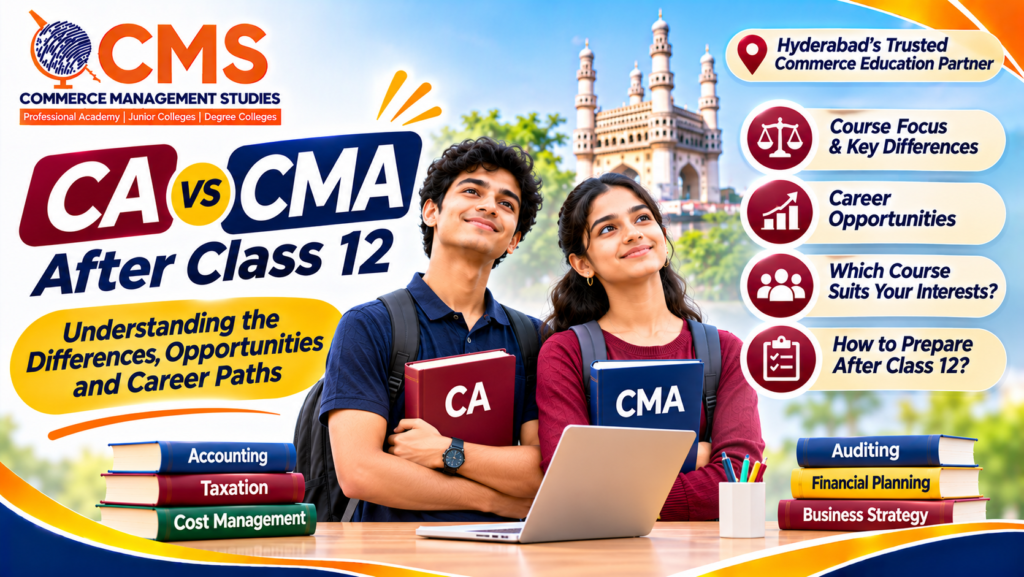
Choosing the right professional course after Class 12 is an important decision for commerce students who want to build careers in accounting, finance, taxation, auditing or business management. Chartered Accountancy (CA) and Cost and Management Accountancy (CMA) are two well-known professional qualifications in India. Both courses develop strong financial and accounting knowledge, but they differ in their areas of focus, professional responsibilities and career opportunities.
Students planning to pursue either qualification should understand what each course involves before making a decision. CA generally focuses on accounting, auditing, taxation and financial reporting, while CMA places greater emphasis on cost management, financial planning, performance analysis and strategic decision-making. At CMS, commerce students can choose MEC, CEC or ACE and explore integrated CA or CMA coaching alongside their academic education, helping them begin professional course preparation early.
What Is Chartered Accountancy (CA)?
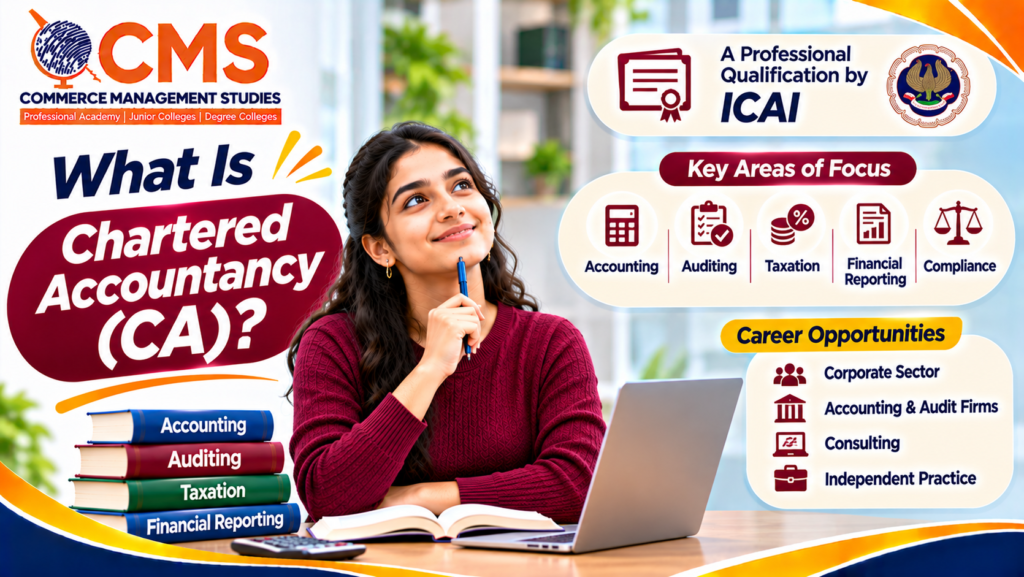
Chartered Accountancy is a professional qualification offered by the Institute of Chartered Accountants of India (ICAI). It prepares students to work in areas such as accounting, auditing, taxation, financial reporting, compliance and financial management.
CA professionals help businesses and individuals maintain financial records, comply with tax regulations, examine financial statements and make informed financial decisions. Their work is important in companies, accounting firms, financial institutions and independent professional practice.
The CA course is structured into three main levels:
- CA Foundation: The entry-level examination that introduces students to accounting, business laws, quantitative aptitude and business economics.
- CA Intermediate: The next stage, which develops knowledge of accounting, taxation, auditing, corporate laws and financial management.
- CA Final: The advanced stage that covers professional-level subjects and prepares candidates for responsibilities in accounting, auditing, taxation and financial management.
Students must also complete the applicable practical training and other requirements prescribed by ICAI. The examination structure, training rules and eligibility conditions should be checked through the latest ICAI announcements.
What Is Cost and Management Accountancy (CMA)?
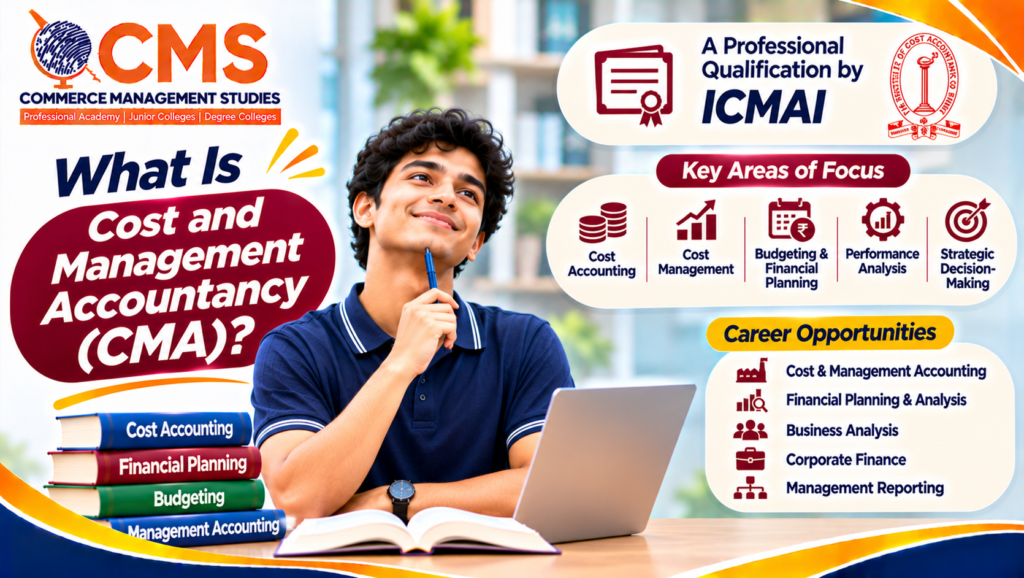
Cost and Management Accountancy is a professional qualification offered by the Institute of Cost Accountants of India (ICMAI). It focuses on cost accounting, financial management, budgeting, cost control, performance evaluation and strategic business planning.
CMA professionals help organisations understand how resources are being used, identify areas where costs can be managed and evaluate the financial performance of business operations. Their work supports management teams in planning budgets, improving efficiency and making business decisions.
The CMA course also consists of three main levels:
- CMA Foundation: Introduces students to business laws, financial and cost accounting, business mathematics, statistics and economics.
- CMA Intermediate: Develops knowledge of financial accounting, cost accounting, taxation, operations management and related areas.
- CMA Final: Covers advanced concepts in strategic financial management, cost and management accounting, taxation, auditing and business strategy.
Students must also complete the practical training and other requirements prescribed by ICMAI. Candidates should refer to the latest institute guidelines for current course and examination requirements.
CA vs CMA: Understanding the Key Differences
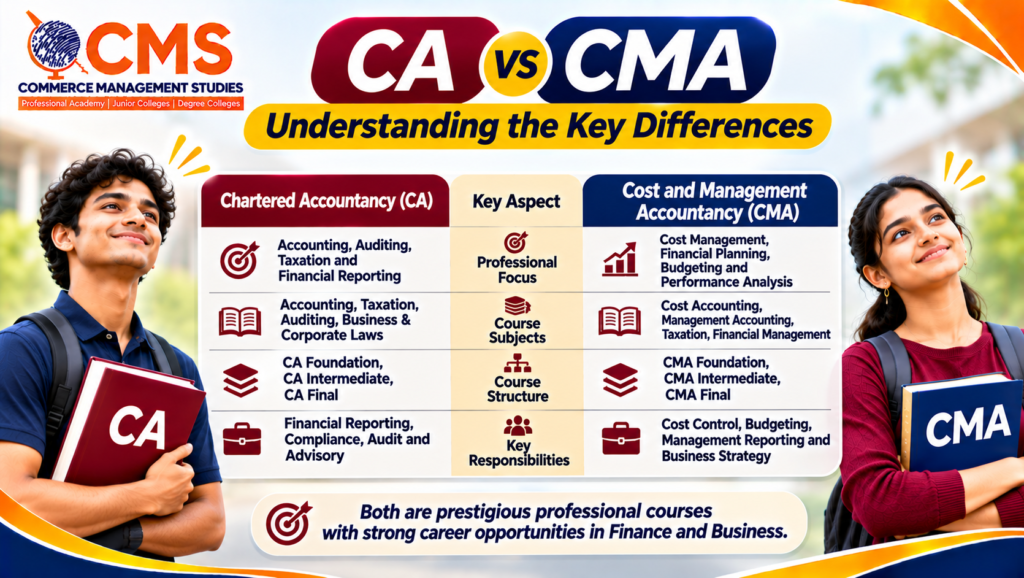
Although both CA and CMA are professional accounting qualifications, their primary areas of focus differ. Understanding these differences can help students identify which course better matches their interests and career goals.
1. Professional Focus
Chartered Accountancy (CA)
CA focuses on financial accounting, auditing, taxation, financial reporting and regulatory compliance. Chartered Accountants help ensure that financial statements are accurate and that businesses follow applicable accounting, tax and legal requirements.
Cost and Management Accountancy (CMA)
CMA focuses on cost measurement, cost control, budgeting, financial planning and management decision-making. Cost and Management Accountants help organisations understand their expenses, improve operational efficiency and evaluate business performance.
2. Course Subjects
Both qualifications include accounting, taxation, business laws and financial concepts. However, the emphasis placed on these subjects differs.
CA subjects generally include:
- Accounting and financial reporting.
- Business laws and corporate laws.
- Taxation, including direct and indirect taxes.
- Auditing and assurance.
- Financial management.
- Strategic management.
CMA subjects generally include:
- Financial and cost accounting.
- Business laws and ethics.
- Direct and indirect taxation.
- Cost and management accounting.
- Operations and strategic management.
- Corporate financial reporting and financial management.
The exact subjects and examination structure depend on the applicable course syllabus and can be revised by the respective professional institutes.
3. Course Structure
Both courses follow a three-level structure, beginning with Foundation and progressing through Intermediate and Final examinations.
In CA, students progress through CA Foundation, CA Intermediate and CA Final, along with the applicable practical training and other requirements prescribed by ICAI.
In CMA, students progress through CMA Foundation, CMA Intermediate and CMA Final, along with the practical training and other requirements prescribed by ICMAI.
The time required to complete either qualification depends on examination performance, training requirements, preparation and the applicable rules.
4. Professional Responsibilities
A Chartered Accountant may work on financial statements, statutory and internal audits, taxation, compliance, financial reporting and advisory assignments.
A Cost and Management Accountant may work on cost analysis, budgeting, financial planning, management reporting, cost control and business performance evaluation.
There can be some overlap between the responsibilities of both professionals. Their actual work depends on their qualifications, experience, employer, professional permissions and the nature of the assignment.
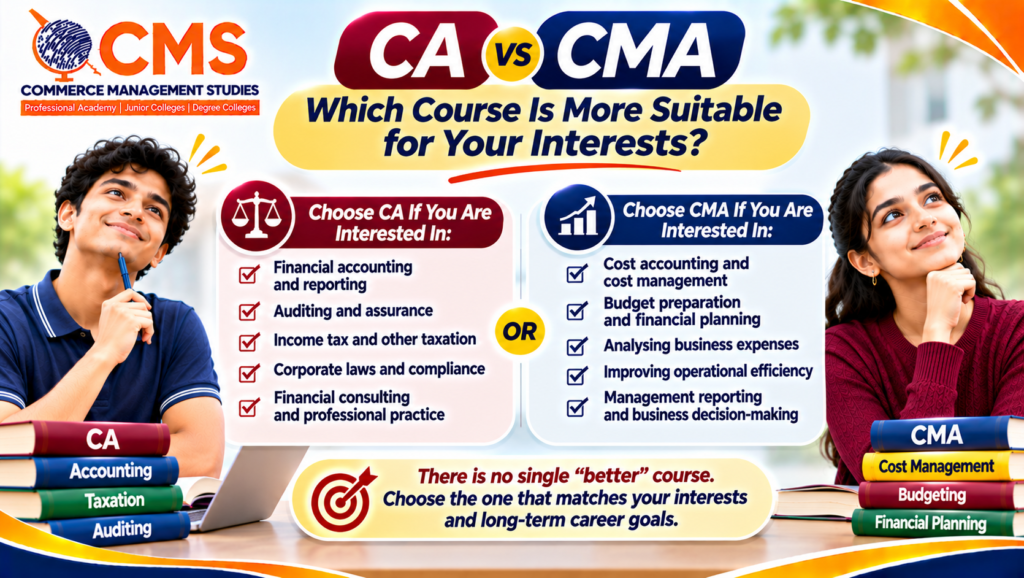
CA vs CMA: Which Course Is More Suitable for Your Interests?
There is no universally better course between CA and CMA. Both offer valuable professional opportunities, but students may find one more suitable depending on the subjects they enjoy and the kind of work they want to pursue.
Choose CA If You Are Interested In:
- Financial accounting and reporting.
- Auditing and assurance.
- Income tax and other taxation matters.
- Corporate laws and regulatory compliance.
- Financial consulting and professional practice.
- Examining and interpreting financial statements.
Students who enjoy understanding how financial records are maintained, how businesses comply with regulations and how financial information is verified may find CA worth exploring.
Choose CMA If You Are Interested In:
- Cost accounting and cost management.
- Budget preparation and financial planning.
- Analysing business expenses.
- Improving operational efficiency.
- Management reporting and performance analysis.
- Supporting business decisions through financial information.
Students who are interested in understanding how businesses manage their costs, allocate resources and improve profitability may find CMA an attractive option.
CA vs CMA: Career Opportunities After Qualification
Both qualifications can lead to opportunities across different industries. The roles available depend on professional qualification, experience, practical skills and the requirements of employers.
Career Opportunities After CA
Chartered Accountants can explore professional roles in accounting, auditing, taxation, finance and advisory services.
Some common career areas include:
- Auditing and Assurance: Examining financial statements and evaluating financial records and controls.
- Taxation: Working on tax planning, tax compliance and tax-related advisory services.
- Financial Reporting: Preparing and reviewing financial statements and ensuring compliance with applicable standards.
- Corporate Finance: Supporting financial planning, business transactions and investment-related activities.
- Consulting: Providing financial, business and regulatory advice to organisations.
- Independent Practice: Establishing a professional practice and offering permitted services to individuals and businesses.
Career Opportunities After CMA
Cost and Management Accountants can explore roles in cost management, financial planning, business analysis and management accounting.
Some common career areas include:
- Cost Accounting: Analysing production and operational costs and identifying opportunities for cost control.
- Financial Planning and Analysis: Preparing budgets, evaluating financial performance and supporting business planning.
- Management Accounting: Providing financial information that helps management make business decisions.
- Budgeting and Cost Control: Monitoring expenses and helping organisations use resources efficiently.
- Business Analysis: Studying financial and operational information to identify performance improvements.
- Corporate Finance: Supporting financial management and strategic planning activities.
Both qualifications can provide opportunities in corporate organisations, consulting firms, financial institutions and other sectors. The specific roles available depend on the professional’s expertise and experience.
CA vs CMA: What About Salary and Career Growth?
Salary is an important consideration for students comparing professional courses, but it should not be the only factor influencing their decision. Earnings after CA or CMA can vary significantly depending on the organisation, industry, job role, location, experience and individual performance.
CA professionals may work in areas such as auditing, taxation, financial reporting, consulting and corporate finance. CMA professionals may work in cost management, budgeting, financial planning, management accounting and business analysis.
Both qualifications offer opportunities for career development. Professionals can build their expertise through practical experience, additional skills, specialisations and leadership responsibilities. Instead of choosing a course based only on salary expectations, students should consider the nature of the work and the professional responsibilities that interest them.
Can Commerce Students Choose CA or CMA After Class 12?
Yes. Students who have completed Class 12 can explore the CA and CMA pathways, subject to the eligibility and registration requirements of the respective professional institutes.
Commerce students can choose from the MEC, CEC and ACE streams and plan their professional course preparation alongside their academic education. Their choice of stream should consider their academic interests, comfort with subjects and future goals.
The three streams provide different combinations of subjects:
MEC – Mathematics, Economics and Commerce
MEC combines Mathematics, Economics and Commerce. Mathematics can help students develop numerical ability and problem-solving skills, while Economics and Commerce introduce them to markets, business activities and financial concepts.
Students interested in accounting, finance and analytical subjects may find MEC a useful academic foundation while preparing for CA or CMA.
CEC – Civics, Economics and Commerce
CEC combines Civics, Economics and Commerce. Students gain exposure to economic concepts, business fundamentals, governance and social institutions.
The Commerce and Economics subjects provide useful background knowledge for students exploring professional qualifications such as CA and CMA. Students should also develop the numerical and accounting skills required by their chosen course through focused preparation.
ACE – Accounting, Commerce and Economics
ACE provides exposure to Accounting, Commerce and Economics. These subjects introduce students to financial records, business operations and economic concepts, which are relevant to professional accounting education.
Students interested in building careers in accounting and finance can explore CA or CMA preparation alongside their ACE education.
The most suitable stream depends on the student’s interests and academic requirements. Students should review the subject combinations and professional course eligibility rules before making their choice.
Why Start CA or CMA Preparation During Class 11 and Class 12?
Starting professional course preparation during school-level commerce education can help students become familiar with accounting, business concepts and examination requirements before entering the next stage of their studies.
Early preparation can provide several advantages:
- Better subject understanding: Students get more time to strengthen their knowledge of accounting, economics, mathematics and business concepts.
- Early exposure to professional examinations: They can understand the structure and expectations of CA or CMA Foundation.
- Improved time management: Students learn to balance academic studies with professional course preparation.
- Regular practice: Consistent problem-solving and revision help build confidence in accounting and quantitative subjects.
- Clearer career direction: Exploring both qualifications helps students understand the professional roles and opportunities associated with each course.
A planned approach during Class 11 and Class 12 can make the transition to professional course preparation more organised.
How CMS Supports Students Preparing for CA and CMA
At CMS, commerce students can choose MEC, CEC or ACE and pursue integrated CA or CMA coaching alongside their academic education. This approach allows students to work towards their school-level academic requirements while developing the knowledge and skills needed for professional course examinations.
The preparation focuses on building subject fundamentals, understanding accounting and business concepts, practising examination-oriented questions and evaluating progress through regular assessments. Students can gradually become familiar with the expectations of professional examinations while continuing their regular studies.
For students looking for Best CA Coaching Centres in Hyderabad or CMA Colleges in Hyderabad, CMS provides an opportunity to explore these professional pathways during their commerce education. Understanding the differences between CA and CMA at an early stage can also help students make a more informed decision about which qualification aligns with their interests.
Conclusion
CA and CMA are two respected professional qualifications that offer different pathways into accounting, finance and business-related careers. While CA places greater emphasis on auditing, taxation, financial reporting and compliance, CMA focuses more on cost management, budgeting, financial planning and business performance analysis.
The right choice depends on the student’s interests, preferred professional responsibilities and long-term career goals. Commerce students can begin exploring these options after Class 12 and prepare for their chosen professional course alongside their academic education. At CMS, students can choose MEC, CEC or ACE with integrated CA or CMA coaching, giving them an opportunity to build their academic foundation while working towards a professional career in finance and accounting.