
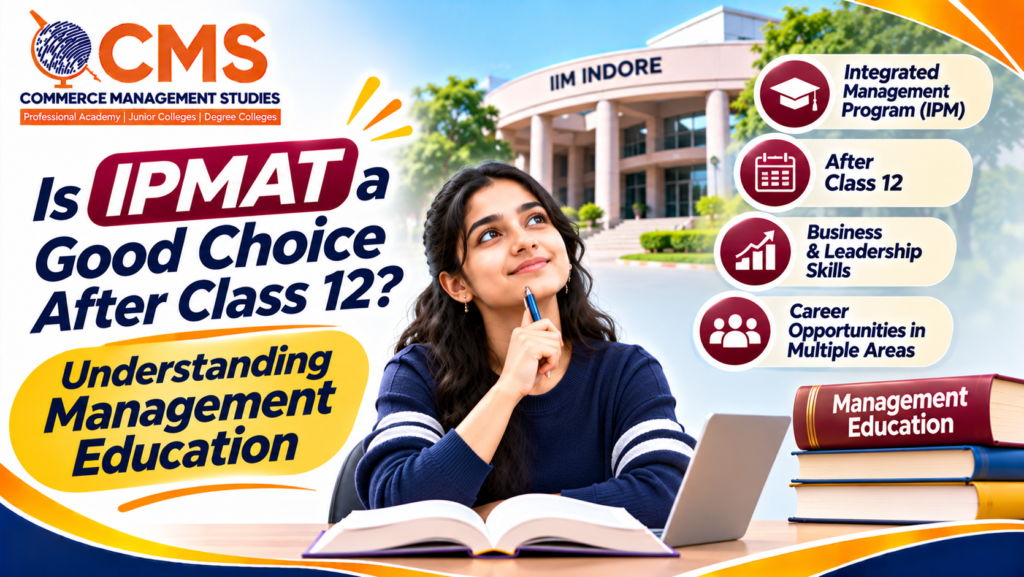
Introduction
Choosing a career path after Class 12 is an important decision, especially for students interested in business, finance, entrepreneurship and management. While many students consider pursuing a traditional undergraduate degree before applying for an MBA, an integrated management program offers another route by combining undergraduate and postgraduate management education into a structured academic pathway. The Integrated Program in Management Aptitude Test (IPMAT) is one of the entrance examinations that helps students explore this option at selected institutions, including the Indian Institute of Management (IIM) Indore.
For students who are interested in management education from an early stage, IPMAT can be a worthwhile option to explore after Class 12. However, deciding whether it is the right choice requires an understanding of the examination, the academic commitment involved, the opportunities available and the skills needed to succeed. At CMS, students pursuing MEC can begin building their foundation for IPMAT alongside their Intermediate education through integrated coaching.
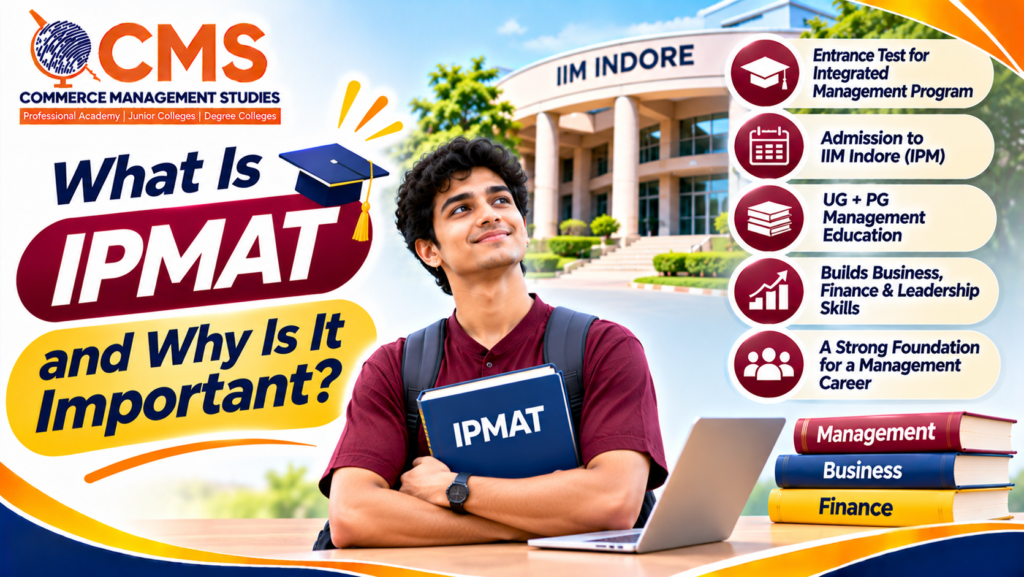
What Is IPMAT and Why Is It Important?
IPMAT, or the Integrated Program in Management Aptitude Test, is an entrance examination conducted by IIM Indore for admission to its five-year Integrated Program in Management (IPM). The program provides students with an opportunity to study management through a combination of undergraduate and postgraduate-level education.
Instead of completing a separate undergraduate degree and then preparing for a conventional MBA entrance examination, students can enter an integrated management pathway soon after Class 12. This allows them to develop an understanding of subjects such as economics, business, finance, mathematics, communication and management over an extended period.
It is important to understand that IPMAT is not a common entrance examination for every IIM or integrated management program. Different institutions may conduct their own entrance tests or follow different admission procedures. Students should therefore check the eligibility requirements and selection process of each institution they wish to apply to.
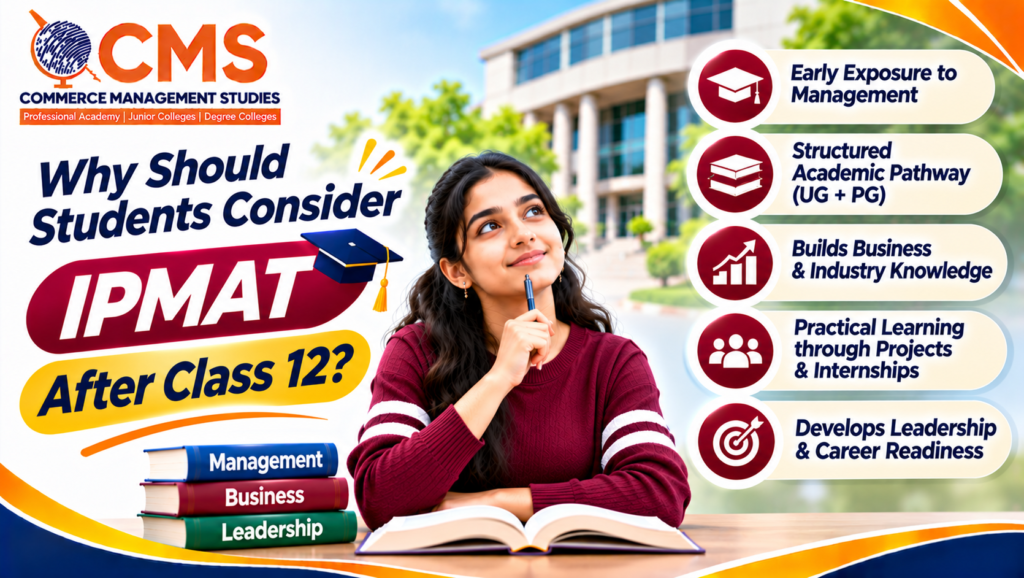
Why Should Students Consider IPMAT After Class 12?
Students who already have an interest in business and management may find IPMAT an attractive option because it provides an opportunity to begin their management education early. It also allows them to explore different areas of business before making more specific career decisions.
Some important reasons to consider this pathway include:
- Early exposure to management: Students can begin studying management-related concepts soon after completing their school education.
- Structured academic pathway: An integrated program combines undergraduate and postgraduate-level learning within a planned course structure.
- Development of business knowledge: Students gain exposure to areas such as economics, finance, marketing, organisational behaviour and business strategy.
- Opportunities for practical learning: Depending on the institution and curriculum, students may participate in projects, internships, presentations and other practical activities.
- Personal and professional development: Management education can help students improve communication, teamwork, decision-making, analytical thinking and leadership skills.
However, students should not choose IPMAT only because it offers an early route into management education. Their interest in the subject, willingness to prepare for a competitive entrance examination and long-term academic goals should also influence the decision.
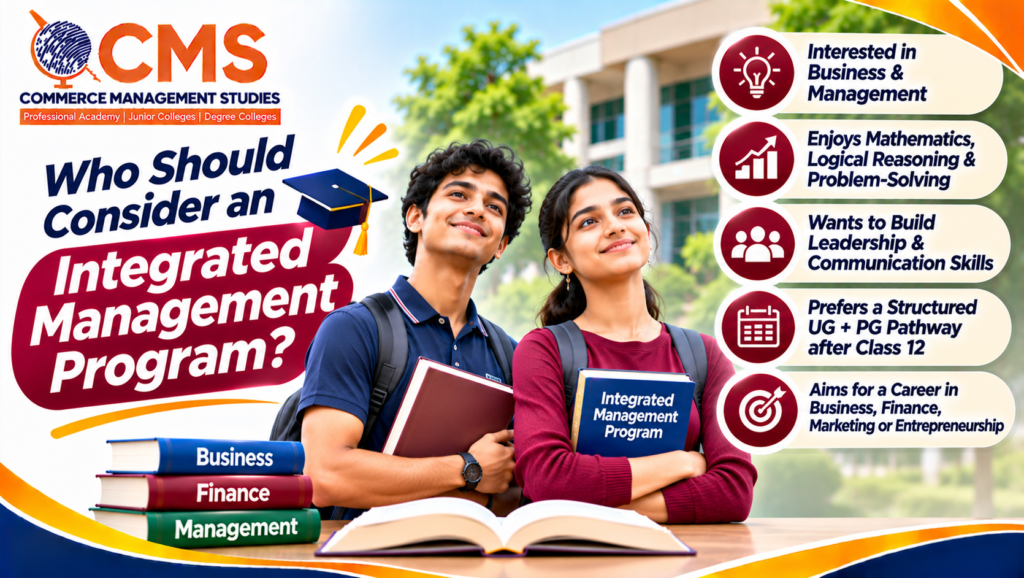
Who Should Consider an Integrated Management Program?
An integrated management program may be suitable for students who are curious about how businesses operate and how organisations make decisions. Students who enjoy understanding markets, analysing information, working with numbers and exploring business ideas may find this academic pathway interesting.
It can be particularly relevant for students who:
- Are interested in business administration, finance, marketing or entrepreneurship.
- Want to understand how companies and organisations function.
- Enjoy mathematics, logical reasoning and problem-solving.
- Have an interest in leadership, communication and decision-making.
- Prefer a structured management education pathway after Class 12.
- Are willing to commit to a longer academic program that combines undergraduate and postgraduate studies.
Students should also consider the duration, curriculum, fees, location and admission requirements of the institutions offering integrated management programs. Comparing these factors can help them make a more informed decision.
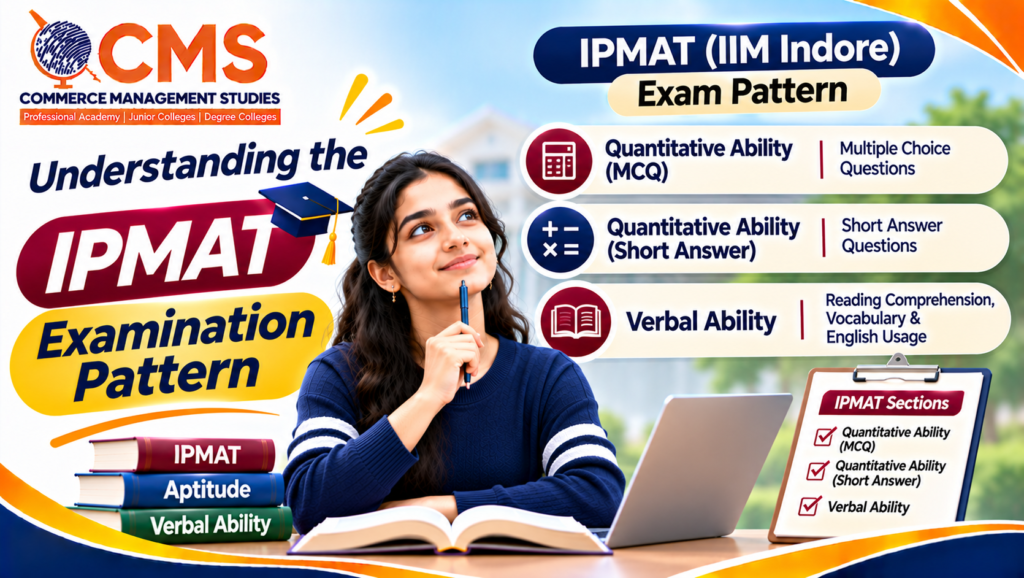
Understanding the IPMAT Examination Pattern
IPMAT preparation requires students to develop both quantitative and verbal abilities. For the IPMAT conducted by IIM Indore, the examination has traditionally included three sections:
- Quantitative Ability – Multiple Choice Questions: Tests mathematical understanding, numerical ability and problem-solving skills.
- Quantitative Ability – Short Answer Questions: Evaluates the ability to solve mathematical problems and arrive at accurate answers without relying on multiple-choice options.
- Verbal Ability: Assesses English language skills, reading comprehension, vocabulary and understanding of written information.
The examination pattern, marking scheme, eligibility conditions and selection process should always be checked through the latest official admission notification, as these details may change. Other institutions offering integrated management programs may conduct different entrance examinations with different sections.
Students preparing for IPMAT should focus on understanding concepts rather than depending entirely on memorisation. Regular practice, time management and the ability to interpret questions accurately are important parts of effective preparation.
What Skills Can Students Develop Through IPMAT Preparation?
Preparing for IPMAT is not limited to learning mathematical formulas or practising English questions. The preparation process encourages students to develop several academic and analytical skills that can also be useful during higher education.
1. Quantitative and Numerical Skills
Quantitative preparation strengthens numerical understanding, calculation ability and mathematical reasoning. Students learn to approach problems systematically and identify suitable methods for solving them.
2. Logical and Analytical Thinking
Many aptitude questions require students to understand information, identify patterns and evaluate possible solutions. Developing these abilities can improve their approach to unfamiliar problems.
3. Reading and Communication Skills
Verbal ability preparation encourages students to read regularly, understand passages, improve vocabulary and express ideas clearly. These skills are useful in presentations, group discussions and academic assignments.
4. Time Management
Competitive entrance examinations require students to balance speed and accuracy. Practising questions under timed conditions helps them decide how to allocate time across different sections.
5. Consistency and Self-Discipline
IPMAT preparation generally requires sustained effort over time. Following a study schedule, revising concepts and analysing practice-test performance can help students develop a disciplined approach to learning.
How Does MEC Support IPMAT Preparation?
The MEC stream, which includes Mathematics, Economics and Commerce, provides an academic foundation that connects with several areas of management education. Mathematics supports the development of numerical ability and problem-solving skills, while Economics introduces students to markets, resources, production and economic decision-making. Commerce helps them understand business activities, financial concepts and the functioning of organisations.
These subjects can provide useful background knowledge for students interested in management. However, Intermediate subject learning alone is not sufficient for a competitive entrance examination. Students also need focused preparation in quantitative aptitude, verbal ability, examination strategy and timed practice.
At CMS, MEC is integrated with IPMAT Coaching in Hyderabad so that students can work towards their Intermediate academic requirements while preparing for the entrance examination. This approach gives students an opportunity to develop their subject knowledge and aptitude skills during the same academic period. Regular practice and examination-oriented preparation can help them identify areas that need improvement and become more familiar with competitive test requirements.
How Should Students Plan Their IPMAT Preparation During Intermediate?
Beginning preparation during Intermediate gives students time to strengthen their fundamentals instead of attempting to cover every topic shortly before the examination. A balanced plan should include conceptual learning, regular practice and revision.
Students can follow these preparation practices:
- Strengthen mathematical fundamentals: Build confidence in arithmetic, algebra, geometry and other relevant quantitative topics.
- Develop a reading habit: Read newspapers, articles and quality written material to improve comprehension and vocabulary.
- Practise aptitude questions: Solve questions regularly and gradually increase their difficulty level.
- Take mock examinations: Attempt timed tests to understand the examination format and improve speed and accuracy.
- Analyse mistakes: Review incorrect answers and identify whether the difficulty is related to concepts, calculation, interpretation or time management.
- Balance board examination preparation: Give sufficient attention to Intermediate subjects while following a realistic entrance preparation schedule.
Students should also keep track of official admission notifications and application timelines. Preparing early is useful, but understanding the requirements of the institutions they intend to apply to is equally important.
What Career Opportunities Can Follow Management Education?
An integrated management program can provide students with a broad academic foundation for exploring different areas of business and organisational management. The subjects studied and the practical exposure gained during the program can help students understand different professional fields.
Depending on their interests, qualifications, specialisation and further experience, graduates may explore opportunities in areas such as:
- Finance and Banking: Financial analysis, banking operations, investment-related roles and financial planning.
- Marketing and Sales: Brand management, market research, sales strategy and customer relationship management.
- Human Resource Management: Recruitment, employee development, training and organisational management.
- Business Analytics: Data interpretation, business research and analytical decision-making.
- Consulting: Business research, problem analysis and organisational strategy.
- Entrepreneurship: Starting and managing businesses, developing business ideas and exploring new markets.
The opportunities available to graduates depend on the program’s curriculum, institutional exposure, individual performance and the requirements of employers. An integrated management degree does not automatically guarantee a particular job or career position, but it can provide a foundation for exploring different professional directions.
Is IPMAT Better Than Pursuing a Regular Undergraduate Degree?
There is no single answer to this question because both pathways can be suitable depending on a student’s interests and career plans. An integrated management program provides a structured route into management education, while a regular undergraduate degree allows students to study a chosen discipline before deciding whether to pursue an MBA or another postgraduate qualification.
Students interested in management from the beginning may prefer exploring IPMAT. Those who want to study subjects such as commerce, economics or another discipline in greater depth before making a postgraduate decision may prefer a regular degree.
Before choosing, students should consider:
- Whether they are genuinely interested in management education.
- The admission requirements and selection process of their preferred institutions.
- The curriculum, academic environment and duration of the program.
- The financial commitment involved.
- Whether they prefer an integrated pathway or the flexibility of choosing postgraduate education later.
Comparing these factors can help students select a pathway that matches their interests and long-term goals rather than making a decision based only on the popularity of an entrance examination.
How CMS Helps MEC Students Explore IPMAT Preparation
For students interested in management education, preparing for IPMAT during Intermediate can make the transition from school-level learning to competitive entrance examinations more organised. At CMS, MEC students have the opportunity to pursue their Intermediate education alongside integrated IPMAT coaching in Hyderabad.
The preparation approach focuses on strengthening mathematical fundamentals, developing verbal ability, practising aptitude questions and becoming familiar with competitive examination requirements. Students can work on their academic subjects while gradually building the skills needed for entrance examinations.
Starting during Intermediate also gives students time to understand the examination, evaluate their progress and identify the institutions that match their academic interests. With consistent preparation and proper planning, students can approach the IPMAT admission process with greater clarity and confidence.
Conclusion
IPMAT can be a good choice after Class 12 for students who are interested in business, leadership, entrepreneurship and management education. Its integrated academic pathway offers an opportunity to begin management studies early, while the preparation process helps students develop quantitative ability, communication skills, analytical thinking and problem-solving skills.
However, choosing this pathway requires careful consideration of personal interests, institutional requirements, academic commitment and long-term goals. Students pursuing MEC can begin exploring this opportunity during Intermediate through focused preparation. With MEC integrated with IPMAT coaching at CMS, students in Hyderabad can work towards their board examinations while building a foundation for management entrance examinations and future academic opportunities.