
Introduction
For students interested in accounting, finance, taxation, auditing and business management, Chartered Accountancy (CA) is one of the professional career paths worth exploring after Intermediate. The qualification opens opportunities across different areas of the financial and business sectors, including accounting, taxation, auditing, financial reporting and corporate advisory services. Students pursuing commerce-related Intermediate streams can begin understanding the CA pathway early and plan their preparation alongside their regular academics.
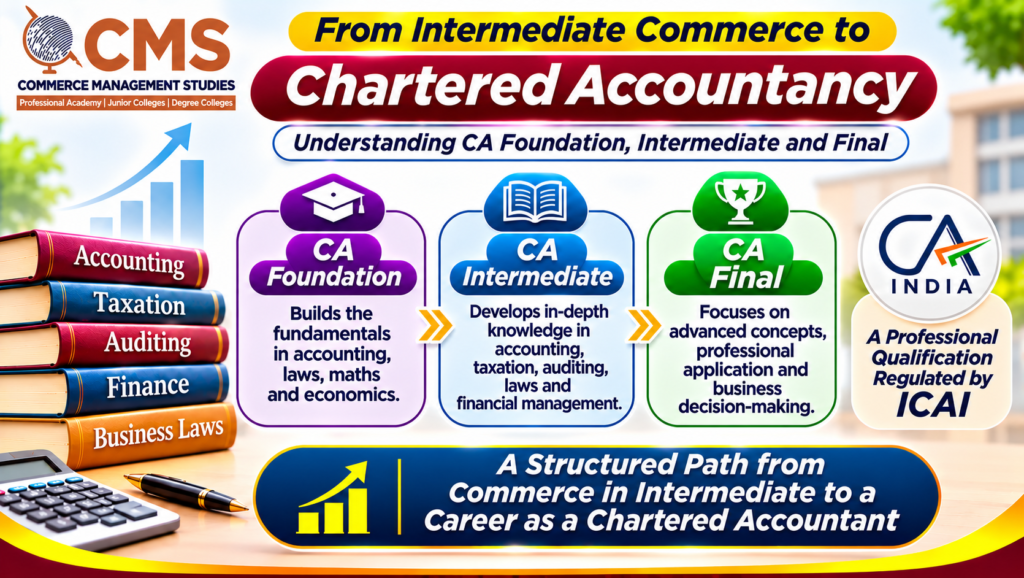
The Chartered Accountancy course in India is regulated by the Institute of Chartered Accountants of India (ICAI). It follows a structured learning pathway consisting of three main examination levels: CA Foundation, CA Intermediate and CA Final, along with mandatory practical training and other course requirements. Understanding how these stages are connected helps Intermediate students prepare for the journey from school-level commerce education to professional accountancy.
What Is the Chartered Accountancy Course?
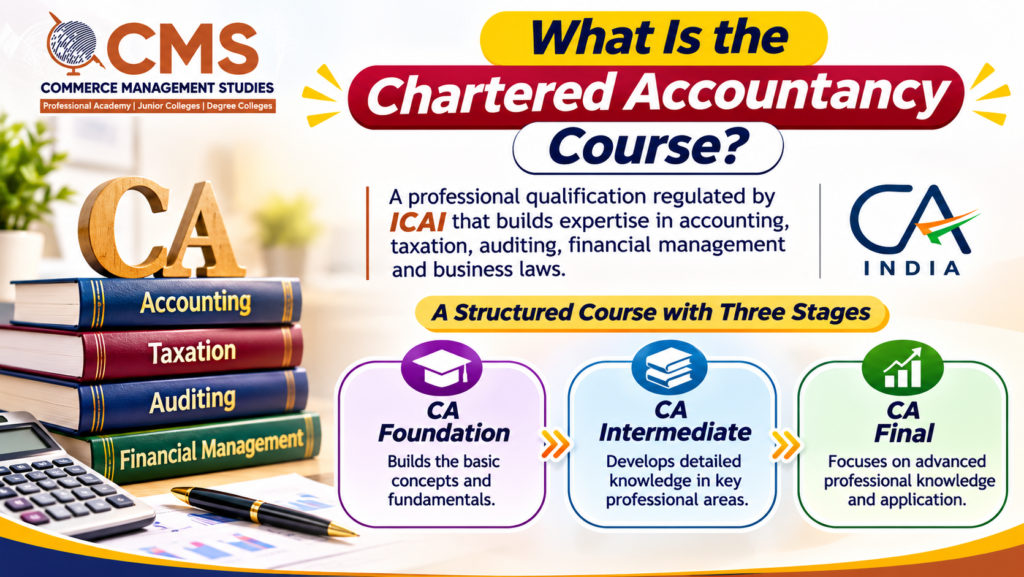
Chartered Accountancy is a professional qualification that develops knowledge and skills in accounting, auditing, taxation, financial management, business laws and related areas. The course combines theoretical education with practical experience, allowing students to understand both the principles of finance and their application in professional environments.
In India, ICAI conducts the CA examinations and regulates the qualification. Students generally enter the course through the Foundation route after Class 12, while eligible graduates and certain other candidates may use the Direct Entry route to register for Intermediate.
The CA qualification involves three examination levels:
- CA Foundation: Introduces students to the basic concepts of accounting, business laws, mathematics, economics and quantitative aptitude.
- CA Intermediate: Develops more detailed knowledge of accounting, taxation, corporate laws, auditing and financial management.
- CA Final: Focuses on advanced professional knowledge, including financial reporting, auditing, taxation and integrated business decision-making.
In addition to clearing the examinations, students must complete the prescribed practical training, information technology and soft-skills courses, and self-paced online modules applicable to their stage of the course.
CA Foundation: The First Step Towards Chartered Accountancy
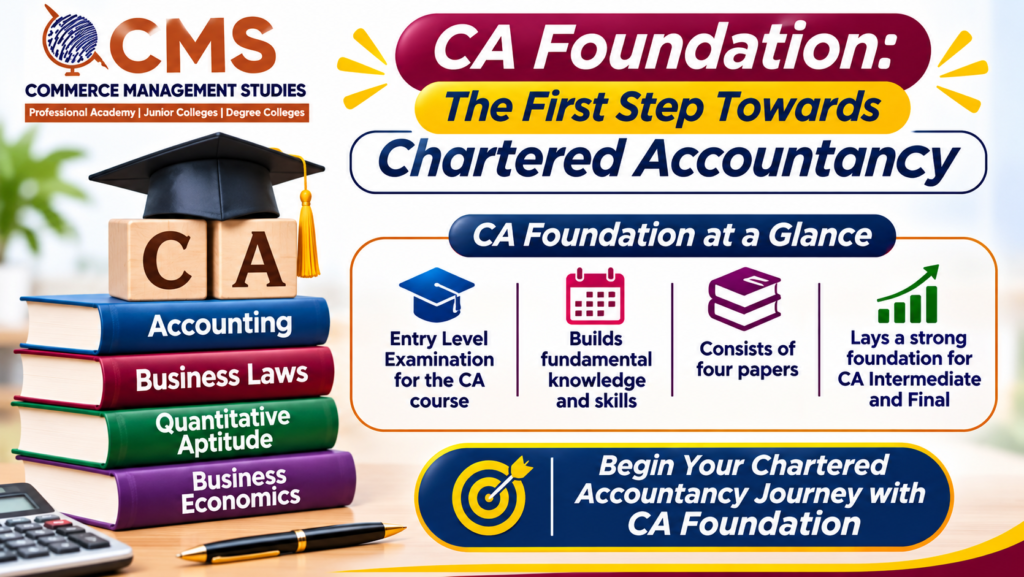
CA Foundation is the entry-level examination for students following the Foundation route. It introduces the fundamental concepts that form the basis of professional accountancy education. Students who have passed Class 10 can register for the Foundation Course, but they can appear for the examination only after appearing in their Class 12 examination and meeting the applicable requirements.
The Foundation level consists of four papers:
1. Accounting
This subject introduces students to basic accounting principles, recording financial transactions, preparing financial statements and understanding accounting concepts. It helps develop the foundation required for more advanced accounting studies.
2. Business Laws
Business Laws introduces students to the legal principles governing business activities. It covers important areas of business law and helps students understand the legal responsibilities and framework within which organisations operate.
3. Quantitative Aptitude
This paper includes Business Mathematics, Logical Reasoning and Statistics. It develops numerical ability, analytical thinking and problem-solving skills that are useful in financial and business-related work.
4. Business Economics
Business Economics introduces students to economic concepts, market behaviour, demand, supply and other principles that influence business decisions. It helps students understand how economic factors affect individuals, organisations and markets.
Foundation preparation requires conceptual clarity, consistent practice and familiarity with different question formats. Students who begin developing these abilities during Intermediate can approach the examination with a more organised preparation plan.
CA Intermediate: Developing Professional Knowledge
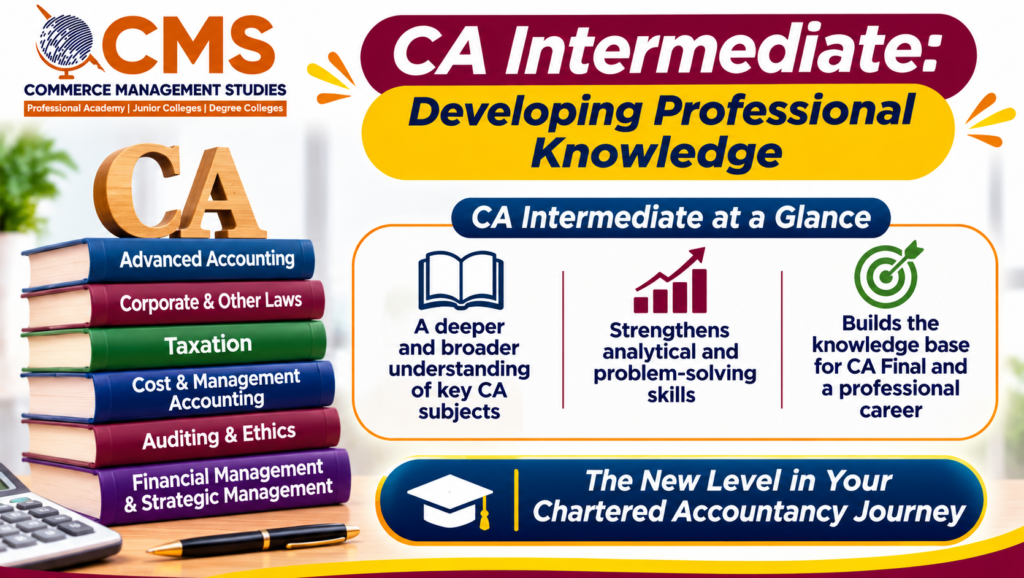
After qualifying CA Foundation and meeting the Class 12 eligibility requirements, students can register for CA Intermediate. This level moves beyond introductory concepts and develops a deeper understanding of the subjects used in accounting and financial practice.
CA Intermediate consists of six papers divided into two groups.
Group I
- Advanced Accounting: Covers more detailed accounting principles, financial statements and the application of accounting standards.
- Corporate and Other Laws: Introduces the legal framework governing companies and other important areas of business law.
- Taxation: Includes Income-tax Law and Goods and Services Tax (GST), helping students understand direct and indirect taxation.
Group II
- Cost and Management Accounting: Focuses on cost determination, budgeting, cost control and the use of accounting information in management decisions.
- Auditing and Ethics: Introduces auditing procedures, professional responsibilities and ethical principles.
- Financial Management and Strategic Management: Covers financial decision-making, investment and financing concepts, along with the principles involved in business strategy.
At this stage, students are expected to develop stronger analytical abilities and apply theoretical knowledge to practical situations. Regular revision, problem-solving and examination practice become increasingly important as the syllabus becomes more detailed.
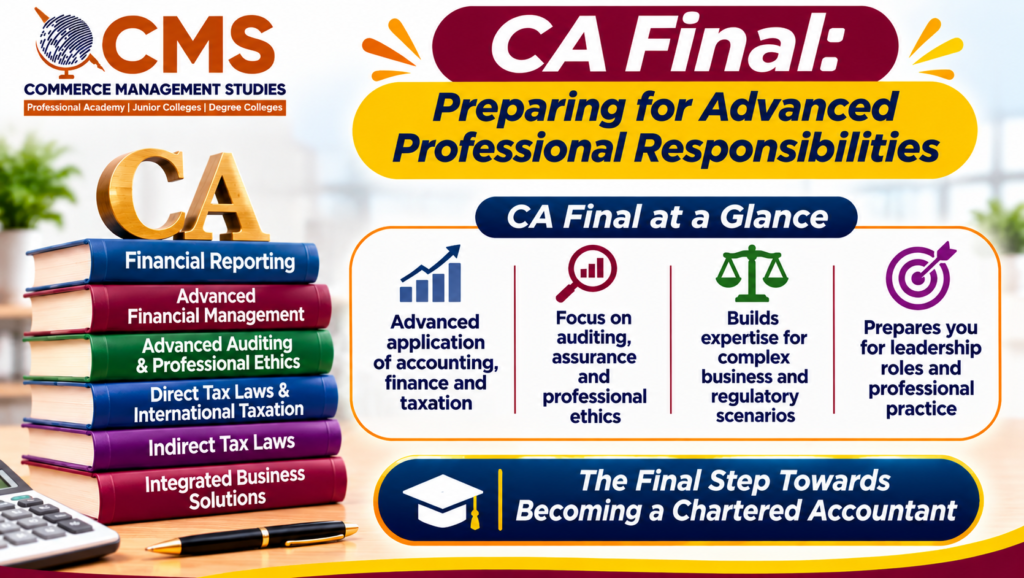
CA Final: Preparing for Advanced Professional Responsibilities
CA Final is the advanced examination level of the Chartered Accountancy course. Students become eligible to register for this stage after passing both groups of CA Intermediate. The subjects focus on advanced applications of accounting, finance, auditing, taxation and business management.
The six CA Final papers are divided into two groups.
Group I
- Financial Reporting: Focuses on advanced financial reporting principles, accounting standards and the preparation and presentation of financial information.
- Advanced Financial Management: Covers advanced financial decisions, investment management, valuation and financial strategies.
- Advanced Auditing, Assurance and Professional Ethics: Develops knowledge of audit practices, assurance engagements, professional standards and ethical responsibilities.
Group II
- Direct Tax Laws and International Taxation: Covers advanced direct taxation concepts and the taxation aspects of international transactions.
- Indirect Tax Laws: Focuses on indirect taxation, including the legal and practical aspects of GST.
- Integrated Business Solutions: Uses multidisciplinary case studies to assess students’ ability to apply professional knowledge to complex business situations.
The Final level requires students to connect knowledge from different subjects and apply it to professional scenarios. Along with examination preparation, students must also fulfil the applicable practical training, Advanced ICITSS and self-paced online module requirements before appearing for the examination.
Practical Training: Applying CA Knowledge in Professional Settings
Practical training is an essential part of the Chartered Accountancy qualification. It allows students to gain professional exposure and understand how accounting, auditing, taxation and financial management work in real organisations.
Under ICAI’s New Scheme of Education and Training, students who have passed both groups of CA Intermediate and completed the required four-week ICITSS can commence practical training. The prescribed duration is two years.
During this period, students work under the guidance of a practising Chartered Accountant or in an eligible training environment. Their experience may involve activities such as:
- Preparing and examining financial records.
- Assisting with audit procedures and documentation.
- Understanding income-tax and GST compliance.
- Working with accounting systems and financial reports.
- Learning about business transactions and regulatory requirements.
- Developing professional communication and workplace skills.
This practical exposure helps students connect their academic learning with professional responsibilities. It also provides an opportunity to understand the expectations and working practices of the accountancy profession.
How Can Intermediate Commerce Students Begin CA Preparation?
Intermediate is a useful stage for students to explore Chartered Accountancy and become familiar with the subjects they may encounter in CA Foundation. Students from MEC, CEC and ACE can pursue the CA pathway, subject to meeting ICAI’s eligibility requirements.
Their Intermediate subjects can provide different forms of academic support.
MEC Students
MEC includes Mathematics, Economics and Commerce. Commerce introduces students to business and accounting-related concepts, while Economics helps them understand markets and financial activities. Mathematics develops numerical ability and problem-solving skills, which can be useful when studying quantitative aptitude.
CEC Students
CEC combines Civics, Economics and Commerce. Commerce provides exposure to business and financial concepts, while Economics develops an understanding of economic systems and market activities. These subjects can help students build familiarity with areas relevant to professional commerce education.
ACE Students
ACE students can also explore Chartered Accountancy after Intermediate. Developing an interest in accounting, business concepts, economics and numerical reasoning can help them prepare for the transition into CA Foundation. Consistent study and additional practice in the relevant areas can support their preparation.
The choice of Intermediate stream does not by itself determine whether a student can pursue CA. What matters is meeting ICAI’s eligibility requirements and developing the subject knowledge and study habits needed for the course.
CA Foundation to CA Final: Understanding the Overall Journey
The CA pathway involves several stages, and students should understand how they fit together before beginning their preparation.
The general Foundation route includes:
- Register for CA Foundation: Students can register after passing Class 10 through ICAI’s prescribed process.
- Complete Class 12: Candidates must appear in their Class 12 examination before becoming eligible to appear for CA Foundation.
- Clear CA Foundation: Students must qualify in the Foundation examination according to ICAI’s passing requirements.
- Register for CA Intermediate: After passing Foundation and satisfying the qualifying examination requirements, students can register for Intermediate.
- Complete the required study period and examinations: Students must fulfil the prescribed study requirements and pass both Intermediate groups.
- Complete ICITSS and practical training: After meeting the applicable requirements, students commence the prescribed two-year practical training.
- Register for CA Final and complete additional requirements: Students register for Final after passing both Intermediate groups and complete the required self-paced modules and Advanced ICITSS.
- Clear CA Final and fulfil all remaining requirements: After satisfying the examination, training and other applicable requirements, students can proceed towards ICAI membership.
ICAI also provides a Direct Entry route for eligible graduates and certain other candidates. However, students entering the CA pathway directly after Intermediate generally follow the Foundation route.
Career Opportunities After Becoming a Chartered Accountant
A Chartered Accountant can explore professional opportunities across several industries and areas of financial management. The qualification provides a foundation for working with businesses, financial institutions, professional firms and other organisations.
Some career areas include:
- Accounting and Financial Reporting: Preparing, reviewing and analysing financial statements and business records.
- Auditing and Assurance: Examining financial information, evaluating internal controls and providing assurance services.
- Taxation: Advising individuals and organisations on tax planning, compliance and related matters.
- Financial Management: Supporting budgeting, financial planning, investment decisions and business performance analysis.
- Corporate Finance: Working on financial strategies, business transactions and corporate advisory assignments.
- Consulting: Helping organisations understand financial processes, regulatory requirements and business-related challenges.
- Independent Practice: Establishing a professional practice after fulfilling ICAI membership and other applicable requirements.
The direction a Chartered Accountant chooses may depend on their interests, experience, specialisation and professional goals. Some professionals work with established organisations, while others build careers through independent practice or specialised advisory services.
How CMS Supports Students Preparing for CA Alongside Intermediate
For students who want to explore Chartered Accountancy while completing their Intermediate education, balancing board subjects with professional course preparation is an important consideration. CMS Best CA Coaching Centres in Hyderabad offers integrated CA coaching with MEC, CEC and ACE Intermediate education, allowing students to work towards both academic and professional learning goals.
The integrated approach helps students become familiar with CA-related concepts while progressing through their Intermediate subjects. Classroom learning, subject-wise practice, regular assessments and examination preparation can help students understand their progress and identify areas that need additional attention.
At CMS, students can begin developing the academic foundation required for CA Foundation while continuing their Intermediate education. This provides an opportunity to become familiar with the professional course at an early stage and plan the next steps towards Chartered Accountancy with better clarity.
For students in Hyderabad considering CA as a career option, understanding the course structure and beginning preparation during Intermediate can make the transition from school-level education to professional studies more organised.
Conclusion
Chartered Accountancy is a structured professional journey that combines academic learning, examinations and practical experience. From CA Foundation to Intermediate and Final, each stage develops a different level of knowledge and professional understanding. For MEC, CEC and ACE students, Intermediate offers an opportunity to explore this career pathway, strengthen relevant academic skills and become familiar with the expectations of the CA course.
Understanding the three examination levels, planning preparation early and maintaining consistency can help students approach Chartered Accountancy with greater confidence. With integrated CA coaching alongside Intermediate education at CMS, students can begin working towards their professional goals while continuing their regular academic studies.