
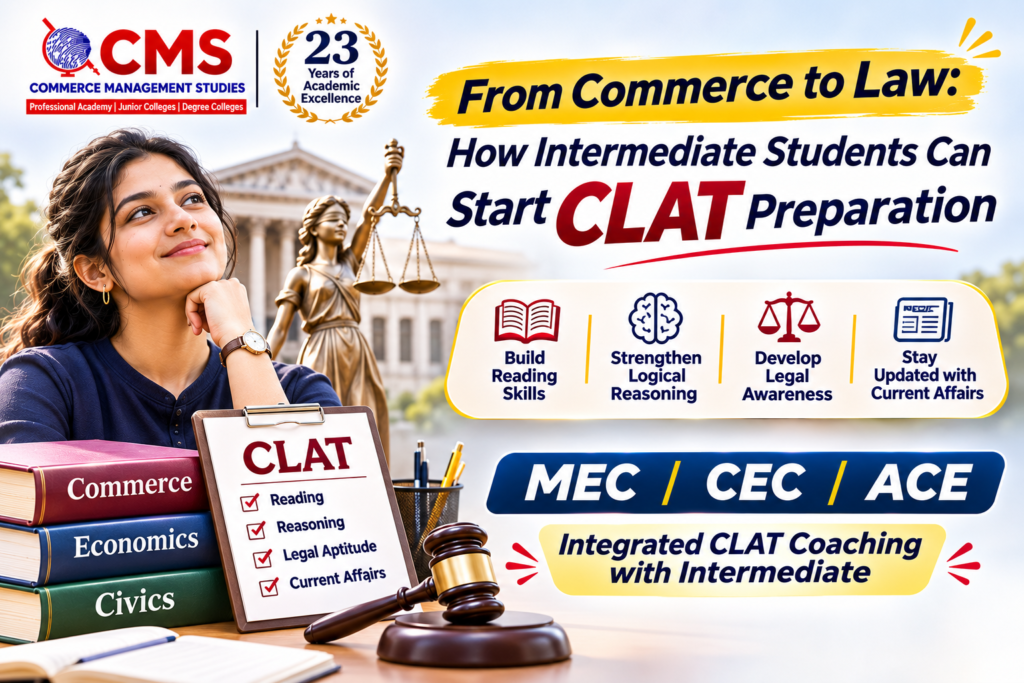
Choosing a career after Class 10 is an important decision for students who want to explore different professional opportunities. For students interested in law, Intermediate Commerce can provide a useful academic foundation while they begin preparing for the Common Law Admission Test (CLAT). Streams such as MEC, CEC and ACE introduce students to business, economics, mathematics-related concepts and governance, helping them develop a broader understanding of the world around them. Alongside their Intermediate education, students can gradually build the reading, reasoning and analytical skills required for law entrance examinations.
At CMS, students pursuing MEC, CEC and ACE can explore integrated CLAT coaching alongside their Intermediate studies. Starting preparation during Intermediate gives students time to become familiar with the examination structure, strengthen their understanding of important subjects and develop a consistent study routine. Although Commerce subjects do not cover the complete CLAT syllabus, they can support students in developing useful academic skills while they prepare for their future in legal education.
1. Why Intermediate Commerce Can Be a Starting Point for CLAT Preparation
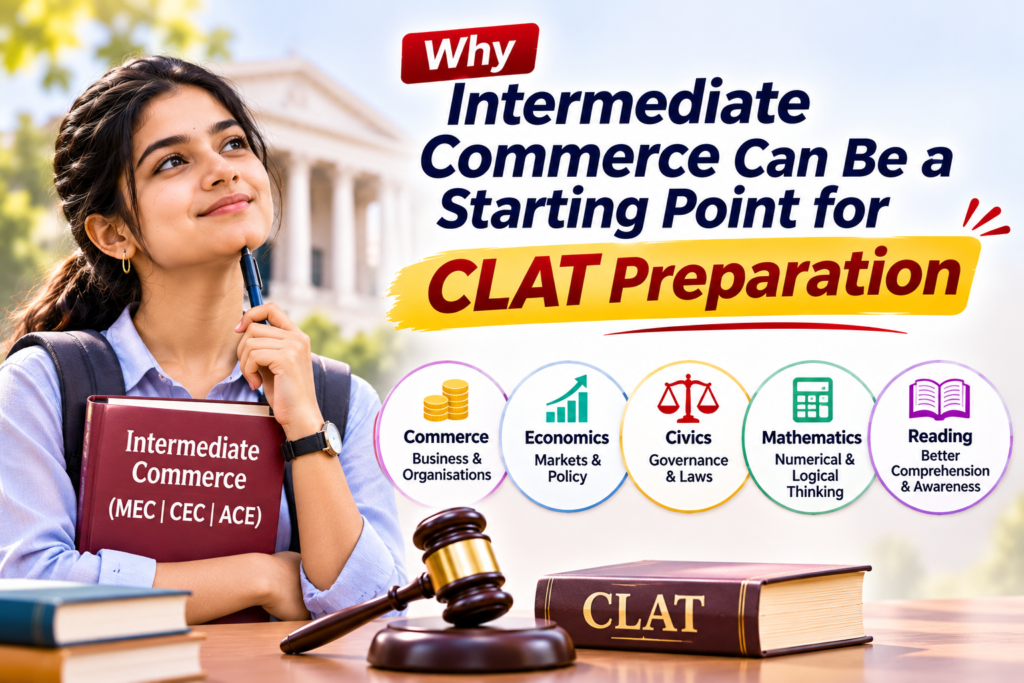
Intermediate Commerce introduces students to several subjects that help them understand business, economic activity, governance and society. These areas encourage students to think about how organisations function, how decisions are made and how different rules influence everyday activities. Students who are interested in law can use this academic exposure as a starting point for exploring legal education and understanding the broader context in which laws operate.
Students from MEC, CEC and ACE can begin developing skills relevant to CLAT through their regular academic studies.
- Commerce: Introduces business activities, financial transactions and the functioning of organisations.
- Economics: Helps students understand markets, economic decisions and developments affecting society.
- Civics: Develops awareness of governance, constitutional principles, rights and responsibilities.
- Mathematics and Analytical Learning: Encourages numerical understanding, logical thinking and problem-solving where included in the student’s stream.
- Regular Academic Reading: Helps students become familiar with different subjects and improve their ability to understand written information.
These subjects provide a useful background, but students should understand that CLAT is a separate entrance examination with its own syllabus and preparation requirements. Intermediate Commerce does not automatically prepare students for every CLAT section. Dedicated preparation is necessary to develop reading comprehension, legal reasoning, logical reasoning, current affairs knowledge and the ability to answer questions within the examination time.
2. Understanding CLAT and Its Importance for Law Aspirants
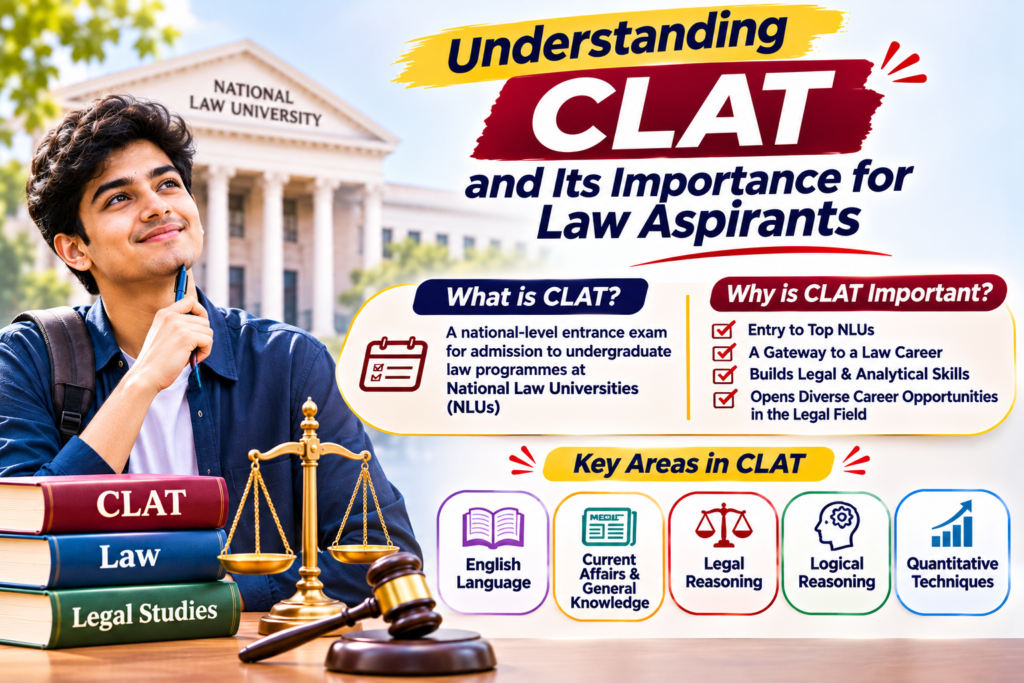
CLAT is a national-level entrance examination used by participating National Law Universities for admission to their undergraduate law programmes, subject to the applicable admission rules. It is an important examination for students who want to explore legal education after completing Class 12. Understanding the examination structure early can help Intermediate students plan their preparation and become familiar with the skills required for law entrance.
The undergraduate CLAT examination generally assesses students through passage-based questions and evaluates their ability to understand information, analyse arguments and apply reasoning. Its major areas include:
- English Language: Reading comprehension, interpretation of passages, vocabulary in context and understanding arguments.
- Current Affairs Including General Knowledge: Awareness of important national and international developments, including relevant events and their context.
- Legal Reasoning: Understanding legal principles presented in passages and applying them to given situations.
- Logical Reasoning: Identifying patterns, evaluating arguments, drawing conclusions and analysing relationships.
- Quantitative Techniques: Interpreting numerical information, analysing data and solving questions involving basic mathematical concepts.
Students should regularly check the official CLAT notification for the examination pattern, syllabus, eligibility requirements and admission details applicable to their examination year. Familiarising themselves with these areas during Intermediate helps students understand what they need to learn beyond their regular board subjects and develop a preparation strategy based on the actual examination requirements.
3. How Commerce Students Can Develop Reading Comprehension Skills
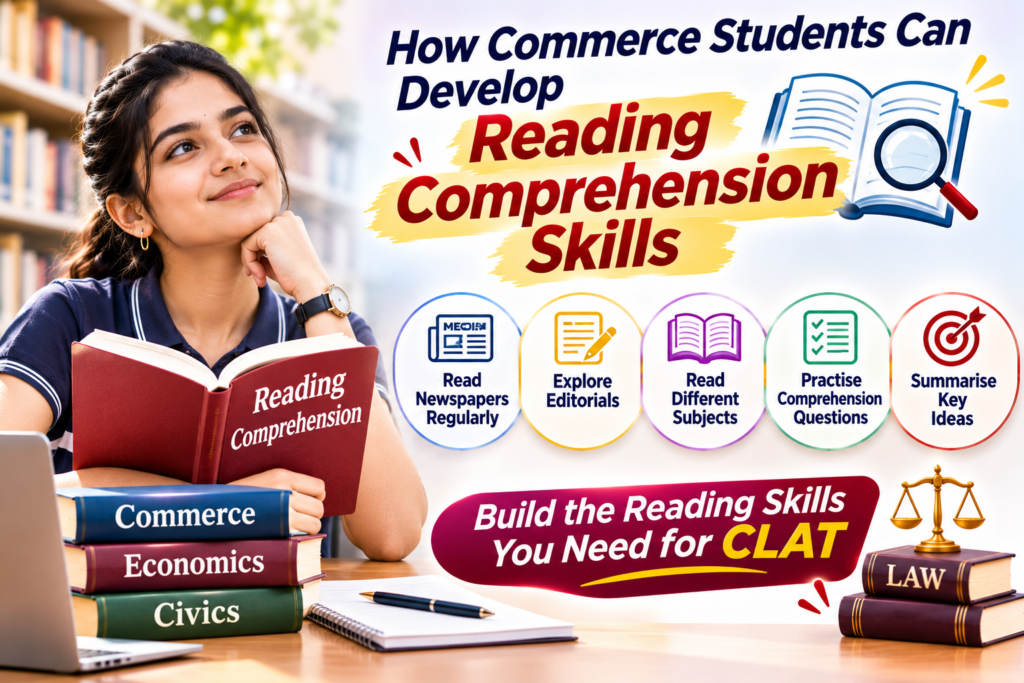
Reading comprehension is an important skill for CLAT preparation because students need to understand passages, identify key information and interpret arguments accurately. Intermediate Commerce students already encounter different types of written material through their textbooks, assignments and examinations. Developing a regular reading habit can help them improve their ability to understand unfamiliar topics and identify the main ideas in a passage.
Students can strengthen their reading skills through a few consistent practices:
- Read Newspapers Regularly: Follow important national and international developments and understand their background.
- Explore Editorials: Practise identifying the central argument, supporting points and conclusions.
- Read Different Subjects: Explore topics related to society, economics, governance, science and public affairs.
- Summarise Passages: Write short summaries to improve understanding and identify essential information.
- Practise Comprehension Questions: Answer questions based on passages and review mistakes carefully.
Regular reading can help students improve their vocabulary, concentration and ability to understand information presented in different contexts. It also encourages them to develop an independent learning habit instead of relying entirely on classroom explanations. As students progress in CLAT preparation, they should practise passage-based questions and learn to distinguish between the main argument, supporting details and conclusions. These skills can help them approach the English, current affairs and reasoning sections more confidently.
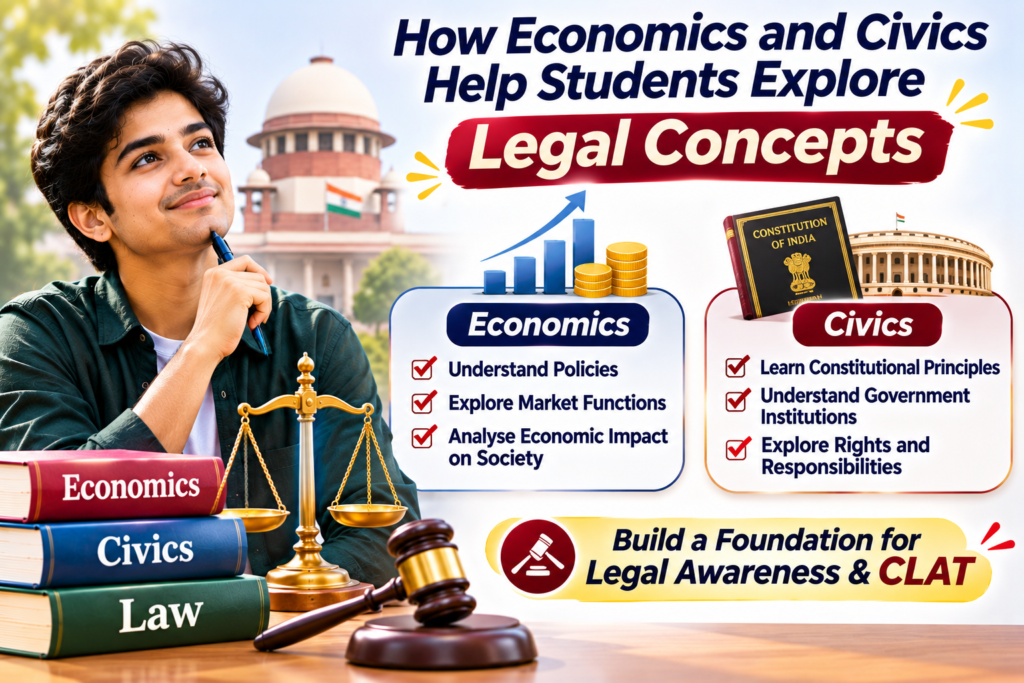
4. How Economics and Civics Help Students Explore Legal Concepts
Economics and Civics introduce students to important aspects of society, governance and public decision-making. Economics helps students understand how policies, markets and financial conditions influence individuals and organisations. Civics introduces students to constitutional principles, government institutions, rights and responsibilities. These subjects can encourage students to develop an interest in the social and institutional issues that are often discussed in current affairs and legal education.
Students can use their Intermediate learning to explore these areas further.
- Economic Developments: Understand how economic policies and market changes affect businesses and society.
- Government Institutions: Learn about the roles and responsibilities of different institutions.
- Constitutional Principles: Develop general awareness of rights, duties and governance.
- Public Issues: Explore important developments involving education, society, administration and public policy.
- Legal Awareness: Become familiar with the role of laws and regulations in maintaining order and protecting rights.
This background can help students develop a broader understanding of the context in which legal and public affairs topics arise. However, CLAT Legal Reasoning requires a specific approach in which students understand the principles presented in a passage and apply them to the situations given. Students should practise legal reasoning questions separately rather than assuming that studying Civics alone is sufficient. Learning to apply a given principle carefully is an important part of preparing for the examination.
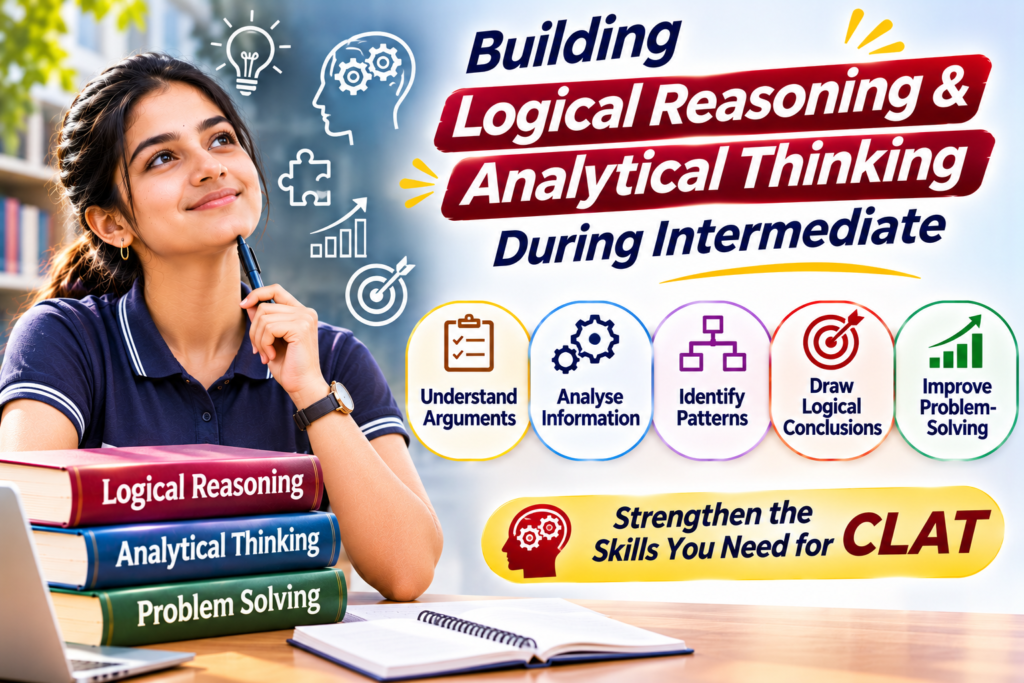
5. Building Logical Reasoning and Analytical Thinking During Intermediate
Logical reasoning helps students examine information, identify relationships and evaluate arguments. These skills are useful in academic learning and are particularly important for CLAT preparation. Commerce students encounter questions and situations that require them to understand information, compare alternatives and arrive at conclusions. Developing these abilities during Intermediate can support their preparation for reasoning-based entrance examinations.
Students can strengthen their logical reasoning skills through regular practice.
- Understand Arguments: Identify the main claim and the reasons supporting it.
- Practise Logical Questions: Solve questions involving relationships, patterns and conclusions.
- Analyse Information: Learn to separate relevant details from unnecessary information.
- Evaluate Conclusions: Check whether a conclusion follows logically from the given statements.
- Review Mistakes: Understand why an answer is incorrect instead of simply memorising the correct option.
Logical reasoning improves through consistent practice and careful analysis. Students should begin with questions appropriate to their current level and gradually move towards passage-based and examination-style problems. Reviewing incorrect answers is equally important because it helps students understand the reasoning behind a question and recognise common mistakes. Over time, this approach can improve accuracy, confidence and the ability to manage reasoning questions within the available examination time.
6. Balancing Intermediate Board Exams with CLAT Preparation
Intermediate students need to manage their board examinations while preparing for CLAT. Both require consistent study, but their preparation methods are different. Board examinations generally require students to understand prescribed subjects and prepare according to their academic syllabus, while CLAT focuses on reading, reasoning, interpretation and applying information. A balanced plan allows students to work towards both goals without neglecting either.
Students can organise their preparation through a practical study routine.
- Prioritise Board Subjects: Complete regular lessons, assignments and revision according to the Intermediate syllabus.
- Set Dedicated CLAT Study Time: Allocate a consistent period for reading, reasoning and entrance examination practice.
- Create Weekly Targets: Set achievable goals for passages, practice questions and current affairs revision.
- Use Short Practice Sessions: Practise comprehension or reasoning questions during available study time.
- Review Progress: Evaluate performance and adjust the study schedule when necessary.
- Increase Practice Gradually: Give more attention to CLAT preparation as students become comfortable with their board study routine.
A balanced schedule helps students maintain consistency while avoiding unnecessary academic pressure. Students should not postpone their Intermediate preparation in the expectation that CLAT coaching alone will support their academic performance. Similarly, focusing only on board examinations until the final stage of Intermediate may leave insufficient time to develop entrance examination skills. Planning ahead and following a manageable routine can help students prepare for both examinations more effectively.
7. How Integrated CLAT Coaching at CMS Supports Intermediate Students
Integrated coaching can help students pursue Intermediate education and CLAT preparation within a structured academic environment. At CMS, MEC, CEC and ACE students can access integrated CLAT coaching alongside their Intermediate studies. This allows them to work towards their board examinations while gradually developing the reading, reasoning and analytical skills required for law entrance preparation.
An organised coaching approach can support students in several ways.
- Faculty Guidance: Support in understanding CLAT topics and developing suitable preparation methods.
- Structured Preparation: A planned approach to covering important examination areas.
- Regular Assessments: Opportunities to evaluate understanding and identify areas that need improvement.
- Mock Tests: Practice with examination-style questions and time management.
- Performance Feedback: Guidance on improving accuracy, comprehension and reasoning.
- Consistent Practice: Encouragement to maintain a regular study routine alongside Intermediate subjects.
Through integrated Intermediate and CLAT coaching, CMS CLAT Coaching Institutes in Hyderabad aims to help students prepare for their academic and entrance examination goals together. Students can gradually become familiar with CLAT question formats, practise important skills and understand their progress through assessments. With appropriate guidance and a balanced study plan, they can use their Intermediate years to develop a foundation for legal education while continuing to focus on their board examinations.
Conclusion
Moving from Intermediate Commerce to law is a pathway that students can begin exploring during their Class 11 and Class 12 education. MEC, CEC and ACE provide exposure to business, economics, governance and other academic areas that can help students develop a broader understanding of society and public affairs. These subjects can support the development of reading, analytical thinking and general awareness, which are useful for CLAT preparation. However, students must also prepare specifically for the entrance examination by practising its prescribed sections and understanding the requirements of the law admission process.
For students interested in pursuing law after Intermediate, starting CLAT preparation early can provide time to develop essential skills and become familiar with the examination. With a consistent study routine, regular practice and suitable academic guidance, students can balance their board examinations with law entrance preparation. At CMS, integrated CLAT coaching alongside MEC, CEC and ACE gives students an opportunity to work towards their Intermediate education and future legal studies within a planned academic approach.